Sildenafil Citrate – Analytical Reference Standard, 1000 mg | CAS 171599-83-0
- Home
- Sildenafil Citrate – Analytical Reference Standard, 1000 mg | CAS 171599-83-0
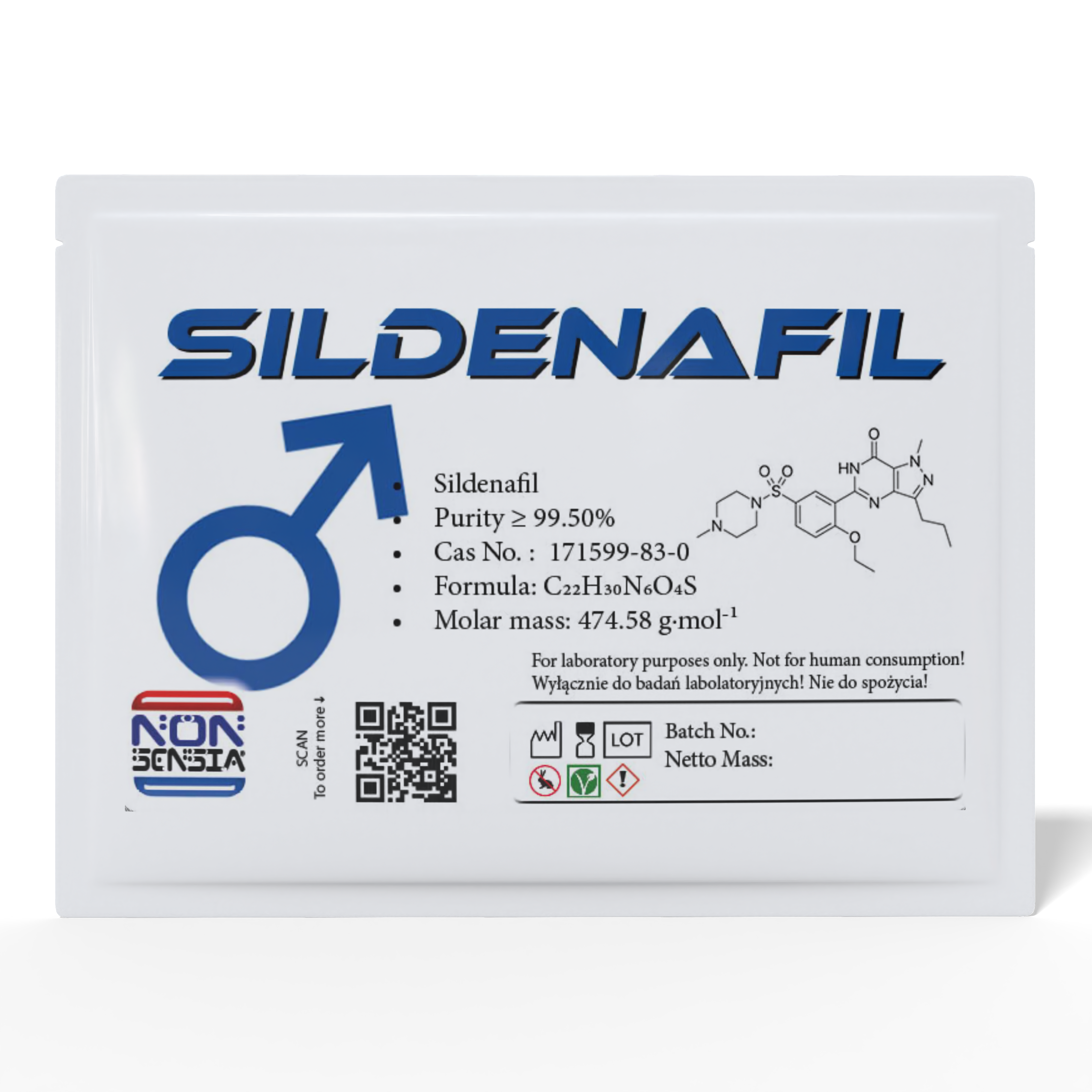
Sildenafil Citrate – Analytical Reference Standard, 1000 mg | CAS 171599-83-0
96,50 zł
Sildenafil Reference Standard — CAS 139755-83-2 (base) / 171599-83-0 (citrate), 1000 mg
Achiral pyrazolo[4,3-d]pyrimidinone, supplied with an explicit form declaration for chromatographic, spectroscopic and adulteration-screening work. Laboratory reagent and analytical reference material only — not for human or animal consumption, and not a medicinal product, even though this molecule is the active substance of authorised medicines elsewhere.
- Net quantity: 1000 mg — and the form that quantity refers to is stated on the lot documentation, because it changes the arithmetic by up to 44%
- Three registered forms, three masses: free base C22H30N6O4S at 474.6 · citrate C28H38N6O11S at 666.7 · citrate monohydrate C28H40N6O12S at 684.7 g·mol−1
- The core problem: 1000 mg of citrate is 711.9 mg of base; 1000 mg of monohydrate is 693.2 mg. Calculate as if the salt were the base and every result is 40.5% too high — reproducibly, in a run that passes every suitability check
- Neither HPLC nor MS will warn you: the citrate dissociates in the mobile phase and electrospray shows the protonated base at m/z 475.2122 whichever form went into the vial. NMR is the method that resolves it
- Stereochemistry: 0 defined and 0 undefined stereocentres, atom and bond alike, in all three records; InChIKey ends
-UHFFFAOYSA-N. The molecule is achiral — there is no R form, no S form and no optical rotation to certify - Analogue family: homosildenafil and aildenafil share the formula C23H32N6O4S and the monoisotopic mass 488.22057470 Da to the eighth decimal; lodenafil and thioaildenafil differ by 35 ppm; one documented analogue is isomeric with sildenafil itself
- CAS trap: the free base is 139755-83-2 and the adulterant lodenafil is 139755-85-4 — same registry block, two characters apart
- Data gaps: no 1H NMR in the public record, no UV-Vis, no Raman, no powder diffraction; the 13C and 15N entries carry a copyright line and a thumbnail only, and the single deposited IR spectrum was recorded on the free base
- Also absent: no pKa and no density in the registry record — reported as an established gap, not filled from memory
- Hazards: Warning — two incompatible classification sets in one record, aggregated from just 7 notifications; only H319 appears in both
- WADA 2026: not listed (measured, with seven positive controls firing on the same document)
Every unit ships with lot documentation stating the form. Full registry data for all three forms, the conversion arithmetic in full, the designed-analogue family with exact masses, the methods that resolve salt from base, spectral coverage and its gaps, regulatory position in Poland, the European Union and the United States, and 42 cited sources are set out below.
Shipping is charged once per order, not per item — adding more items to this order does not increase the delivery cost.
Quick Payment
100% New
Fast Delivery
- Additional Information
Product classification — read before ordering. This item is a chemical reagent and analytical reference material. It is not a medicinal product, dietary supplement, food, feed, novel food or cosmetic, and it is not intended for human or animal consumption or for any in-vivo administration whatsoever. It is supplied exclusively to laboratories, research institutions and professional users for in-vitro analytical, chromatographic and method-development work. Scientific findings summarised on this page describe substances investigated in published laboratory and clinical research; they are reported here as bibliographic facts about that literature and are not product claims, dosage guidance, or a recommendation of any use of this reagent.
One name, three registry records, three different masses. Read section 4 before you weigh anything. Sildenafil circulates as a free base and as a citrate salt, and the salt has a hydrate of its own. The three records carry molecular masses of 474.6, 666.7 and 684.7 g·mol−1 [1][2][3]. A laboratory that weighs out 1000 mg of material labelled simply sildenafil and calculates concentration against the mass of the base, while actually holding the citrate, overstates the result by 40.5 per cent. Choose the monohydrate instead of the anhydrous salt and the same calculation moves again, by a further 2.7 per cent. This is the most consequential arithmetic on this page, and no spectrum and no chromatogram will warn you about it — only a certificate line will.
Key facts
- Substance
- Sildenafil (INN, BAN; Latin sildenafilum); development code UK-92480. Two registered forms: free base and citrate salt
- CAS
- 139755-83-2 (free base) · 171599-83-0 (citrate) — see section 5 for why these two numbers are so easily crossed
- EC number
- 604-158-7 (base) · 638-824-3 (citrate) [4]
- UNII (FDA)
- 3M7OB98Y7H (base) · BW9B0ZE037 (citrate)
- PubChem CID
- 135398744 (base) [1] · 135413523 (citrate) [2] · 139067414 (citrate monohydrate) [3]
- Formula
- C22H30N6O4S · C28H38N6O11S · C28H40N6O12S
- Molecular mass
- 474.6 · 666.7 · 684.7 g·mol−1
- Monoisotopic mass
- 474.20492463 · 666.23192722 · 684.24249191 Da
- InChIKey
BNRNXUUZRGQAQC-UHFFFAOYSA-N(base) ·DEIYFTQMQPDXOT-UHFFFAOYSA-N(citrate) ·YTZKAZQLNBKKJF-UHFFFAOYSA-N(monohydrate)- Stereocentres
- 0 defined, 0 undefined, atom and bond alike — in all three records. The molecule is achiral
- Conversion
- 1000 mg citrate = 711.9 mg base · 1000 mg monohydrate = 693.2 mg base · 1000 mg base = 1404.8 mg citrate
- Melting point
- 189–190 °C and 187–189 °C — two independent entries, agreeing to within two degrees [1]
- Water solubility
- 3.5 mg·mL−1, entry flagged /Sildenafil citrate/ — a figure for the salt, not for the base [1]
- Absent from the record
- pKa, density, 1H NMR, UV-Vis, Raman, powder X-ray diffraction — see sections 8 and 9
- ATC
- G04BE03; veterinary code QG04BE03
- GHS
- Warning — two competing classification sets in one record, aggregated from 7 notifications; no CLP Annex VI entry apparent (section 11)
- WADA 2026
- Not listed [6]
- Pack
- 1000 mg
On this page
- What this material is
- Identity and registry codes
- Structure and stereochemistry
- The central problem: which mass do you divide by
- Identity traps in the numbers themselves
- The designed-analogue family, and why the parent anchors it
- Methods that resolve the form, and methods that cannot
- Physicochemical data, and where the sources disagree
- Spectra: what is deposited, what is missing
- Solid form
- Hazard classification
- Regulatory status
- Handling, storage and documentation
- What we certify and what we do not
- Terms of supply
- Questions and answers
1. What this material is
This page describes sildenafil supplied as an analytical reference material: a weighed quantity of a single identified chemical substance, intended to serve as the point of comparison against which another sample is measured. A reference material has one job and it is a narrow one. When a customs laboratory reports that a seized tablet contains sildenafil, when a food-control laboratory reports that a herbal preparation has been adulterated with it, or when a manufacturer reports that an active-ingredient batch conforms to specification, that report is only as good as the material the instrument was calibrated against. Everything downstream inherits the identity, the declared form and the stability of one vial.
Sildenafil is an inhibitor of phosphodiesterase type 5. That pharmacology is the reason the molecule exists, the reason it is prescribed, and the reason it is counterfeited more energetically than almost any other small molecule in commerce — but it has no bearing whatsoever on the reagent described here, which is a powder for use on a bench. What this page is about is a different and much less discussed problem, and it is the reason the card runs long.
Sildenafil has a mass problem, not a structure problem. Unlike most of the difficult compounds in this catalogue, its structure is unambiguous: one connectivity, no stereocentres, no tautomeric argument, a clean and diagnostic fragmentation. The difficulty sits one level up, in which weighable substance the name refers to. The base and the citrate salt are separate registry entries with separate CAS numbers, separate EC numbers, separate UNIIs, separate InChIKeys and molecular masses differing by 192.1 g·mol−1 [1][2]. The salt has a monohydrate with a third set of numbers again [3]. Sections 4 and 5 set out what follows, including the uncomfortable fact that the two most important CAS numbers in this family differ from one another by two characters.
The second reason a laboratory holds this particular standard is defensive. Sildenafil is the archetypal undeclared addition to preparations sold as herbal, and around the parent molecule has grown an entire family of designed analogues — homosildenafil, aildenafil, lodenafil, thioaildenafil, acetildenafil and others — synthesised specifically so that a screening method built around the parent will not see them [23][24][25]. Section 6 shows what those analogues do to an exact-mass measurement, and it is not what most people expect: two of them share a molecular formula and a monoisotopic mass with each other to the eighth decimal place.
For the general terms on which this shop supplies reference materials, the surrounding reference standards category collects the rest of the catalogue on the same basis. The nearest neighbour in that catalogue is tadalafil, which presents the mirror-image difficulty: an unambiguous single form, but four stereoisomers sharing one exact mass. Between them the two cards cover both halves of the identity problem for this compound class.
2. Identity and registry codes
Every identifier below is quoted from a public registry, with the registry named and the form stated. The form is not a footnote here. A table that gives one CAS number and one formula for sildenafil without saying which substance it means is not a shortcut; it is an error waiting to be transcribed onto a certificate.
| Identifier | Free base | Citrate salt |
|---|---|---|
| PubChem CID | 135398744 [1] | 135413523 [2] |
| CAS Registry Number | 139755-83-2 | 171599-83-0 |
| EC number | 604-158-7 | 638-824-3 |
| UNII (FDA) | 3M7OB98Y7H | BW9B0ZE037 |
| Molecular formula | C22H30N6O4S | C28H38N6O11S |
| Molecular mass | 474.6 g·mol−1 | 666.7 g·mol−1 |
| Monoisotopic mass | 474.20492463 Da | 666.23192722 Da |
| InChIKey | BNRNXUUZRGQAQC-UHFFFAOYSA-N | DEIYFTQMQPDXOT-UHFFFAOYSA-N |
| Covalently bonded units | 1 | 2 — the registry's own statement that this is a salt |
| ChEBI | CHEBI:9139 | CHEBI:58987 |
| ChEMBL | CHEMBL192 | CHEMBL1737 |
| DSSTox | DTXSID6023579 | DTXSID4046076 |
| KEGG | C07259 (compound); D08514 (drug) | D02229 |
| NCI Thesaurus | C61940 | C26670 |
| Non-proprietary name | Sildenafil (INN, BAN) | Sildenafil citrate (USAN) |
Several identifiers are shared rather than split. DrugBank DB00203, HMDB0005039, MDL MFCD00867528, Nikkaji J897.167F and Wikidata Q191521 attach to the substance concept rather than to a particular salt form, and the ATC code G04BE03 likewise covers every product regardless of form. The development code UK-92480 appears in the synonym set in several typographic variants, including UK-92,480-10 and UK 92480-10; a further code, HIP-0908, is also present.
The third record: the monohydrate
A third entry belongs in any serious identity discussion of this compound and is routinely omitted from supplier tables.
| PubChem CID | 139067414 |
|---|---|
| Title in the record | Sildenafil citrate monohydrate |
| Molecular formula | C28H40N6O12S |
| Molecular mass | 684.7 g·mol−1 |
| Monoisotopic mass | 684.24249191 Da |
| InChIKey | YTZKAZQLNBKKJF-UHFFFAOYSA-N |
| Covalently bonded units | 3 — protonated base, citrate anion, and one water molecule |
| Topological polar surface area | 255 Å2 |
| Heavy atoms / complexity | 47 / 1060 |
| Stereocentres | 0 defined, 0 undefined, atom and bond alike |
The covalently bonded units row is the most informative single field in these three tables, and it costs nothing to check. One unit means a single molecule with no counter-ion. Two means a salt. Three means a salt with a solvent of crystallisation. A record that claims a free base while the registry entry it cites reports two or three units is describing two different articles in one sentence.
Machine-readable descriptors for the base
| Canonical SMILES | CCCC1=NN(C2=C1N=C(NC2=O)C3=C(C=CC(=C3)S(=O)(=O)N4CCN(CC4)C)OCC)C |
|---|---|
| Isomeric SMILES | Identical to the line above — there is no stereochemistry to encode |
| InChI | InChI=1S/C22H30N6O4S/c1-5-7-17-19-20(27(4)25-17)22(29)24-21(23-19)16-14-15(8-9-18(16)32-6-2)33(30,31)28-12-10-26(3)11-13-28/h8-9,14H,5-7,10-13H2,1-4H3,(H,23,24,29) |
| XLogP3-AA | 1.5 |
| Topological polar surface area | 118 Å2 |
| Hydrogen-bond donors / acceptors | 1 / 8 |
| Rotatable bonds | 7 |
| Heavy atoms / complexity | 33 / 838 |
| Formal charge / isotope atoms | 0 / 0 |
| Canonicalised | Yes |
Note the second row. For most compounds in this catalogue the isomeric SMILES carries information the canonical string does not; here the two are character-for-character identical, because the molecule has nothing stereochemical to declare. That identity is itself a verifiable fact rather than an omission, and section 3 states it in the registry's own terms.
The descriptor block also explains the chromatographic behaviour discussed in section 7. Seven rotatable bonds and a computed logP of 1.5 describe a moderately flexible, moderately lipophilic molecule that retains well on reversed-phase material; a topological polar surface area of 118 Å2 with eight hydrogen-bond acceptors and one donor describes something that will also interact strongly with residual silanols if the column is not well end-capped. The citrate raises the polar surface area to 250 Å2 and the acceptor count to 15 [2] — which matters a great deal for solubility and for solid-state behaviour, and not at all for the chromatogram, because the salt dissociates in the mobile phase.
Two systematic names, one of them generated wrongly
The registry record for the free base contains an internal disagreement about its own systematic name, and it is worth resolving explicitly because both spellings are in circulation.
| Computed IUPAC name (automated generator) | 5-[2-ethoxy-5-(4-methylpiperazin-1-yl)sulfonylphenyl]-1-methyl-3-propyl-6H-pyrazolo[4,5-d]pyrimidin-7-one |
|---|---|
| Record description and depositor synonyms (agreeing with the literature) | 5-[2-ethoxy-5-[(4-methylpiperazin-1-yl)sulfonyl]phenyl]-1-methyl-3-propyl-1,6-dihydro-7H-pyrazolo[4,3-d]pyrimidin-7-one |
The difference is the fusion descriptor. Counted across the whole record, pyrazolo[4,3-d] occurs 38 times and pyrazolo[4,5-d] exactly once — and that single occurrence is the automatically generated field. The record's own prose description opens Sildenafil is a pyrazolo[4,3-d]pyrimidin-7-one having a methyl substituent at the 1-position, a propyl substituent at the 3-position, so the source contradicts its own generator. This card uses [4,3-d] throughout, which is the form used in the pharmacopoeial monograph title context [7] and in every method paper cited here. The practical consequence is a search failure rather than a chemical one: a literature or inventory search keyed on the generated string will miss almost everything worth finding.
3. Structure and stereochemistry
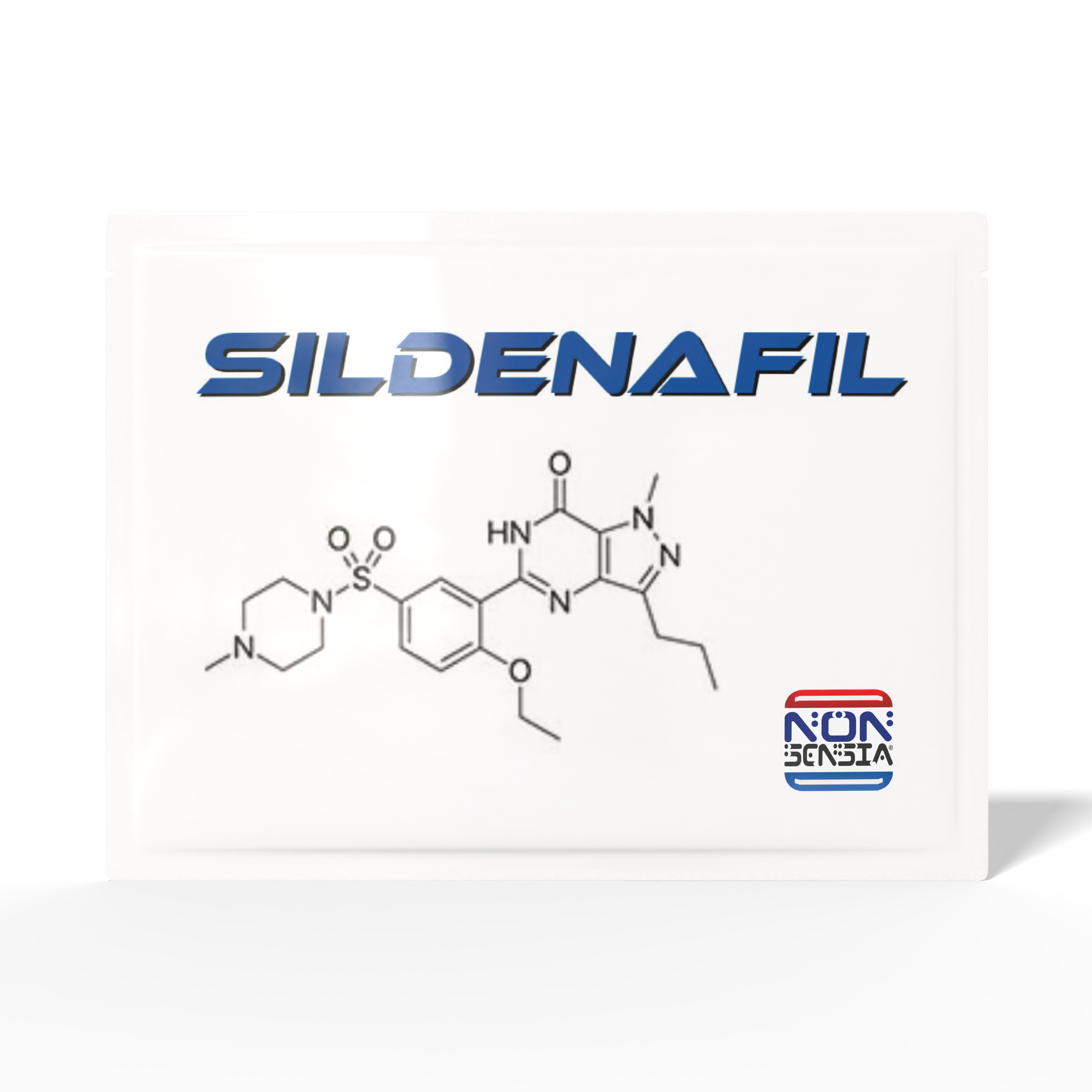
Sildenafil is a pyrazolo[4,3-d]pyrimidin-7-one bearing a methyl group at position 1, a propyl group at position 3, and a 2-ethoxy-5-[(4-methylpiperazin-1-yl)sulfonyl]phenyl group at position 5. The bicyclic heteroaromatic core carries the amide-like N–H that is the molecule's only hydrogen-bond donor; the arylsulfonyl group links the core to the basic piperazine, and it is the distal piperazine nitrogen that is protonated in the citrate salt.
The stereochemical statement in the registry is unambiguous, and because two neighbouring cards in this catalogue turn on stereochemical subtleties it is worth quoting rather than paraphrasing.
| Defined Atom Stereocenter Count | 0 |
|---|---|
| Undefined Atom Stereocenter Count | 0 |
| Defined Bond Stereocenter Count | 0 |
| Undefined Bond Stereocenter Count | 0 |
| InChIKey second block | UHFFFAOYSA — the hash that appears when there is no stereochemical layer at all |
| Same four counts, citrate salt [2] | 0 / 0 / 0 / 0 |
| Same four counts, citrate monohydrate [3] | 0 / 0 / 0 / 0 |
Sildenafil is achiral, and the statement is checkable twice over. All four stereocentre counts are zero, and the second block of the InChIKey is UHFFFAOYSA in every one of the three records — the value that appears when a structure carries no stereo layer whatsoever. The two facts are independent readings of the same structure and they agree. It follows that there is no R form of sildenafil, no S form, no dextrorotatory isomer and no enantiomeric excess to report. Chiral chromatography on this compound has nothing to separate. Any specification or listing that reports an optical rotation or an enantiomeric purity for sildenafil is reporting a property the molecule does not possess.
Two caveats keep that statement honest. First, the citric acid in the salt has a prochiral centre — the central carbon bearing the hydroxyl — but a prochiral centre is not a stereocentre, and the registry counts it as zero accordingly [2]. Second, achirality of the parent tells you nothing about the analogues: as section 6 shows, several designed analogues in circulation do carry stereocentres, so a chiral method that is pointless for the parent may be exactly the method that separates an adulterant from it.
The contrast across a catalogue is instructive. L-DOPA is the case where configuration is the whole substance, the two enantiomers being different articles with different names. Apigenin, like sildenafil, is flat and achiral, and for both compounds an indexing system that keys on the InChIKey skeleton loses nothing at all — whereas for a molecule with two stereocentres the same practice silently merges several distinct substances into one. Knowing which of those situations you are in is a five-second check on the four counts above, and it is worth making a habit of it.
4. The central problem: which mass do you divide by
This is the analytical fact that governs everything a laboratory does with sildenafil, and it deserves stating in the bluntest available terms.
The name sildenafil maps onto three weighable substances with three different molecular masses. Free base, 474.6 g·mol−1 [1]. Citrate salt, 666.7 [2]. Citrate monohydrate, 684.7 [3]. Every gravimetric calculation — stock concentration, calibration level, assay content, recovery, limit of quantification expressed in mass terms — divides by one of those three numbers. Choosing the wrong one does not produce a noisy result or a failed system-suitability test. It produces a clean, reproducible, fully documented result that is wrong by a fixed factor.
The arithmetic, spelled out
| You weighed 1000 mg of | Base content | Factor | If you calculate as if it were base |
|---|---|---|---|
| Free base [1] | 1000.0 mg | 1.00000 | Correct |
| Citrate salt [2] | 711.9 mg | 474.6 / 666.7 = 0.71186 | Overstated by 40.5 % |
| Citrate monohydrate [3] | 693.2 mg | 474.6 / 684.7 = 0.69315 | Overstated by 44.3 % |
Running the same arithmetic in the other direction: 1000 mg of base corresponds to 1404.8 mg of the anhydrous citrate and to 1442.7 mg of the monohydrate. A method that specifies weigh 25 mg of sildenafil without naming a form has specified three different experiments.
The salt-versus-base error is the large one and it is the one everybody eventually hears about. The second error is subtler and it is the reason the monohydrate belongs on this page at all: between the anhydrous citrate and its monohydrate the difference is 2.7 per cent (711.9 mg against 693.2 mg of base per gram weighed). Water accounts for 2.63 per cent of the monohydrate's formula mass. That is not a rounding error. It sits inside the range where an assay method is expected to be accurate, and it will show up as a systematic bias against a properly declared standard rather than as anything that looks like a mistake.
What this means for a certificate. The single most important line on documentation for this substance is not the purity figure. It is the form declaration: which of the three records the material corresponds to, stated with its CAS number and its molecular formula together so that the two can be checked against each other. A purity of 99.8 per cent measured on the wrong assumed form is a precise statement about the wrong quantity. Purity and identity are separate claims, and only one of them is affected by chromatography.
A pairing that circulates in the market and describes nothing
Commercial listings for this substance very frequently pair the citrate CAS number 171599-83-0 with the free-base molecular formula C22H30N6O4S. That pairing corresponds to no registered substance. The citrate's formula is C28H38N6O11S [2]; the formula C22H30N6O4S belongs with CAS 139755-83-2 [1]. Wherever the two appear side by side, one of them is wrong and there is no way to tell from the listing which one, so the net weight quoted alongside them is not interpretable either. These are not registry values in combination; they are two registry values from two different records printed as though they were one.
The same trap runs the other way. Listings that quote a molecular mass of 474.6 while describing the material as a citrate, or 666.7 while describing it as sildenafil, have made the same error with the numbers transposed. The check takes ten seconds: a formula containing eleven oxygens is a citrate; a formula containing four is a base. Count the oxygens before trusting the mass.
Why chromatography does not rescue you
It is tempting to assume that an assay against a certified reference standard will catch a form error, because the chromatogram would look wrong. It would not. Sildenafil citrate dissociates completely in any normal reversed-phase mobile phase; the citrate anion is unretained and, having no useful chromophore at the wavelengths used for the analyte, is typically invisible in the ultraviolet trace. The base and the salt give the same peak, at the same retention time, with the same spectrum and the same mass spectrum. What differs is only how much analyte was in the milligram you weighed.
Mass spectrometry is equally unhelpful for this specific question, and for the same reason. The salt does not survive electrospray as a salt; what is observed is the protonated base at m/z 475.2122 whichever form went into the vial. The one technique that does answer the question directly — nuclear magnetic resonance, which sees the citrate protons and carbons in solution and the whole ion pair in the solid — is precisely the technique for which the public record holds nothing usable. Sections 7 and 9 deal with that pair of facts together, because they are the same fact seen from two sides.
The catalogue offers a useful contrast on how a salt should be declared. Procaine hydrochloride carries the salt in its product name, so the question of which mass to divide by is answered before anyone opens the vial; benzocaine, its close structural relative, is supplied as the free base and named accordingly. Naming the counter-ion in the title of the article is the cheapest available prevention for the entire class of error described in this section.
5. Identity traps in the numbers themselves
Beyond the arithmetic, this compound family carries a set of traps that live in the identifiers rather than in the chemistry. Each of the following was measured on the registry records rather than recalled, and each one has a plausible route into a real certificate.
Trap 1: two CAS numbers two characters apart, and one of them is an adulterant
| CAS | Substance | Status |
|---|---|---|
139755-83-2 | Sildenafil, free base [1] | Active substance of authorised medicines |
139755-85-4 | Lodenafil, carrying hydroxyhomosildenafil among its synonyms [10] | Designed analogue, documented as an adulterant |
171599-83-0 | Sildenafil citrate [2] | Salt form of the active substance |
Read the first two rows again. The free base and a known designed analogue sit in the same CAS block and differ in two characters, one in the two-digit middle block and one in the check digit. A transcription slip, an optical-character-recognition error on a scanned certificate, or a copy that clips a digit produces a valid-looking number for a different compound — and not a harmless different compound, but exactly the class of substance that screening exists to find. The third row adds a second hazard: the same two-digit middle block, 83, sits in both principal numbers of the family — 139755-83-2 and 171599-83-0 — which is precisely the kind of shared fragment that survives a careless partial match.
The defence is mechanical and costs nothing: never carry a CAS number without its formula, and never carry a formula without its molecular mass. Three fields disagree loudly where one field fails silently. Bromantane is the counter-example in this catalogue — a single form, a single number, no salt, no close registry neighbour with a confusable identifier — and a card for that compound can safely carry one CAS number in isolation. This one cannot.
Trap 2: one record, several names, and a name search that redirects
Querying the registry by name for hydroxyhomosildenafil returns a record whose title is Lodenafil [10]. Querying for dimethylsildenafil returns a record whose title is Aildenafil and whose first listed synonym is Methisosildenafil [9]. Querying for sulfoaildenafil returns a record titled Thioaildenafil, which also carries sildenafil thione as a synonym [11].
None of this is an error in the registry; these are genuine synonym relations, correctly resolved. The trap is on the reading side. A laboratory that reports hydroxyhomosildenafil detected and a laboratory that reports lodenafil detected have reported the same finding, and a database that treats those two strings as different analytes will double-count them or, worse, will fail to match a result against a watch list written in the other name. The same applies across the trio dimethylsildenafil / methisosildenafil / aildenafil, where three names resolve to one substance.
Trap 3: retired identifiers still in circulation
The registry record for the free base carries a removed synonyms block containing three further registry numbers — 1126745-90-1, 1094598-75-0 and 1971915-89-5 — that are not flagged as deprecated but have been withdrawn from the synonym set. This card does not treat any of them as identifiers of the substance, and neither should a certificate. The same block also contains the string CID5212, which is the trace of an older compound identifier having been merged into the present record [1]. A legacy inventory or spectral library keyed on CID 5212 is not left with a dead pointer, and that is the subtler problem: a property query on CID 5212 still answers, returning the same molecular formula C22H30N6O4S but an empty title field, while the canonical record for the substance is CID 135398744 [1]. An automated pipeline reading that response will find a formula where it expected a name, and a silent merge of this kind is not guaranteed to be visible in an export.
Trap 4: the official register does not name the form consistently either
This is not a supplier failing, it is a systemic one, and it is worth showing because it explains why the confusion is so durable. Across the 97 authorisations for this substance in the Polish Register of Medicinal Products, the active-substance field takes four different values [5]:
| Value in the register | Count | What it names |
|---|---|---|
| Sildenafili citras | 49 | The salt, in Latin |
| Sildenafilum | 41 | The base, in Latin |
| Syldenafilu cytrynian | 6 | The salt, in Polish, with a different spelling of the stem |
| Sildenafilum + Sildenafili citras | 1 | Both, in one field |
The ATC code is uniform across all 97 — G04BE03 without exception, including the products indicated in pulmonary arterial hypertension — so the classification layer is consistent while the substance-naming layer is not. Note also the spelling variant: the Polish form uses syldenafil with a y, so a search written only with the international i spelling returns six fewer records than exist. That is a small number in this register and a potentially decisive one in a smaller dataset.
6. The designed-analogue family, and why the parent anchors it
Sildenafil is one of the two most frequently encountered undeclared additions to preparations marketed for sexual performance, and the published record on the problem is large, methodologically serious and directly relevant to why a laboratory holds an authenticated standard. Two successive reviews by the same group catalogue the class [23][24], an earlier review sets out the analytical techniques and their limits [25], and a recent review covers sample preparation and detection in complex matrices [33]. The regulatory side of the same phenomenon is documented in public notifications about products found to contain the substance undeclared, cited within the registry record itself [1].
What makes the problem hard is not that sildenafil is added where it is not declared. It is that modified analogues are synthesised specifically to defeat a screening method built around the parent. The registry holds separate records for the principal ones, and reading their computed properties side by side is more instructive than any prose description.
| Compound | Formula | Mass | Monoisotopic mass | Stereocentres | CAS |
|---|---|---|---|---|---|
| Sildenafil (base) [1] | C22H30N6O4S | 474.6 | 474.20492463 | 0 | 139755-83-2 |
| Acetildenafil [12] | C25H34N6O3 | 466.6 | 466.26923897 | 0 | 831217-01-7 |
| Homosildenafil [8] | C23H32N6O4S | 488.6 | 488.22057470 | 0 | 642928-07-2 |
| Aildenafil, also methisosildenafil or dimethylsildenafil [9] | C23H32N6O4S | 488.6 | 488.22057470 | 2 | 496835-35-9 |
| Lodenafil, also hydroxyhomosildenafil [10] | C23H32N6O5S | 504.6 | 504.21548932 | 0 | 139755-85-4 |
| Thioaildenafil, also sulfoaildenafil [11] | C23H32N6O3S2 | 504.7 | 504.19773125 | 2 | 856190-47-1 |
| Nitrosoprodenafil [13] | C27H35N9O5S2 | 629.8 | 629.22025760 | 2 | 1266755-08-1 |
Every registry number in that table was read back from the record it belongs to, and every check digit recomputed. Three facts in it matter more than the rest.
Two analogues share a formula and an exact mass
Homosildenafil and aildenafil have the same molecular formula, C23H32N6O4S, and the same monoisotopic mass, 488.22057470 Da, to the eighth decimal place [8][9]. They are constitutional isomers: one carries an N-ethyl group on the piperazine, the other carries two methyls on the ring. No mass measurement at any resolution separates them, because there is nothing to separate — it is the same number. They are told apart by retention, by nuclear magnetic resonance, and by the fact that one of them has two stereocentres and the other has none.
That last difference is the useful one, and it inverts the usual advice. Sildenafil itself is achiral (section 3), so a chiral column has nothing to do on the parent — but a chiral method applied to a sample containing aildenafil will resolve into components while homosildenafil will not. A technique that is pointless for the analyte becomes diagnostic for the adulterant.
Two more analogues share a nominal mass and differ by 35 parts per million
Lodenafil at 504.21548932 Da and thioaildenafil at 504.19773125 Da [10][11] both round to 505 on a unit-resolution instrument and to 504.2 on a two-decimal report. The difference is 0.01776 Da, which is 35 parts per million at this mass, and separating them requires a resolving power of roughly 28,000. A modern time-of-flight or orbital-trap instrument delivers that comfortably. A triple quadrupole running unit resolution does not, and neither does an ion trap. The two compounds are chemically quite different — one has an extra oxygen, the other has a second sulfur in place of an oxygen — and the mass spectrometer's ability to say so depends entirely on which mass spectrometer it is.
One analogue is isomeric with sildenafil itself
The hardest documented case is a sildenafil analogue that is isomeric with the parent, isolated and identified as an adulterant in an instant coffee premix [27]. Isomeric means identical formula and therefore identical exact mass to the parent. Mass alone cannot detect it at any resolution; what detects it is a retention-time comparison against an authenticated standard, followed by structure elucidation. Work combining variable-temperature nuclear magnetic resonance with high-resolution tandem mass spectrometry has been developed specifically for resolving structures in this family [28], and new members continue to appear — two further inhibitors of this class were isolated from pressed confectionery and characterised in a 2025 report [29].
The parent's fragmentation, and what it does and does not prove
The protonated molecule of sildenafil, [M+H]+ at m/z 475.2122, produces a well-characterised and reproducible product-ion series. The deposited spectra are these [1]:
| Source and conditions | Principal ions (m/z) |
|---|---|
Orbitrap, CCMSLIB00005434457, [M+H]+ 475.213 | 475.210 (100), 58.0656 (78.55), 100.0995 (49.54), 99.0917 (32.38), 311.1488 (7.02) |
| LC-ESI-QTOF, spectrum 374792 | 475.211, 283.118, 311.149, 476.214, 299.113 |
| LC-ESI-QTOF, spectrum 374793 | 316.114, 136.050, 255.123, 284.126, 283.118 |
| Ion trap, MS2, [M+H]+ 475.2122 (104 peaks) | 311.1, 377.1, 313.2 |
| Ion trap, [M+H]+ 475.2122 (55 peaks) | 377, 311, 475 |
| Ion trap, doubly charged [M+2H]2+ 238.1097 (25 peaks) | 224, 312.1, 224.5 |
| Orbitrap, cluster ions, labelled in the record [2M+Na]+ and [2M+K]+ | 949.416 and 971.398 — see the note below: these two labels do not reconcile with the mass of this molecule |
| Electron-ionisation GC-MS, 247 peaks | base peak 99, then 404, then 56 |
| Electron-ionisation GC-MS, replicate library, 71 peaks | base peak 99, then 56, then 404 |
Hashed spectral identifiers run right through this record — 44 distinct SPLASH hashes across the deposited spectra — and they matter because they allow an exact match rather than a visual one. The two tandem entries quoted above carry splash10-0059-2494500000-e3f8387aee5a0463363c and splash10-05s0-3892000000-aa19715309275e16a6c0.
A deposited label that does not survive arithmetic. The two cluster-ion entries are recorded with precursor type [2M+Na]+ at m/z 949.416 and [2M+K]+ at 971.398 [1]. Neither pairing works. With a monoisotopic mass of 474.20492463 Da, [2M+H]+ falls at 949.417, [2M+Na]+ at 971.399 and [2M+K]+ at 987.373. The stated masses are therefore correct for [2M+H]+ and [2M+Na]+ respectively, and the labels are one adduct out of step. The spectra themselves settle it: the entry labelled [2M+Na]+ has its base peak at 475.210, which is the protonated monomer, while the entry labelled [2M+K]+ has its base peak at 497.199, which is the sodiated monomer. We report the record as it stands and the arithmetic beside it, because a deposited adduct assignment copied into a method without that check is exactly the kind of error a reference-data page should catch rather than propagate.
Read the ion list structurally. The low-mass ions at 100.0995, 99.0917 and 58.0656 come from the N-methylpiperazine end of the molecule; the ions at 311 and 283 come from the pyrazolo[4,3-d]pyrimidinone core. That is exactly why they are dangerous as identity criteria. The analogues in the table above retain both of those parts. A transition list built on 475 → 311 identifies the core; a transition list built on the piperazine fragments identifies a substituent pattern that several family members share. Neither is an identity, and a screening method that reports sildenafil confirmed on that basis has confirmed a family membership.
The doubly charged entry deserves separate mention. At [M+2H]2+ the precursor sits at m/z 238.1097 — a value with no visible relationship to 475, occupying a region of the spectrum crowded with unrelated small molecules. A method that scans only for the singly protonated species will not see that channel at all, and an analyst reviewing a spectrum will not recognise 238.1097 as sildenafil unless it has been pointed out.
The electron-ionisation spectra add their own warning. Both deposited gas-chromatographic spectra have their base peak at m/z 99, a small fragment carrying almost no structural information, with the more diagnostic ion at 404 in second or third place. A library search weighted towards base-peak agreement is being driven by the least specific ion in the spectrum.
7. Methods that resolve the form, and methods that cannot
Section 4 established that the question base or salt is not answered by chromatography or by mass spectrometry. This section sets out what does answer it, and what each method costs.
Nuclear magnetic resonance: the method that was built for this question
A study combining 1H, 13C and 15N nuclear magnetic resonance examined sildenafil base and sildenafil citrate in solution, in the solid state, and in finished pharmaceutical dosage forms [14]. That is the exact discrimination this page turns on, addressed directly, in all three of the physical states in which the question arises. Protonation of the piperazine nitrogen on salt formation shifts the neighbouring resonances; the citrate itself contributes its own carbon and proton signals in solution; and in the solid the whole ion pair is visible.
An independent solid-state approach reached the same discrimination by a different physical route: 1H–14N cross-relaxation spectroscopy distinguishes sildenafil from sildenafil citrate in the solid [15]. Two techniques resting on different physics, agreeing on the same distinction, is a stronger result than either alone — and it means a laboratory with access to either one can settle the question without sending material away.
The wider methodological case for nuclear magnetic resonance in falsification work is set out in a review of the approach [31], which is the background against which the sildenafil-specific papers should be read. There is a sharp irony in the position of this technique for this compound: it is the method that answers the identity question best, and it is the method for which the public record holds the least usable reference data (section 9).
Reversed-phase liquid chromatography: excellent for purity, silent on form
Sildenafil is an easy chromatographic analyte and the literature reflects that. A classical method determines sildenafil citrate and related substances in commercial products and tablets [18]; a stability-indicating reversed-phase method covers the pure substance and pharmaceutical samples [19]. A more recent ultra-high-performance method compares genuine and illegal medicines containing sildenafil citrate and tadalafil in the same run [21], which is the practical configuration for a control laboratory, since the two substances co-occur constantly in seized material.
These methods do what they say. They measure how much analyte is present relative to a standard, and they resolve related substances and degradation products. What they cannot do is tell you whether the powder in the vial was a salt, because the counter-ion leaves the analytical window before the detector sees anything. Their accuracy is therefore inherited wholesale from the form declaration on the standard, which is the point section 4 makes from the other direction.
A note on detection. Sildenafil does have a usable chromophore, which puts it in a comfortable position relative to compounds that do not: mebicar, for instance, is transparent in the ultraviolet and unretained on reversed-phase material, so the default pharmaceutical method does not see it at all. For sildenafil the default method works. The difficulty is that it works so smoothly that it can mask a form error indefinitely.
Stability-indicating work and what should not be present
A stability-indicating thin-layer method characterised the product of oxidative stress degradation of sildenafil in addition to quantifying the parent [20]. For a reference material this is useful in a negative sense: it defines a species that should be absent from properly stored, properly handled material, and it names a stress condition under which it appears. A method that resolves the degradant from the parent is a method that can demonstrate the standard has not drifted.
Vibrational spectroscopy with chemometrics
Infrared and Raman spectroscopy combined with multivariate statistics has been shown to discriminate genuine, generic and counterfeit tablets of a related phosphodiesterase inhibitor [22]. The approach transfers directly to sildenafil in principle, and it has a specific advantage in the present context: vibrational spectroscopy is sensitive to the solid state, which means it sees the difference between a base and a salt, and between one crystalline form and another, where solution methods do not. Its limitation for this compound is on the reference side rather than the instrument side, as section 9 sets out.
Impurity fingerprinting: asking whose material this is
A different question can be asked of the same chromatogram. Rather than is this sildenafil, impurity fingerprinting asks where did this sildenafil come from, reading the trace-level profile as a signature of a particular synthesis and a particular plant [32]. Directly relevant here is a study of the quality of sildenafil active substance obtained from an illegal source [30] — which is, in the most literal sense, an assessment of what distinguishes documented material from undocumented powder. Fingerprinting depends on chromatographic reproducibility at trace levels, and therefore on a stable, well-characterised standard to anchor the retention axis.
What every method above needs. Nuclear magnetic resonance needs a reference spectrum of known form to compare against. Liquid chromatography needs a standard of declared form to convert peak area into content. Vibrational spectroscopy needs a reference spectrum recorded on the same solid form. Impurity fingerprinting needs an authentic profile to define what a normal impurity pattern looks like. Not one of these techniques answers the question what am I holding without something of established identity to hold it against. That is what an analytical reference standard is for, and it is why the form declaration on the documentation is not a decorative detail.
8. Physicochemical data, and where the sources disagree
The registry record for sildenafil carries a populated experimental-properties section, which puts it well ahead of most compounds in this catalogue. It also carries contradictions and form-mixing that a careful reader should see rather than have resolved for them. Values below carry their attribution, and where the record flags a value as belonging to the salt, that flag is reproduced.
| Property | Value | Attribution and form |
|---|---|---|
| Physical description | Solid | Registry record |
| Colour and form | Crystals | Registry record, no form flag |
| Colour and form | White to off-white crystalline powder | Flagged /Sildenafil citrate/ — describes the salt |
| Melting point | 189–190 °C | First entry |
| Melting point | 187–189 °C | Second, independent entry; the two agree within two degrees |
| Water solubility | 3.5 mg·mL−1 | Flagged /Sildenafil citrate/ — a value for the salt, not the base |
| logP, experimental | 1.9 | Experimental entry |
| log Kow | 2.75 | Second experimental entry, disagreeing with the first |
| XLogP3-AA | 1.5 | Computed |
| Collision cross-section | 212.7 Å2 for [M+H]+ | Travelling-wave measurement, calibrated with a commercial ion-mobility calibration kit |
| pKa | No value | Absent from the record |
| Density | No value | Absent from the record |
The solubility figure describes the salt
This is the row most likely to be quoted out of context. 3.5 mg·mL−1 is carried in the record with an explicit form flag reading /Sildenafil citrate/, so it is a statement about the salt. Citrate salts of basic drugs are routinely more soluble than the corresponding free bases, and nothing in the record supports transferring this number to the base. Anyone preparing an aqueous stock should treat the figure as applying to the material it was measured on and determine solubility for whichever form is actually in hand.
The two experimental partition coefficients disagree
The record contains two experimental lipophilicity values, 1.9 and 2.75, alongside a computed value of 1.5. A spread of 0.85 log units between two experimental determinations is a factor of about seven in partition ratio. That is not a rounding difference and it is not resolvable from the record itself, because neither entry is accompanied by a stated method, pH or ionic strength — and for a molecule with a basic piperazine, the apparent partition coefficient is strongly pH-dependent. The honest summary is that sildenafil is moderately lipophilic and that a specific number should come from the method paper that will use it, not from an aggregator.
Two absences that are not oversights
There is no pKa in the record and no density. The missing pKa is the one that hurts. Sildenafil carries a basic piperazine and a weakly acidic amide N–H; its ionisation state governs its chromatographic retention, its solubility, its extraction behaviour from an aqueous matrix, and the choice of mobile-phase pH in any method development. A laboratory developing a method for this compound therefore has to determine or source that value elsewhere. We report the absence rather than supplying a number from memory, because a pKa quoted without a source and a method is exactly the kind of value that propagates through a dozen documents and cannot afterwards be traced.
The collision cross-section entry deserves a note of its own. At 212.7 Å2 for the protonated molecule, measured on a travelling-wave instrument against a commercial calibration mixture, this is a genuinely useful orthogonal identity dimension — ion mobility measures shape rather than mass, so it can separate species that mass spectrometry cannot. The caveat is that travelling-wave cross-sections are calibrant-dependent and not directly comparable with values measured on drift-tube instruments, so the figure travels with its method or not at all.
9. Spectra: what is deposited, what is missing
Deposited spectroscopic data is where the public record for this compound is at its thinnest, and the pattern of the gaps is not random. It is worth setting out in full, because several of the gaps sit precisely where sections 4 to 7 said the answers would have to come from.
| Technique | Present | Provenance and usable content |
|---|---|---|
| GC-MS, electron ionisation | Yes, two spectra | Main and replicate library entries, 247 and 71 peaks; contributed by a forensic-toxicology mass-spectrometry committee |
| MS/MS | Yes, seven spectra | Four LC-ESI-QTOF entries — two acquisitions, each deposited twice under different intensity normalisation — and three ion-trap entries, one of them on a doubly charged precursor |
| High-resolution MS2 | Yes, three spectra | Orbitrap; a protonated molecule plus two cluster-ion entries whose deposited adduct labels are one adduct out of step with their stated m/z (section 6) |
| LC-MS | Yes, 43 spectra | The largest single spectral block in the record. Most are negative-ion acquisitions: the recurring precursor value is m/z 473.1976, which is [M−H]− for this molecule |
| ATR-IR | Yes, one spectrum | ATR-film from dichloromethane on a diamond accessory. Sample provenance: a catalogue item described as the free base, lot identified as a free-base lot |
| 13C NMR | Entry present | Copyright notice and thumbnail image only — no shift table, no solvent, no field, no instrument |
| 15N NMR | Entry present | Copyright notice and thumbnail image only — same limitation |
| 1H NMR | No | The one-dimensional NMR section contains leaves for 13C and 15N only; there is no 1H leaf at all |
| 2D NMR | No | — |
| UV-Vis | No | — |
| Raman | No | — |
| Powder X-ray diffraction | No | — |
Those absences were measured, not assumed, and the measurement was checked against records where the same leaves are populated: the identical traversal of the registry's spectral index returns 1H NMR, 2D NMR, UV and Raman leaves for both aspirin and paracetamol, and 17O NMR for the latter. The traversal finds those sections when they exist, so their absence here is a property of this record rather than of the search.
Four observations follow, and each one is uncomfortable in a different way.
First, there is no proton spectrum. None. This is the gap that matters most, and it matters for a reason specific to this molecule rather than as a generic complaint about database coverage. Section 7 established that nuclear magnetic resonance is the technique that answers the base-versus-salt question, in solution, in the solid, and in finished dosage forms [14]. The public record holds no proton spectrum against which a laboratory could make that comparison. The method that resolves the central identity problem for this compound has no reference data deposited for it.
Second, the two NMR entries that do exist are unusable as reference data. The 13C and 15N entries carry a copyright statement and a thumbnail image and nothing else — no table of chemical shifts, no solvent, no field strength, no instrument, no acquisition parameters. A thumbnail cannot be compared against an acquired spectrum, cannot be searched, and cannot be used to assign a signal. The presence of an entry in a spectral index is not the same as the presence of a spectrum, and an inventory system that records NMR: available for this compound has recorded something that is true and useless in the same field.
Third, and most pointed: the only infrared spectrum in the record was recorded on the free base. The deposited ATR-IR spectrum carries its sample provenance explicitly — a supplier catalogue number and lot number, both of which identify the material as a free-base lot. Infrared spectroscopy is a solid-state technique, and the base and the citrate are different solids with different hydrogen-bonding networks. The spectrum therefore does not describe the salt, which is the form in which this substance is most commonly manufactured, prescribed and counterfeited. A laboratory comparing an acquired infrared spectrum of citrate material against this deposited spectrum will see differences, and those differences will be real and will mean nothing about identity. Section 7 recommended vibrational spectroscopy precisely because it sees the solid state; this is the price of that sensitivity when the reference is recorded on the other form.
Fourth, there is no ultraviolet spectrum and no Raman spectrum, while the great majority of published quantitative work on this compound uses liquid chromatography with ultraviolet or diode-array detection [18][19][21]. The molecule has a strong chromophore, so this is a gap in deposition rather than in physics; but it means the wavelength of maximum absorbance and the absorptivity used to build a calibration must come from the method paper rather than from a reference record. The absence of powder diffraction data compounds the solid-form problem discussed in the next section: there is no deposited pattern against which to check which crystalline form a batch corresponds to.
Compare a compound where the record is thin across the board rather than thin in specific places. Chlodantane has almost no deposited data of any kind, which is at least an honest and uniform poverty. Sildenafil's record is rich in mass spectrometry and empty in exactly the two techniques — proton NMR and vibrational spectroscopy on the correct form — that would answer the questions mass spectrometry cannot. The shape of the gap tracks the shape of the problem.
10. Solid form
Section 4 treated the form question as arithmetic. It is also a solid-state question, and the two are not the same. Knowing that a material is the citrate does not tell you which citrate solid it is.
A combined computational and experimental screen of multicomponent solid forms of sildenafil produced new salts, cocrystals, and hybrid salt–cocrystals [16]. That result is worth reading carefully. A hybrid salt–cocrystal is a single crystalline phase in which one component is ionised and another is not; it is a form whose very classification is contested, and it exists for this molecule. The practical message is that sildenafil citrate names a stoichiometry, not a solid: several distinct crystalline arrangements can satisfy that stoichiometry, and they will differ in dissolution behaviour, in hygroscopicity, in infrared and Raman spectra, and in powder diffraction pattern while being chemically the same salt.
The published single-crystal structure associated with the registry record adds a second wrinkle: it is the structure of the free base, not of the salt [17]. The structural data are lodged with the crystallographic database under their own deposition number. So the solid whose atomic arrangement is documented in the primary literature is not the solid that is manufactured, prescribed and counterfeited — the same displacement that section 9 found in the infrared spectrum, appearing again one technique over.
What follows for a reference material. A description reading white crystalline powder is not a solid-form statement; it is a colour and a texture. For this substance the honest position is that the form should be established, by thermal analysis and powder diffraction, on the material actually in hand — and that no deposited powder pattern exists in the public record to compare it against (section 9). The two melting-point entries in the record, 189–190 °C and 187–189 °C [1], are the only routinely available solid-state check, and a melting point is a weak discriminator between polymorphs of the same salt.
Hydrate status is the practical face of this. The monohydrate is a registered form [3] and water accounts for 2.63 per cent of its mass; a material equilibrated at high humidity and one dried under vacuum can therefore differ in assay by that amount without either being adulterated. Compare alpha-GPC, where the hygroscopicity is so pronounced that it dominates handling entirely. Sildenafil citrate is not in that category, but it is not indifferent to water either, and the storage guidance in the registry record insists on protection from moisture for exactly this reason.
11. Hazard classification
The registry carries GHS classification information for sildenafil, and the first thing to say about it is that the record contains two different classifications for the same substance, side by side, without reconciling them.
| Code | Statement | Class | Share of notifiers |
|---|---|---|---|
| H319 | Causes serious eye irritation | Eye Irrit. 2 | 68.9 % |
| H302 | Harmful if swallowed | Acute Tox. 4, oral | 34 % |
| H412 | Harmful to aquatic life with long lasting effects | Aquatic Chronic 3 | 33 % |
Precautionary codes for set A: P264, P264+P265, P270, P273, P280, P301+P317, P305+P351+P338, P330, P337+P317, P501.
| Code | Statement | Class | Share of notifiers |
|---|---|---|---|
| H315 | Causes skin irritation | Skin Irrit. 2 | not stated — single entry |
| H319 | Causes serious eye irritation | Eye Irrit. 2 | not stated — single entry |
| H335 | May cause respiratory irritation | STOT SE 3 | not stated — single entry |
Precautionary codes for set B: P261, P264, P264+P265, P271, P280, P302+P352, P304+P340, P305+P351+P338, P319, P321, P332+P317, P337+P317, P362+P364, P403+P233, P405, P501. The signal word is Warning in both sets.
How thin the basis is, in the record's own words. The aggregation carries the statement: Aggregated GHS information provided per 103 reports by companies from 7 notifications to the ECHA C&L Inventory. Seven notifications. That is among the narrowest foundations the inventory admits, and the percentage column shows the consequence directly: the highest agreement on any single hazard statement is 68.9 per cent, and two of the three statements are supported by about one notifier in three. Percentages of this kind count opinions, not measurements. A figure of 34 per cent for harmful if swallowed means that a third of a very small group of notifiers took that view; it does not describe a dose, a study or a species.
Across the two sets there are five distinct hazard statements and exactly one, H319, appears in both. Set A classifies for acute oral toxicity and long-term aquatic hazard; set B classifies for skin and respiratory irritation. Neither set mentions the other's endpoints. A safety data sheet written from set A and one written from set B would agree on eye protection and on very little else. Anyone building a risk assessment from this record should read both and take the union, not pick the more convenient one.
No harmonised classification is apparent. The registry record shows no index entry under Annex VI of the CLP Regulation, which would mean that everything above is self-classification by suppliers and that a different supplier may lawfully classify the same substance differently. We flag the confidence on this statement explicitly: it is an inference from absence in the aggregating record, not the result of a direct read of the harmonised list. The corresponding entry on the agency's own substance portal is served as a client-rendered application whose content could not be read by retrieval, so the primary confirmation remains open. The substance is separately recorded as REACH registered, status active, dossier last updated 25 May 2018 [4].
The record also carries handling guidance drawn from supplier safety documentation, flagged /Sildenafil citrate/: safety glasses to EN 166, gloves, impervious clothing, particle respirator for nuisance exposure, avoidance of dust formation, adequate ventilation, and the instruction not to let the product enter drains. Combustion products are listed as carbon oxides, nitrogen oxides and sulfur oxides. Section 13 translates this into bench practice.
12. Regulatory status
Each statement in this section is a measurement against a named document, and each negative statement was made with a positive control on the same document, so that a zero can be distinguished from a broken search.
Anti-doping
Sildenafil does not appear on the World Anti-Doping Code Prohibited List for 2026 [6]. Searching the document returns zero occurrences for sildenafil, zero for tadalafil, zero for vardenafil, zero for phosphodiesterase, zero for PDE5 and zero for erectile; the set of all tokens in the document matching the pattern *afil is empty. Those zeros are meaningful because the same search of the same document returns testosterone 32 times, salbutamol 7, erythropoietin 5, meldonium twice, ostarine twice, furosemide twice and bromantan twice — seven positive controls, all firing. The instrument sees substances when they are there.
Inhibitors of this class have nonetheless been discussed in sports medicine, including a specific question about performance under hypoxic conditions [42]. Being the subject of a published question and being prohibited are different states, and the List is the authority on the second.
Controlled substances
Sildenafil does not appear in the Polish schedules of narcotic drugs and psychotropic substances. Searching the consolidated schedules returns zero occurrences for sildenafil and zero for the Polish spelling syldenafil, against positive controls in the same document returning 27 occurrences for the amphetamine stem and two for the cocaine stem. A second, independent measurement supports the same conclusion by a different route: across all 97 national authorisations for this substance, zero carry the supply category reserved for narcotic and psychotropic products, while the same parser applied to opioid products returns that category for 47 of 47 oxycodone authorisations, 42 of 44 fentanyl authorisations and 17 of 22 morphine authorisations [5]. Two instruments, two documents, the same answer.
There is no United States controlled-substance schedule. A scan of the registry record for scheduling fields returns nothing, while the same scan applied to a known Schedule IV substance returns three separate hits — an agency code number, a drug-class entry and a schedule description. The scanner fires; the target is empty.
Medicinal product status
Sildenafil is the active substance of medicines authorised in the European Union and in the United States. Under the classification system used across the European medicines registers it carries a single code, G04BE03, with the veterinary equivalent QG04BE03. In the United States it is a prescription-only substance, first approved in 1998, and the register of approved products with therapeutic-equivalence evaluations identifies currently marketed prescription products containing sildenafil citrate [1]. A pharmacopoeial monograph exists for the citrate salt [7].
The Polish register is worth setting out in detail, because the supply-category picture is counter-intuitive and is routinely summarised wrongly.
| Strength and form | Prescription | Restricted prescription | Non-prescription |
|---|---|---|---|
| 100 mg, solid oral forms | 28 | 0 | 0 |
| 75 mg, oral lamellae | 1 | 0 | 0 |
| 50 mg, solid oral forms | 13 | 0 | 12, plus 6 further authorisations whose pack list carries both markers |
| 25 mg, solid oral forms | 7 | 0 | 17, plus 3 further authorisations whose pack list carries both markers |
| 20 mg tablets | 3 | 4 | 0 |
| 12.5 mg per dose, oral suspension | 1 | 0 | 0 |
| 10 mg·mL−1, powder for suspension | 0 | 1 | 0 |
| 0.8 mg·mL−1, solution for injection | 0 | 1 | 0 |
Three findings, in descending order of how often they are stated wrongly.
The non-prescription category is not confined to the lowest strength. The common summary — that sildenafil is available without prescription only in a small strength — is true in direction and too narrow in fact. Non-prescription packs exist at both 25 mg and 50 mg, and by count the 50 mg group is substantial rather than marginal.
The highest strength is uniformly prescription-only. All 28 authorisations at 100 mg carry prescription packs and none carries a non-prescription pack. That is one of the cleanest boundaries in the whole register: the category tracks the strength, without exception, at the top of the range.
The 20 mg strength is the most tightly controlled, not the least. Four of the seven authorisations at 20 mg sit in the restricted prescription category, which is stricter than ordinary prescription, and so do the powder for suspension and the solution for injection. That reflects the fact that this strength and these forms belong to products used in a cardiopulmonary indication rather than a urological one. This page does not reproduce the indications, contraindications or regimens of any of those products; the authorised product information is the only proper source for that, and it is not summarised here.
An honest note on the counting. The supply category in this register is an attribute of the pack, not of the authorisation, and one authorisation carries many packs. Two independent passes over the same official export, using different rules for handling authorisations whose pack list contains more than one category and for handling packs marked as withdrawn, gave 36 and 38 as the number of authorisations touching the non-prescription category. Neither number is wrong; they answer slightly different questions. The rows above are reported per authorisation with the mixed cases shown separately rather than folded into either column, so that the ambiguity is visible instead of averaged away. The total of the table is 97, matching the register's own count. Positive controls, run on the same query field as the sildenafil count: the register returns 87 authorisations for tadalafil and 292 for paracetamol, against 97 here, so the endpoint is not answering every question with this substance. The distinction matters, because the register also exposes a product-name search that answers the same words with different totals; a control taken from one field and a result taken from the other would prove nothing about either.
The market context, documented officially and in the literature
The reason a customs, forensic or food-control laboratory holds this standard is set out plainly in the record itself, which cites public notifications issued about products sold for sexual performance and found to contain an undeclared drug ingredient [1]. Around those notifications sits a substantial peer-reviewed literature: screening studies of adulterated supplements [35], determinations of this inhibitor class in dietary supplements [34], and a screening method for adulterated supplements in a national market combined with a preliminary cytotoxicity assessment [36]. The same phenomenon is documented for the neighbouring molecules in the class — falsified vardenafil tablets available online [37], falsified tadalafil tablets distributed by internet [38], and the isolation of new tadalafil analogues from supplement products [39][40].
Two things follow for a reference-materials page. First, the demand for authenticated standards of this substance is current rather than historical: reviews of detection methods continue to be published [24][33], and new analogues continue to be isolated [29]. Second, the legitimate use of such a standard is detection — the laboratory that holds it is the one testing the adulterated product, not the one making it. A published clinical overview of the substance exists from 2002 [41] and is cited here only as a bibliographic fact about the literature, not as a statement about this article.
13. Handling, storage and documentation
The guidance below follows from the classification in section 11 and the form and solid-state considerations in sections 4 and 10. It concerns handling of a laboratory reagent by trained personnel and nothing else. Note that the storage statements in the registry record attach to finished medicinal products — tablets, injection, powder for suspension — rather than to bulk substance, so they are reported below as what they are and adapted rather than copied.
| Personal protection | Nitrile gloves, safety glasses with side shields to EN 166, laboratory coat. The union of the two classification sets in section 11 includes eye irritation, skin irritation and respiratory irritation, so weigh in a fume hood or under local exhaust and avoid raising dust. |
|---|---|
| Dust | The supplier guidance in the record is explicit about dust formation and about providing exhaust ventilation where dust is generated. This is a fine crystalline solid that becomes airborne readily; static on plastic weighing vessels makes it worse. |
| Moisture | Store dry, in a closed container. The registry storage statements for the bulk powder used in a finished product specify keeping it in its original packaging to protect it from moisture [1]. Given that a monohydrate is a registered form [3] and represents a 2.63 per cent mass difference, water uptake is an assay error waiting to happen, not merely a housekeeping matter. |
| Temperature | Ambient. The record's statements for finished products specify below 30 °C for powder and 25 °C with excursions permitted between 15 and 30 °C for tablets [1]. We make no case for refrigeration of the solid: nothing in the record supports it, and cold storage of a container opened in a warm room invites condensation, which works directly against the row above. |
| Light | Keep in a closed container away from direct light as ordinary good practice. Unlike some compounds in this catalogue, no specific photolytic degradation pathway for this substance is documented in the sources cited here; the oxidative degradation product characterised in the literature [20] is the better-documented concern. |
| Solution preparation | Determine solubility on the form in hand. The only aqueous solubility figure in the record, 3.5 mg·mL−1, is flagged as applying to the citrate [1] and should not be assumed to transfer to the base. Record which form the stock was prepared from, and record the factor used, on the same page as the concentration. |
| Weighing and calculation | Write the form, the molecular mass and the conversion factor into the method before the first weighing, not into the report afterwards. Section 4 is the whole justification for this row. |
| Waste | Halogen-free organic chemical waste, in accordance with local regulations. Do not release to drains — one of the two classification sets includes a long-term aquatic hazard statement (section 11). Combustion products include nitrogen and sulfur oxides. |
| Records | Record lot number, date opened, storage location, and the declared form. For this substance the form declaration is the field most likely to be missing from a legacy record and the field most expensive to reconstruct later. |
14. What we certify and what we do not
This section exists because the difference between a supplier's statement and a certified value is the difference a reference material is bought for. We would rather state the boundary plainly than let a page imply more than it can support.
| Claim | Status |
|---|---|
| Chemical identity of the three registered forms: CAS, EC, UNII, formulae, masses, InChI keys, stereodescriptors, computed descriptors | Quoted from named public registries [1][2][3][4], each identifier traceable to its source record |
| Conversion factors between base, citrate and monohydrate | Arithmetic on the registry masses, shown in full in section 4 so that it can be checked rather than trusted |
| Regulatory statements in section 12 | Measured against named documents [1][5][6], each negative accompanied by a positive control on the same document |
| Literature summarised in sections 6 to 10 | Every claim carries a citation with a resolvable identifier |
| Absence of a harmonised CLP classification | Inference, not measurement. Based on absence in the aggregating record; the agency's own substance page could not be read directly. Reported at reduced confidence in section 11 |
| Which of the three forms a given unit contains, and its water content | Declared on the lot documentation accompanying the material, not on this page. Catalogue copy is the wrong place for a lot-specific statement, and section 4 is the reason it must not be guessed from a net weight |
| Purity figure for the specific lot supplied | Not certified on this page. Any purity statement applies to the lot it was measured on and belongs on lot documentation |
| Solid form: polymorph, hydrate, cocrystal or hybrid phase | Not certified. Given the multicomponent solid forms documented for this molecule [16] and the absence of any deposited powder diffraction pattern, this is a real omission rather than a formality |
| Enantiomeric or diastereomeric purity | Not applicable, and we will not print a figure for it. The substance is achiral in all three registry records (section 3); a chiral purity value for sildenafil would be a fabricated number, not a conservative one |
| Reference spectra | Not supplied and not reproduced here. Section 9 sets out what the public record does and does not hold, including the absence of any proton NMR spectrum and the fact that the only deposited infrared spectrum was recorded on the free base |
| Pharmacopoeial status | This material is not supplied as a pharmacopoeial reference standard. A monograph for sildenafil citrate exists [7]; a monograph is not a reference substance, and this article is neither |
| Monograph limits and impurity specifications | Not reproduced. The monograph text sits behind paid access and we have not read it. We will not paraphrase limits we have not seen |
| Anything about medicinal use, indications, regimens or effects | Outside the scope of this page entirely. Section 12 counts authorisations and supply categories; it does not summarise product information, and nothing here is guidance about any medicine |
15. Terms of supply
This material is supplied as a laboratory reagent and analytical reference material, for in-vitro laboratory use by qualified personnel in an appropriately equipped facility. It is not a medicinal product, not a dietary supplement, not a food, feed or cosmetic ingredient, and it is not supplied for administration to humans or animals in any form or by any route. This shop is not a pharmacy and does not dispense medicines.
By ordering, the purchaser confirms that they are a professional user acquiring the material for laboratory purposes; that they will handle it in accordance with section 13 and their own institutional risk assessment; that they will not administer it to humans or animals, nor supply it to any person who intends to; and that they are responsible for compliance with all laws applicable at the destination, which for a substance that is an active pharmaceutical ingredient in the destination jurisdiction may include requirements that do not apply to ordinary reagents.
Nothing on this page is medical advice, nor an offer of a medicinal product, nor guidance on the use of any medicine. Statements in section 12 about authorised medicines describe those medicines and their register entries; they describe neither this article nor any use of it. Where the literature cited on this page reports clinical findings, those findings are reported as bibliographic facts about published research and are not attributed to the material supplied here.
16. Questions and answers
- Which form is this — the base or the citrate?
- The form is stated on the lot documentation that accompanies the material, together with the CAS number and the molecular formula so that the two can be checked against each other. It is deliberately not asserted in catalogue copy, because a form statement that is not lot-specific is worth nothing and section 4 explains what a wrong one costs. If your method depends on the form — and for any gravimetric calculation it does — read that line before weighing.
- Why does the difference between base and salt matter so much?
- Because it is a fixed multiplicative error that no analytical check will catch. The free base has a molecular mass of 474.6, the citrate 666.7, the citrate monohydrate 684.7 [1][2][3]. One gram of the citrate contains 711.9 mg of base; one gram of the monohydrate contains 693.2 mg. Calculate as though a gram of citrate were a gram of base and every concentration you report is 40.5 per cent too high, reproducibly, in a run that passes all its system-suitability criteria.
- Can I tell base from salt by chromatography or mass spectrometry?
- No. The salt dissociates in the mobile phase, the citrate anion is unretained and is invisible at the detection wavelengths used for the analyte, and electrospray shows the protonated base at m/z 475.2122 whichever form went into the vial. What does answer the question is nuclear magnetic resonance, which has been shown to distinguish base from citrate in solution, in the solid state and in finished dosage forms [14], and independently by solid-state cross-relaxation measurement [15].
- Does sildenafil have stereoisomers?
- No. All four stereocentre counts in the registry record are zero — defined and undefined, atom and bond — and the second block of the InChIKey is
UHFFFAOYSA, which is the hash for a structure with no stereo layer at all. The same is true of the citrate and of the monohydrate [1][2][3]. There is no R form, no S form and no optical rotation to report; chiral chromatography on this compound has nothing to separate. - Then why does the analogue table in section 6 list stereocentres?
- Because several of the designed analogues are chiral even though the parent is not. Aildenafil and thioaildenafil each carry two defined stereocentres [9][11]. That produces a usefully counter-intuitive method: a chiral separation, pointless on the parent, can distinguish an adulterant from it. It is one of the few cases where a technique that is irrelevant to your analyte is relevant to what you are screening for.
- What is the hardest analogue to detect?
- Two answers, both measured. Within the family, homosildenafil and aildenafil share a molecular formula and a monoisotopic mass of 488.22057470 Da to the eighth decimal place [8][9], so no mass measurement at any resolution separates them. Against the parent, an analogue isomeric with sildenafil itself has been isolated from an instant coffee premix [27] — identical formula, identical exact mass, detectable only by retention comparison against an authenticated standard and by structure elucidation. Related work on distinguishing one analogue from its own close relatives makes the same point for the sulfur-containing branch of the family [26].
- What resolving power do I need to separate lodenafil from thioaildenafil?
- Roughly 28,000. Their monoisotopic masses are 504.21548932 and 504.19773125 Da [10][11], a difference of 0.01776 Da or about 35 parts per million at that mass. A time-of-flight or orbital-trap instrument manages it comfortably; a unit-resolution quadrupole or an ion trap reports them as the same nominal mass.
- Is there a proton NMR spectrum in the public record?
- There is not. The one-dimensional NMR section of the registry record contains leaves for carbon-13 and nitrogen-15 and no proton leaf at all, and the two entries that do exist carry only a copyright statement and a thumbnail image — no shift table, no solvent, no field strength, no instrument [1]. Since nuclear magnetic resonance is the technique that resolves this compound's central identity question, that is the single most consequential gap in the record.
- Why is the deposited infrared spectrum a problem?
- Because it was recorded on the free base. The sample provenance is stated in the record, and it identifies a free-base catalogue item and a free-base lot [1]. Infrared spectroscopy is a solid-state technique and the base and the citrate are different solids, so the deposited spectrum does not describe the form in which this substance is most commonly manufactured. A comparison of citrate material against it will show real differences that mean nothing about identity.
- What crystalline form is supplied?
- We do not certify a solid form, and section 14 says so explicitly. A screen of multicomponent solid forms of this molecule produced new salts, cocrystals and hybrid salt–cocrystals [16], so sildenafil citrate names a stoichiometry rather than a solid. There is no deposited powder diffraction pattern in the public record to compare against, and the published single-crystal structure associated with the record is that of the free base rather than the salt [17].
- Is there a pKa value on this page?
- No, because there is none in the registry record and we do not supply numbers from memory. The absence is worth knowing rather than papering over: the molecule has a basic piperazine and a weakly acidic amide N–H, so ionisation governs retention, solubility and extraction, and method development needs the value. Source it from a physicochemical study with a stated method and carry the source with the number.
- How reliable is the hazard classification?
- Read it as a count of opinions, not a measurement. The aggregated set comes from seven notifications and 103 company reports; the strongest agreement on any statement is 68.9 per cent and two of the three statements are supported by about a third of notifiers [1]. The record also carries a second, incompatible classification from a single supplier, and across the two sets only one hazard statement appears in both. Take the union of the two sets for a risk assessment, and treat percentages as what they are.
- Is sildenafil prohibited in sport?
- Not under the 2026 Prohibited List. The document returns zero occurrences for sildenafil, tadalafil, vardenafil, phosphodiesterase, PDE5 and erectile, and the set of all tokens matching the pattern
*afilin that document is empty [6]. Seven positive controls on the same document all fired, so the zero reflects the List and not a failed search. A question about this class under hypoxic conditions has been raised in the sports-medicine literature [42], which is a different matter from a listing. - Is it a controlled substance?
- Not in Poland, not in the United States, and not in the European Union. The Polish schedules return zero occurrences against positive controls of 27 for the amphetamine stem and two for the cocaine stem; a second measurement across all 97 national medicine authorisations finds zero in the supply category reserved for narcotic and psychotropic products, while the same parser returns that category for 47 of 47 oxycodone authorisations [5]. A scan of the registry record for United States scheduling fields returns nothing, while the same scan on a known Schedule IV substance returns three hits.
- Is sildenafil available without prescription in Poland?
- Partly, and the boundary is not where the usual summary puts it. Non-prescription packs exist at 25 mg and also at 50 mg; all 28 authorisations at 100 mg are prescription-only without exception; and the 20 mg strength together with the injection and the powder for suspension sit in the stricter restricted prescription category [5]. None of this changes the status of the material on this page, which is a reagent and not a medicine in any supply category.
- Why does a laboratory need an authenticated standard of this particular compound?
- Because it is among the most frequently falsified substances in circulation and the most frequently found undeclared ingredient in preparations sold as herbal. Public notifications on that subject are cited in the registry record itself [1], and the peer-reviewed literature runs from broad reviews of the analogue class [23][24][25] through screening studies of adulterated supplements [34][35][36] to assessments of active substance obtained from illegal sources [30]. The laboratory holding the standard is the one testing the product, and it cannot report an identification it has nothing to compare against.
- Do you supply a certificate of analysis?
- Kilogram-scale orders come with a batch Certificate of Analysis. What that documentation does and does not cover is set out in section 14, including the items we do not certify: solid form, water content, and reference spectra. It does state the form, which for this substance is the field that everything else depends on.
References
Registry, pharmacopoeial and regulatory sources
- National Center for Biotechnology Information. 2026. "PubChem Compound Summary for CID 135398744, Sildenafil." PubChem. https://pubchem.ncbi.nlm.nih.gov/compound/135398744.
- National Center for Biotechnology Information. 2026. "PubChem Compound Summary for CID 135413523, Sildenafil Citrate." PubChem. https://pubchem.ncbi.nlm.nih.gov/compound/135413523.
- National Center for Biotechnology Information. 2026. "PubChem Compound Summary for CID 139067414, Sildenafil Citrate Monohydrate." PubChem. https://pubchem.ncbi.nlm.nih.gov/compound/139067414.
- European Chemicals Agency. 2026. "Sildenafil — substance information, EC 604-158-7, registry entry 100.122.676; REACH registered substance, status active, dossier updated 25 May 2018." ECHA. https://chem.echa.europa.eu/100.122.676.
- Urząd Rejestracji Produktów Leczniczych, Wyrobów Medycznych i Produktów Biobójczych. 2026. "Rejestr Produktów Leczniczych — substancja czynna Sildenafilum / Sildenafili citras; public register and full CSV export." https://rejestry.ezdrowie.gov.pl/rpl/search/public.
- World Anti-Doping Agency. 2026. "World Anti-Doping Code International Standard: Prohibited List 2026." WADA. https://www.wada-ama.org/en/prohibited-list.
- United States Pharmacopeial Convention. n.d. "Sildenafil Citrate." USP–NF, monograph m75220, version 06_01. https://doi.org/10.31003/uspnf_m75220_06_01.
- National Center for Biotechnology Information. 2026. "PubChem Compound Summary for CID 135565273, Homosildenafil." PubChem. https://pubchem.ncbi.nlm.nih.gov/compound/135565273.
- National Center for Biotechnology Information. 2026. "PubChem Compound Summary for CID 135452876, Aildenafil (Methisosildenafil; Dimethylsildenafil)." PubChem. https://pubchem.ncbi.nlm.nih.gov/compound/135452876.
- National Center for Biotechnology Information. 2026. "PubChem Compound Summary for CID 135452901, Lodenafil (Hydroxyhomosildenafil)." PubChem. https://pubchem.ncbi.nlm.nih.gov/compound/135452901.
- National Center for Biotechnology Information. 2026. "PubChem Compound Summary for CID 56841591, Thioaildenafil (Sulfoaildenafil)." PubChem. https://pubchem.ncbi.nlm.nih.gov/compound/56841591.
- National Center for Biotechnology Information. 2026. "PubChem Compound Summary for CID 135566112, Acetildenafil." PubChem. https://pubchem.ncbi.nlm.nih.gov/compound/135566112.
- National Center for Biotechnology Information. 2026. "PubChem Compound Summary for CID 73425531, Nitrosoprodenafil." PubChem. https://pubchem.ncbi.nlm.nih.gov/compound/73425531.
Salt form, solid state and crystal structure
- Wawer, I., M. Pisklak, and Z. Chilmonczyk. 2005. "1H, 13C, 15N NMR Analysis of Sildenafil Base and Citrate (Viagra) in Solution, Solid State and Pharmaceutical Dosage Forms." Journal of Pharmaceutical and Biomedical Analysis 38 (5): 865–870. https://doi.org/10.1016/j.jpba.2005.01.046.
- Gregorovič, A., T. Apih, and J. Seliger. 2016. "1H–14N Cross-Relaxation Spectrum Analysis in Sildenafil and Sildenafil Citrate." Solid State Nuclear Magnetic Resonance 78: 16–23. https://doi.org/10.1016/j.ssnmr.2016.05.003.
- Barbas, R., M. Font-Bardia, A. Paradkar, C. A. Hunter, and R. Prohens. 2018. "Combined Virtual/Experimental Multicomponent Solid Forms Screening of Sildenafil: New Salts, Cocrystals, and Hybrid Salt–Cocrystals." Crystal Growth & Design 18 (12): 7618–7627. https://doi.org/10.1021/acs.cgd.8b01413.
- Stepanovs, D., and A. Mishnev. 2012. "Molecular and Crystal Structure of Sildenafil Base." Zeitschrift für Naturforschung B 67 (5): 491–494. https://doi.org/10.5560/ZNB.2012-0073.
Chromatographic, stability-indicating and spectroscopic methods
- Daraghmeh, N., M. Al-Omari, A. A. Badwan, and A. M. Y. Jaber. 2001. "Determination of Sildenafil Citrate and Related Substances in the Commercial Products and Tablet Dosage Form Using HPLC." Journal of Pharmaceutical and Biomedical Analysis 25 (3–4): 483–492. https://doi.org/10.1016/s0731-7085(00)00512-4.
- Dinesh, N. D., B. K. Vishukumar, P. Nagaraja, N. M. Made Gowda, and K. S. Rangappa. 2002. "Stability Indicating RP-LC Determination of Sildenafil Citrate (Viagra) in Pure Form and in Pharmaceutical Samples." Journal of Pharmaceutical and Biomedical Analysis 29 (4): 743–748. https://doi.org/10.1016/s0731-7085(02)00123-1.
- Abdel-Kader, M. S., P. Alam, G. A. Soliman, R. Al-Shdefat, and O. Afzal. 2021. "Eco-Friendly Stability-Indicating RP-HPTLC Method for Sildenafil Analysis, Characterization and Biological Evaluation of Its Oxidized Stress Degradation Product." Scientific Reports 11 (1): 15358. https://doi.org/10.1038/s41598-021-94854-6.
- Reis, N. F. A., L. F. G. Silva, M. A. C. E. Souza, S. Fialho, C. Souza Moreira, M. Oliveira Andrade, et al. 2021. "UHPLC for Quality Evaluation of Genuine and Illegal Medicines Containing Sildenafil Citrate and Tadalafil." Journal of Chromatographic Science 59 (1): 30–39. https://doi.org/10.1093/chromsci/bmaa073.
- Špalovská, D., T. Pekárek, M. Kuchař, and V. Setnička. 2021. "Comparison of Genuine, Generic and Counterfeit Cialis Tablets Using Vibrational Spectroscopy and Statistical Methods." Journal of Pharmaceutical and Biomedical Analysis 206: 114383. https://doi.org/10.1016/j.jpba.2021.114383.
Falsification, adulteration and designed analogues
- Kee, C. L., X. Ge, V. Gilard, M. Malet-Martino, and M. Y. Low. 2018. "A Review of Synthetic Phosphodiesterase Type 5 Inhibitors (PDE-5i) Found as Adulterants in Dietary Supplements." Journal of Pharmaceutical and Biomedical Analysis 147: 250–277. https://doi.org/10.1016/j.jpba.2017.07.031.
- Kee, C. L., X. Ge, M. Y. Low, V. Gilard, and M. Malet-Martino. 2023. "Analytical Methods for the Detection and Characterization of Unapproved Phosphodiesterase Type 5 Inhibitors (PDE-5i) Used in Adulteration of Dietary Supplements — A Review." Food Additives & Contaminants: Part A 40 (12): 1495–1530. https://doi.org/10.1080/19440049.2023.2279567.
- Patel, D. N., L. Li, C. L. Kee, X. Ge, M. Y. Low, and H. L. Koh. 2014. "Screening of Synthetic PDE-5 Inhibitors and Their Analogues as Adulterants: Analytical Techniques and Challenges." Journal of Pharmaceutical and Biomedical Analysis 87: 176–190. https://doi.org/10.1016/j.jpba.2013.04.037.
- Moriyasu, T., K. Minowa, M. Sakamoto, K. Kishimoto, H. Kadoi, J. Nakajima, et al. 2011. "Differentiation Between Sulfoaildenafil and Its Analogs." Journal of AOAC International 94 (6): 1770–1777. https://doi.org/10.5740/jaoacint.10-425.
- Mohd Yusop, A. Y., L. Xiao, and S. Fu. 2022. "Isolation and Identification of an Isomeric Sildenafil Analogue as an Adulterant in an Instant Coffee Premix." Forensic Sciences Research 7 (2): 290–298. https://doi.org/10.1080/20961790.2020.1829375.
- Tachikawa, H., R. Nishiyama, Y. Kosugi, Y. Ichikawa-Kaji, N. Uemura, Y. Moriuchi, T. Moriyasu, T. Suzuki, and A. Inomata. 2024. "Variable Temperature-Nuclear Magnetic Resonance Experiment and High-Resolution MS/MSn Measurement of Hydroxycarbodenafil, and Its PDE5 Inhibitory Activity." Journal of Pharmaceutical and Biomedical Analysis 246: 116226. https://doi.org/10.1016/j.jpba.2024.116226.
- Zhao, L.-H., X.-P. Liu, P.-Z. Dong, X. Xiang, and G. Shen. 2025. "Isolation and Identification of Two Novel PDE-5 Inhibitors Illegally Added to Pressed Candies." Food Additives & Contaminants: Part A 42 (2): 180–190. https://doi.org/10.1080/19440049.2024.2445201.
- Keizers, P. H. J., A. Wiegard, and B. J. Venhuis. 2016. "The Quality of Sildenafil Active Substance of Illegal Source." Journal of Pharmaceutical and Biomedical Analysis 131: 133–139. https://doi.org/10.1016/j.jpba.2016.08.027.
- Holzgrabe, U., and M. Malet-Martino. 2011. "Analytical Challenges in Drug Counterfeiting and Falsification — The NMR Approach." Journal of Pharmaceutical and Biomedical Analysis 55 (4): 679–687. https://doi.org/10.1016/j.jpba.2010.12.017.
- Sacré, P.-Y., E. Deconinck, M. Daszykowski, P. Courselle, R. Vancauwenberghe, P. Chiap, et al. 2011. "Impurity Fingerprints for the Identification of Counterfeit Medicines — A Feasibility Study." Analytica Chimica Acta 701 (2): 224–231. https://doi.org/10.1016/j.aca.2011.05.041.
- Tian, X.-Y., M.-M. Zhang, and F.-R. Sun. 2026. "PDE-5 Inhibitors in Complex Matrices: Recent Updates on Pretreatment and Detection Methods." Journal of Chromatography A 1766: 466581. https://doi.org/10.1016/j.chroma.2025.466581.
Surveys of adulterated products and the wider inhibitor family
- Gheorghiu, O. R. C., A. M. Ciobanu, C. M. Gutu, C. Chitescu, G. Costea, D. Anghel, et al. 2023. "Determination of Phosphodiesterase Type-5 Inhibitors (PDE-5) in Dietary Supplements." Molecules 28 (10): 4116. https://doi.org/10.3390/molecules28104116.
- Jairoun, A. A., S. S. Al-Hemyari, M. Shahwan, S. Zyoud, B. Ibrahim, and S. Zyoud. 2022. "Screening and Determination of Synthetic PDE-5 Inhibitors in Adulterated Sexual Enhancement Supplements." Molecules 27 (19): 6737. https://doi.org/10.3390/molecules27196737.
- Dal Molin, T. R., L. Pappis, A. Kolinski Machado, G. Domingos da Silveira, M. Rorato Sagrillo, C. Gonzalez Urquhart, et al. 2024. "Adulterated Dietary Supplements Commercialized in Brazil: Development of a Screening Method and a Preliminary Study of Cytotoxicity." Food Additives & Contaminants: Part A 41 (10): 1197–1218. https://doi.org/10.1080/19440049.2024.2385712.
- Zhu, S., N. Yoshida, K. Kimura, R. Matsushita, and H. Tsuboi. 2020. "Falsified Vardenafil Tablets Available Online." Journal of Pharmaceutical and Biomedical Analysis 177: 112872. https://doi.org/10.1016/j.jpba.2019.112872.
- Sanada, T., N. Yoshida, R. Matsushita, K. Kimura, and H. Tsuboi. 2020. "Falsified Tadalafil Tablets Distributed in Japan via the Internet." Forensic Science International 307: 110143. https://doi.org/10.1016/j.forsciint.2020.110143.
- Lee, H.-C., Y.-L. Lin, Y.-C. Huang, C. Tsai, and D. Wang. 2018. "Identification of a New Tadalafil Analogue, N-3-Hydroxypropylnortadalafil, in a Supplement Product." Journal of Pharmaceutical and Biomedical Analysis 158: 257–261. https://doi.org/10.1016/j.jpba.2018.05.049.
- Hasegawa, T., K. Takahashi, M. Saijo, T. Ishii, T. Nagata, M. Kurihara, et al. 2009. "Isolation and Structural Elucidation of Cyclopentynafil and N-Octylnortadalafil Found in a Dietary Supplement." Chemical and Pharmaceutical Bulletin 57 (2): 185–189. https://doi.org/10.1248/cpb.57.185.
Clinical and sports-medicine context
- Osterloh, I. H., and A. Riley. 2002. "Clinical Update on Sildenafil Citrate." British Journal of Clinical Pharmacology 53 (3): 219–223. https://doi.org/10.1046/j.0306-5251.2002.bjcpxxx.doc.x.
- Basile, L., M. Marino, and S. La Vignera. 2022. "Is Sildenafil a Doping Drug in Hypoxic Conditions?" The Aging Male 25 (1): 156–158. https://doi.org/10.1080/13685538.2022.2079628.