Product classification — read before ordering. This item is a chemical reagent and analytical reference material. It is not a medicinal product, dietary supplement, food, feed, novel food or cosmetic, and it is not intended for human or animal consumption or for any in-vivo administration whatsoever. It is supplied exclusively to laboratories, research institutions and professional users for in-vitro analytical, chromatographic and method-development work. Scientific findings summarised on this page describe substances investigated in published laboratory and clinical research; they are reported here as bibliographic facts about that literature and are not product claims, dosage guidance, or a recommendation of any use of this reagent.
This substance is a controlled drug in the United Kingdom and in the United States, and a prescription-only medicine throughout Poland and the European Union. Read section 12 before ordering. Pregabalin is named in the Misuse of Drugs Act 1971 as a Class C drug and in the Misuse of Drugs Regulations 2001 under Schedule 3 [15][16][17], and in the United States it is a Schedule V controlled substance under 21 CFR 1308.15(e)(7), DEA code 2782 [18]. In Poland it does not appear in the schedules of narcotic drugs, psychotropic substances or new psychoactive substances [10][11], but every one of the 635 pack records across all 118 marketing authorisations in the national register carries the prescription-only supply category [12]. Import, holding and onward supply of a controlled drug are matters for the competent authority in the destination country, and nothing in section 15 displaces them.
The analytical hook: mass does not identify this molecule, and no free reference spectrum exists for any of its three registry records. Three measured facts compound one another. First, 2-aminooctanoic acid carries the identical formula C8H17NO2 and the identical monoisotopic mass 159.125928785 Da to every decimal place [1][4] — accurate mass excludes gabapentin and identifies nothing. Second, the dominant product ion of protonated pregabalin is the water loss at m/z 142.1226, numerically the same as protonated pregabalin lactam [1][5], a documented process impurity and degradation product [5]; under in-source dehydration the principal degradant and the parent stop being distinguishable at the fragment, and only chromatographic separation against a standard decides. Third, none of the three stereochemical records carries a deposited 1H NMR, 13C NMR or ultraviolet spectrum, while the same query returns spectra for gabapentin, caffeine and leucine [1][2][3][6][7][8] — leucine being a shape-matched control, an aliphatic amino acid with the same isobutyl branch and no chromophore either, which nonetheless has a deposited ultraviolet spectrum. The zero is a real absence, not a blind instrument.
Key facts
- Substance
- Pregabalin (INN, USAN); (3S)-3-(aminomethyl)-5-methylhexanoic acid, single specified enantiomer
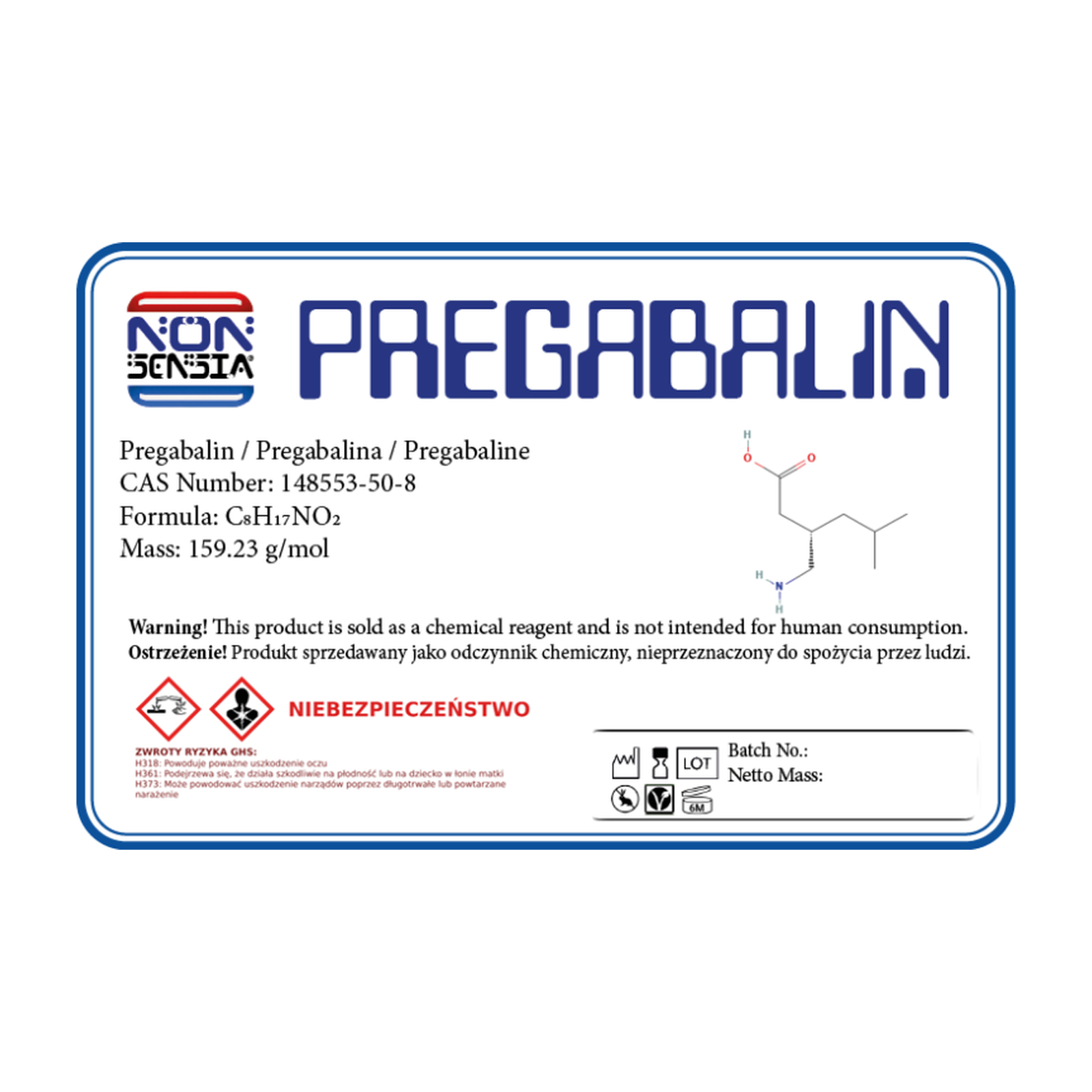
- CAS, (S) form
- 148553-50-8 — the number that identifies this article
- Other CAS in circulation
- 148553-51-9 for the (R) enantiomer; 128013-69-4 for the record deposited without a configuration. These are not synonyms (section 3)
- EC number
- 604-639-1 (S) · 811-425-3 (R) · 876-133-0 (unspecified)
- PubChem CID
- 5486971 [1]
- UNII
- 55JG375S6M
- Formula
- C8H17NO2 — correct, and identical for all three stereochemical records
- Molecular mass
- 159.23 g·mol−1
- Monoisotopic mass
- 159.125928785 Da; [M+H]+ 160.1332
- InChIKey
AYXYPKUFHZROOJ-ZETCQYMHSA-N- Stereocentres
- 1 defined, 0 undefined — a single carbon, C3; the isopropyl carbon is not a centre (section 4)
- Salt form
- None. Free amino acid, zwitterionic in water. No salt-to-base conversion factor applies to this substance
- Acid–base character
- pKa1 4.2, pKa2 10.6, isoelectric point near 7.4 — charged or zwitterionic across the whole usable reversed-phase range
- Specific rotation
- +10.52° (D, c = 1.00, water) for the (S) form, quoted in the registry record from the Merck Index [1]
- Melting point
- Sources disagree: 176–178 °C and 186–188 °C, from two different attributions in the same record (section 9)
- Chromophore
- None beyond an isolated carboxyl. Detection at 254 nm is pointless; ultraviolet work needs derivatisation (sections 6 and 7)
- Deposited spectra
- ATR-IR and FT-Raman for the (S) form only; GC-MS, LC-MS (n = 34) and MS-MS (n = 6) for the (S) form, and GC-MS plus one LC-MS entry for the record without a configuration. No 1H NMR, no 13C NMR and no UV for any of the three records; the (R) record has no spectrum of any kind
- GHS
- Danger — H318, H361, H373, from 199 company reports across 22 notifications for the (S) form; the (R) record has 2 reports and a different set; the unspecified record has no classification section at all (section 11)
- Legal status
- UK: Class C, Schedule 3 · USA: Schedule V · Poland and EU: prescription-only medicine, not in the narcotic schedules · WADA 2026: not established (section 12)
- Grade
- Analytical reference material, supplied for in-vitro laboratory use only
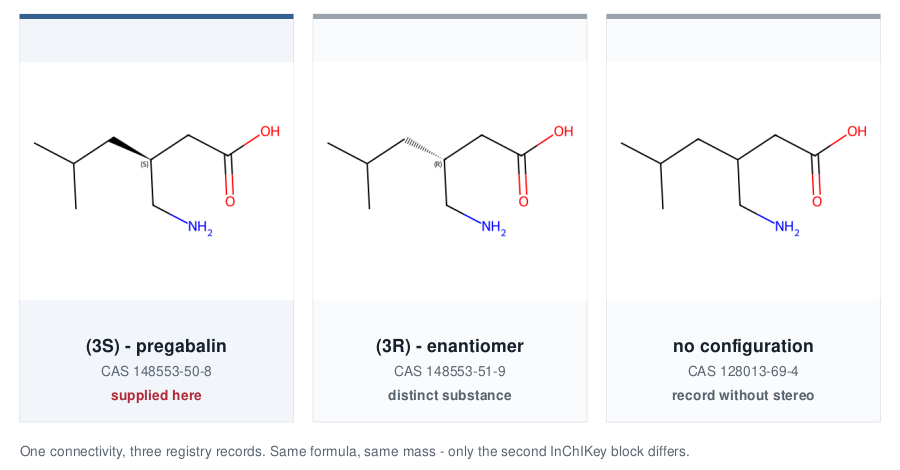
One connectivity, three registry records. Left: the (3S) form, CAS 148553-50-8. Centre: the (3R) enantiomer, CAS 148553-51-9. Right: the record deposited without a configuration, CAS 128013-69-4. Same formula, same molecular mass, same monoisotopic mass to nine decimal places; different CAS number, different EC number, different UNII, and radically different depth of public data behind each.
On this page
- What this material is
- Identity: three registry records, not one
- Identity traps in the numbers themselves
- Structure, stereochemistry and the zwitterion
- The central problem: mass does not identify this substance
- Why the default method struggles, read from the descriptors
- Methods that work, methods that fail
- Resolving the enantiomers
- Physicochemical data, and where the sources disagree
- Spectra: what exists, what does not
- Hazard classification across the three records
- Regulatory status, measured per jurisdiction
- Handling, storage and documentation
- What we certify and what we do not
- Terms of supply
- Questions and answers
1. What this material is
This page describes pregabalin supplied as an analytical reference material: a weighed quantity of a single identified substance, intended to serve as the point of comparison against which another sample is measured. A reference material has one narrow job. When a laboratory reports that a seized tablet contains pregabalin, that a serum sample does, that a synthesis batch conforms to a specification, or that a capsule declared as one gabapentinoid in fact contains another, that report is worth exactly as much as the material the instrument was calibrated against. Everything downstream inherits the identity, the purity and the configuration of one vial.
Three features make this molecule an awkward one to hold, and they are the reason this card runs long. It is chiral, and the two enantiomers plus the unspecified form occupy three separate registry records with three separate CAS numbers, three EC numbers and three UNII codes [1][2][3]. It is a zwitterionic aliphatic amino acid with no chromophore, which puts it outside the reach of the reversed-phase-plus-ultraviolet method most laboratories reach for first. And it sits at a mass it shares exactly with at least one other simple amino acid, while its own principal degradant collides with its own dominant fragment.
The regulatory dimension is not a footnote either. Pregabalin is the active substance of medicines authorised centrally in the European Union and of 118 separate authorisations in the Polish national register [12][13][14], and it is a scheduled controlled drug in two of the five jurisdictions measured in section 12 [15][16][17][18]. Those facts attach to finished medicinal products and to the persons who place them on the market. They do not convert a laboratory reagent into a medicine, and they do not make a medicine of the article described here. They do mean that the legal question a buyer must answer before ordering is a larger question than for an ordinary reagent, and section 12 sets out precisely which document says what, with a positive control on each measurement.
Three other cards in this catalogue turn on closely related analytical problems from different directions. Alpha-GPC is the same class of difficulty in a purer form — a permanently charged, chromophore-free molecule that reversed-phase chromatography barely retains. Mebicar is the case where the default pharmaceutical method sees nothing at all, for want of both retention and absorbance. Tadalafil is the stereochemical counterpart: four stereoisomers, one exact mass, an identity question mass spectrometry cannot answer. Pregabalin is, unusually, a member of all three families at once. The general terms on which reference materials are supplied here are collected in the reference standards category.
2. Identity: three registry records, not one
The single most consequential fact about ordering this substance is that the name pregabalin and the formula C8H17NO2 together do not specify a unique article. Three distinct registry records share that formula and that connectivity, and each carries its own set of identifiers.
| Identifier | (S) — pregabalin, this article | (R) — the enantiomer | Unspecified configuration |
|---|---|---|---|
| PubChem CID | 5486971 | 125889 | 4715169 |
| CAS Registry Number | 148553-50-8 | 148553-51-9 — see section 3 | 128013-69-4 |
| EC number | 604-639-1 | 811-425-3 | 876-133-0 |
| UNII | 55JG375S6M | 81R7ZI0HBG | HG6X3838RD |
| InChIKey | AYXYPKUFHZROOJ-ZETCQYMHSA-N | AYXYPKUFHZROOJ-SSDOTTSWSA-N | AYXYPKUFHZROOJ-UHFFFAOYSA-N |
| Isomeric SMILES | CC(C)C[C@@H](CC(=O)O)CN | CC(C)C[C@H](CC(=O)O)CN | CC(C)CC(CC(=O)O)CN |
| ChEMBL | CHEMBL1059 | CHEMBL167003 | CHEMBL88034 |
| DSSTox | DTXSID1045950 | DTXSID90276292 | DTXSID20861392 |
| Nikkaji | J702.547E | J866.310F | J258.872B |
| Molecular mass | 159.23 | 159.23 | 159.23 |
| Monoisotopic mass | 159.125928785 | 159.125928785 | 159.125928785 |
Read the last three rows against the first four. The three records are identical in everything a mass spectrometer or an elemental analysis can see, and different in every registry identifier a purchase order is written with. The InChIKey is the one machine-readable descriptor that separates them, and it separates them only in its second block: all three share the skeleton AYXYPKUFHZROOJ, which encodes connectivity alone. Any inventory system, certificate archive or spectral library indexing on the fourteen-character skeleton has already merged the three into one entity.
Further identifiers for the (S) form
The (S) record carries the full weight of cross-database curation, and the contrast with the other two is itself informative. Its identifiers include DrugBank DB00230, KEGG D02716, ChEBI CHEBI:64356, HMDB HMDB0014375, NCI Thesaurus C64625, RxNorm concept 187832, PharmGKB PA164754814, DrugCentral 2255, Pharos 5FRSHFCBHS4X, Metabolomics Workbench 42632 and the DEA controlled-substance code 2782 [1][18]. The (R) record carries an NSC number, NSC759256, and very little else [2]. Where a curated database has an entry at all, it is almost always an entry for the (S) form; the enantiomer exists in the registry as a structure, not as a documented material.
| Preferred IUPAC name | (3S)-3-(aminomethyl)-5-methylhexanoic acid |
|---|---|
| INN / USAN | Pregabalin (both, and with no salt designation in either) |
| InChI | InChI=1S/C8H17NO2/c1-6(2)3-7(5-9)4-8(10)11/h6-7H,3-5,9H2,1-2H3,(H,10,11)/t7-/m0/s1 |
| XLogP3 | −1.6 (computed) |
| Topological polar surface area | 63.3 Å2 |
| Hydrogen-bond donors / acceptors | 2 / 3 |
| Rotatable bonds | 5 |
| Complexity / formal charge | 123 / 0 |
| Collision cross-section | 136.99 Å2 for [M+H]+; 134.48 Å2 for [M+Na]+, travelling-wave calibration against polyalanine and drug standards |
Two of these numbers do more work than they look as though they should. A topological polar surface area of 63.3 Å2 on a molecule of eleven heavy atoms is very high in proportion: the polarity is concentrated in two ionisable groups rather than spread thinly over a large scaffold. And the computed XLogP3 of −1.6 is the descriptor-level statement of the entire chromatographic problem in section 6. A molecule that prefers water to octanol by a factor near forty has no thermodynamic reason to sit on a C18 surface, and it does not.
The tail of the InChI string deserves one more line, because it is the part that most database imports lose. The layer /t7-/m0/s1 is the stereochemical layer: t7- assigns the parity at atom 7, m0 fixes the mirror flag and s1 declares absolute rather than relative stereochemistry. Truncate the InChI before /t, or store the canonical rather than the isomeric SMILES, and what remains describes all three records equally well and none of them specifically.
3. Identity traps in the numbers themselves
Section 2 listed the identifiers. This section lists the places where those identifiers, taken at face value, will hand a laboratory the wrong material or the wrong count. Each of these was observed in a public source and is reported as observed.
Trap one: the (R) record carries two CAS numbers, one of them belonging to the (S) form
The registry record for the (R) enantiomer lists both 148553-51-9 and 148553-50-8 [2]. The second of those is the number for the (S) form, which has its own record [1]. Whether this is a deposition error or a deliberate record merge was not established, and it is reported here as an observation about the record rather than as a conclusion about CAS assignment.
The practical consequence is sharp and one-directional. A CAS number alone is not sufficient to order the (R) enantiomer. An order that specifies only a CAS number can be filled from a record where that number appears in a list of two, and the material received may be the opposite enantiomer. An order for the (R) form should specify the InChIKey AYXYPKUFHZROOJ-SSDOTTSWSA-N, the UNII 81R7ZI0HBG, or the isomeric SMILES, and should ask for the optical purity method by which the supplier established which one it is holding — a question section 8 shows is not rhetorical.
Trap two: the racemic CAS number circulates as though it were a synonym
Numbers 128013-69-4 and 148553-50-8 appear interchangeably in commercial listings. They are not interchangeable. The first belongs to the record deposited without a configuration [3], the second to the (S) enantiomer [1]. They differ in EC number, in UNII, in the InChIKey stereo block, in the depth of curated cross-references, and — as section 11 shows — in whether any hazard classification exists at all. A specification sheet quoting one number in the identity row and the other in the synonyms row has not described one substance twice; it has described two substances once each.
Trap three: the molecular formula is right and proves nothing
Commercial offers of this material routinely declare C8H17NO2. That declaration is correct and consistent with the registry [1][2][3]. It is also consistent with the (R) enantiomer, with the unspecified record, and with 2-aminooctanoic acid [4], which is a different compound entirely. A formula that is shared by everything in the neighbourhood carries no discriminating information, and a certificate whose identity section rests on formula and molecular mass has asserted membership of a set rather than an identity.
Trap four: no salt, therefore no conversion factor — and no excuse for one
Pregabalin is supplied and used as the free amino acid. It is not a hydrochloride, not a sulfate, not a mesylate. The registry deposits explicit zwitterionic records alongside the neutral ones — CID 25271887 for the (S) form, CID 40561619 for the (R) form and CID 44313144 for the unspecified record — with the carboxylate and ammonium groups drawn out [1][2][3]. Independently, all 118 Polish authorisations state their strength as pregabalin, with no salt counted in the number [12].
This is worth stating plainly because the opposite convention is so common elsewhere in a reagent catalogue that it becomes a habit. Procaine hydrochloride is the contrasting case: there, the difference between the salt and the free base is a real mass difference that must be applied to every weighing and every concentration. Here there is nothing to apply, and a certificate offering a salt-to-base factor for pregabalin is describing a substance it has not looked at.
Trap five: two therapeutic classification codes, live at the same time
The Polish register does not carry one anatomical-therapeutic-chemical code for this substance. It carries two. Counted across the 118 authorisations: N02BF02 on 59 records, N03AX16 on 56 records, and 2 records with the field empty [12]. The veterinary product carries QN03AX16. The European regulator publishes N02BF02 for the centrally authorised medicine [14].
The two codes are not contradictory in substance — the older places the substance among antiepileptics, the newer among gabapentinoids within analgesics — but they are contradictory as a database key. A query filtered on either code alone returns roughly half the register. The date on which the migration will conclude, and which code is the target for the national register, were not established. Anyone counting authorisations, market presence or product families through the classification field should count through both codes and say so.
Trap six: two spellings of the active substance name, and an empty European number
Within the same register the active substance field appears in two spellings: Pregabalinum on 111 records and Pregabaline on 7 [12]. A string-matched query on the first spelling loses six per cent of the register silently. Separately, the field holding the European authorisation number is empty for every centrally authorised human product and populated only for the veterinary one, which carries EU/2/21/273 [12]. The European numbers for the human products have to be taken from the Union Register [13], not from the national one. Whether the empty field is an error or a convention was not established.
What the six traps have in common. Not one of them is a fact about the molecule. Every one is a fact about how the molecule is recorded — a duplicated CAS number, a formula that does not discriminate, a code mid-migration, a spelling variant, an empty field. The chemistry in sections 4 to 8 is difficult in its own right, but the errors most likely to reach a certificate come from the identifier layer, and they are all cheap to avoid once named.
4. Structure, stereochemistry and the zwitterion
Pregabalin is a saturated, unbranched-backbone six-carbon acid carrying an aminomethyl group at C3 and a methyl branch at C5. There is no ring, no double bond outside the carboxyl, and no aromatic system anywhere in the molecule. Its entire structural interest sits at one carbon and in the pairing of two ionisable groups.
The stereocentre count, done by hand and then checked against the record
Counted directly from the structure, this molecule has exactly one stereogenic centre:
- C3 is a centre. It carries four different groups: −CH2NH2, −CH2COOH, −CH2CH(CH3)2 and −H. Four different substituents on a tetrahedral carbon is the definition, and this carbon satisfies it.
- C5 is not a centre. The isopropyl carbon carries two identical methyl groups. Two identical substituents disqualify it, however tempting the branch looks in a drawn structure.
- There is no bond stereochemistry. Bond stereochemistry requires restricted rotation about a double bond, and the molecule has no C=C bond at all.
The registry confirms the count numerically. Quoted verbatim from the records, the four stereo counters read:
| Counter | (S) — CID 5486971 | (R) — CID 125889 | Unspecified — CID 4715169 |
|---|---|---|---|
| Defined atom stereocentre count | 1 | 1 | 0 |
| Undefined atom stereocentre count | 0 | 0 | 1 |
| Defined bond stereocentre count | 0 | 0 | 0 |
| Undefined bond stereocentre count | 0 | 0 | 0 |
| Formal charge | 0 | 0 | 0 |
| Isotope atom count | 0 | 0 | 0 |
The arithmetic that follows is short and unusually clean. One stereocentre gives 21 = two stereoisomers. Two enantiomers plus one record that declines to specify a configuration is exactly three records, which is exactly what the registry holds. The stereochemical space of this molecule is closed: there is no fourth form waiting to be discovered, no diastereoisomer, no cis/trans pair. That is a genuinely helpful property and it is worth naming, because it is the one respect in which pregabalin is simpler than the harder cases in this catalogue. Tadalafil has two centres and therefore four stereoisomers, all four with registry records and all four sharing one exact mass; noopept carries one defined centre in a peptide-like scaffold; apigenin is flat and achiral and has no stereochemical question to answer at all.
Two centres would have made this a four-body problem. One centre makes it a two-body problem with a documented physical handle: the specific rotation of the (S) form, +10.52° measured at the sodium D line, c = 1.00, in water, quoted in the registry record from the Merck Index [1]. That is a number a laboratory with a polarimeter can actually check, and it is an unusually valuable thing to have, because the corresponding value for many chiral reference materials is simply absent from the public record.
The zwitterion, and why it governs everything downstream
The molecule carries a carboxylic acid and a primary amine on the same short chain. The registry record quotes acid dissociation constants of pKa1 = 4.2 for the carboxyl and pKa2 = 10.6 for the amine, attributed to the Physicians Desk Reference [1]. The isoelectric point implied by that pair sits near 7.4.
Read those two constants against the working range of reversed-phase chromatography, roughly pH 2 to pH 8 on silica-based phases:
| Mobile-phase pH | Carboxyl (pKa 4.2) | Amine (pKa 10.6) | Net species |
|---|---|---|---|
| 2.0 | protonated, neutral | protonated, cationic | cation |
| 4.2 | half ionised | protonated, cationic | cation, partly zwitterionic |
| 7.4 | ionised, anionic | protonated, cationic | zwitterion, net zero |
| 8.0 | ionised, anionic | protonated, cationic | zwitterion |
| 12.0 (outside silica range) | ionised, anionic | largely neutral | anion |
There is no accessible pH at which this molecule is both neutral and lipophilic. At the isoelectric point it is net-neutral but carries two full formal charges, which is not the same thing at all as being uncharged: the dipole is large, the hydration shell is tight, and the affinity for an alkyl-bonded silica surface stays negligible. That single sentence explains section 6, section 7 and half of section 13.
5. The central problem: mass does not identify this substance
This is the heart of the card. Everything else is context for it.
The intuition most analysts start from is that pregabalin and gabapentin, being close structural analogues, must be hard to tell apart. That intuition is exactly backwards on the mass axis, and it distracts from the two collisions that are real.
Gabapentin is trivially separable by mass, and that is the least interesting fact here
| Compound | Formula | CID | Monoisotopic mass (Da) | [M+H]+ |
|---|---|---|---|---|
| Pregabalin | C8H17NO2 | 5486971 | 159.125928785 | 160.1332 |
| Gabapentin | C9H17NO2 | 3446 | 171.125928785 | 172.1332 |
| 2-Aminooctanoic acid | C8H17NO2 | 69522 | 159.125928785 | 160.1332 |
| Pregabalin lactam | C8H15NO | 16101323 | 141.115364102 | 142.1226 |
| Vigabatrin | C6H11NO2 | 5665 | 129.078978594 | 130.0863 |
| Tranexamic acid | C8H15NO2 | 5526 | 157.110278721 | — |
| Baclofen | C10H12ClNO2 | 2284 | 213.055656300 | — |
| Mirogabalin | C12H19NO2 | 59509752 | 209.141578849 | — |
Pregabalin and gabapentin differ by exactly 12.0000 Da, one carbon-12 atom, with identical hydrogen, nitrogen and oxygen counts. Note that the decimal parts of the two monoisotopic masses are identical to the last digit — 0.125928785 in both — because the difference is a single atom whose mass defect is zero by definition. A single-quadrupole instrument at unit resolution separates 160 from 172 without effort. Distinguishing pregabalin from gabapentin by mass is not an analytical challenge.
Collision one: a perfect isobar that is a different compound
2-Aminooctanoic acid, CID 69522, has the same molecular formula and the same monoisotopic mass as pregabalin to every decimal place the registry publishes: 159.125928785 Da [1][4]. It is a straight-chain amino acid with the amino group at C2, and it is a genuinely different substance. Accurate mass excludes gabapentin. It does not identify pregabalin. No instrument, at any resolving power, separates two identical numbers.
There is one saving grace and it is worth stating precisely, because it is the mirror image of the failure mode in section 2. The InChIKey of 2-aminooctanoic acid is AKVBCGQVQXPRLD-UHFFFAOYSA-N [4] — a different skeleton block from the pregabalin family AYXYPKUFHZROOJ, because the connectivity genuinely differs. So the identifier that fails to separate the three stereochemical records succeeds against the isobar, and the mass measurement that separates nothing within the family succeeds against gabapentin. Each tool is blind in a different direction, and the only way to see is to use more than one.
Collision two: the principal degradant lands on the principal fragment
This is the more damaging of the two, because it involves the substance itself rather than an unrelated compound.
The dominant fragmentation of protonated pregabalin in positive electrospray is the loss of water. Arithmetically: 160.1332 − 18.0106 = 142.1226. Separately, pregabalin lactam — systematically 4-(2-methylpropyl)pyrrolidin-2-one, CID 16101323, C8H15NO, monoisotopic 141.115364102 Da — protonates to give [M+H]+ = 142.1226 [5]. The two numbers are the same number, and they are the same number because the fragmentation is a dehydrative cyclisation to the same species.
The lactam is not a hypothetical. It is a documented process impurity, deposited in the public registry under the synonyms pregabalin lactam impurity, pregabalin impurity IV and Pregabalin USP RC C [5]. It arises by intramolecular condensation of the amine onto the carboxyl, which is precisely the reaction the molecule is set up to undergo whenever water can be lost. Process impurities of pregabalin are isolated and characterised in the published literature, although the dedicated isolation study cited here [28] concerns a different one — the unsaturated 4-ene acid, 3-(aminomethyl)-5-methylhex-4-enoic acid, not the lactam.
The consequence, stated plainly. If dehydration occurs in the ion source — and in-source dehydration of an amino acid is unremarkable — then a lactam-contaminated sample and a clean sample produce the same base fragment at the same mass. The transition that most methods use to confirm pregabalin, 160 → 142, is a transition the principal degradant can also satisfy by simply being protonated. Only the chromatographic separation distinguishes them, and the retention time that anchors that separation has to come from an authentic standard of each.
The deposited spectra bear this out quantitatively. The MassBank record MSBNK-Athens_Univ-AU166801, contributed by N. Alygizakis, R. Aalizadeh and N. Thomaidis of the University of Athens, was acquired on a Bruker maXis Impact quadrupole time-of-flight instrument in positive electrospray, MS2, collision-induced dissociation at 10 eV, on an Acclaim RSLC C18 column, 2.2 µm, 2.1 × 100 mm, retention time 3.941 min, precursor 160.1332 [9]. Its ion list is unambiguous about which peak dominates.
| Record and conditions | Product ions, m/z (relative intensity) |
|---|---|
| MassBank MSBNK-Athens_Univ-AU166801, QTOF, 10 eV [9] | 142.1228 (999), 160.1335 (810), 143.1067 (215), 143.1258 (86), 125.0964 (81) |
MS-MS 2234255, positive; SPLASH splash10-01ox-0900000000-f61d6c12dadd60399296 | 142.1222 (100), 160.1328 (89.69), 143.106 (22.92), 161.1358 (8.11), 124.1117 (6.61) |
MS-MS 2234278, higher energy; SPLASH splash10-0a4i-9000000000-37e1f57223b0ba6b95f6 | base peak 55.0543 (100), then 55.0179 (38.68), 83.0855 (13.43), 69.0699 (11.59), 57.0699 (10.91) |
MS-MS 2234650, higher energy; SPLASH splash10-0a4i-9100000000-ea797f17647a8718608d | base peak 55.0543, same low-mass series |
At low collision energy the water-loss ion is the base peak in both independent records, at 999 and at 100 relative units respectively — that is, the ion that collides with the lactam is not a minor channel but the channel. At high collision energy the spectrum collapses to a low-mass hydrocarbon series topped by m/z 55.0543, which carries no structural specificity whatsoever and would be shared by a wide range of aliphatic amines and acids. The informative window for this compound sits between a fragment that is ambiguous and a fragment set that is generic.
None of this makes mass spectrometry useless for pregabalin, and published serum and plasma methods do quantify it reliably [26][30]. It makes mass spectrometry insufficient on its own, and it makes the retention axis — which is to say the standard — carry the identification.
6. Why the default method struggles, read from the descriptors
The default identity and assay method in a pharmaceutical or forensic laboratory is reversed-phase liquid chromatography on a C18 column with ultraviolet detection, usually at 254 nm. For most of the substances in this catalogue that method works on the first attempt. For pregabalin it fails twice over, and both failures can be predicted from the computed descriptors in section 2 before a single injection is made. That is worth doing deliberately, because a method that fails for a reason you can name is a method you can replace, while a method that fails for a reason you cannot name looks like a bad batch.
Failure one: nothing retains it
| Descriptor | Value | What it implies for a C18 separation |
|---|---|---|
| XLogP3 | −1.6 | Partitions roughly forty times in favour of water over octanol. There is no lipophilic surface for an alkyl phase to grip |
| Experimental logP at pH 7.4 | −1.35 | The measured value agrees with the computed one in sign and in magnitude, which is not always the case (section 9) |
| Topological polar surface area | 63.3 Å2 | High relative to eleven heavy atoms; the polarity is concentrated, not diluted across a scaffold |
| Hydrogen-bond donors / acceptors | 2 / 3 | Five hydrogen-bonding sites on a molecule of mass 159; strong preference for a protic mobile phase |
| pKa1 / pKa2 | 4.2 / 10.6 | Charged or zwitterionic at every accessible pH (section 4). Ion suppression by mobile-phase pH is not available |
| Aromatic rings | 0 | No π-π interaction with a phenyl phase either — the usual second option is closed as well |
The consequence is elution at or near the void volume. Anything that co-elutes at the void — salts, matrix, sample solvent — arrives at the detector at the same moment, so even if the compound could be seen, it would be seen against everything else in the injection. The routes around this are buffering, ion pairing, hydrophilic-interaction chromatography, mixed-mode phases, or derivatisation to add the missing lipophilicity. Only the last of those also solves the second failure.
Failure two: nothing absorbs
The molecule has no aromatic ring, no conjugated system and no heteroatom chromophore beyond an isolated carboxylic acid. The only accessible electronic transition is the n → π* of that carboxyl, near 210 nm, with a very small molar absorptivity. Detection at 254 nm is not weak for this compound; it is meaningless, because there is nothing absorbing at that wavelength to detect.
Working at 210 nm is possible but expensive in a different currency: at that wavelength the mobile phase, the sample solvent, dissolved oxygen and most matrix components absorb as well, so the baseline is high and the signal sits on top of it. This is the same structural predicament as alpha-GPC, and it is the opposite of what a card such as methylene blue describes, where the chromophore is so dominant that visible-range detection is trivial and the analytical problems lie elsewhere entirely. Benzocaine and paracetamol sit at that same easy end: an aromatic ring conjugated to a heteroatom, a strong band well clear of the solvent cut-off, and a method that writes itself.
The rule this illustrates. Ultraviolet detection is not a property of an instrument, it is a property of a molecule. Reversed-phase retention is not a property of a column, it is a property of a partition coefficient. Both of the numbers that decide the outcome for pregabalin — XLogP3 −1.6 and the absence of any aromatic ring — are printed in the free public record [1] and can be read before the method is written. The failure is predictable, which means the correct method can be chosen first rather than fourth.
7. Methods that work, methods that fail
What follows is a description of the published analytical literature for this compound. Each entry names the derivatising agent, the detection wavelength or mode, and where reported, the figure of merit. These are bibliographic facts about published methods; the reagent on this page is the calibrant such methods require, not a claim about any of them.
Derivatisation: the mainstream answer
Every one of these methods works by the same logic. The molecule has two nucleophilic handles — a primary amine and a carboxylate — and a reagent that attaches a chromophore or a fluorophore to one of them converts an undetectable analyte into a detectable one. The chromophore comes from the reagent, not from the substance. That fact carries a corollary that runs through this entire section: the calibration curve then measures the derivative, and the relationship between derivative and analyte has to be anchored by a standard of known content.
| Reagent | Detection | Reported performance | Source |
|---|---|---|---|
| Ninhydrin, phosphate buffer at pH 7.4 | Visible absorbance, λmax 402.6 nm | Spectrophotometric determination in pure form and in capsules | [21] |
| Fluorescamine, borate buffer at pH 10 | Fluorescence, emission 487 nm, excitation 390 nm | Working range 0.01–0.3 µg·mL−1; limit of detection 0.0017 µg·mL−1 | [22] |
| 4-Chloro-7-nitrobenzofurazan (NBD-Cl) | HPLC with fluorescence detection | Determined simultaneously with gabapentin, vigabatrin and topiramate in plasma | [24] |
| Alkyl chloroformate (hexyl chloroformate) | GC-MS | Derivatises the amine and the carboxyl in one step; sample preparation under five minutes | [25] |
| Novel xanthone-analogue fluorescent reagent | Fluorescence | Reaction conditions optimised by chemometric design rather than one-factor-at-a-time | [23] |
| Marfey reagent (Nα-5-fluoro-2,4-dinitrophenyl-5-L-alanine amide) | HPLC, absorbance 340 nm | Optical impurity determination; limit of detection for the (R) impurity 1.1 × 10⁻⁸ g·mL−1 | [20] |
Two entries in that table deserve a second look. The alkyl chloroformate route [25] is unusual in derivatising both functional groups in a single operation, which is what makes a gas-chromatographic method viable for a compound that is otherwise far too polar and too involatile for the technique. And the Marfey reagent [20] is not a detection method at all in the ordinary sense — it is a chiral derivatisation that converts a pair of enantiomers into a pair of diastereomers, which is the subject of section 8.
The honest counterexample: it can be done without derivatisation
A page that only listed derivatisation methods would be overstating the case, so here is the contrary evidence. Reversed-phase HPLC with diode-array detection and no derivatisation at all has been published for the capsule form: a Hypersil BDS C8 column, 150 × 4.6 mm, 5 µm, phosphate buffer at pH 6.9 with acetonitrile in a 95:5 ratio, 1 mL·min−1, with a reported limit of quantification of 0.6 mg·L−1 [27]. That is a real, validated, working method, and it contradicts any blanket claim that ultraviolet detection is impossible here.
The right way to hold both facts at once is quantitative rather than rhetorical:
| Approach | Reported figure of merit | Expressed in mg·L−1 | Source |
|---|---|---|---|
| RP-HPLC, diode array, no derivatisation | Limit of quantification 0.6 mg·L−1 | 0.6 | [27] |
| Fluorescamine derivatisation, spectrofluorimetry | Limit of detection 0.0017 µg·mL−1 | 0.0017 | [22] |
| Marfey derivatisation, chiral impurity | Limit of detection 1.1 × 10⁻⁸ g·mL−1 | 0.011 | [20] |
The gap between the first and second rows is roughly two and a half orders of magnitude. That number decides the method selection, and it decides it cleanly:
- Content determination in a formulated product, where the analyte is present at percentage level: underivatised reversed-phase with diode-array detection is adequate and simpler [27].
- Trace work, biological matrices, impurity profiling or stability-indicating assay: derivatisation or mass-spectrometric detection is not a preference, it is a requirement [22][24][26].
Mass-spectrometric methods, and what they still require
Liquid chromatography with tandem mass spectrometry sidesteps the chromophore problem entirely, since detection no longer depends on absorbance. Published methods quantify pregabalin together with gabapentin and vigabatrin in human serum by ultra-performance liquid chromatography with mass-spectrometric detection [26], and gas chromatography with mass-spectrometric detection after chloroformate derivatisation covers the same three analytes [25]. Forensic work has used these to measure serum concentrations in apprehended drivers [29] and to profile post-mortem casework [30], and urinary detection windows after non-medical use have been characterised [31].
All of that works. None of it removes the requirement in section 5: the confirming transition 160 → 142 is shared with the protonated lactam, so the retention time carries the identification, and the retention time is only as trustworthy as the standard that fixed it.
8. Resolving the enantiomers
Section 4 established that this molecule has exactly one stereocentre and therefore exactly two enantiomers. This section is about telling them apart, which is a harder problem than the count suggests, and about the asymmetry in what the public record holds for each.
Chiral separation is achievable, but not on an ordinary column and not without a reagent
Enantiomers have identical scalar physical properties in an achiral environment: the same mass, the same boiling point, the same infrared spectrum, the same retention on a C18 column. Separating them requires a chiral environment, which can be a chiral stationary phase, a chiral mobile-phase additive, or — the route documented for this compound — conversion into a pair of diastereomers, which do differ.
The published method uses the Marfey reagent, Nα-5-fluoro-2,4-dinitrophenyl-5-L-alanine amide, as a pre-column chiral derivatising agent, with separation on an ordinary octadecylsilane column (Inertsil ODS-2, 5 µm, 250 × 4.6 mm), phosphoric acid buffer and acetonitrile at 55:45, 1.0 mL·min−1, at room temperature, with absorbance detection at 340 nm and a reported limit of detection for the (R) impurity of 1.1 × 10⁻⁸ g·mL−1 [20].
Three things about that method are worth extracting, because they are what a buyer actually needs to know:
- The column is achiral. The chirality lives in the reagent, not in the stationary phase. A laboratory does not need a chiral column to do this work, which lowers the cost considerably.
- The detection wavelength belongs to the reagent. 340 nm is the dinitrophenyl chromophore. The analyte contributes nothing to the signal, exactly as in section 7.
- Migration order must be assigned. The method produces two peaks. Which peak is which is not deducible from the chromatogram; it is established by injecting a standard of known configuration. Without that, the method measures a ratio between two unlabelled peaks.
The physical anchor, and why it matters here more than usual
There is one further handle, and for this molecule it is unusually accessible: the specific rotation of the (S) form is +10.52° at the sodium D line, c = 1.00, in water, quoted in the registry record from the Merck Index [1]. A polarimeter is ordinary equipment in a way that a chiral chromatography system is not, and the existence of a published reference value means a measurement made on incoming material has something to be compared against. Many chiral reference materials have no deposited rotation at all, which reduces the polarimeter from a check to a curiosity.
Two cautions belong with that number. It is a value for the (S) form in water at a stated concentration, and specific rotation depends on solvent, concentration, temperature and wavelength; a measurement made under other conditions is not comparable to it. And it is a bulk property, so it reports the enantiomeric composition of the sample as a whole, not the presence of a small enantiomeric impurity, for which the chromatographic method [20] is the appropriate tool by a wide margin.
The asymmetry of the record between the two enantiomers
The two enantiomers are equally real chemically and radically unequal in the public record. This was measured across every category the registry publishes:
| Category | (S) CID 5486971 | (R) CID 125889 | Unspecified CID 4715169 |
|---|---|---|---|
| Hazard notifications to the European inventory | 199 reports / 22 notifications | 2 reports / 2 notifications | no classification section |
| ATR infrared spectrum | present | absent | absent |
| FT-Raman spectrum | present | absent | absent |
| GC-MS | present | absent | present |
| LC-MS | present, n = 34 | absent | present, n = 1 |
| MS-MS | present, n = 6 | absent | absent |
| 1H NMR | absent | absent | absent |
| 13C NMR | absent | absent | absent |
| Ultraviolet spectrum | absent | absent | absent |
The (R) enantiomer has no deposited spectrum of any kind. Not infrared, not Raman, not gas-chromatographic mass spectrometry, not liquid-chromatographic mass spectrometry, not tandem mass spectrometry. A laboratory that acquires material labelled as the (R) enantiomer has nothing in the free public record to compare it against. Confirmation of that form rests on the sign of the optical rotation relative to the (S) value [1], on a chiral chromatographic method whose peak assignment must itself be anchored [20], or on spectra recorded in-house. That is a materially different situation from the (S) form, and it is a question to settle with a supplier before ordering rather than after.
9. Physicochemical data, and where the sources disagree
The registry record carries a populated experimental-properties section, and it also carries internal contradictions. Values below are given with the attribution the record itself gives them. Where sources conflict, the conflict is reported rather than averaged, and where a value has no attribution, that absence is stated as part of the value.
| Property | Value | Attribution as it appears in the record |
|---|---|---|
| Physical form | White to off-white crystalline solid | Physicians Desk Reference, 61st edition, page 2539 |
| Melting point | 176–178 °C | World Health Organization review document |
| Melting point | 186–188 °C | Merck Index, 13th edition, page 1381 |
| Boiling point | 144–147 °C | World Health Organization review document — see the contradiction below |
| Solubility, qualitative | Freely soluble | World Health Organization review document |
| Solubility, qualitative | Freely soluble in water and in both basic and acidic solutions | Physicians Desk Reference, 61st edition, page 2539 |
| Solubility, numeric | 11.3 g·L−1 | Human Metabolome Database — source named, but no literature citation attached |
| logP | +1.3 | Human Metabolome Database — source named, but no literature citation attached |
| logP, n-octanol / 0.05 M phosphate buffer at pH 7.4 | −1.35 | Physicians Desk Reference, 61st edition, page 2539 |
| XLogP3 | −1.6 | computed |
| pKa1 / pKa2 | 4.2 / 10.6 | Physicians Desk Reference, 61st edition, page 2539 |
| Specific rotation | +10.52° (D, c = 1.00, water) | Merck Index, 13th edition, page 1381 |
| Collision cross-section | 136.99 Å2 [M+H]+; 134.48 Å2 [M+Na]+ | travelling-wave measurement, polyalanine and drug-standard calibration |
Disagreement one: a boiling point below the melting point
The same source document is credited in the record with a melting point of 176–178 °C and a boiling point of 144–147 °C [1]. A liquid that boils some thirty degrees below the temperature at which its own solid melts is not a subtle inconsistency; at atmospheric pressure it is physically impossible. The likely explanations are a measurement under reduced pressure with the pressure omitted, or a transcription error. Which of those it is cannot be settled at the source: the cited World Health Organization document returns HTTP 404 at the address given for it and at the content-delivery mirror, checked on 23 August 2026. The number is therefore reported here with its contradiction attached and without a pressure, because the pressure was never recorded. Figures near 144–147 °C circulate in commercial listings as a plain boiling point; they are not registry values, and a boiling point without a stated pressure is not a usable physical constant.
Disagreement two: three values of logP, one of them without a citation and with the wrong sign
The record holds −1.6 (computed), −1.35 (measured at pH 7.4, attributed to a named page of a named edition) and +1.3, deposited from the Human Metabolome Database with no literature citation attached [1]. The first two agree with each other in sign and closely in magnitude, and both are what one expects of a zwitterion with an isoelectric point near 7.4. The third is the odd one, it is the one with no citation behind it, and a positive logP for a species bearing two full formal charges at physiological pH is implausible on its face. This page reports the two negative values that carry a literature citation as the usable ones and flags the third as uncited rather than silently dropping it.
Disagreement three: a verbal solubility that contradicts the number beside it
Two independent verbal descriptions in the record say freely soluble [1]. By the pharmacopoeial convention that phrase denotes roughly 100–1000 g·L−1. The numeric value deposited in the same record is 11.3 g·L−1, which falls in the band conventionally described as sparingly soluble, about 10–33 g·L−1. The verbal descriptions and the number cannot both be right. The number is, once again, the value that carries a depositing database but no literature citation. A laboratory preparing an aqueous stock should treat the discrepancy as an open question and determine the solubility it actually needs on the material in hand.
What is missing entirely
Checked by name against the record and absent in every case [1]: density, vapour pressure, refractive index, flash point, decomposition temperature, stability and shelf-life data, odour, and any solubility figure for an organic solvent. The deposited solubility data covers water and aqueous solutions only. For a compound routinely dissolved for injection onto a chromatograph, the absence of organic-solvent solubility figures is a real inconvenience rather than a pedantic one, and it means stock-solution work starts with a small determination rather than with a table lookup.
10. Spectra: what exists, what does not
This is where the public record for pregabalin is at its thinnest, and the shape of the gap is the reason the third hook at the top of this page reads as it does. The measurement below was made by querying each spectral section by name for each record, and it was made with positive controls, because a query that returns nothing for every input is indistinguishable from a query that is broken.
| Spectrum type | Pregabalin (S) | (R) | Unspecified | Gabapentin | Caffeine | Leucine |
|---|---|---|---|---|---|---|
| Ultraviolet | absent | absent | absent | absent | present | present |
| 1H NMR | absent | absent | absent | present | present | present |
| 13C NMR | absent | absent | absent | absent | present | present |
| Infrared / ATR | present | absent | absent | present | present | present |
| Raman | present | absent | absent | present | present | present |
| GC-MS | present | absent | present | present | present | present |
| LC-MS | present (34) | absent | present (1) | present (60) | present (114) | present (29) |
Why leucine is the control that matters. Caffeine is an easy control — it is a heavily studied aromatic compound with a strong chromophore, and of course it has an ultraviolet spectrum. Leucine is the hard one, and it was chosen deliberately: it is an aliphatic amino acid with the same isobutyl branch as pregabalin, it is a zwitterion, and it has no chromophore either. If the ultraviolet section were empty for pregabalin merely because chromophore-free compounds do not get ultraviolet spectra deposited, then leucine would be empty too. It is not. Leucine has a deposited ultraviolet spectrum and deposited proton and carbon spectra. The zero for pregabalin is therefore a fact about what has been deposited, not an artefact of the compound class, and it is safe to state as an absence rather than as an unknown.
What is present, and the licence attached to it
For the (S) form only, the record holds an ATR infrared spectrum and an FT-Raman spectrum, both contributed by Forensic Spectral Research on a sample from Lipomed AG, catalogue number PRE-1475, lot 1475.1B0.1 (the infrared spectrum recorded on a Bio-Rad FTS instrument), with rights held by a commercial publisher; a GC-MS spectrum contributed by the Mass Spectrometry Committee of the Toxicology Section of the American Academy of Forensic Sciences; 34 LC-MS entries, including the MassBank record described in section 5 [9]; and six MS-MS spectra [1].
The vibrational spectra exist but they are behind paid access. They are not a free point of comparison, which for a laboratory doing an incoming-goods identity check is a practical distinction rather than a legal nicety: a spectrum you cannot open is, at the moment of the check, the same as a spectrum that is not there.
The consequence for identity confirmation
Put the three findings together. There is no free reference spectrum in the public record by which a laboratory can confirm this substance by nuclear magnetic resonance or by ultraviolet absorption. Confirmation by proton or carbon spectroscopy requires acquiring the spectrum in-house on material of known identity, which is to say on an authenticated standard. The vibrational spectra that do exist are paywalled and cover the (S) form alone. The mass spectra that are freely available confirm connectivity, and section 5 explains why connectivity is not identity for this molecule.
That is an unusual combination, and it is worth being explicit that it is unusual. For most substances in this catalogue, at least one free, high-quality reference spectrum exists somewhere in the public record. For pregabalin, the free record consists of mass spectra that cannot separate it from an isobar and cannot separate its parent ion from its own degradant.
11. Hazard classification across the three records
The classification below is an aggregation of supplier self-classifications notified to the European inventory, and it is important to read what that means before relying on it. The percentages are counts of how many notifying companies agreed with one another. They are not confidence intervals on a toxicological finding, and they are not a harmonised classification.
Provenance statement, made explicitly. The legacy host of the European agency returned HTTP 403 and one of its search interfaces returned HTTP 502 from the network used for this measurement on 23 August 2026. The agency's current substance portal did answer, HTTP 200, and it confirms the identifiers for this substance — EC 604-639-1, CAS 148553-50-8, registry entry 100.119.513 — with an empty index-number field, which is the machine-readable form of the Annex VI finding below. What that portal did not expose is the per-notification breakdown. The percentages below are therefore taken from the aggregation of the classification and labelling inventory republished in the chemical registry record [1][2][3], and the notification counts behind them have not been re-counted at the agency.
The (S) form: 199 reports, 22 notifications
| Code | Statement | Class | Share of notifiers |
|---|---|---|---|
| H361 | Suspected of damaging fertility or the unborn child | Repr. 2 | 97% |
| H318 | Causes serious eye damage | Eye Dam. 1 | 72.9% |
| H373 | May cause damage to organs through prolonged or repeated exposure | STOT RE 2 | 50.3% |
Signal word: Danger. Precautionary statements carried in the aggregation: P203, P260, P264+P265, P280, P305+P354+P338, P317, P318, P319, P405 and P501 [1]. The classification rests on 199 reports from companies, across 22 notifications; 21 of those notifications supply hazard codes, covering 198 of the 199 reports, and one report of the 199 states that the substance does not meet the criteria for classification at all.
The spread in the percentage column is the visible signature of how a self-classification aggregate is built. Near-unanimity on the reproductive-toxicity endpoint at 97 per cent, a clear majority on serious eye damage, and something close to a coin toss on organ toxicity after repeated exposure. That is a measure of how much the notifying companies agreed, and nothing more. The single dissenting report is worth naming rather than rounding away, because it is the honest indication that this is an opinion count.
The (R) form: 2 reports, and a different set of hazards
| Code | Statement | Class | Share of notifiers |
|---|---|---|---|
| H361 | Suspected of damaging fertility or the unborn child | Repr. 2 | 100% |
| H318 | Causes serious eye damage | Eye Dam. 1 | 50% |
| H336 | May cause drowsiness or dizziness | STOT SE 3 | 50% |
Two reports across two notifications. On a base of two, a share of fifty per cent means one notifier. The set is not the same as for the (S) form: H336 appears here and does not appear there, and H373 appears there and not here. The record for the unspecified configuration, CID 4715169, has no classification section at all [3].
Three records, three different hazard pictures, one molecule at the level of the formula. Notification coverage runs 199, then 2, then zero. It would be easy to read that sequence as a statement about relative hazard. It is not. It is a statement about which form is placed on the European market in quantity — the (S) form is an active pharmaceutical ingredient made at scale, the (R) form is a reference impurity, and the unspecified record is a database convention. Absence of a classification is absence of notification, not evidence of safety. The one endpoint that is agreed across both enantiomers, and agreed most strongly on each, is the reproductive-toxicity classification H361 at 97 and 100 per cent, and that is the endpoint that should drive the risk assessment for handling either form.
Two limits on the above, both structural. First, none of this is a harmonised classification: the agency's current substance portal returns this substance with an empty index-number field, an index number being the identifier a harmonised Annex VI entry carries, so every code here is supplier self-classification and none of it is legally binding as a harmonised entry. A different supplier may lawfully classify the same substance differently. Second, the aggregation was read through the registry rather than at the agency, for the access reasons stated above.
12. Regulatory status, measured per jurisdiction
This is the section a buyer should read before any other. Every statement below is a measurement against a named document, and every negative statement was made with a positive control on the same document, so that a zero can be told apart from a search that was not working. Where a measurement could not be made, this page says so rather than filling the gap from memory.
| Jurisdiction | Finding | Primary source |
|---|---|---|
| United Kingdom | Controlled drug. Class C under the Misuse of Drugs Act 1971 and Schedule 3 under the Misuse of Drugs Regulations 2001. Control extends to any stereoisomeric form, and to esters, salts and preparations | [15][16][17] |
| United States | Controlled substance, Schedule V. 21 CFR 1308.15(e)(7), DEA code 2782, added by the final rule at 70 FR 43633, effective 28 July 2005 | [18] |
| Poland — narcotics schedules | Not listed. Zero occurrences in the consolidated schedules of narcotic drugs, psychotropic substances and new psychoactive substances, including the amendment in force since 28 July 2026 | [10][11] |
| Poland — medicines register | Prescription-only medicine. 118 authorisations, 635 pack records, supply category Rp on 635 of 635 | [12] |
| European Union | Centrally authorised medicine. Marketing authorisation EU/1/04/279, record status active | [13][14] |
| Anti-doping | Not established. The current list could not be retrieved from the measuring network; see the subsection below | [19] |
United Kingdom: controlled, and the control covers both enantiomers
The consolidated legislation names the substance directly. The Misuse of Drugs Act 1971, Schedule 2, Part 3 (Class C drugs), paragraph 1(b) reads: “Pregabalin ((S)-3-(aminomethyl)-5-methylhexanoic acid).” [15]. It was inserted by an amending order made on 12 December 2018, whose explanatory note states that the order “brings the compounds known as Pregabalin and Gabapentin under permanent control as Class C drugs under that Act” [16]. In parallel, the Misuse of Drugs Regulations 2001, Schedule 3, paragraph 1(a) names the same substance, inserted by a separate instrument with effect from 1 April 2019 [17].
The stereochemical reach of that control is set by the general paragraphs rather than by the naming paragraph, and it is broad. Schedule 2, Part 3, paragraph 2 of the Act extends control to “any stereoisomeric form of a substance for the time being specified in paragraph 1 of this Part of this Schedule not being phenylpropanolamine” [15], and the corresponding paragraph of Schedule 3 of the Regulations does the same [17]. Further paragraphs of that schedule extend it to esters, to salts, and to preparations and products containing the substance [17].
The entry names only the (S) form; the general clause captures the (R) form as well. A laboratory ordering the (R) enantiomer as an impurity standard into the United Kingdom is ordering a controlled drug, notwithstanding that the enantiomer is not named anywhere in the schedule.
The measuring instrument was checked on the same documents. On Schedule 2 of the Act [15], Gabapentin, Buprenorphine, Tramadol, Ketamine, Diazepam, Flunitrazepam and Midazolam all return hits. On Schedule 3 of the Regulations [17] the controls that fire are Gabapentin, Buprenorphine, Tramadol, Flunitrazepam and Midazolam; Ketamine and Diazepam return zero there, correctly, because they sit in other schedules of the same instrument. The search finds what it should find, and does not find what should not be there.
United States: Schedule V, and a difference in drafting worth seeing
The federal schedule, in the version dated 1 August 2026, carries at 21 CFR 1308.15(e)(7) the entry “Pregabalin [(S)-3-(aminomethyl)-5-methylhexanoic acid] 2782”, within paragraph (e), Depressants [18]. The controlled-substance code is 2782, and the source note to the section credits the entry to the final rule at 70 FR 43635, published and effective 28 July 2005. Positive controls in the same paragraph return Brivaracetam 2710, Cenobamate 2720, Ezogabine 2779, Ganaxolone 2401, Lacosamide 2746 and Lasmiditan 2790 [18]; the instrument fires.
A negative worth recording alongside it: gabapentin returns zero occurrences in the whole of part 1308 [18], which is to say it is not federally scheduled, in contrast to the position in the United Kingdom where the two substances were brought under control together [16]. Individual states of the United States regulate gabapentinoids on their own authority, and state law was not measured here; that gap is stated in section 14 rather than glossed.
A measured difference in the wording of two neighbouring paragraphs. The preamble to paragraph (d), Stimulants, of the same section extends control to a substance “including its salts, isomers and salts of isomers”. The preamble to paragraph (e), Depressants — the paragraph containing pregabalin — reads “including its salts”, with no clause about isomers [18]. The entry itself names only the (S) form. Set against the United Kingdom, where an explicit any stereoisomeric form clause captures the (R) enantiomer [15][17], the two texts are drafted differently in a respect that matters for an enantiomeric impurity standard. This page reports the difference in wording as measured and draws no legal conclusion from it. How a given consignment is classified is a determination for the competent authority, and it is not one a supplier of reagents can make on a buyer's behalf.
Poland: not in the narcotics schedules, and prescription-only in every pack
The Polish schedules were measured on the current legal state rather than on an archived copy. The chain of instruments was established through the legislative interface of the national parliament: the base regulation of 17 August 2018 on the schedules of psychotropic substances, narcotic drugs and new psychoactive substances; the consolidated text published in 2024; and two subsequent amendments, the later of which has been in force since 28 July 2026 and was therefore in force on the day of measurement [10][11].
| Term | Role | Consolidated text | 2025 amendment | 2026 amendment |
|---|---|---|---|---|
| pregabalin / pregabalina | target | 0 | 0 | 0 |
| CAS stem 148553 | target | 0 | 0 | 0 |
| systematic-name fragments | target | 0 | — | — |
| morfina | positive control | 50 | 4 | 0 |
| amfetamin | positive control | 27 | 1 | 0 |
| diazepam | positive control | 4 | 0 | 0 |
| ketamin | positive control | 3 | 1 | 0 |
| fenobarbital | positive control | 2 | 0 | 0 |
| zolpidem | positive control | 1 | 0 | 0 |
| klonazepam | positive control | 1 | 0 | 0 |
Seven positive controls fire, two of them on a single occurrence each. An instrument that detects a term appearing exactly once in a long consolidated schedule is an instrument sensitive enough for the zero beside pregabalina to mean something. The systematic name was searched as well, in case the substance were scheduled under its chemical description rather than its international name; that search is also zero. The 2026 amendment, checked for content, concerns tetrahydrocannabinols and the transposition of a delegated European directive, not this substance [11].
Turning to the medicines register, the public search interface of the national register returned 118 marketing authorisations for the active substance, all 118 retrieved without error [12]. The composition of that set:
| Marketing authorisations | 118 |
|---|---|
| Distinct trade names | 21 |
| Marketing-authorisation holders | 21 |
| Human / veterinary | 117 human, 1 veterinary (authorisation EU/2/21/273, code QN03AX16, target species cat) |
| Pharmaceutical forms | 109 hard capsules, 4 tablets, 3 prolonged-release tablets, 2 oral solutions |
| Strengths recorded | 25, 50, 75, 100, 150, 200, 225 and 300 mg; 82.5, 165 and 330 mg in the prolonged-release form; 20 and 50 mg·mL−1 as solutions |
| Authorisation procedures | decentralised 53, centralised 50, mutual recognition 14, parallel import 1 |
| Pack records counted | 635 (634 human, 1 veterinary) |
| Supply category | Prescription-only on 635 of 635 pack records — 100%, uniform across all 21 trade names |
Trade names present in the register: Bulgaplin, Egzysta, Linefor, Lynagex XR, Lyrica, Naxalgan, Pentegin, Pragiola, Preato, Pregabalin Accord, Pregabalin Aurovitas, Pregabalin Medreg, Pregabalin Pharmalab, Pregabalin Reddy, Pregabalin Sandoz, Pregabalin Viatris, Pregabalin Viatris Pharma, Pregabalin Zentiva, Pregamid, Tabagine, and the veterinary product Bonqat [12].
The supply-category measurement was made discriminating rather than trusting. On the same data surface and through the same field, morphine sulfate returns the restricted-prescription category (Rpw) on 25 of 25 pack records, while gabapentin returns ordinary prescription on 136 of 136 and zolpidem tartrate on 112 of 112 [12]. The field is capable of returning more than one value, so the uniform result for pregabalin is a measurement rather than an artefact of a field that only ever says one thing.
A caution against the obvious inference. A prescription-only category does not prove the absence of legal control. Zolpidem sits in the Polish psychotropic schedules and nonetheless carries the ordinary prescription category on all of its packs [12]. The finding that pregabalin is not scheduled in Poland comes from the measurement of the schedules themselves [10][11], not from the supply category, and the two measurements answer different questions. This distinction is the same one tianeptine illustrates from the other direction, where the legal position varies sharply between jurisdictions that describe the substance in otherwise similar terms.
European Union: centrally authorised, with one register field to distrust
The Union Register of medicinal products carries the record for the centrally authorised product: authorisation number EU/1/04/279, active substance pregabalin, holder Upjohn EESV, record status active [13]. The European regulator publishes the corresponding assessment record, with the classification code N02BF02, therapeutic areas indexed as epilepsy, anxiety disorders and neuralgia, and a document revision number of 72 [14]. The registry record independently gives a first-approval year of 2004, an availability type of prescription-only and an oral route [1].
One data-quality note, already flagged in section 3 and repeated here because it changes how a citation should be written: in the Polish national register the field holding the European authorisation number is empty for every centrally authorised human product and populated only for the veterinary one [12]. European authorisation numbers must be taken from the Union Register [13], not from the national one.
Anti-doping: not established, and stated as not established
The anti-doping status of this substance was not established, and this page will not guess it. The current prohibited list could not be retrieved from the network used for this measurement on 23 August 2026: the issuing body's site returned HTTP 202 with an empty body — a challenge page — including with a full browser header set, HTTP/2 and compression negotiated; two European institutional mirrors returned HTTP 403; a further intergovernmental source returned HTTP 404; two national anti-doping bodies were unreachable; and a public search tool answered HTTP 200 but executes its query in the browser, returning its own home page for every term including the positive controls, which makes it an invalid instrument rather than a negative result [19]. What was established is the identity of the document currently in force, through a national agency page that did respond: the 2026 list. Its contents were not read.
Because there is no working positive control, the correct verdict is not established — not not prohibited. A zero from an instrument that returns zero for everything is not a zero. This gap is a property of network access on the day of measurement and is closable from another network; it is not a property of the substance. Anyone competing under anti-doping rules must consult the current list directly.
Why the control status exists at all, as a bibliographic matter
The literature behind the United Kingdom reclassification is substantial and is cited here as literature, not as a characterisation of this reagent. A systematic review of misuse and abuse of the gabapentinoid class appeared in 2017 [32], following an earlier commentary asking whether the pattern was cause for concern [33]; an analysis of an adverse-event reporting system quantified reports of abuse, misuse, dependence and overdose [34]; prevalence and risk factors were examined in a treatment population [35]; and further open questions were set out subsequently [38]. Contemporaneous reporting in the general medical press covered the British government's decision to reclassify and the coming into force of the control [36][37], alongside earlier critical commentary on prescribing of the class [44]. The forensic record includes post-mortem toxicology profiles [30], serum concentrations in apprehended drivers [29] and urinary detection windows after non-medical use [31]. A regulator communication on avoiding use in pregnancy has also been reported in that press [42], which is the clinical counterpart of the H361 classification in section 11.
The pharmacology and pharmacokinetics of the substance are likewise a matter of published record: a direct comparison of the pharmacokinetics and pharmacodynamics of the two gabapentinoids [39], a study across degrees of renal function [40], a review monograph [41], and case reports of altered serum concentrations of a co-administered antipsychotic [43]. None of that literature describes this reagent, and none of it is reproduced here as a property of it. It is named because it is the reason the regulatory picture in this section looks the way it does, and because a card that reported the control status without indicating where it came from would be less useful than one that does.
13. Handling, storage and documentation
The guidance below follows from the classification in section 11 and the chemistry in sections 4 and 5. It concerns handling of a laboratory reagent by trained personnel in an appropriately equipped facility, and nothing else.
| Personal protection | Nitrile gloves, safety glasses or goggles, laboratory coat. The aggregated classification includes serious eye damage at a 72.9 per cent notifier share, so eye protection is the non-negotiable item rather than the default one [1]. |
|---|---|
| Reproductive-toxicity endpoint | H361, Repr. 2, is the most strongly agreed classification for this substance and it is agreed for both enantiomers, at 97 and 100 per cent respectively [1][2]. It should be the endpoint that drives the local risk assessment, the weighing arrangements and any restriction on who handles the material. |
| Weighing | Weigh in a fume hood or under local exhaust ventilation. Fine crystalline solids become airborne readily, and the aggregation carries an organ-toxicity endpoint for repeated exposure at just over half of notifiers [1]. |
| Moisture | Store dry, in a closed container. The relevant degradation chemistry is an intramolecular condensation to the lactam with loss of water (section 5) [5]; keeping the solid dry does not make that reaction impossible, but a dry, cold, closed system is a much less mobile one. |
| Temperature | Ambient in a closed container is consistent with everything in the public record; no deposited stability or decomposition data supports a refrigeration requirement, because no such data is deposited at all (section 9). Where cold storage is used, allow the container to reach room temperature before opening, since condensation on a hygroscopic amino acid works directly against the row above. |
| Solution preparation | Aqueous solutions are straightforward in principle — the substance is water-soluble on every account in the record — but the numeric solubility is contradicted by the verbal one (section 9), so the working concentration should be determined rather than assumed. No organic-solvent solubility figure exists in the record for any solvent. |
| Solution stability | Treat prepared solutions as having an unestablished shelf life. The lactam pathway is a solution-phase reaction, and section 5 explains why a mass-spectrometric check will not reveal that it has occurred. Prepare fresh, or establish stability with a chromatographic method that separates the lactam. |
| Waste | Halogen-free organic chemical waste, in accordance with local regulations. Do not release to drains. |
| Records | Record the lot number, the date of opening, the storage location, and — specific to this substance — which of the three registry identities the material was ordered against, by InChIKey rather than by CAS number alone (section 3). |
| Import and holding | In jurisdictions where the substance is a controlled drug (section 12), possession, import and onward supply may require an authorisation that has nothing to do with the reagent grade of the material. Establish that position before ordering, not on arrival. |
14. What we certify and what we do not
This section exists because the difference between a supplier's statement and a certified value is exactly the difference a reference material is bought for. We would rather state the boundary plainly than let a page imply more than it can support.
| Claim | Status |
|---|---|
| Chemical identity: CAS, EC, UNII, formula, masses, InChI, InChIKey, stereodescriptors | Quoted from named public registries [1][2][3], each identifier traceable to the record it came from |
| Regulatory statements in section 12 | Measured against named primary documents [10][11][12][13][14][15][16][17][18], each negative accompanied by a positive control on the same document |
| Anti-doping status | Not established. Stated as not established, with the failed retrieval recorded rather than substituted by an older list [19] |
| Spectral gaps in section 10 | Measured with positive controls, including a shape-matched control [6][7][8]. The absence of proton, carbon and ultraviolet spectra is a measurement, not an assumption |
| Hazard classification | Percentages read from the registry aggregation, not re-counted at the agency. The agency's current substance portal did answer and confirms the identifiers and the empty index-number field (no Annex VI entry), but not the per-notification breakdown |
| Purity figure for the specific lot supplied | Not certified on this page. Any purity statement applies to the lot it was measured on and belongs on lot documentation, not in catalogue copy |
| Enantiomeric purity or optical purity | Not certified. Establishing it requires the chiral method in section 8 [20] with a configuration-assigned standard. We do not report a figure we have not measured |
| Lactam content | Not certified. The lactam [5] requires a chromatographic method that resolves it from the parent; a mass-spectrometric check does not (section 5) |
| Water content | Not certified. |
| Solid form, crystallinity, polymorph | Not certified. No powder diffraction or thermal data for this substance was found in the public record |
| Pharmacopoeial status | This material is not supplied as a pharmacopoeial reference standard. Where such standards exist for this substance they are obtainable from the issuing body; this is not that article and the two are not interchangeable for compendial testing |
| Monograph limits and impurity specifications | Not reproduced. Where monographs exist their texts are behind paid access and we have not read them. We will not paraphrase limits we have not seen |
| United States state law | Not measured. The measurement covered federal scheduling only [18]. Individual states regulate gabapentinoids on their own authority |
| Boiling point and pressure | Not resolvable. The value in the record contradicts the melting point in the same record and the cited source document is no longer retrievable (section 9) |
15. Terms of supply
This material is supplied as a laboratory reagent and analytical reference material, for in-vitro laboratory use by qualified personnel in an appropriately equipped facility. It is not a medicinal product, not a dietary supplement, not a food, feed or cosmetic ingredient, and it is not supplied for administration to humans or animals in any form or by any route.
By ordering, the purchaser confirms that they are a professional user acquiring the material for laboratory purposes; that they will handle it in accordance with section 13 and their own institutional risk assessment; that they will not administer it to humans or animals, nor supply it to any person who intends to; and that they are responsible for compliance with every law applicable at the destination. For this substance that responsibility is unusually concrete. Section 12 records that the substance is a scheduled controlled drug in the United Kingdom and in the United States, that the United Kingdom control extends by general clause to both enantiomers, and that it is a prescription-only medicinal substance across the European Union. Requirements arising from any of those positions are matters for the competent authority in the destination country, and they are not displaced by the reagent grade of the material or by anything stated on this page.
Nothing on this page is medical advice, nor an offer of a medicinal product, nor guidance on the use of any medicine. Statements about authorised medicines in section 12 describe those medicines, their registers and their authorisations; they describe neither this article nor any use of it. The literature summarised in sections 7, 8 and 12 is described as literature, and no finding reported in it is presented as a property of the material supplied here.
16. Questions and answers
- Is this the same substance as the active ingredient in authorised pregabalin medicines?
- It is the same chemical substance. It is not the same article in law. An authorised medicine is a finished product manufactured under pharmaceutical quality rules, released against a marketing authorisation and accompanied by approved product information; there are 118 such authorisations in the Polish register alone and a centrally authorised product in the European Union [12][13]. This is a reagent supplied for laboratory work, released against no such framework. The molecule being identical is precisely what makes the distinction worth stating rather than assuming.
- Is pregabalin a controlled drug?
- In two of the jurisdictions measured, yes. In the United Kingdom it is a Class C drug under the Misuse of Drugs Act 1971 and a Schedule 3 substance under the Misuse of Drugs Regulations 2001 [15][16][17]. In the United States it is a Schedule V controlled substance under 21 CFR 1308.15(e)(7), DEA code 2782 [18]. In Poland it does not appear in the narcotics, psychotropic or new-psychoactive schedules — measured against the consolidated text and both amendments in force, with seven positive controls firing on the same documents [10][11] — but it is a prescription-only medicinal substance there, on 635 of 635 pack records [12]. Section 12 sets out each measurement and its control.
- Does the United Kingdom control cover the (R) enantiomer, given that the schedule names only the (S) form?
- Yes. The naming paragraph specifies the (S) form, but the general paragraph of the same schedule extends control to any stereoisomeric form of a substance specified in it, excepting one named substance that is not this one [15][17]. The same schedule further covers esters, salts and preparations [17]. Anyone importing the (R) enantiomer into the United Kingdom as an impurity standard is importing a controlled drug.
- Is it prohibited in sport?
- We do not know, and we will not guess. The current prohibited list could not be retrieved from the network used for this measurement: the issuing body returned an empty challenge response, institutional mirrors returned access errors, and the one search tool that responded executes its query in the browser and returned its home page for every term including the positive controls [19]. With no working positive control, the honest verdict is not established rather than not prohibited — a zero from an instrument that returns zero for everything is not a zero. The gap is a property of network access on the day of measurement, not of the substance, and anyone competing under anti-doping rules should consult the current list directly.
- Which CAS number should I put on my order?
- For the (S) form, 148553-50-8 [1]. But add the InChIKey, because the CAS number alone is not sufficient here: the registry record for the (R) enantiomer carries both 148553-51-9 and 148553-50-8 [2], and a third number, 128013-69-4, belongs to the record deposited without a configuration [3]. Specify
AYXYPKUFHZROOJ-ZETCQYMHSA-Nfor the (S) form,AYXYPKUFHZROOJ-SSDOTTSWSA-Nfor the (R) form, and the UNII as a second check. - Can I confirm the identity of this material by liquid chromatography with tandem mass spectrometry?
- You can confirm a mass and a fragment, which is a real and useful result but is weaker than it sounds for this compound in two independent ways. 2-Aminooctanoic acid has the same formula and the same monoisotopic mass to every published decimal [4], so accurate mass does not identify pregabalin. And the confirming transition 160 → 142 collides with the protonated lactam [5], which the registry lists as a pregabalin process impurity. What actually discriminates is the chromatographic separation, and the retention axis is fixed by a standard.
- Can pregabalin and gabapentin be told apart by mass?
- Trivially. They differ by exactly 12.0000 Da — one carbon — giving 159.125928785 against 171.125928785 and protonated ions at 160.1332 against 172.1332 [1][6]. A single quadrupole at unit resolution separates them without effort. The common assumption that structural analogues must be hard to distinguish by mass is wrong here, and it distracts from the two collisions that are real.
- What is the lactam, and why does the page keep returning to it?
- Pregabalin lactam is 4-(2-methylpropyl)pyrrolidin-2-one, the cyclic amide formed when the amine condenses onto the carboxyl with loss of water [5]. The registry lists it as a pregabalin process impurity under the synonyms pregabalin lactam impurity and pregabalin impurity IV [5]. It matters because protonated lactam appears at m/z 142.1226 and the dominant fragment of protonated pregabalin, the water loss, appears at the same 142.1226. Under in-source dehydration the two become indistinguishable at the fragment, so an assay must resolve them chromatographically or it does not see the degradation at all.
- Can I run it on a C18 column with ultraviolet detection at 254 nm?
- Not usefully, and both halves of the failure are predictable from the free public descriptors before the first injection. Retention: XLogP3 is −1.6, the measured logP at pH 7.4 is −1.35, and the molecule is charged or zwitterionic at every accessible pH because its pKa values are 4.2 and 10.6 [1]. Detection: there is no aromatic ring and no conjugation, only an isolated carboxyl absorbing weakly near 210 nm. At 254 nm there is nothing to detect.
- So is derivatisation mandatory?
- No, and it would be dishonest to say so. Reversed-phase chromatography with diode-array detection and no derivatisation has been published for the capsule form, on a C8 column with a phosphate buffer at pH 6.9, with a limit of quantification of 0.6 mg·L−1 [27]. The correct statement is quantitative: that limit is about two and a half orders of magnitude worse than a fluorescamine method at 0.0017 µg·mL−1 [22]. For content determination in a formulated product the simple method suffices; for trace work, biological matrices or impurity profiling it does not.
- Which derivatising reagent should I choose?
- It depends on the detector and on the question. Ninhydrin with visible detection at 402.6 nm is the simplest [21]. Fluorescamine at pH 10, read at 487 nm emission, is the most sensitive of the published spectroscopic options [22]. NBD-Cl with fluorescence detection has been run against three other antiepileptic analytes in one method [24]. Alkyl chloroformates derivatise the amine and the carboxyl in one step and make gas chromatography viable, with sample preparation under five minutes [25]. A chemometrically optimised xanthone-analogue reagent has also been reported [23]. For optical purity the answer is different and specific: the Marfey reagent, read at 340 nm [20].
- How do I establish that I am holding the (S) form and not the (R) form?
- Two routes, and both need a comparison point. Chiral derivatisation with the Marfey reagent on an ordinary octadecylsilane column resolves the pair with detection at 340 nm and a reported detection limit for the (R) impurity of 1.1 × 10⁻⁸ g·mL−1 [20] — but the method gives two peaks and does not say which is which without a standard of assigned configuration. Or measure the optical rotation: the (S) form is reported at +10.52° (D, c = 1.00, water) [1]. Rotation is a bulk property and will not reveal a small enantiomeric impurity; the chromatographic method will.
- Is there a reference nuclear magnetic resonance spectrum I can compare against?
- No, and this is a measured absence rather than an assumption. None of the three registry records carries a deposited proton or carbon spectrum, and none carries an ultraviolet spectrum either [1][2][3]. The same query returns spectra for gabapentin, caffeine and leucine [6][7][8]. Leucine is the control that makes the zero meaningful: it is an aliphatic amino acid with the same isobutyl branch and no chromophore, and it nonetheless has a deposited ultraviolet spectrum. Infrared and Raman spectra exist for the (S) form but sit behind paid access, and the (R) record has no spectrum of any kind. Identity confirmation by nuclear magnetic resonance therefore requires acquiring the spectrum in-house on authenticated material.
- Is it supplied as a salt? Do I need a conversion factor?
- It is not a salt and no conversion factor applies. Pregabalin is a free amino acid, zwitterionic in water, and the registry deposits explicit zwitterionic records alongside the neutral ones for each configuration [1][2][3]. Independently, all 118 Polish authorisations state strength as pregabalin with no salt counted in the figure [12]. A certificate offering a salt-to-base factor for this substance has not looked at the substance.
- How many stereocentres does it have? The isopropyl group looks like one.
- Exactly one, at C3, and the isopropyl carbon is not it. C3 carries four different groups — aminomethyl, carboxymethyl, isobutyl and hydrogen — while the isopropyl carbon carries two identical methyl groups, which disqualifies it. There is no bond stereochemistry because there is no carbon-carbon double bond. The registry states it numerically: defined atom stereocentre count 1, undefined 0, defined bond stereocentre count 0, undefined bond stereocentre count 0 [1][2], and for the unspecified record, defined 0 and undefined 1 [3]. One centre means two stereoisomers, and the three registry records exhaust that space.
- What is the melting point?
- The record holds two values with two different attributions: 176–178 °C and 186–188 °C [1]. We report both rather than choosing. The same record also carries a boiling point of 144–147 °C attributed to the first of those sources — some thirty degrees below its own melting point, which is impossible at atmospheric pressure and suggests a measurement at reduced pressure with the pressure omitted. That cannot be resolved at the source, because the cited document is no longer retrievable at the address given for it. Figures near 144–147 °C circulate in commercial listings as plain boiling points; they are not registry values.
- Why does the (R) enantiomer carry different hazard codes from the (S) form?
- Because the classifications are supplier self-classifications and the two records have wildly different notification coverage: 199 company reports across 22 notifications for the (S) form, 2 reports across 2 notifications for the (R) form, and no classification section at all for the unspecified record [1][2][3]. On a base of two, a fifty per cent share means one notifier. The difference measures market presence and notifier opinion, not relative toxicity. The endpoint agreed across both enantiomers, at 97 and 100 per cent, is the reproductive-toxicity classification, and that is the one that should drive a handling risk assessment.
- Do you supply a certificate of analysis?
- Kilogram-scale orders come with a batch Certificate of Analysis. What that documentation does and does not cover is set out in section 14, and for this substance the exclusions are worth reading before ordering rather than after: enantiomeric purity, lactam content, water content and solid form are not certified here. We would rather name those gaps than let a certificate imply a coverage it does not have.
References
Registry, spectral and computational sources
- National Center for Biotechnology Information. 2026. “PubChem Compound Summary for CID 5486971, Pregabalin ((3S)-3-(aminomethyl)-5-methylhexanoic acid).” PubChem. https://pubchem.ncbi.nlm.nih.gov/compound/5486971.
- National Center for Biotechnology Information. 2026. “PubChem Compound Summary for CID 125889, (3R)-3-(aminomethyl)-5-methylhexanoic acid.” PubChem. https://pubchem.ncbi.nlm.nih.gov/compound/125889.
- National Center for Biotechnology Information. 2026. “PubChem Compound Summary for CID 4715169, 3-(aminomethyl)-5-methylhexanoic acid, configuration unspecified.” PubChem. https://pubchem.ncbi.nlm.nih.gov/compound/4715169.
- National Center for Biotechnology Information. 2026. “PubChem Compound Summary for CID 69522, 2-Aminooctanoic acid.” PubChem. https://pubchem.ncbi.nlm.nih.gov/compound/69522.
- National Center for Biotechnology Information. 2026. “PubChem Compound Summary for CID 16101323, 4-(2-Methylpropyl)pyrrolidin-2-one (pregabalin lactam).” PubChem. https://pubchem.ncbi.nlm.nih.gov/compound/16101323.
- National Center for Biotechnology Information. 2026. “PubChem Compound Summary for CID 3446, Gabapentin.” PubChem. https://pubchem.ncbi.nlm.nih.gov/compound/3446.
- National Center for Biotechnology Information. 2026. “PubChem Compound Summary for CID 2519, Caffeine.” PubChem. https://pubchem.ncbi.nlm.nih.gov/compound/2519.
- National Center for Biotechnology Information. 2026. “PubChem Compound Summary for CID 6106, L-Leucine.” PubChem. https://pubchem.ncbi.nlm.nih.gov/compound/6106.
- Alygizakis, N., R. Aalizadeh, and N. Thomaidis. 2016. “MassBank Record MSBNK-Athens_Univ-AU166801: Pregabalin, LC-ESI-QTOF, MS2, 10 eV, precursor m/z 160.1332.” MassBank Europe, University of Athens. https://massbank.eu/MassBank/RecordDisplay?id=MSBNK-Athens_Univ-AU166801.
Regulatory and legislative sources
- Minister Zdrowia. 2024. “Obwieszczenie w sprawie ogłoszenia jednolitego tekstu rozporządzenia w sprawie wykazu substancji psychotropowych, środków odurzających oraz nowych substancji psychoaktywnych.” Dziennik Ustaw 2024, poz. 1139, consolidating the regulation of 17 August 2018 (Dz.U. 2018, poz. 1591). https://api.sejm.gov.pl/eli/acts/DU/2024/1139.
- Minister Zdrowia. 2026. “Rozporządzenie zmieniające rozporządzenie w sprawie wykazu substancji psychotropowych, środków odurzających oraz nowych substancji psychoaktywnych.” Dziennik Ustaw 2026, poz. 934, in force from 28 July 2026; with the earlier amendment Dz.U. 2025, poz. 598. https://api.sejm.gov.pl/eli/acts/DU/2026/934.
- Urząd Rejestracji Produktów Leczniczych, Wyrobów Medycznych i Produktów Biobójczych. 2026. “Rejestr Produktów Leczniczych — substancja czynna Pregabalinum; 118 pozwoleń, 635 opakowań.” Counted from the register's own complete public export
Rejestr_Produktow_Leczniczych_calosciowy_stan_na_dzien_20260823.csv, read 23 August 2026. https://rejestry.ezdrowie.gov.pl/rpl/search/public. - European Commission. 2026. “Union Register of Medicinal Products for Human Use — Lyrica, EU/1/04/279, active substance pregabalin, status active.” https://ec.europa.eu/health/documents/community-register/html/h279.htm.
- European Medicines Agency. 2026. “Lyrica — European public assessment report; INN pregabalin; ATC code N02BF02.” EMA. https://www.ema.europa.eu/en/medicines/human/EPAR/lyrica.
- United Kingdom. 1971. “Misuse of Drugs Act 1971, Schedule 2, Part 3 (Class C Drugs), paragraphs 1(b) and 2.” Consolidated text, legislation.gov.uk. https://www.legislation.gov.uk/ukpga/1971/38/schedule/2.
- United Kingdom. 2018. “The Misuse of Drugs Act 1971 (Amendment) Order 2018.” SI 2018/1356, made 12 December 2018, with explanatory note bringing pregabalin and gabapentin under permanent control as Class C drugs. https://www.legislation.gov.uk/uksi/2018/1356/made.
- United Kingdom. 2001. “Misuse of Drugs Regulations 2001, Schedule 3, paragraphs 1(a), 2, 3(b), 4 and 5.” Consolidated text as amended by SI 2018/1383, in force 1 April 2019. https://www.legislation.gov.uk/uksi/2001/3998/schedule/3.
- United States. 2026. “21 CFR 1308.15 — Schedule V, paragraph (e)(7): Pregabalin [(S)-3-(aminomethyl)-5-methylhexanoic acid] 2782.” Electronic Code of Federal Regulations, version of 1 August 2026. https://www.ecfr.gov/current/title-21/chapter-II/part-1308/section-1308.15.
- World Anti-Doping Agency. 2026. “World Anti-Doping Code International Standard: Prohibited List 2026.” Document identified but not retrieved from the measuring network on 23 August 2026; contents not verified and no status asserted on this page. https://www.wada-ama.org/en/prohibited-list.
Derivatisation, detection and chromatographic methods
- Chen, X., D. Zhang, J. Deng, and X. Fu. 2008. “Determination of Optical Impurity of Pregabalin by HPLC with Pre-Column Chiral Derivatization.” Journal of Chromatographic Science 46 (1): 42–44. https://doi.org/10.1093/chromsci/46.1.42.
- Bali, A., and P. Gaur. 2011. “A Novel Method for Spectrophotometric Determination of Pregabalin in Pure Form and in Capsules.” Chemistry Central Journal 5: 59. https://doi.org/10.1186/1752-153x-5-59.
- Walash, M. I., F. Belal, N. El-Enany, and M. H. El-Maghrabey. 2011. “Simple and Sensitive Spectrofluorimetric Method for the Determination of Pregabalin in Capsules through Derivatization with Fluorescamine.” Luminescence 26 (5): 342–348. https://doi.org/10.1002/bio.1235.
- Kritikos, N., A. Iliou, A. D. Kalampaliki, E. Gikas, I. K. Kostakis, B. Y. Michel, and Y. Dotsikas. 2022. “Chemometrically Assisted Optimization of Pregabalin Fluorescent Derivatization Reaction with a Novel Xanthone Analogue and Validation of the Method for the Determination of Pregabalin in Bulk via a Plate Reader.” Molecules 27 (6): 1954. https://doi.org/10.3390/molecules27061954.
- Martinc, B., R. Roškar, I. Grabnar, and T. Vovk. 2014. “Simultaneous Determination of Gabapentin, Pregabalin, Vigabatrin, and Topiramate in Plasma by HPLC with Fluorescence Detection.” Journal of Chromatography B 962: 82–88. https://doi.org/10.1016/j.jchromb.2014.05.030.
- Hložek, T., M. Bursová, P. Coufal, and R. Čabala. 2016. “Gabapentin, Pregabalin and Vigabatrin Quantification in Human Serum by GC-MS after Hexyl Chloroformate Derivatization.” Journal of Analytical Toxicology 40 (9): 749–753. https://doi.org/10.1093/jat/bkw070.
- Chahbouni, A., A. Sinjewel, J. C. G. den Burger, R. M. Vos, A. J. Wilhelm, A. I. Veldkamp, and E. L. Swart. 2013. “Rapid Quantification of Gabapentin, Pregabalin, and Vigabatrin in Human Serum by Ultraperformance Liquid Chromatography with Mass-Spectrometric Detection.” Therapeutic Drug Monitoring 35 (1): 48–53. https://doi.org/10.1097/ftd.0b013e31827788c0.
- Kasawar, G. B., and M. N. Farooqui. 2010. “Development and Validation of HPLC Method for the Determination of Pregabalin in Capsules.” Indian Journal of Pharmaceutical Sciences 72 (4): 517–519. https://doi.org/10.4103/0250-474x.73935.
- Prakash, L., M. Himaja, B. Ramakrishna Yadav, and A. Maheshwara Reddy. 2015. “Cost-Effective Isolation of a Process Impurity of Pregabalin.” Scientia Pharmaceutica 83 (3): 453–463. https://doi.org/10.3797/scipharm.1501-16.
Forensic and toxicological literature
- Kriikku, P., L. Wilhelm, J. Rintatalo, J. Hurme, J. Kramer, and I. Ojanperä. 2014. “Pregabalin Serum Levels in Apprehended Drivers.” Forensic Science International 243: 112–116. https://doi.org/10.1016/j.forsciint.2014.06.030.
- Häkkinen, M., E. Vuori, E. Kalso, M. Gergov, and I. Ojanperä. 2014. “Profiles of Pregabalin and Gabapentin Abuse by Postmortem Toxicology.” Forensic Science International 241: 1–6. https://doi.org/10.1016/j.forsciint.2014.04.028.
- Spigset, O., and A. A. Westin. 2013. “Detection Times of Pregabalin in Urine after Illicit Use: When Should a Positive Specimen Be Considered a New Intake?” Therapeutic Drug Monitoring 35 (1): 137–140. https://doi.org/10.1097/ftd.0b013e31827789dd.
Literature behind the control status
- Evoy, K. E., M. D. Morrison, and S. R. Saklad. 2017. “Abuse and Misuse of Pregabalin and Gabapentin.” Drugs 77 (4): 403–426. https://doi.org/10.1007/s40265-017-0700-x.
- Schifano, F. 2014. “Misuse and Abuse of Pregabalin and Gabapentin: Cause for Concern?” CNS Drugs 28 (6): 491–496. https://doi.org/10.1007/s40263-014-0164-4.
- Evoy, K. E., J. R. Covvey, A. M. Peckham, L. Ochs, and K. E. Hultgren. 2019. “Reports of Gabapentin and Pregabalin Abuse, Misuse, Dependence, or Overdose: An Analysis of the Food and Drug Administration Adverse Events Reporting System.” Research in Social and Administrative Pharmacy 15 (8): 953–958. https://doi.org/10.1016/j.sapharm.2018.06.018.
- Sason, A., M. Adelson, S. Schreiber, and E. Peles. 2018. “Pregabalin Misuse in Methadone Maintenance Treatment Patients in Israel: Prevalence and Risk Factors.” Drug and Alcohol Dependence 189: 8–11. https://doi.org/10.1016/j.drugalcdep.2018.04.025.
- Iacobucci, G. 2017. “UK Government to Reclassify Pregabalin and Gabapentin after Rise in Deaths.” BMJ 358: j4441. https://doi.org/10.1136/bmj.j4441.
- Mayor, S. 2018. “Pregabalin and Gabapentin Become Controlled Drugs to Cut Deaths from Misuse.” BMJ 363: k4364. https://doi.org/10.1136/bmj.k4364.
- Schifano, F., and S. Chiappini. 2019. “Pregabalin: A Range of Misuse-Related Unanswered Questions.” CNS Neuroscience & Therapeutics 25 (5): 659–660. https://doi.org/10.1111/cns.13115.
Pharmacokinetics and clinical monographs
- Bockbrader, H. N., D. Wesche, R. Miller, S. Chapel, N. Janiczek, and P. Burger. 2010. “A Comparison of the Pharmacokinetics and Pharmacodynamics of Pregabalin and Gabapentin.” Clinical Pharmacokinetics 49 (10): 661–669. https://doi.org/10.2165/11536200-000000000-00000.
- Randinitis, E. J., E. L. Posvar, C. W. Alvey, A. J. Sedman, J. A. Cook, and H. N. Bockbrader. 2003. “Pharmacokinetics of Pregabalin in Subjects with Various Degrees of Renal Function.” The Journal of Clinical Pharmacology 43 (3): 277–283. https://doi.org/10.1177/0091270003251119.
- Lyseng-Williamson, K. A., and A. Siddiqui. 2008. “Pregabalin: A Review of Its Use in Fibromyalgia.” Drugs 68 (15): 2205–2223. https://doi.org/10.2165/00003495-200868150-00009.
- Wise, J. 2022. “Avoid Prescribing Pregabalin during Pregnancy if Possible, Says UK Drug Regulator.” BMJ 377: o1010. https://doi.org/10.1136/bmj.o1010.
- Gahr, M., M. M. Schmid, and C. Schönfeldt-Lecuona. 2012. “Pregabalin-Associated Elevation of Clozapine Serum Levels.” Pharmacopsychiatry 45 (7): 297–299. https://doi.org/10.1055/s-0032-1306312.
- Spence, D. 2013. “Bad Medicine: Gabapentin and Pregabalin.” BMJ 347: f6747. https://doi.org/10.1136/bmj.f6747.