Procaine Hydrochloride ≥99% – Analytical Reference Standard, 1000 mg | CAS 51-05-8
- Home
- Procaine Hydrochloride ≥99% – Analytical Reference Standard, 1000 mg | CAS 51-05-8
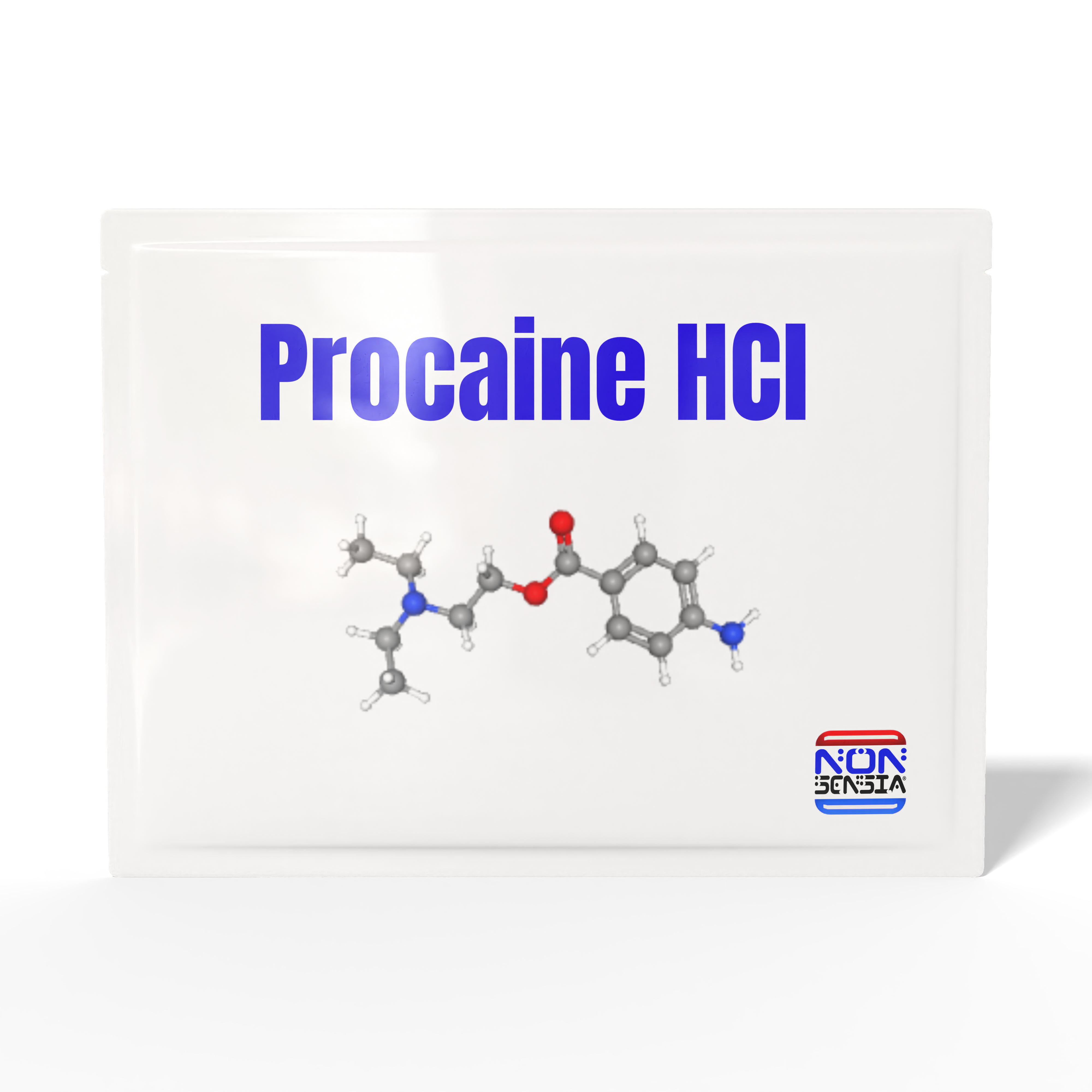
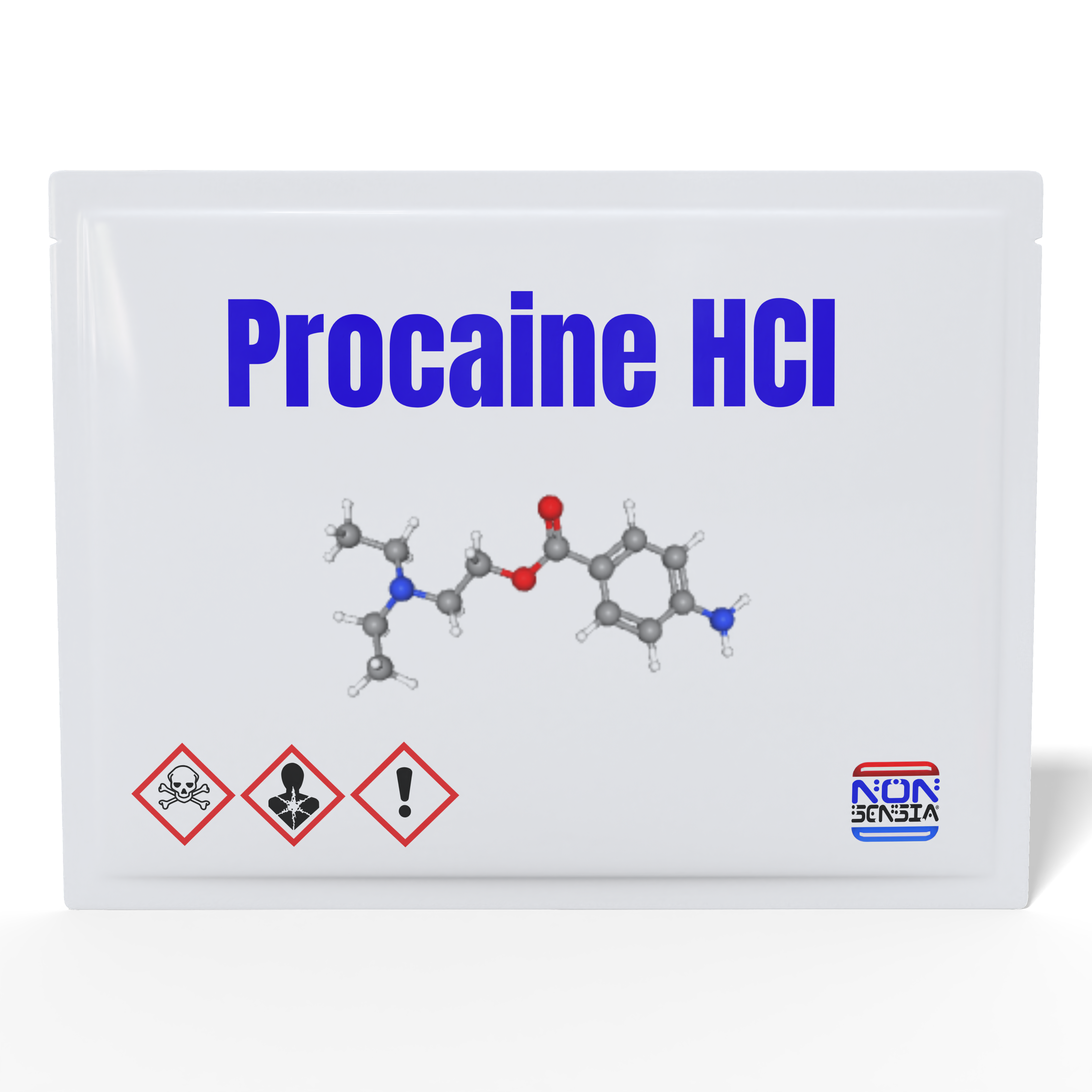
Procaine Hydrochloride ≥99% – Analytical Reference Standard, 1000 mg | CAS 51-05-8
23,13 zł
Procaine Hydrochloride Reference Standard — CAS 51-05-8, C13H21ClN2O2, 272.77 g·mol−1
Achiral aminoester salt, supplied with the counter-ion declared in the article name, for chromatographic, spectroscopic and stability method-development work. Laboratory reagent and analytical reference material only — not for human or animal consumption, and not a medicinal product, even though this molecule is the active substance of authorised veterinary medicines elsewhere.
- The salt question is answered before the vial is opened: the article is the hydrochloride, CAS 51-05-8, two covalently bonded units in the registry record. The free base is a different article at CAS 59-46-1 and 236.31 g·mol−1
- Conversion: 1000 mg of salt contains 866.3 mg of procaine base; 1000 mg of base corresponds to 1154.3 mg of salt. Crossing the two is +15.43% one way and −13.37% the other — and nothing in the chromatogram warns you
- Net quantity: as stated on the order line and on the lot documentation supplied with the material
- The core analytical problem: procaine is an ester of 4-aminobenzoic acid and hydrolyses back to it. Parent and degradant both give the acylium at m/z 120.0444 — 60.30% of base peak in the deposited spectrum — so the most tempting quantifier rises on both sides of the degradation reaction. Use 237.16 → 164.07 and 237.16 → 100.11 instead; both need the ester bond intact
- A second, purely instrumental overlap: the carbon-13 isotopologue of protonated procainamide sits 0.0193 Da from protonated procaine, needing a resolving power near 12,300. A unit-resolution quadrupole cannot separate them at the precursor stage
- Stereochemistry: 0 defined atom, 0 undefined atom, 0 defined bond, 0 undefined bond — verbatim, in both registry records. The molecule is achiral, so any quoted optical rotation, enantiomeric excess or R/S designation for procaine is disprovable in one lookup
- No hydrate of the salt exists in the registry; a dihydrate of the free base does, melting at 51 °C against 153–156 °C for this material
- Data gaps, measured: the hydrochloride record has no experimental-properties section at all — every physical constant of the salt is an annotation inside the base record. No GC-MS on the salt, no numerical UV, no carbon-13 in a solvent the salt dissolves in, no 2D NMR, no quantitative NMR, no powder diffraction. The ATR-infrared and Raman spectra come from a single lot of a single supplier
- Source conflicts reported, not averaged: three pKa values (8.7 / 8.05 / 9.04), three experimental logP values (2.14 / 1.92 / 1.8), and two different reference works giving 30 mL and 15 mL of alcohol per gram for the same salt
- Hazards: Danger — H301 (99.4%), H317 (87.3%), H319 (24.7%), H360 Repr. 1A (22.8%), H370 (22.8%), aggregated from 158 reports across 11 notifications. The free base carries only Warning and H302, from one company and one notification — the same molecule, classified twice
- Regulatory: not on the 2026 Prohibited List, not scheduled in Poland or the United States (each measured with positive controls that fire); four Polish authorisations, all veterinary, all in combination with adrenaline
Kilogram-scale orders come with a batch Certificate of Analysis, and section 14 names what it does not cover. Full registry data for salt and base side by side, the conversion arithmetic in full, the fragment analysis behind the two selective transitions, spectral coverage and its gaps, solid-state knowledge sorted by what is measured and what is merely assumed, the hazard position with notifier counts, regulatory status across five jurisdictions, and 37 cited sources are set out below.
Out of stock
This standard is currently unavailable. Related analytical reference standards in stock:
Quick Payment
100% New
Fast Delivery
- Additional Information
Product classification — read before ordering. This item is a chemical reagent and analytical reference material. It is not a medicinal product, dietary supplement, food, feed, novel food or cosmetic, and it is not intended for human or animal consumption or for any in-vivo administration whatsoever. It is supplied exclusively to laboratories, research institutions and professional users for in-vitro analytical, chromatographic and method-development work. Scientific findings summarised on this page describe substances investigated in published laboratory and clinical research; they are reported here as bibliographic facts about that literature and are not product claims, dosage guidance, or a recommendation of any use of this reagent.
The obvious stability marker for this compound is the one ion a method must not use. Read section 6 before writing one. Procaine is an ester of 4-aminobenzoic acid, and it hydrolyses back to that acid. Both the intact ester and its hydrolysis product deliver the 4-aminobenzoyl acylium at m/z 120.0444: the parent by cleaving the ester bond, the acid by losing water from its protonated molecule. The deposited product-ion spectrum for the hydrochloride shows that ion at 60.30 per cent of base peak [1], which makes it look like an excellent quantifier. It is not one. It grows on the left-hand side of the degradation reaction and grows again on the right, so a stability-indicating assay built on it measures a substance plus its own decomposition and reports the total as intact material. The transitions that survive the argument are 237.16 → 164.07 and 237.16 → 100.11, because both require the ester bond to be unbroken. Benzocaine, a different ester of the same acid, feeds the same 120.0444 as well.
Key facts
- Substance
- Procaine hydrochloride; systematically 2-(diethylamino)ethyl 4-aminobenzoate hydrochloride. Latin Procaini hydrochloridum. The article supplied is the salt, not the free base
- CAS
- 51-05-8 (hydrochloride, this product) · 59-46-1 (free base). The registry states the pairing literally:
51-05-8(HYDROCHLORIDE)and59-46-1(FREE BASE)[2] - EC number
- 200-077-2 (salt) · 200-426-9 (base) [10]
- UNII (FDA)
- 95URV01IDQ (salt) · 4Z8Y51M438 (base)
- PubChem CID
- 5795 (salt) [1] · 4914 (base) [2]
- Formula
- C13H21ClN2O2 (salt) · C13H20N2O2 (base)
- Molecular mass
- 272.77 · 236.31 g·mol−1; the difference, 36.46, is exactly M(HCl)
- Monoisotopic mass
- 272.1291556 · 236.152477885 Da [1][2]
- InChIKey
HCBIBCJNVBAKAB-UHFFFAOYSA-N(salt) ·MFDFERRIHVXMIY-UHFFFAOYSA-N(base)- Stereocentres
- 0 defined atom, 0 undefined atom, 0 defined bond, 0 undefined bond — quoted verbatim, identical in both records. The molecule is achiral
- Conversion
- 1000 mg salt = 866.3 mg base; 1000 mg base = 1154.3 mg salt. Crossing the two is a 15.43 per cent error one way and 13.37 per cent the other
- Covalent units
- 2 (salt) · 1 (base) — the registry field that answers salt or not mechanically
- Melting point
- 153–156 °C, described as six-sided plates, monoclinic or triclinic — an annotation carried inside the base record under a
/HYDROCHLORIDE/tag, because the salt record has no experimental-properties section at all (section 8) [2] - Water solubility
- 1 g dissolves in 1 mL of water. For alcohol two different reference works give 30 mL and 15 mL for 1 g — a two-fold conflict between the Merck Index and Remington’s [2]
- pKa
- Three values in circulation: 8.7, 8.05 and 9.04, from three different annotators [1][2]
- GHS (salt)
- Danger — H301 (99.4%), H317 (87.3%), H319 (24.7%), H360 (22.8%), H370 (22.8%); aggregated per 158 reports from 11 notifications [1]. The free base carries Warning and H302 from a single notification [2]
- Regulatory
- Not on the 2026 Prohibited List [12]; not scheduled in Poland [13] or under the United States Controlled Substances Act [14]; registered under REACH, dossier 18943 [10]; four Polish authorisations, all veterinary [11]
- Net quantity
- As stated on the order line and on the lot documentation supplied with the material
On this page
- What this material is
- Identity and registry codes
- The traps that live around this name
- Which mass do you divide by
- Structure and stereochemistry
- The central problem: the standard and its degradant share an ion
- Methods that resolve it, and methods that cannot
- Physicochemical data, and where the sources disagree
- Spectra: what is deposited, what is missing
- Solid form, and what is not known about it
- Hazard classification
- Regulatory status
- Handling, storage and documentation
- What we certify and what we do not
- Terms of supply
- Questions and answers
1. What this material is
This page describes procaine hydrochloride supplied as an analytical reference material: a weighed quantity of a single identified substance, intended to serve as the point of comparison against which another sample is measured. When a laboratory reports a content figure for a procaine preparation, or quantifies the compound in a biological matrix, or shows that a batch has or has not degraded, that report is only as good as the material the instrument was calibrated against. Everything downstream inherits the identity, the form and the stability of one vial.
Two things distinguish this compound from most of the catalogue, and they pull in opposite directions.
The first is that the identity question is unusually well settled. The product name carries the counter-ion, so the arithmetic problem that quietly wrecks results for many reference materials — which of the two masses do I divide by — is answered before the vial is opened. The molecule is achiral, so there is no configuration to assign, no chiral separation to develop and no enantiomeric excess to certify. No hydrated form of the salt has a registry record at all. Sections 4 and 5 set out how much of the usual work that removes; section 3 sets out the traps it does not remove.
The second is that the analytical question is unusually badly settled, and for a reason that follows from the chemistry rather than from any gap in the record. Procaine is an ester. Esters hydrolyse. The hydrolysis of this particular ester has been studied continuously since at least 1949 [20][21][22][23], its product is 4-aminobenzoic acid, and that product has been detected and quantified in real marketed preparations [25][26]. The uncomfortable part appears when the obvious modern technique is pointed at the problem: in electrospray tandem mass spectrometry, the substance and the product of its decomposition converge on the same diagnostic ion. That is the subject of section 6, and it is why this card runs long.
The literature volume is not small. A title-field search of the biomedical index returns 2,788 records for procaine, against 10,871 for lidocaine, 466 for benzocaine and 19 for bromantane, with a deliberately meaningless control string returning zero — so the instrument both fires and stays silent when it should. But the distribution is severely uneven, and the unevenness is itself the finding: of those 2,788, roughly 29 touch crystallography or polymorphism, roughly 46 touch chromatography or mass spectrometry, and roughly 95 touch stability or hydrolysis. The overwhelming remainder is mid-twentieth-century pharmacology and clinical medicine. A compound can be heavily published and still thinly characterised in exactly the dimensions a reference material is bought for. That is the position here, and it is the mirror image of the problem on the chlodantane card, where the entire world literature is two papers.
The terms on which this and every other reference material here is supplied are collected in the reference standards category.
2. Identity and registry codes
Every identifier below is quoted from a public registry, with the registry named and — more importantly for this substance — with the form named. Procaine holds two complete sets of identifiers, one for the hydrochloride and one for the free base, and a great many documents mix them.
| Identifier | Hydrochloride — this product | Free base |
|---|---|---|
| Preferred name | Procaine hydrochloride; Procaini hydrochloridum | Procaine (INN, BAN, JAN); Procainum |
| Systematic name | 2-(diethylamino)ethyl 4-aminobenzoate;hydrochloride | 2-(diethylamino)ethyl 4-aminobenzoate |
| CAS Registry Number | 51-05-8 | 59-46-1 |
| Deprecated CAS | 12663-50-2, 138481-13-7, 41585-82-4, 8023-03-8 | 91484-72-9 |
| PubChem CID | 5795 [1] | 4914 [2] |
| EC number | 200-077-2 [10] | 200-426-9 |
| UNII (FDA) | 95URV01IDQ | 4Z8Y51M438 |
| ChEBI | CHEBI:8431 | CHEBI:8430 |
| ChEMBL | CHEMBL1200841 | CHEMBL569 |
| KEGG | C07894 and D00740 | C07375 and D08422 |
| EPA DSSTox | DTXSID1044435 | DTXSID7045021 |
| NCI Thesaurus | C47688 | C61906 |
| MDL number | MFCD00013000 | MFCD00007893 |
| Therapeutic database entry | absent | DB00721 |
| Metabolite database entry | absent | HMDB0014859 |
| Nikkaji | absent | J4.603E |
| Wikidata / encyclopaedia article | absent | Q423741 / Procaine |
| International non-proprietary name | absent | PROCAINE |
| ATC codes | absent | N01BA02; also C05AD05 and S01HA05; veterinary QN01BA02, QC05AD05, QS01HA05 |
Read the bottom six rows
Six entries in the right-hand column have no counterpart on the left. The drug-facing identifiers — the therapeutic database entry, the metabolite database entry, the encyclopaedia article, the international non-proprietary name and every one of the anatomical-therapeutic-chemical codes — belong to the free base and are simply not present in the hydrochloride record. This is not an oversight in the registry; it is the registry being correct. A non-proprietary name names a substance, and the substance named is procaine. A therapeutic classification code classifies an active moiety, and the moiety is procaine.
The consequence is easy to state and easy to miss: a document that describes this article by its therapeutic code, or by the non-proprietary name alone, has stopped describing the material on the shelf and started describing the base. For a reference material that is not a pedantic distinction, because base and salt differ by 36.46 g·mol−1 and by 15.43 per cent of assay result. The arithmetic is in section 4.
Machine-readable descriptors
| Descriptor | Hydrochloride (CID 5795) | Free base (CID 4914) |
|---|---|---|
| SMILES | CCN(CC)CCOC(=O)C1=CC=C(C=C1)N.Cl | CCN(CC)CCOC(=O)C1=CC=C(C=C1)N |
| InChI | InChI=1S/C13H20N2O2.ClH/c1-3-15(4-2)9-10-17-13(16)11-5-7-12(14)8-6-11;/h5-8H,3-4,9-10,14H2,1-2H3;1H | InChI=1S/C13H20N2O2/c1-3-15(4-2)9-10-17-13(16)11-5-7-12(14)8-6-11/h5-8H,3-4,9-10,14H2,1-2H3 |
| InChIKey | HCBIBCJNVBAKAB-UHFFFAOYSA-N | MFDFERRIHVXMIY-UHFFFAOYSA-N |
| Topological polar surface area | 55.6 Å2 | 55.6 Å2 |
| Complexity | 221 | 221 |
| Rotatable bonds | 7 | 7 |
| Hydrogen-bond donors | 2 | 1 |
| Hydrogen-bond acceptors | 4 | 4 |
| Heavy atoms | 18 | 17 |
| Covalently bonded units | 2 | 1 |
| Formal charge / isotope atoms | 0 / 0 | 0 / 0 |
| XLogP3 | field absent — not computed for the salt | 1.9 |
Four rows differ and eight do not, and that asymmetry decides which fields can separate salt from base in an automated pipeline and which cannot. Topological polar surface area, complexity and rotatable-bond count are identical for the two forms. A record-matching routine keyed on any of them merges the salt and the base without comment. The fields that discriminate are the covalent-unit count, the heavy-atom count, the hydrogen-bond-donor count and the presence or absence of a computed partition coefficient — and of those four, only the covalent-unit count is unambiguous: two covalently bonded units at formal charge zero is a salt; one is a neutral molecule.
The missing partition coefficient earns its own note. The registry computes no XLogP value for the hydrochloride; the field is not empty, it is not present. Every logP figure that appears on a document about procaine hydrochloride was therefore obtained on the base, whatever the document says. The three experimental values in circulation are collected in section 8, and they disagree with one another by more than a factor of two.
3. The traps that live around this name
Because the salt question is settled, the failure modes for this substance migrate elsewhere. They are worth listing individually, because each one has a different tell and a different fix.
One word, two records
A name search of the registry does not resolve to a single substance. Querying procaine hydrochloride, procaine hcl or Procaini hydrochloridum returns the salt record; querying procaine returns the base; and querying the historical trade name novocain returns both records at once. That last result is not a defect in the search — the trade name genuinely covered a salt preparation and the substance in it — but it means the oldest and most widely recognised name for this compound is the one that discriminates least. Documents written before the modern naming conventions settled use it heavily.
No hydrate of the salt, but a dihydrate of the base
A direct query for procaine hydrochloride monohydrate returns a not-found response from the registry: no hydrated form of the hydrochloride holds a record. The negative is worth having, because hydration is the second most common way a reference material's mass gets divided by the wrong number, and here it does not apply.
What does exist is a dihydrate of the free base, melting at 51 °C and described as needles from aqueous alcohol, against 61 °C for the anhydrous base [2]. That is a different article from the one on this page in two respects at once — different ionisation state and different hydration — and its melting point sits a hundred degrees below the hydrochloride's. A melting-point check that lands near 51 or 61 rather than near 153 is not a failed test on this material; it is a correct test on something else.
Other procaine salts hold their own records
| Substance | Formula | Molecular mass | Covalent units |
|---|---|---|---|
| Procaine hydrochloride — this product | C13H21ClN2O2 | 272.77 | 2 |
| Procaine, free base | C13H20N2O2 | 236.31 | 1 |
| Procaine benzylpenicillin, monohydrate | C29H40N4O7S | 588.7 | 3 |
| Procaine borate | separate registry record | — | — |
| Procaine nitrate | separate registry record | — | — |
The third row is the one that turns up in practice. Procaine benzylpenicillin is a different active substance in which procaine appears as the counter-ion rather than as the analyte, and its record carries three covalently bonded units and three defined stereocentres — contributed entirely by the penicillin, since procaine has none. It is the reason a database search on the string procain in a medicines register returns dozens of results that have nothing to do with a local-anaesthetic assay. Section 12 shows exactly how many.
Substring collisions in registry searches
The Latin stem Procaini is a substring of Chloroprocaini and, less obviously, sits inside Oxybuprocaini. A substance-name query against the Polish medicines register for Procaini hydrochloridum returns six records, of which two are substring hits that must be discarded: one product whose active substance is chloroprocaine hydrochloride and one whose active substance is oxybuprocaine hydrochloride. Both are genuine, authorised, human medicines — and neither contains procaine. A count taken without that filter overstates the result by a third and, worse, converts a veterinary-only picture into a mixed one. Section 12 gives the filtered count and the controls that make it trustworthy.
Procainamide: one atom away, a different compound entirely
The closest structural neighbour is not another ester but an amide. Replace the ester oxygen with an N–H and procaine becomes procainamide.
| Property | Procaine (base) | Procainamide | Comment |
|---|---|---|---|
| Formula | C13H20N2O2 | C13H21N3O | O replaced by NH |
| Molecular mass | 236.31 | 235.33 | falls by 0.98 |
| Monoisotopic mass | 236.152477885 | 235.168462302 | differ by 0.98402 Da |
| Heavy atoms | 17 | 17 | identical |
| Complexity | 221 | 221 | identical |
| Rotatable bonds | 7 | 6 | differs |
| Hydrogen-bond donors | 1 | 2 | differs |
| XLogP3 | 1.9 | 0.9 | differs |
| Stereocentres | 0 / 0 / 0 / 0 | 0 / 0 / 0 / 0 | both achiral |
Two of the descriptors most often used for coarse record matching — heavy-atom count and complexity score — are numerically identical for these two substances. They are also, and this is the part with teeth, close enough in mass to interfere in a mass spectrometer that is not resolving properly. Section 6 works that arithmetic out and gives the resolving power required to separate them.
Benzocaine and the ester family
Benzocaine is the ethyl ester of the same acid: C9H11NO2, molecular mass 165.19, monoisotopic 165.078978594, a single covalently bonded unit and therefore a free base with no counter-ion at all [4]. Chloroprocaine adds a ring chlorine; tetracaine replaces the aromatic amine with a butylamino group. All of them share the 4-aminobenzoate motif, and section 6 shows what that shared motif does to a fragment-based identification.
What the traps have in common. Not one of the confusions above is a stereochemical confusion, and not one of them is a hydrate confusion. They are all connectivity and counter-ion confusions — which substance, in which ionisation state, with what attached. That is the opposite of the situation on the tadalafil card, where connectivity is never in doubt and configuration is the whole problem. Knowing which class of error a given molecule is exposed to determines which test is worth running, and running the wrong one is how a laboratory produces a clean report about the wrong thing.
4. Which mass do you divide by
For most reference materials in this catalogue this section would be a warning. Here it is closer to a statement of what has already been decided, and the contrast is instructive enough to be worth spelling out.
The arithmetic
| M(salt), C13H21ClN2O2 | 272.773 g·mol−1 |
|---|---|
| M(base), C13H20N2O2 | 236.315 g·mol−1 |
| M(HCl) | 36.458 g·mol−1 |
| Closure check | 236.315 + 36.458 = 272.773 — exact |
| Base fraction of the salt | 0.866343 |
| 1000 mg of salt contains | 866.3 mg of procaine base |
| 1000 mg of base corresponds to | 1154.3 mg of salt |
| Error from treating salt as base | +15.43 per cent |
| Error from treating base as salt | −13.37 per cent |
The two error figures are not the same number with opposite signs, and the asymmetry catches people out. A 15.43 per cent overstatement and a 13.37 per cent understatement are reciprocals of each other, not negatives. Either is more than an order of magnitude larger than the tolerance implied by a purity specification in the region of 99 per cent, and neither leaves a trace in the chromatogram: the run passes suitability, the peak shape is fine, the calibration is linear, and the answer is wrong by a fixed factor.
Why the name settles it, and what a name has to contain to settle it
The reason this does not become a problem here is entirely lexical. The product is named as the hydrochloride; the registry states the pairing in a dedicated field, literally as 51-05-8(HYDROCHLORIDE) and 59-46-1(FREE BASE) [2]; and the registry record for the article carries a covalent-unit count of two. Three independent statements of the same fact, one of them mechanical.
That is not the norm. A short survey across this catalogue makes the point better than an argument does:
| Material | Registry situation | Conversion consequence |
|---|---|---|
| Procaine hydrochloride — this product | Salt named in the article name; two covalent units in the record | 1000 mg = 866.3 mg base. Settled before opening |
| Benzocaine | Free base, one covalent unit, no salt form in ordinary supply | None — 1000 mg is 1000 mg of the ester |
| Sildenafil | Base and citrate and citrate monohydrate, three separate records at 474.6, 666.7 and 684.7 | 1000 mg citrate = 711.9 mg base — a 40 per cent question the name does not answer |
| Methylene blue | The principal record is already a chloride salt, C16H18ClN3S at 319.9 with two covalent units; a trihydrate record exists separately at 373.9 with five | 1000 mg trihydrate = 855.6 mg of the anhydrous salt |
| CDP-choline | Free form at 488.32 with one covalent unit; sodium salt at 510.31 with two | About 4.3 per cent, small enough to be mistaken for assay noise |
| L-DOPA | Zwitterionic amino acid, one covalent unit, no counter-ion | None — but it carries a stereocentre, which procaine does not |
Read the middle three rows next to the first. For sildenafil the name sildenafil is compatible with three different masses spanning 210 g·mol−1; for methylene blue the plain name already denotes a salt, so the question becomes hydration rather than ionisation; for the cytidine diphosphate ester the discrepancy is small enough to hide inside an assay tolerance, which makes it the most dangerous of the three. Procaine hydrochloride is the case where the label does the work, and that is worth paying for in a reference material even though it looks like nothing on the certificate.
The residual risk, which is not zero. The name settles what is in the vial. It does not settle how a result is expressed. A content figure reported as procaine and a content figure reported as procaine hydrochloride differ by the factor above, and both phrasings appear in method papers, in monograph titles and on certificates. When comparing two numbers for the same batch, establish which basis each was expressed on before concluding that they disagree. Roughly a seventh of an apparent discrepancy in this compound is arithmetic rather than chemistry.
5. Structure and stereochemistry
Procaine is the 2-(diethylamino)ethyl ester of 4-aminobenzoic acid: an aromatic amine at one end, an ester linkage in the middle, a tertiary aliphatic amine at the other. In the hydrochloride, the proton sits on the aliphatic nitrogen — the more basic of the two by a wide margin — and the chloride balances it.
The registry states the stereochemistry without ambiguity, and identically for both forms [1][2]:
| Field | Hydrochloride (CID 5795) | Free base (CID 4914) |
|---|---|---|
| Defined atom stereocentre count | 0 | 0 |
| Undefined atom stereocentre count | 0 | 0 |
| Defined bond stereocentre count | 0 | 0 |
| Undefined bond stereocentre count | 0 | 0 |
| Isotope atom count | 0 | 0 |
| Formal charge | 0 | 0 |
| Covalently bonded units | 2 | 1 |
| InChIKey central block | UHFFFAOYSA | UHFFFAOYSA |
Four zeros, twice over. The molecule is achiral. There is no carbon in the structure bearing four different substituents and no double bond capable of geometric isomerism; the aromatic ring is para-substituted and therefore symmetric across its long axis, and the two ethyl groups on the aliphatic nitrogen are equivalent to one another. The central block of both InChIKeys, UHFFFAOYSA, is the marker the registry uses when a structure carries neither a stereochemical nor an isotopic layer — it is the same block that appears on apigenin and on chlodantane, and for the same reason.
What achirality removes from the specification
Four items that appear routinely on reference-material documentation are inapplicable here, as a property of the molecule rather than as a gap in the data:
- Chiral separation. There is nothing to separate. A chiral column applied to this compound is an expense with no possible finding.
- Enantiomeric excess. The field should not appear on a specification for this substance. If it does, at any value including 100 per cent, the document is describing something that cannot exist.
- Specific rotation. An achiral compound in an achiral solvent rotates plane-polarised light by zero, and a polarimeter reading on this material measures the instrument, not the substance.
- Configurational stability. There is no configuration to lose, so no epimerisation pathway and no shelf-life question arising from one. Contrast the tadalafil case, where the substance can convert into its own designated impurity in storage without any change of mass.
A free credibility check, and it takes one query. Because the four stereodescriptor counts are zero in the public record, any supplier document claiming an optical purity, an enantiomeric excess, a dextrorotatory or laevorotatory form, or an R/S designation for procaine is making a claim the registry contradicts in a single lookup. This is one of the cheapest verification gates available to a purchasing laboratory, it costs nothing, and it discriminates. Where it matters that a compound does have configuration to certify, the neighbouring cards say so plainly: tadalafil has two defined centres and four separately registered stereoisomers, modafinil has one at sulfur and is supplied as the racemate, L-DOPA has one and the name itself carries the answer.
What achirality does not remove is everything in section 6. A molecule can be perfectly defined in three dimensions and still be indistinguishable from its own decomposition product by the technique most likely to be used on it.
6. The central problem: the standard and its degradant share an ion
This is the analytical fact that governs everything a laboratory does with this material, and it is worth stating in the bluntest available terms.
The reaction
Procaine is an ester, and the ester bond is the weak point. In water it hydrolyses to 4-aminobenzoic acid and 2-(diethylamino)ethanol. The mass balance closes exactly:
| Substrate, procaine base | C13H20N2O2, monoisotopic 236.1525 Da |
|---|---|
| Plus water | 18.0106 Da |
| Product 1, 4-aminobenzoic acid | C7H7NO2, monoisotopic 137.0477 Da [3] |
| Product 2, 2-(diethylamino)ethanol | C6H15NO, monoisotopic 117.1154 Da |
| Closure | 137.0477 + 117.1154 − 236.1525 = 18.0106 — exactly the mass of water |
The reaction is not a laboratory curiosity dredged up to make a page longer. It has an unbroken literature going back three-quarters of a century. Hydrolysis in aqueous buffers was characterised as a function of pH in 1949 [20]; the chemical — as distinct from enzymatic — kinetics of procaine and chloroprocaine were compared in 1951 [21]; the reaction was run in deuterium oxide in 1964, and the solvent isotope effect observed there is mechanistic evidence that a water molecule attacks the ester carbonyl directly rather than the substrate falling apart on its own [22]; and the kinetics were revisited in aqueous and micellar media in 2013 [23]. In parallel, the appearance of 4-aminobenzoic acid has been used as the marker of decomposition: a simple azo-coupling colour test with thymol was published as proof of the acid's identity as a decomposition product in 1988 [24], a zero-crossing first-derivative ultraviolet method was developed to determine it specifically as a degradation product of procaine hydrochloride in 2002 [25], and it was assayed in a real marketed solution by chromatography in 2000 [26].
Two independent enzymatic routes exist as well, and they matter to anyone working in a biological matrix: procaine is a substrate for ester hydrolysis by skin and liver preparations across species [35], and equine plasma and synovial fluid carry a procaine esterase activity vigorous enough to have been characterised in its own right [36]. In a biological sample, therefore, the reaction continues after the sample is taken.
The trap
The 4-aminobenzoyl acylium at m/z 120.0444 is produced by the intact ester and by its hydrolysis product alike. Protonated procaine cleaves at the ester bond to give it. Protonated 4-aminobenzoic acid, at 138.0550, loses water to give it. The two routes converge on the identical formula, C7H6NO+, and therefore on the identical exact mass. No mass measurement at any resolution separates them, because there is nothing to separate: it is the same ion. A method that quantifies procaine through m/z 120 rises when the substance is present and rises again as the substance disappears.
The deposited product-ion spectrum makes the temptation concrete. Fragmenting the protonated molecule at m/z 237.16 on a quadrupole time-of-flight instrument gives [1]:
| Observed m/z | Relative intensity | Assignment | Computed m/z | Selective for the intact ester? |
|---|---|---|---|---|
| 237.160675 | 100 % | [M+H]+, C13H21N2O2+ | 237.1598 | yes |
| 164.070572 | 60.56 % | loss of diethylamine, C9H10NO2+ | 164.0706 | yes |
| 120.044754 | 60.30 % | 4-aminobenzoyl acylium, C7H6NO+ | 120.0444 | no |
| 100.112190 | 38.18 % | diethylaminoethyl cation, C6H14N+ | 100.1121 | yes |
| 238.163559 | 15.66 % | first isotopologue of [M+H]+ | — | — |
The three fragment ions agree with the deposited measurement to within 0.0004 Da, and the precursor to within 0.0009 Da, which is the check that the arithmetic above is arithmetic about this compound and not about something else. The spectrum carries a hashed spectral identifier, splash10-01w0-1950000000-1f4de90a31c5658a10d3, so it can be matched exactly rather than by eye.
Read the last column. The third most intense fragment is the one that must not be used, and it is intense enough — 60 per cent of base peak — that a method developer scanning the spectrum for a strong, low-mass, low-background quantifier will land on it first. Its low mass is precisely what makes it attractive, and precisely what makes it non-selective: a small fragment carries less structural information, and this one carries only the acyl half of the molecule, which is the half the two compounds have in common.
The transitions that survive
Two fragments require the ester bond to be intact, and each fails for a different reason if it is not:
- 237.16 → 164.07. The precursor is the protonated ester; the product retains the aromatic ring, the carbonyl and the ester oxygen with the ethylene bridge, having lost diethylamine. 4-Aminobenzoic acid cannot form it, because it has no such bridge to keep.
- 237.16 → 100.11. The product is the amine half. 4-Aminobenzoic acid cannot form it either, because it has no amine half.
A stability-indicating method for this compound is therefore built on those two transitions, with m/z 120 reserved for the one job it is genuinely good at — detecting the 4-aminobenzoate class as a whole, which is useful when screening for the presence of any member of the family and useless when quantifying one of them. The mechanistic literature on why these particular bonds break the way they do sits in a study of the gas-phase decomposition pathways of aminobenzoate esters [27], which is the theoretical underpinning for treating the acylium as a class marker rather than an identity.
The consequence for what a laboratory buys. A stability-indicating method for procaine needs a calibration for the parent and a calibration for 4-aminobenzoic acid, with a response factor established between them, because the quantity of interest during a stability study is the ratio of the two and neither one alone answers the question. That is two reference materials on the bench, not one. Anyone who has ever tried to close a mass balance on an ester degradation with a single standard has discovered this the expensive way, usually at the point where the sum of parent and degradant fails to come to a hundred per cent and nobody can say which of the two figures is at fault.
A second overlap, this one purely instrumental
The acylium problem is chemical: two substances genuinely produce one ion. The following problem is different in kind — two ions are genuinely distinct and an under-resolving instrument merges them anyway.
Procainamide differs from procaine by the substitution of N–H for the ester oxygen, which lowers the monoisotopic mass by 0.98402 Da [2][5]. Work through the consequences for protonated species:
| Procaine [M+H]+ | 237.1598 |
|---|---|
| Procainamide [M+H]+ | 236.1757 |
| First 13C isotopologue of protonated procainamide | 237.1791 |
| Separation from protonated procaine | 0.0193 Da |
| Resolving power required at m/z 237 | approximately 12,300 |
A unit-resolution quadrupole, which is what most routine triple-quadrupole instruments run in the first mass-selecting stage, cannot do this. It will pass the isotope peak of procainamide into the same precursor window as procaine. Whether that matters depends on how much procainamide is present and on whether the product-ion filter downstream rejects it — and it will, because the two compounds fragment differently — but the interference is real at the precursor stage and it is invisible in the total-ion chromatogram. A time-of-flight or orbital-trapping instrument resolves the pair comfortably; the arithmetic above is the number to check against an instrument's specification rather than to assume.
The two overlaps are worth holding apart in the mind, because they call for opposite responses. The acylium overlap is not solved by better instrumentation at all — the ion is the same ion, and no resolving power in existence separates a thing from itself. The procainamide overlap is solved by better instrumentation, and by nothing else. Conflating them leads to buying the wrong solution to the wrong problem.
7. Methods that resolve it, and methods that cannot
Every method below has a published basis. Each carries the same prerequisite: a reference material of known identity and known form. None of them is self-calibrating.
Liquid chromatography with tandem mass spectrometry
The workhorse, and the one that needs the section-6 caveat attached to it in writing. Use 237.16 → 164.07 as quantifier and 237.16 → 100.11 as qualifier; do not use 120.04 for either. If the study is a stability study, run 4-aminobenzoic acid as a separate analyte with its own transitions rather than inferring its concentration from a decline in the parent, because a mass balance that is calculated rather than measured cannot detect a second degradation route.
Gas chromatography with mass spectrometry, and why the two techniques disagree
Here the record contains a structural surprise that has a physical explanation.
The hydrochloride record carries no gas-chromatographic mass spectrum at all. Its spectral tree holds one-dimensional nuclear magnetic resonance, liquid-chromatographic mass spectrometry, an ultraviolet entry, infrared and Raman — and nothing else. All five deposited electron-ionisation spectra sit on the free base record [1][2]. That is not an archival accident: an amine hydrochloride injected into a hot gas-chromatographic inlet gives up its hydrogen chloride, and what travels down the column is the base. A laboratory searching a spectral library for “procaine hydrochloride” by gas chromatography will not find it, because in the strict sense it does not exist.
The base peak in all five of those electron-ionisation spectra is m/z 86, computed at 86.0964 for the iminium ion CH2=N+Et2, followed by 99 and then 120. Compare that with the electrospray series in section 6, where the base peak is the intact protonated molecule and 86 does not feature at all. The two techniques see this molecule through entirely different fragments. A laboratory transferring a method from gas to liquid chromatography, or reconciling an old identification against a new one, is comparing two fragment sets with only m/z 120 in common — and section 6 has already disqualified that one as an identity criterion.
Retention behaviour on the gas-chromatographic side is documented as retention-index values rather than as retention times, which is the portable form: 34 values on non-polar standard phases spanning 1978 to 2049, a median of 2006, a semi-standard non-polar range of 1988.8 to 2058, and a single polar-standard value of 3250. A spread of 71 index units across nominally equivalent columns is itself an argument for anchoring retention against a standard rather than against a literature value.
Ultraviolet and derivative spectrophotometry
The compound has a strong chromophore, and the classical determination methods use it. The specific problem of measuring the degradation product in the presence of the parent — two overlapping ultraviolet absorptions — was solved by zero-crossing first-derivative spectrometry [25], a technique that exploits the fact that at the wavelength where one component's derivative crosses zero, the reading depends only on the other. It is elegant, it is cheap, and it requires both compounds in hand to locate the crossing point in the first place.
Chromatography with conventional detection
An early high-speed liquid-chromatographic determination of procaine in pharmaceutical forms was published in 1976 [28] and remains a useful historical anchor when comparing a new method against a monograph. For the degradation product specifically, the assay of 4-aminobenzoic acid formed by hydrolysis in a marketed solution [26] is the more instructive precedent, because it was performed on a real preparation rather than on a spiked laboratory sample.
Electrochemistry, and a documented reason to hold this standard even if you never assay procaine
The voltammetry of local anaesthetics has been reviewed in detail [31], and modern determinations continue: an ion-selective electrode method for procaine in pharmaceutical samples was published in 2024 [30], and a multiplexed electrochemical aptamer sensor on a nanoporous electrode reported procaine among its targets in 2026 [34]. All of them need a calibrant.
The second market, and it is not an assay market. Procaine has been shown to completely suppress the electrochemical signal of cocaine, alongside chlorpromazine, promethazine and dextromethorphan [32]. The mechanism was worked out explicitly. The practical implication for a forensic or customs laboratory using rapid voltammetric screening is severe: a negative result on such an instrument can mean the analyte is absent or it can mean a common cutting agent has silenced the electrode, and the two cases look identical on the readout. Subsequent work on reagentless voltammetric identification from complex powders [33] operates in the same space. Laboratories in this position hold a procaine standard not in order to measure procaine but in order to know what their instrument does when procaine is present — which is a use case for a reference material that no assay method paper will ever mention.
The cheap screen that still works
For laboratories without chromatography, the azo-coupling reaction of the liberated aromatic amine with thymol produces a coloured product and was published specifically as proof of 4-aminobenzoic acid as a decomposition product of procaine [24]. It is a qualitative test, it is a century-old chemistry, and it costs almost nothing. As a batch-triage screen — has this material begun to hydrolyse at all — it answers the question that matters before any instrument is switched on.
Infrared, and the assignment the record does not carry
The hydrochloride has deposited infrared and Raman spectra (section 9) but no band assignments. Those were published separately, in a comparative computational study of the protonated procaine structures that interpreted the spectra of the hydrochloride specifically [29]. This is a small point with a large practical consequence: having a spectrum and knowing which band is which are different states, and for this salt the second requires going outside the registry record.
8. Physicochemical data, and where the sources disagree
This section starts with a structural fact about the record itself, because it explains the shape of everything that follows.
The hydrochloride record has no experimental-properties section. Not an empty one — the section does not exist anywhere in the record's structure, which was established by walking the section tree rather than by searching for a string. Every physical constant of the hydrochloride is carried as an annotation inside the free-base record, tagged with the suffix /HYDROCHLORIDE/ [1][2]. Anyone who queries the salt's registry entry mechanically — which is what a data pipeline does — receives a record with no melting point, no solubility, no pKa and no refractive index. That vacuum is a structural feature of the public record for this substance, and it is precisely the kind of vacuum into which unsourced numbers get written.
| Property | Value | Attribution and status |
|---|---|---|
| Melting point | 153–156 °C | Annotation tagged /HYDROCHLORIDE/; verbatim: Crystals. Six-sided plates, monoclinic or triclinic |
| Physical description | White crystalline powder | Annotation tagged /HYDROCHLORIDE/ |
| Odour | Odourless | Annotation tagged /HYDROCHLORIDE/ |
| Water solubility | 1 g in 1 mL | Annotation tagged /HYDROCHLORIDE/ |
| Solubility in alcohol | 1 g in 30 mL in one entry; 1 g in 15 mL in another | Two different reference works — 30 mL from the Merck Index (1996), 15 mL from Remington’s Pharmaceutical Sciences (1975); reported rather than resolved |
| Solubility, other solvents | Slightly soluble in chloroform; practically insoluble in ether | Annotation tagged /HYDROCHLORIDE/, qualitative |
| pH of a 0.1 M solution | 6.0; aqueous solution acid to litmus | Annotation tagged /HYDROCHLORIDE/ |
| pKa | 8.7 | Annotation tagged /HYDROCHLORIDE/ |
| Refractive index | 1.5611 at 25 °C, sodium D line | Annotation tagged /HYDROCHLORIDE/ |
| Air stability | Stable in air | Annotation tagged /HYDROCHLORIDE/, qualitative |
| Thermal decomposition | Emits toxic fumes of nitrogen oxides on heating to decomposition | Registry annotation |
| Property | Value | Attribution |
|---|---|---|
| Melting point, anhydrous base | 61 °C | Three independent annotators in agreement |
| Melting point, base dihydrate | 51 °C, needles from aqueous alcohol | Single annotation; a different article from either the base or the salt |
| Crystal description, base | Anhydrous plates, tables from ligroin or ether | Single annotation |
| Water solubility, base | 9450 mg·L−1 at 30 °C in one source; 6.81 g·L−1 in another, without stated temperature | Two sources, roughly 39 per cent apart |
| Partition coefficient, base | logP 2.14; log Kow 1.92; logP 1.8 | Three experimental values from three annotators; not averaged |
| Computed partition coefficient | XLogP3 = 1.9 | Computed for the base only; the field is absent for the salt |
| pKa, base | 8.05 at 15 °C, conjugate acid; 9.04, basic pKa | Two further values from two annotators |
| Ultraviolet maxima | 221 nm (log ε 3.90) and 290 nm (log ε 4.23), in water | Annotation without a form suffix; we do not assign it to the salt |
| Collision cross-section, [M+H]+ | 155.9 and 157.1 Å2 by drift tube in nitrogen; 153.99, 154.6 and 154.7 Å2 by travelling wave | Two techniques, roughly 2 per cent apart |
| Collision cross-section, adducts | 157.12 Å2 [M+Na]+; 158.45 Å2 [M+K]+; 149.62 Å2 [M+H−H2O]+ | Deposited values |
Three pKa values, and why the spread is not a rounding problem
The record carries 8.7 tagged to the hydrochloride, 8.05 at 15 °C described as the conjugate-acid value, and 9.04 described as a basic pKa. The extremes are almost a full unit apart. For a compound whose aqueous behaviour is entirely governed by the protonation state of one aliphatic nitrogen, that unit determines the ionised fraction at working pH: at pH 7.4 the three values imply roughly 95, 82 and 98 per cent protonation respectively. Anyone selecting a mobile-phase pH, calculating a distribution ratio or predicting retention should use one of the three deliberately and record which, rather than adopting whichever value the first search returns. We report all three with attribution and do not resolve them, because the sources describe them under different conditions and the conditions are not fully stated.
Three partition coefficients, same treatment
Experimental values of 2.14, 1.92 and 1.8 span a factor of about 2.2 in the underlying ratio. The computed value, 1.9, sits in the middle, which is reassuring about the computation and says nothing about which measurement is right. All four describe the base; none describes the hydrochloride, for which no such value is computed at all.
What is absent from both records, stated as a finding rather than a gap
Neither record carries a density, a boiling point, a flash point, a vapour pressure, a Henry's law constant, a viscosity, an autoignition temperature or a powder diffraction pattern. The absence of a boiling point is not an oversight: an ammonium salt of this kind decomposes before it boils, which is consistent with the thermal-decomposition annotation above. The absence of a density is more ordinary neglect — nobody measured it, or nobody deposited it. A crystallographic reference declares fields for space group, unit cell, density and nuclear quadrupole resonance for this compound, but serves the field headings without values behind a paid barrier, so the numbers are known to exist somewhere and are not available here. Values for these properties appearing on commercial listings are not registry values, and where they carry no attribution they should be treated as unsourced until an attribution is produced.
One further absence deserves separating out, because it is a case where we deliberately did not claim a zero. A hygroscopicity annotation exists in the record without a form suffix. It could describe the base, the salt or both. We have not assigned it to the hydrochloride, and the handling guidance in section 13 treats moisture as a matter to control for a reason drawn from section 6 rather than from that annotation.
9. Spectra: what is deposited, what is missing
Spectroscopic coverage for the hydrochloride is real but narrower than the compound's age and prominence would suggest, and the pattern of the gaps is not random.
| Technique | Present | Provenance |
|---|---|---|
| 1H NMR | Yes | Bruker AC-300; sample from a Japanese fine-chemicals supplier; commercial spectral collection |
| 13C NMR | Yes | Sample from a German chemicals manufacturer; commercial spectral collection |
| 13C shift list with assignments | No — see below | — |
| 2D NMR (COSY, HSQC, HMBC) | No | — |
| Quantitative NMR | No | — |
| LC-MS/MS | Yes | Quadrupole time-of-flight, positive electrospray, precursor 237.16; hashed identifier deposited |
| GC-MS | No — none in the salt record | Five spectra exist, all on the free-base record |
| UV-Vis | Entry present, no numerical values | Copyright line and a thumbnail image only |
| FTIR | Yes, potassium bromide wafer | Sample from a United States manufacturer |
| ATR-IR | Yes | Forensic Spectral Research; catalogue 01713, lot 236 |
| FT-Raman | Yes | Forensic Spectral Research; same catalogue number, same lot |
| Powder X-ray diffraction | No | — |
Four observations follow, each uncomfortable in a different way.
First, the only carbon spectrum with an actual shift list describes the wrong form. A fully tabulated 13C spectrum exists — nine signals at 166.69, 150.98, 131.64, 119.91, 113.79, 62.87, 51.36, 47.89 and 12.16 ppm, recorded at 22.53 MHz — and it was recorded in deuterochloroform. Procaine hydrochloride is practically insoluble in chloroform. What that spectrum describes is therefore the free base, and it is filed with the base record accordingly. Nine signals for thirteen carbons is exactly right for this structure: the para-substituted ring contributes four aromatic environments rather than six, and the two ethyl groups on the nitrogen are equivalent, collapsing four carbons into two. The signal at 166.69 ppm is the ester carbonyl, and it is worth knowing where it sits, because an amide carbonyl in the corresponding position appears elsewhere — which makes this one line a check on the ester-versus-amide question raised in section 3.
There is no carbon spectrum of the salt in a solvent the salt dissolves in. That would mean deuterated dimethyl sulfoxide or deuterium oxide, and no such spectrum is deposited. For a laboratory that wants to confirm the protonation state spectroscopically — the aliphatic carbons shift on protonation — the reference data does not exist in the public record and has to be generated.
Second, the ultraviolet entry has no numbers in it. The salt record carries an ultraviolet-visible entry consisting of a copyright statement and a thumbnail image. The numerical maxima that circulate for this compound — 221 nm at log ε 3.90 and 290 nm at log ε 4.23 — come from an annotation on the base record without a form suffix (section 8). Given that a substantial share of published quantitative work on this compound uses ultraviolet detection, and given that the derivative method for its degradation product [25] depends on the exact shape of the absorption band, that is a gap with practical weight. A calibration built here has to take its wavelength and its absorptivity from a method paper, not from a reference record.
Third, the two vibrational spectra are not two independent confirmations. The attenuated-total-reflectance infrared spectrum and the Fourier-transform Raman spectrum were recorded on one sample, from one supplier, from one lot — catalogue 01713, lot 236, both fields deposited explicitly. Two techniques on one material tell you two things about that material; they do not tell you that a second lot would look the same. Given that vibrational spectra are the techniques most sensitive to solid form, and given that section 10 establishes we do not know whether this salt has more than one solid form, the single-lot provenance is a real limitation. The potassium-bromide infrared spectrum comes from a different supplier's sample, which helps, but potassium-bromide pressing can itself convert one solid form into another, so it is not a clean independent replicate either.
Fourth, and most consequential for a certificate: there is no quantitative NMR spectrum and no spectrum tied to a certified lot. Quantitative NMR is the technique that establishes absolute purity without a purity standard of the same compound, which is exactly the circularity a reference material has to escape. Nothing of the kind is deposited for this substance. A supplier that generates one, on the lot supplied, in a solvent the salt dissolves in, has produced data that does not currently exist anywhere in the public record.
10. Solid form, and what is not known about it
For a compound in continuous use since the first decade of the twentieth century, the solid-state record is remarkably thin, and the honest description of it requires distinguishing three different states: what is measured, what is behind a paid barrier, and what nobody appears to have looked at.
| Question | Status | Basis |
|---|---|---|
| Crystal habit and optical crystallography | Published | A dedicated crystallographic-properties paper from 1958 [16] |
| Crystal system | Described qualitatively as six-sided plates, monoclinic or triclinic | Registry annotation [2] — note that the description itself hedges between two systems |
| Space group, unit cell, crystallographic density | Declared to exist, values not available | A materials database lists the field headings for this compound and serves them without values behind a paid barrier |
| Nuclear quadrupole resonance | Declared to exist, values not available | Same source, same barrier |
| Modern structure deposition | Not established — see below | We could not query the dedicated crystallographic database |
| Polymorphism | Not established in either direction | No paper found documenting polymorphs; no paper found ruling them out |
| Powder diffraction pattern | Absent from both registry records | Section tree, both records [1][2] |
| Thermal analysis of the salt | Absent from both registry records | Section tree, both records [1][2] |
Two absences we deliberately did not claim
The row reading not established for a modern structure deposition is written that way on purpose. We did not find a contemporary single-crystal determination for this salt in the sources available to us, and the dedicated crystallographic database is not one we can query. The correct statement is that we did not find one, not that none exists, and those are different claims. Collapsing them is how a research note becomes a false assertion.
The polymorphism row is written the same way and for a stronger reason. We found no publication documenting polymorphic forms of procaine hydrochloride and no publication establishing that only one form exists. That is an absence of measurement, not a finding of monomorphism. Nothing on this page should be read as a statement that this salt has a single solid form, because nothing we measured supports one. For a compound whose two vibrational reference spectra come from a single lot (section 9), that uncertainty has a direct practical edge: a material in an undocumented second form would give a legitimately different infrared spectrum while being the same substance, and a comparison against the deposited spectra would flag it as a discrepancy.
What the counter-ion literature does establish
Where the salt-form question has been studied for this family, the answer is that the choice of counter-ion is not a formality. A comparative study of a set of procaine and procainamide derivatives examined solution and solid-state properties together and showed how they move with the counter-ion [17]. More recently, procaine has been used as the cation in ionic liquids paired with pharmaceutically active anions, with the interactions designed and analysed explicitly [18] — work that only makes sense if the pairing changes physical behaviour materially. And the crystallisation behaviour of local-anaesthetic mixtures, with and without added adjuvants, has been examined by quantitative light microscopy [19], which is the practical end of the same question: what comes out of solution, and when.
Taken together these say that the solid form of an aminoester anaesthetic salt is a variable worth controlling. What they do not do is tell you which forms this particular salt adopts, because none of them set out to answer that.
11. Hazard classification
The registry carries an aggregated hazard classification for both forms, and the most instructive thing about them is that they are different classifications for the same molecule.
| Code | Statement | Class | Share of notifiers |
|---|---|---|---|
| H301 | Toxic if swallowed | Acute Tox. 3 | 99.4 % |
| H317 | May cause an allergic skin reaction | Skin Sens. 1 | 87.3 % |
| H319 | Causes serious eye irritation | Eye Irrit. 2 | 24.7 % |
| H360 | May damage fertility or the unborn child | Repr. 1A | 22.8 % |
| H370 | Causes damage to organs | STOT SE 1 | 22.8 % |
Signal word: Danger. The precautionary codes attached to the aggregation are P203, P260, P261, P264, P264+P265, P270, P272, P280, P301+P316, P302+P352, P305+P351+P338, P308+P316, P318, P321, P330, P333+P317, P337+P317, P362+P364, P405 and P501.
The pictograms are served by the registry as images rather than as text, and we did not read them. That is stated rather than guessed, because a pictogram set inferred from hazard codes is an inference and looks identical on the page to a quotation.
How thin the basis is, quoted exactly
The record states that this aggregation is “provided per 158 reports by companies from 11 notifications”, that “10 notifications provided by 157 of 158 reports” carry hazard statement codes, and that the substance was “reported as not meeting GHS hazard criteria per 1 of 158 reports” [1]. Eleven notifications is a narrow foundation, and the percentage column is the visible consequence of that narrowness. The near-unanimous 99.4 per cent for acute oral toxicity and the 22.8 per cent for reproductive toxicity are not measurements of how toxic the substance is at those endpoints; they are counts of how many notifying companies took each view. A percentage of this kind is a tally of opinions, not a confidence interval on a toxicological finding, and it should never be read as one.
The same molecule, classified twice, inconsistently
| Hydrochloride | Free base | |
|---|---|---|
| Signal word | Danger | Warning |
| Acute toxicity, oral | H301, Acute Tox. 3 (99.4 %) | H302, Acute Tox. 4 (100 %) |
| Skin sensitisation | H317, Skin Sens. 1 (87.3 %) | not classified |
| Reproductive toxicity | H360, Repr. 1A (22.8 %) | not classified |
| Organ toxicity | H370, STOT SE 1 (22.8 %) | not classified |
| Basis | 158 reports from 11 notifications | 1 company, 1 notification |
The salt is classified one acute-toxicity category more severely than the base and carries three hazard classes the base does not. A 15 per cent difference in molecular mass between the two forms does not produce a category shift in acute toxicity, and nothing in the record argues that it should. The difference between these two classifications is a difference in who notified, not a difference in what the substance does. Eleven notifiers looked at the salt; one looked at the base. That is the whole of it.
For a laboratory the operational reading is straightforward: this material is supplied as the salt, so the salt's classification governs, and it is the harsher of the two. Treat the base's gentler entry as what it is — the opinion of a single notifier — and not as evidence that the molecule is mild.
The reproductive-toxicity entry, handled precisely
H360 with the class Repr. 1A appears at 22.8 per cent of notifiers. It is neither safe to ignore nor honest to present as settled. Two things are true at once. The entry is literal: the registry carries an explicit hazard-class field reading Repr. 1A (22.8 %), so this is not an inference drawn from the combination of H360 with the signal word Danger, which would leave the 1A-versus-1B question open. And the entry is self-classification: slightly more than a fifth of notifiers took this view and slightly less than four fifths did not. A risk assessment that omits it is incomplete; a risk assessment that presents it as an established property of the substance is overstating a supplier tally. The correct handling is to record it as a notified classification held by a minority of notifiers, and to let the institutional assessment decide what follows from that.
Whether a harmonised European classification exists
This is a question we could partly answer, and the partial answer is reported as partial.
What we measured: procaine and its hydrochloride do not appear on the authoritative list of substances carrying an Annex VI classification for carcinogenicity, mutagenicity or reproductive toxicity, as that list is reproduced in the registry records. The instrument fires when it should — the same query on formaldehyde and on acrylamide returns their Annex VI CMR entries, and it returns them at category level. For a substance carrying a notified Repr. 1A entry at 22.8 per cent, absence from the harmonised CMR list is a meaningful negative: the reproductive-toxicity classification in the table above is supplier opinion and is not harmonised law.
What we did not establish: whether a harmonised Annex VI entry exists for this substance on some non-CMR basis. The European chemicals portal now serves its substance pages as an application shell whose content arrives afterwards, so a plain retrieval returns markup and no data; and the consolidated text of the classification regulation was not retrievable in a form we could search with a working positive control. Where we cannot build a control, we do not report a zero. The defensible statement is the narrow one above, and anyone needing the full harmonised position should take it from the official inventory directly.
12. Regulatory status
Each statement in this section is a measurement against a named document, and each negative statement was made with a positive control on the same document, so that a zero can be told apart from a broken search.
Anti-doping
Procaine does not appear on the World Anti-Doping Code Prohibited List for 2026 [12]. Searching the list returns zero occurrences for procaine, prokain, novocain, benzocaine and for both CAS numbers. Those zeros carry weight because the same search of the same document returns bromantan twice, modafinil four times, meldonium twice, erythropoietin four times and cocaine four times — the instrument fires when it should. The only appearance of the phrase local anaesthetic agents in the entire document is in a note permitting adrenaline in local administration, which is a statement about adrenaline.
Do not carry that conclusion across jurisdictions. In equine sport procaine is a long-established controlled substance, and the analytical literature reflects it: a dedicated chromatographic method for procaine in equine plasma and urine was published for exactly this purpose [37], and the esterase activity of equine plasma and synovial fluid — which determines how fast the compound disappears from a sample — was characterised specifically in the horse [36]. Human anti-doping and equine regulation are different regimes with different lists, and a finding in one is not evidence about the other. This card measures the human list because that is the document it names; it makes no claim about the equine rules.
Controlled substances
Procaine is not scheduled in Poland. Searching the consolidated Polish schedules of narcotic drugs and psychotropic substances returns zero occurrences for prokain, procain, nowokain, novocain, benzokain, lidokain and for both CAS numbers, against positive controls in the same document returning 27 hits for the amphetamine stem, 57 for the morphine stem, 38 for fentanyl, 3 for ketamine, 2 for cocaine and 1 for lysergide [13].
Procaine is not a controlled substance under the United States Controlled Substances Act. The alphabetical schedule listing, retrieved directly, returns zero for procaine, novocain, chloroprocaine, lidocaine and benzocaine, with positive controls in the same document returning 25 for amphetamine, 11 for testosterone, 2 for cocaine and 2 for ketamine [14].
A note on grep counts taken from documents. The fentanyl control on that same listing returns 68 or 74 occurrences depending on how the text is extracted from the source file — whether layout is preserved or not. The document is the same and the verdict is unaffected, because a positive control only has to be non-zero. But it is a useful reminder that counts extracted from formatted documents are properties of the extraction as much as of the text, and should not be quoted as fixed constants across sessions or between people.
Medicinal product status in Poland
This is the most consequential regulatory finding on the page, and it is not the one a reader would predict.
| Product | Composition | Holder | Registration | Type |
|---|---|---|---|---|
| Polocainum Hydrochloricum 2 % cum Adrenalino 0.005 % | procaine hydrochloride 20 mg + adrenaline 0.05 mg per mL | Biowet Drwalew | 0731, code QN01BA52 | Veterinary |
| Polocainum Hydrochloricum 5 % cum Adrenalino 0.005 % | procaine hydrochloride 50 mg + adrenaline 0.05 mg per mL | Biowet Drwalew | 0732, code QN01B | Veterinary |
| Procamidor Duo | procaine hydrochloride 40 mg + adrenaline tartrate 0.036 mg per mL | Vetviva Richter | 2915, code QN01BA52 | Veterinary |
| Pronestesic | same composition and strength | FATRO | 2598, code QN01BA52 | Veterinary |
Four authorisations, all four veterinary, all four in fixed combination with adrenaline, and none of them for human use. A search of the register for procaine hydrochloride as an active substance returns six raw records, of which two are the substring collisions described in section 3 — one chloroprocaine product and one oxybuprocaine product, both genuine human medicines containing no procaine. Filtering those leaves the four above.
The zero for human products is a real zero rather than a limitation of the search, and the controls establish that. Querying the same register by product name returns 43 results for paracetamol and 48 for ibuprofen; querying by active substance returns 82 records for lidocaine hydrochloride, of which 80 are flagged as human, and 10 for articaine hydrochloride. Deliberately meaningless query strings return zero. An instrument that finds 80 human products for a neighbouring local anaesthetic and none for this one is discriminating, not blind. Where the register does hold human products containing procaine at all, it holds them as procaine benzylpenicillin — a different active substance in which procaine is the counter-ion — and there are exactly two such human entries against roughly two dozen veterinary ones.
European residue provisions
Procaine appears in the European Union table of pharmacologically active substances used in veterinary medicine, in the entry allowing its use in all species raised for the production of food, with no maximum residue limit required and no other provisions attached [15]. The row is identical in the consolidated versions dated 2024 and 2026, and the controls fire on the same document — benzylpenicillin three times, lidocaine twice, ivermectin once.
This is a residue provision addressed to manufacturers of veterinary medicines and to national residue-monitoring programmes. It confers nothing on the article described on this page and says nothing about it. It is quoted because it is part of the compound's regulatory position and because its existence explains the second analytical market for a procaine standard: residue-monitoring laboratories need a calibrant even for substances whose residues are not limited, in order to demonstrate that a method would have found them.
Chemicals regulation, pharmacopoeias and other jurisdictions
| European chemicals regulation | Registered. Status recorded as active, dossier number 18943, last updated in July 2018; EC number 200-077-2 [10] |
|---|---|
| United States pharmacopoeia | Three monographs exist and their identifiers resolve: Procaine Hydrochloride [7], Procaine Hydrochloride Injection [8] and Procaine Hydrochloride and Epinephrine Injection [9]. A registry annotation independently records the grade designation for the hydrochloride |
| European pharmacopoeia | Chemical reference substances are documented indirectly: three separate synonym entries appear in the salt record and none in the base record, naming a reference substance, an identification-and-assay reference and a system-suitability reference. The monograph number itself is not established — the issuing body's catalogue requires authentication, and we do not guess numbers |
| United States medicines regulation | Recorded as an approved active ingredient, first approval 1954, availability type recorded as discontinued, parenteral route [1] |
| New Zealand | Verbatim: does not have an individual approval but may be used under an appropriate group standard |
| Australia | Two tier I assessments published, one for environment and one for human health, filed under the systematic name of the monohydrochloride |
| Japan | Accepted-name status; entries in the Japanese pharmacopoeia listing and in the over-the-counter risk-category classifications |
| United Kingdom | Present on the veterinary medicines list, consistent with the Polish picture |
| Environmental monitoring | Present on the suspect-substance exchange lists used for environmental screening — a further market for an authenticated standard |
The regulatory picture in one sentence, and it is not what the compound's reputation suggests. In this jurisdiction procaine hydrochloride is, as an authorised medicine, a veterinary substance and nothing else — four products, every one of them in combination with adrenaline — while its residues in animals raised for food are provided for at European level without a numerical limit. None of that attaches to the material on this page, which is supplied as a laboratory reagent under the terms in section 15. An authorised medicine and an analytical reference material are two different legal articles even when the molecule is identical, and the difference determines who may supply the article, to whom, with what documentation, and for what purpose.
13. Handling, storage and documentation
The guidance below follows from the classification in section 11 and the degradation chemistry in section 6. It concerns handling of a laboratory reagent by trained personnel and nothing else.
| Personal protection | Nitrile gloves, safety glasses, laboratory coat. Weigh in a fume hood or under local exhaust. The notified classification for the salt is Danger with acute oral toxicity category 3 at near-unanimity among notifiers, and skin sensitisation at 87 per cent; the sensitisation entry is the one that argues hardest for gloves, because sensitisation is cumulative and does not announce itself on first exposure |
|---|---|
| Reproductive-toxicity entry | A notified Repr. 1A classification exists at 22.8 per cent of notifiers (section 11). It is not harmonised, and it is not negligible. Record it explicitly in the institutional risk assessment rather than resolving it silently in either direction |
| Moisture | Store dry. This is not generic caution. The principal degradation route is hydrolysis of the ester bond by water [20][21][22][23], and the solvent isotope study [22] is direct evidence that a water molecule is the attacking species. A dry solid is a much less mobile system than a damp one |
| Temperature | Ambient, in a closed container. Nothing in the registry record supports refrigeration for this salt, and a solid melting at 153–156 °C has no thermal reason to need it. Cold storage of a container subsequently opened in a warm room invites condensation, which works directly against the row above |
| Solutions | Aqueous stocks are the exposure. Hydrolysis in aqueous buffer is pH-dependent and documented across the accessible range [20], so a stock solution has a shelf life that a solid does not. Prepare fresh, record the preparation date and the buffer, and do not assume that a solution stored for a month is the concentration written on the vial |
| Light | Protect as a general precaution. We give no photostability finding, because none is on record for this salt, and we will not present prudence as a measurement |
| Incompatibilities | Strong acid or base with heat accelerates ester hydrolysis; that is ester chemistry rather than a documented property of this particular substance. On heating to decomposition the material is recorded as emitting toxic fumes of nitrogen oxides [2] |
| Waste | Halogen-containing organic chemical waste, in accordance with local regulations. Do not release to drains — the compound appears on environmental suspect lists for a reason |
| Records | Record lot number, date opened, storage conditions and, for this compound specifically, the date and buffer of every solution prepared. Given section 6, the age of a solution is more informative here than for most reagents |
| Periodic check | If the material is held long enough to matter, run the section-7 colour test or a short chromatographic check for 4-aminobenzoic acid rather than assuming stability from the certificate. A certificate states the material's condition at the moment of testing and cannot state its condition afterwards |
14. What we certify and what we do not
This section exists because the difference between a supplier's statement and a certified value is the difference a reference material is bought for. We would rather state the boundary plainly than let a page imply more than it supports.
| Claim | Status |
|---|---|
| Chemical identity: CAS, formula, masses, InChI, InChIKey, stereodescriptors, salt form | Quoted from named public registries [1][2], each identifier traceable to its source and each stated for the correct form |
| Salt-to-base conversion arithmetic in section 4 | Arithmetic, not measurement. Computed from registry formulae with the closure check shown. It tells you what a gram of pure salt would contain, not what a given lot contains |
| Fragment masses and the two selective transitions in section 6 | Computed from formulae and checked against the deposited spectrum, the three fragments agreeing to within 0.0004 Da and the precursor to within 0.0009 Da. The transitions are a method-development starting point, not a validated method |
| Regulatory statements in section 12 | Measured against named documents [11][12][13][14][15], each negative accompanied by a positive control on the same document |
| Literature summarised in sections 6, 7 and 10 | Every claim carries a citation with a resolvable identifier; all were checked for retraction or correction notices with a detector validated on a known retraction |
| Assay or purity figure for the specific lot supplied | Not certified on this page. The ≥99 % in the article name is the release specification the material is supplied against; the measured value for the lot supplied is stated on the lot documentation, not here |
| Content of 4-aminobenzoic acid | Not certified. Given section 6 this is the impurity that matters most for this compound, and we do not report a figure we have not measured. It is the first thing to ask a supplier for, including us |
| Water content | Not certified. |
| Solid form, polymorph or crystal habit | Not certified — and additionally not knowable from the public record, because whether this salt has more than one form has not been established in either direction (section 10) |
| Enantiomeric excess or optical purity | Inapplicable by construction. The molecule is achiral, all four stereodescriptor counts are zero, and the field should not appear on a specification for this substance |
| Ultraviolet absorptivity for the salt | Not asserted. No numerical ultraviolet data is deposited for the hydrochloride; the figures in circulation come from an annotation on the free-base record without a form suffix |
| Pharmacopoeial status | This material is not supplied as a pharmacopoeial reference standard. Reference substances for this compound exist and are obtainable from the issuing bodies; this is not one of those articles, and the two are not interchangeable for compendial testing |
| Monograph limits and impurity specifications | Not reproduced. Monographs exist [7][8][9], but their texts sit behind paid access and we have not read them. We will not paraphrase limits we have not seen |
| European pharmacopoeial monograph number | Not established. The issuing body's catalogue requires authentication. We report the gap rather than filling it with a plausible number |
| Harmonised European hazard classification | Partly established. Absence from the harmonised carcinogen, mutagen and reproductive-toxicant list was measured with working controls; whether a harmonised entry exists on some other basis was not established, and is reported as not established (section 11) |
15. Terms of supply
This material is supplied as a laboratory reagent and analytical reference material, for in-vitro laboratory use by qualified personnel in an appropriately equipped facility. It is not a medicinal product, not a dietary supplement, not a food, feed or cosmetic ingredient, and it is not supplied for administration to humans or animals in any form or by any route.
By ordering, the purchaser confirms that they are a professional user acquiring the material for laboratory purposes; that they will handle it in accordance with section 13 and their own institutional risk assessment; that they will not administer it to humans or animals, nor supply it to any person who intends to; and that they are responsible for compliance with all laws applicable at the destination, which for a substance that is an active pharmaceutical ingredient in the destination jurisdiction may include requirements that do not apply to ordinary reagents.
Nothing on this page is medical or veterinary advice, nor an offer of a medicinal product, nor guidance on the use of any medicine. Statements about authorised veterinary products in section 12 describe those products and their authorisations; they describe neither this article nor any use of it. The published research summarised in sections 6, 7 and 10 is reported as bibliographic fact about that literature and is not a claim about this material.
16. Questions and answers
- Is this the salt or the free base?
- The salt. The article is procaine hydrochloride, CAS 51-05-8, formula C13H21ClN2O2, molecular mass 272.77 g·mol−1. The registry record for it shows two covalently bonded units at formal charge zero, which is what a salt looks like mechanically, and the registry states the pairing explicitly as
51-05-8(HYDROCHLORIDE)against59-46-1(FREE BASE). The free base is a different article with a different CAS number, a different registry record and a mass 36.46 g·mol−1 lower. - How much procaine base does a gram of this material contain?
- 866.3 mg. The base fraction of the salt is 0.866343, computed from the two registry formulae with the closure check M(base) + M(HCl) = M(salt) shown in section 4. Running the calculation the other way, 1000 mg of base corresponds to 1154.3 mg of salt. Treating one as the other is a 15.43 per cent error in one direction and 13.37 per cent in the other, and neither leaves any trace in a chromatogram.
- Can you certify optical purity or enantiomeric excess?
- No, and the reason is not that we have not measured it. The molecule is achiral: defined atom stereocentres 0, undefined atom stereocentres 0, defined bond stereocentres 0, undefined bond stereocentres 0, quoted verbatim and identical in both registry records, with the central InChIKey block
UHFFFAOYSAin each. There is no configuration to certify, no chiral separation to develop and no rotation to measure. Any document quoting an enantiomeric excess, an optical rotation or an R/S designation for procaine is describing something that does not exist, and one registry lookup shows it. - Can I confirm identity by LC-MS/MS?
- Yes, provided the transitions are chosen deliberately. The protonated molecule at m/z 237.16 fragments to 164.07, 120.04 and 100.11 in the deposited spectrum. Use 237.16 → 164.07 and 237.16 → 100.11; both require the ester bond to be intact. Section 6 explains why the third one must not be used.
- Why can a stability-indicating method not use m/z 120?
- Because the substance and its hydrolysis product both produce it. The ion is the 4-aminobenzoyl acylium, C7H6NO+, computed at 120.0444 and observed at 120.044754. Procaine gives it by cleaving the ester bond; 4-aminobenzoic acid, the hydrolysis product, gives it by losing water from its protonated molecule at 138.0550. They are not two ions that happen to be close in mass — they are the same ion. A signal that grows both as the parent is present and as the parent disappears cannot measure how much parent is left.
- So what is m/z 120.0444 actually good for?
- Detecting the 4-aminobenzoate class as a whole. Every ester of 4-aminobenzoic acid that retains the acyl half will feed it, including benzocaine, whose protonated molecule at 166.0863 loses ethanol to reach the same 120.0444. That makes it a serviceable class screen and an unserviceable identity criterion, which is a useful distinction to have made explicitly before a method is validated rather than afterwards.
- Could procainamide interfere with a procaine measurement?
- At the precursor-selection stage on a unit-resolution instrument, yes. Procainamide is procaine with N–H in place of the ester oxygen, lighter by 0.98402 Da. Its protonated molecule sits at 236.1757 and its first carbon-13 isotopologue at 237.1791, which is 0.0193 Da from protonated procaine at 237.1598. Separating them needs a resolving power near 12,300 — comfortable for a time-of-flight or orbital-trapping analyser, impossible for a quadrupole running unit resolution. The product-ion filter downstream will reject it, because the two fragment differently, but the interference is real at the first stage and does not show in the total-ion chromatogram.
- Is there a hydrate?
- Not of the salt. A direct registry query for a monohydrate of procaine hydrochloride returns a not-found response: no hydrated form of this salt holds a record. There is a dihydrate of the free base, melting at 51 °C against 61 °C for the anhydrous base — a different article in two respects, and one whose melting point sits about a hundred degrees below the hydrochloride's 153–156 °C.
- Why does the hydrochloride's registry record have no melting point?
- Because it has no experimental-properties section at all. That was established by walking the record's section tree rather than by searching text, and the same traversal finds the section present on the free-base record. Every physical constant of the hydrochloride is carried as an annotation inside the base record, tagged
/HYDROCHLORIDE/. A pipeline that queries the salt's identifier mechanically therefore receives a record with no melting point, no solubility and no pKa — which is worth knowing before assuming that a supplier's silence on those properties reflects a supplier's negligence. - Which pKa should I use?
- Whichever one you can name, and record which. Three values circulate: 8.7 tagged to the hydrochloride, 8.05 at 15 °C described as a conjugate-acid value, and 9.04 described as a basic pKa. The extremes are nearly a full unit apart, which at pH 7.4 is the difference between about 82 and about 98 per cent protonation. We report all three with attribution and resolve none of them, because the sources state different conditions and do not state them fully.
- Why do the gas-chromatographic and liquid-chromatographic spectra look nothing alike?
- Because they are spectra of different species. In a hot gas-chromatographic inlet an amine hydrochloride gives up its hydrogen chloride and the free base travels down the column, which is why the salt's registry record carries no electron-ionisation spectrum at all while the base's record carries five. Those five have a base peak at m/z 86, the diethyl iminium ion, computed at 86.0964 — an ion that does not feature in the electrospray series, whose base peak is the intact protonated molecule. The only fragment the two techniques share is m/z 120, and section 6 has already disqualified that as an identity criterion.
- Is there a powder diffraction pattern or a modern crystal structure?
- No diffraction pattern is deposited in either registry record. For crystallography there is a dedicated 1958 paper on the crystallographic properties of this salt, and a materials database that declares fields for space group, unit cell, density and nuclear quadrupole resonance while serving the headings without values behind a paid barrier. We did not find a contemporary structure deposition, and we say we did not find one rather than that none exists, because the dedicated crystallographic database is not one we can query.
- Does this salt have polymorphs?
- Unknown, in both directions. We found no publication documenting polymorphic forms and none establishing that only one form exists. That is an absence of measurement, not a finding of a single form, and nothing on this page should be read as the latter. It matters practically, because the two vibrational reference spectra in the public record were recorded on a single lot from a single supplier, and a material in an undocumented second form would give a legitimately different infrared spectrum while being the same substance.
- Is procaine prohibited in sport?
- Not on the 2026 human Prohibited List. The search returns zero for procaine, novocain and benzocaine while the same search of the same document returns bromantan twice, modafinil four times, meldonium twice and cocaine four times — so the zero reflects the list rather than a failed search. Equine sport is a separate regime in which procaine is long established as a controlled substance, which is why a dedicated chromatographic method for equine plasma and urine exists. A finding about one regime is not evidence about the other.
- Is it a controlled substance in Poland or the United States?
- Neither. It returns zero occurrences in the consolidated Polish schedules of narcotic drugs and psychotropic substances, against controls in the same document returning 27 for the amphetamine stem, 57 for the morphine stem and 38 for fentanyl; and zero in the United States alphabetical schedule listing, against controls returning 25 for amphetamine and 11 for testosterone. Both zeros come from instruments that fire.
- Is procaine an authorised human medicine in Poland?
- As a single active substance, no. The register holds four authorisations for procaine hydrochloride, all four veterinary and all four in fixed combination with adrenaline. The zero for human products is a real zero: the same register, queried the same way, returns 82 records for lidocaine hydrochloride of which 80 are flagged human, and 43 products for paracetamol. Where the register does hold a human product containing procaine, it holds it as procaine benzylpenicillin — a different active substance in which procaine is the counter-ion. None of this changes the status of the material on this page, which is a reagent and not a medicine in any supply category.
- Is there a harmonised European hazard classification?
- Partly answered, and we say which part. Procaine does not appear on the harmonised list of substances classified for carcinogenicity, mutagenicity or reproductive toxicity, and that measurement has working controls — the same query returns the entries for formaldehyde and acrylamide. Since 22.8 per cent of notifiers self-classify this salt as Repr. 1A, that absence is meaningful: the reproductive-toxicity entry is supplier opinion, not harmonised law. Whether a harmonised entry exists on some other, non-CMR basis we did not establish, because we could not build a working control for that question, and where we cannot build a control we do not report a zero.
- Why is the salt classified more severely than the base?
- Because more companies notified it. The salt carries Danger, acute oral toxicity category 3 and three further hazard classes, aggregated from 158 reports across 11 notifications. The base carries Warning and acute oral toxicity category 4, from a single company making a single notification. A 15 per cent difference in molecular mass does not move an acute-toxicity category, and nothing in the record argues that it should. The difference is in who filed, not in what the substance does. This material is the salt, so the salt's classification governs, and it is the harsher of the two.
- Is there a single consolidated source I can read instead of this page?
- For the chemistry, yes, and it is the best single document on this compound: a 64-page monographic profile of procaine hydrochloride published in 1999, covering identity, the full spectral set, methods of determination, stability and synthesis [6]. It predates the electrospray literature in section 6 and the electroanalytical work in section 7, and it is behind paid access, but for consolidated characterisation of the salt itself nothing else in the literature is close.
- Do you supply lot documentation?
- Kilogram-scale orders come with a batch Certificate of Analysis. What it does and does not cover is set out in section 14, including the items we do not certify: solid form, water content, and — the one that matters most for this compound — the content of 4-aminobenzoic acid. We would rather name that gap than let a certificate imply a coverage it does not have.
References
Registry records
- National Center for Biotechnology Information. 2026. "PubChem Compound Summary for CID 5795, Procaine Hydrochloride." PubChem. https://pubchem.ncbi.nlm.nih.gov/compound/5795.
- National Center for Biotechnology Information. 2026. "PubChem Compound Summary for CID 4914, Procaine." PubChem. https://pubchem.ncbi.nlm.nih.gov/compound/4914.
- National Center for Biotechnology Information. 2026. "PubChem Compound Summary for CID 978, 4-Aminobenzoic Acid." PubChem. https://pubchem.ncbi.nlm.nih.gov/compound/978.
- National Center for Biotechnology Information. 2026. "PubChem Compound Summary for CID 2337, Benzocaine." PubChem. https://pubchem.ncbi.nlm.nih.gov/compound/2337.
- National Center for Biotechnology Information. 2026. "PubChem Compound Summary for CID 4913, Procainamide." PubChem. https://pubchem.ncbi.nlm.nih.gov/compound/4913.
Monographic and pharmacopoeial sources
- Florey, Klaus, ed. 1999. "Procaine Hydrochloride." In Analytical Profiles of Drug Substances and Excipients, 395–458. Academic Press. https://doi.org/10.1016/s0099-5428(08)60628-0.
- United States Pharmacopeial Convention. n.d. "Procaine Hydrochloride." USP-NF, monograph m69390. https://doi.org/10.31003/uspnf_m69390_04_01.
- United States Pharmacopeial Convention. n.d. "Procaine Hydrochloride Injection." USP-NF, monograph m69400. https://doi.org/10.31003/uspnf_m69400_04_01.
- United States Pharmacopeial Convention. n.d. "Procaine Hydrochloride and Epinephrine Injection." USP-NF, monograph m69440. https://doi.org/10.31003/uspnf_m69440_04_01.
Regulatory documents and inventories
- European Chemicals Agency. 2026. "Procaine hydrochloride — substance information, EC 200-077-2; registration dossier 18943." ECHA. https://echa.europa.eu/registration-dossier/-/registered-dossier/18943.
- Urząd Rejestracji Produktów Leczniczych, Wyrobów Medycznych i Produktów Biobójczych. 2026. "Rejestr Produktów Leczniczych — substancja czynna Procaini hydrochloridum." https://rejestry.ezdrowie.gov.pl/rpl/search/public.
- World Anti-Doping Agency. 2026. "World Anti-Doping Code International Standard: Prohibited List 2026." WADA. https://www.wada-ama.org/en/prohibited-list.
- Minister Zdrowia. 2024–2026. "Wykaz substancji psychotropowych, środków odurzających oraz nowych substancji psychoaktywnych" — consolidated text and the two subsequent amending regulations. Internetowy System Aktów Prawnych. https://isap.sejm.gov.pl/.
- United States Drug Enforcement Administration, Diversion Control Division. 2026. "Controlled Substances — Alphabetical Order." https://www.deadiversion.usdoj.gov/schedules/orangebook/c_cs_alpha.pdf.
- European Union. 2026. "Commission Regulation (EU) No 37/2010 on pharmacologically active substances and their classification regarding maximum residue limits in foodstuffs of animal origin," consolidated text of 1 January 2026. EUR-Lex. https://eur-lex.europa.eu/eli/reg/2010/37(1)/2026-01-01.
Salt form, solid state and crystallography
- Rose, H. A. 1958. "Crystallographic Properties of Procaine Hydrochloride." Acta Crystallographica 11 (4): 300–301. https://doi.org/10.1107/s0365110x58000736.
- Olivera, María Eugenia, María Veronica Ramírez Rigo, Ana Karina Chattah, Patricia Rebeca Levstein, Miria Baschini, and Ruben Hilario Manzo. 2003. "Solution and Solid State Properties of a Set of Procaine and Procainamide Derivatives." European Journal of Pharmaceutical Sciences 18 (5): 337–348. https://doi.org/10.1016/s0928-0987(03)00036-8.
- Panić, Jovana, Aleksandar Tot, Patrik Drid, Slobodan Gadžurić, and Milan Vraneš. 2021. "Design and Analysis of Interactions in Ionic Liquids Based on Procaine and Pharmaceutically Active Anions." European Journal of Pharmaceutical Sciences 166: 105966. https://doi.org/10.1016/j.ejps.2021.105966.
- Hoerner, Elisabeth, Ottokar Stundner, Anna Seisl, Heidi Fiegl, and Lukas Gasteiger. 2025. "Crystallization of Mixtures of Local Anesthetics with and without Select Adjuvants: A Semiquantitative Light Microscopy Analysis." Regional Anesthesia & Pain Medicine 50 (1): 59–64. Issue year 2025; the registration record carries an issue date of 2024, and the discrepancy is reported rather than resolved. https://doi.org/10.1136/rapm-2023-105229.
Hydrolysis: kinetics, mechanism and the degradation product
- Terp, P. 1949. "Hydrolysis of Procaine in Aqueous Buffer Solutions." Acta Pharmacologica et Toxicologica 5 (4): 353–362. https://doi.org/10.1111/j.1600-0773.1949.tb03399.x.
- Aven, Manuel, and Francis F. Foldes. 1951. "The Chemical Kinetics of Procaine and Chloroprocaine Hydrolysis." Science 114 (2956): 206–208. https://doi.org/10.1126/science.114.2956.206-b.
- Siegel, F. P., F. D. Hiter, S. V. Susina, and M. I. Blake. 1964. "Stability of Procaine in Deuterium Oxide." Journal of Pharmaceutical Sciences 53 (8): 978–979. https://doi.org/10.1002/jps.2600530838.
- Al-Blewi, Fawzia Faleh, Hamad A. Al-Lohedan, M. Z. A. Rafiquee, and Zuheir A. Issa. 2013. "Kinetics of Hydrolysis of Procaine in Aqueous and Micellar Media." International Journal of Chemical Kinetics 45 (1): 1–9. Issue year 2013; the registration record carries an issue date of 2012, and the discrepancy is reported rather than resolved. https://doi.org/10.1002/kin.20735.
- Büsing, Gerhard, and Hartmut Grigat. 1988. "The Azo Dye from 4-Aminobenzoic Acid and Thymol — Proof of 4-Aminobenzoic Acid as a Decomposition Product of Procaine." Archiv der Pharmazie 321 (7): 433. https://doi.org/10.1002/ardp.19883210716.
- Badea, Irinel, Dana Moja, and Luminita Vladescu. 2002. "Determination of para-Aminobenzoic Acid, a Degradation Product of Procaine Hydrochloride, by Zero-Crossing First-Derivative Spectrometry." Analytical and Bioanalytical Chemistry 374 (1): 51–53. https://doi.org/10.1007/s00216-002-1446-0.
- Galais, Ph., C. Dauphin, D. Pradeau, and A. Chevallier. 2000. "Assay of para-Aminobenzoic Acid Formed by Hydrolysis of Procaine in CP1B Solution." Chromatographia 52 (1–2): 115–119. https://doi.org/10.1007/bf02490804.
Fragmentation, chromatography and electroanalysis
- Xia, Hanxue, Yong Zhang, Julius Pavlov, Freneil B. Jariwala, and Athula B. Attygalle. 2016. "Competitive Homolytic and Heterolytic Decomposition Pathways of Gas-Phase Negative Ions Generated from Aminobenzoate Esters." Journal of Mass Spectrometry 51 (3): 245–253. https://doi.org/10.1002/jms.3740.
- Khalil, S. K. Wahba, and W. H. Shelver. 1976. "High-Speed Liquid Chromatographic Determination of Procaine in Pharmaceuticals." Journal of Pharmaceutical Sciences 65 (4): 606–608. https://doi.org/10.1002/jps.2600650434.
- Palafox, M. Alcolea. 1992. "A Comparative Study of the Procaine–H+ Structures. Interpretation of the Procaine Hydrochloride Spectra by AM1." Journal of Molecular Structure: THEOCHEM 262: 7–20. https://doi.org/10.1016/0166-1280(92)85094-2.
- Özbek, Oguz, and Onur Cem Altunoluk. 2024. "Potentiometric Determination of the Local Anesthetic Procaine in Pharmaceutical Samples." Analytical Biochemistry 695: 115657. https://doi.org/10.1016/j.ab.2024.115657.
- Pysarevska, Solomiya, Serhiy Plotycya, and Liliya Dubenska. 2021. "Voltammetry of Local Anesthetics: Theoretical and Practical Aspects." Critical Reviews in Analytical Chemistry 51 (4): 339–352. Issue year 2021; the registration record carries an issue date of 2020. https://doi.org/10.1080/10408347.2020.1729691.
- de Jong, Mats, Nick Sleegers, Anca Florea, Joren Van Loon, Alexander L. N. van Nuijs, Nele Samyn, and Karolien De Wael. 2019. "Unraveling the Mechanisms behind the Complete Suppression of Cocaine Electrochemical Signals by Chlorpromazine, Promethazine, Procaine, and Dextromethorphan." Analytical Chemistry 91 (24): 15453–15460. https://doi.org/10.1021/acs.analchem.9b03128.
- Vannoy, Kathryn J., Lynn E. Krushinski, Edgar F. Kong, and Jeffrey E. Dick. 2022. "Reagentless Voltammetric Identification of Cocaine from Complex Powders." Analytical Chemistry 94 (37): 12638–12644. https://doi.org/10.1021/acs.analchem.2c01630.
- Xie, Yu, Jinhao Lai, Xi Yan, and Kalle Salminen. 2026. "Multiplexed Electrochemical Aptasensor on a Nanoporous Electrode: Towards Sensitive and Anti-Fouling Detection of Procaine, ATP and Adenosine in Biofluids." Talanta 308: 129876. https://doi.org/10.1016/j.talanta.2026.129876.
Enzymatic hydrolysis and the equine context
- Jewell, Christopher, Chrisita Ackermann, N. Ann Payne, Gwendolyn Fate, Richard Voorman, and Faith M. Williams. 2007. "Specificity of Procaine and Ester Hydrolysis by Human, Minipig, and Rat Skin and Liver." Drug Metabolism and Disposition 35 (11): 2015–2022. https://doi.org/10.1124/dmd.107.015727.
- Tobin, T., J. W. Blake, C. Y. Tai, L. Sturma, and S. Arnett. 1976. "Pharmacology of Procaine in the Horse: Procaine Esterase Properties of Equine Plasma and Synovial Fluid." American Journal of Veterinary Research 37 (10): 1165–1170. https://doi.org/10.2460/ajvr.1976.37.10.1165.
- Stevenson, A. J., M. P. Weber, F. Todi, M. Mendonca, J. D. Fenwick, L. Young, et al. 1992. "Determination of Procaine in Equine Plasma and Urine by High-Performance Liquid Chromatography." Journal of Analytical Toxicology 16 (2): 93–96. Twelve authors; the first six are named. https://doi.org/10.1093/jat/16.2.93.