Product classification — read before ordering. This item is a chemical reagent and analytical reference material. It is not a medicinal product, dietary supplement, food, feed, novel food or cosmetic, and it is not intended for human or animal consumption or for any in-vivo administration whatsoever. It is supplied exclusively to laboratories, research institutions and professional users for in-vitro analytical, chromatographic and method-development work. Scientific findings summarised on this page describe substances investigated in published laboratory research; they are reported here as bibliographic facts about that literature and are not product claims, dosage guidance, or a recommendation of any use of this reagent.
This substance has almost no public reference data. Read sections 5 and 14 before ordering. There is no deposited spectrum of any kind for chlodantane — no 1H NMR, no 13C NMR, no mass spectrum, no infrared, no Raman, no ultraviolet [1]. There are no experimental physical properties: no melting point, no solubility, no measured partition coefficient, no density [1]. There is no entry in the European chemicals inventory at all, and therefore no hazard classification, harmonised or self-declared [4]. The entire world literature describing this compound amounts to two publications [10][11]. We are telling you this before you order rather than after, because it changes what a reference standard can do for you here: it cannot confirm your material against a library, because no library exists. Section 6 sets out what it can do instead.
Key facts
- Substance
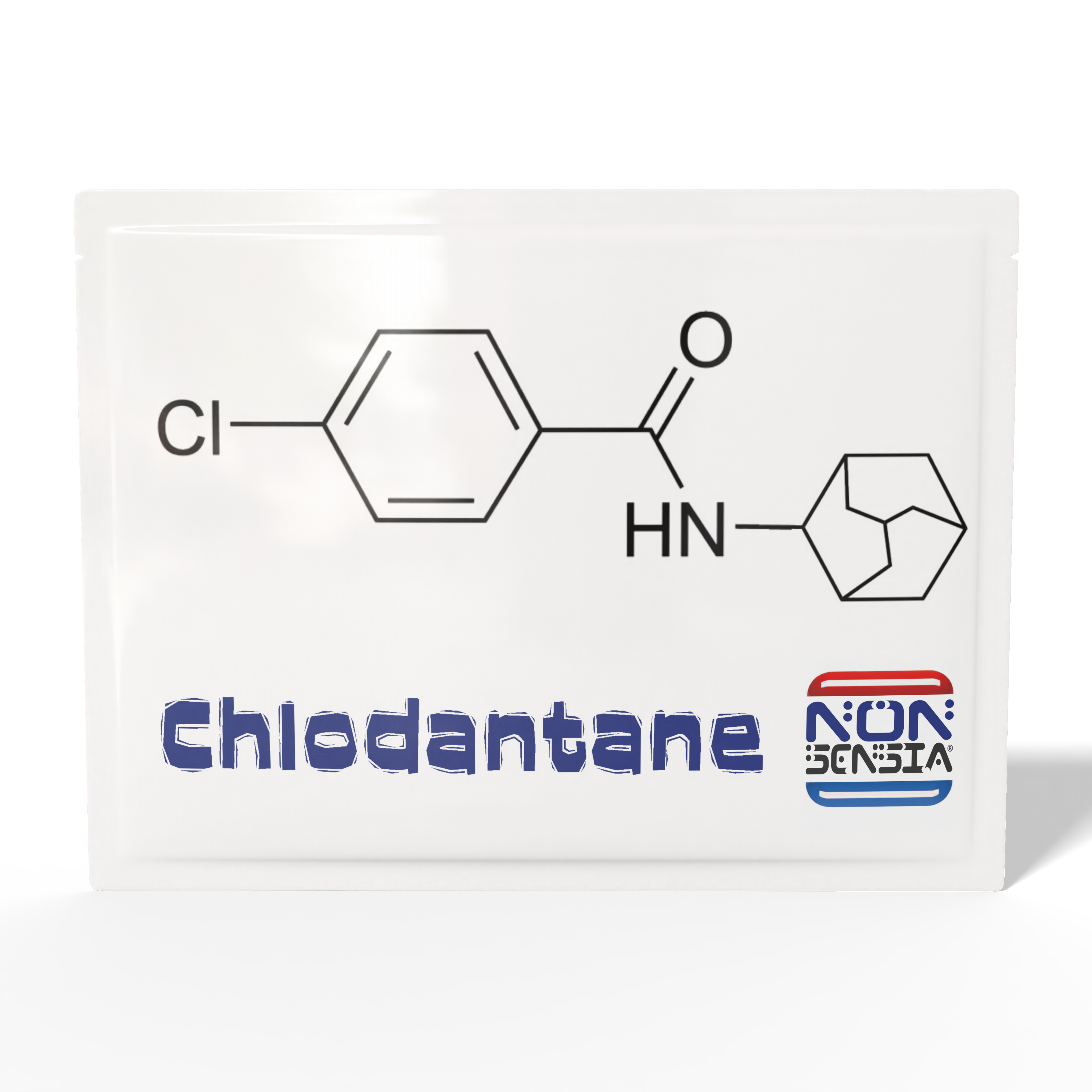
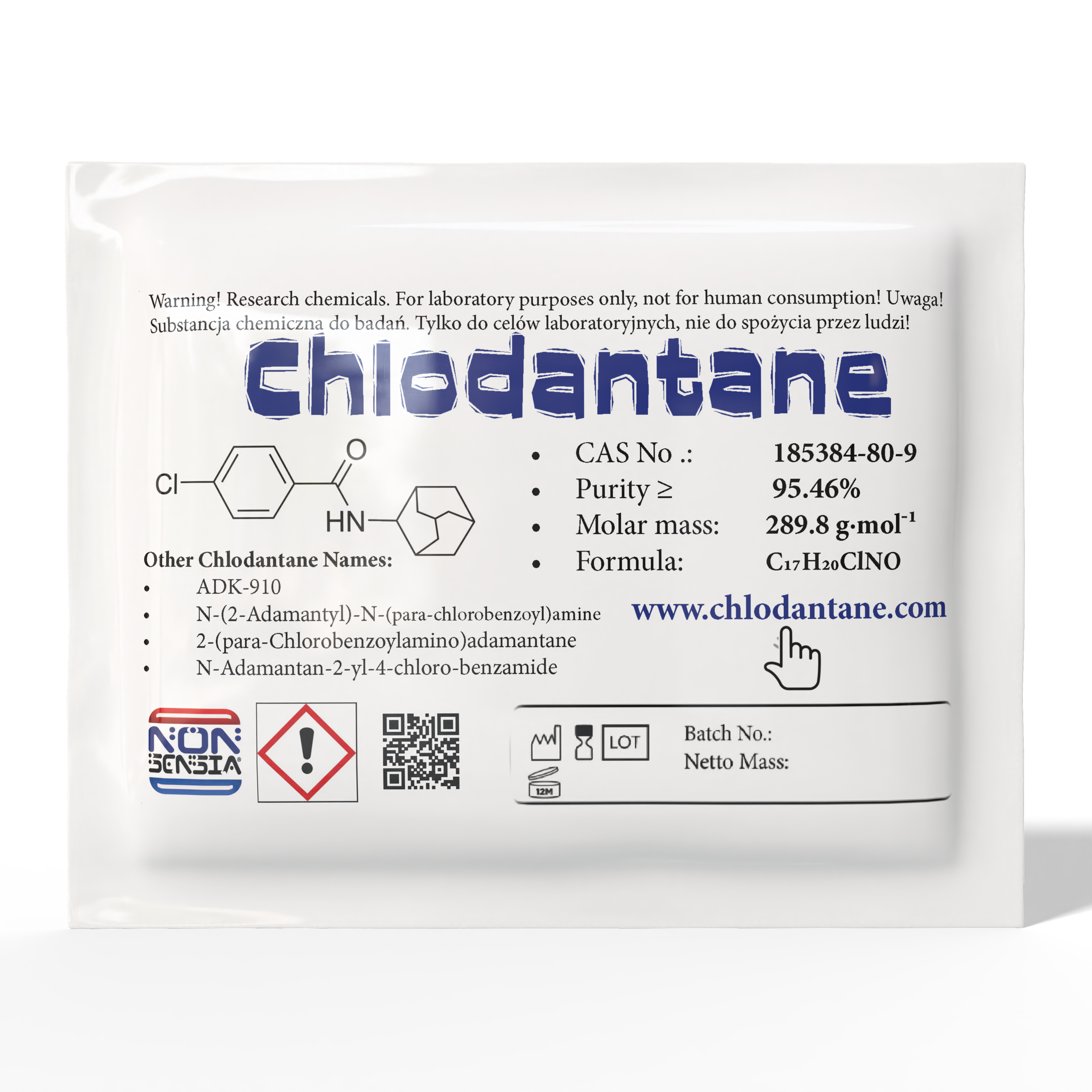
- Chlodantane (хлодантан); systematically N-(2-adamantyl)-4-chlorobenzamide
- CAS
- 185384-80-9
- PubChem CID
- 959689 [1]
- DSSTox
- DTXSID201376531 [5]
- EC number
- None — no entry in the European inventory [4]
- UNII / ChEMBL / ChEBI / DrugBank / KEGG / ATC / INN
- None of these exist for this substance
- Formula
- C17H20ClNO
- Molecular mass
- 289.80 g·mol−1
- Monoisotopic mass
- 289.1233420 Da
- InChIKey
VOHIYJJUKAUCCU-UHFFFAOYSA-N- Stereocentres
- None — achiral (see section 7)
- Bridge
- Amide, NH–C(=O)–Ar — not the aryl amine its nickname implies
- Computed logP
- XLogP3-AA 4.2; TPSA 29.1 Å2 (computed, not measured)
- Deposited spectra
- None of any kind [1]
- GHS classification
- None exists — see section 12 for what to do about that
- WADA 2026
- Not listed by name; read the caveat in section 11 [7]
- Pack sizes
- Eight, from 1 g to 500 g
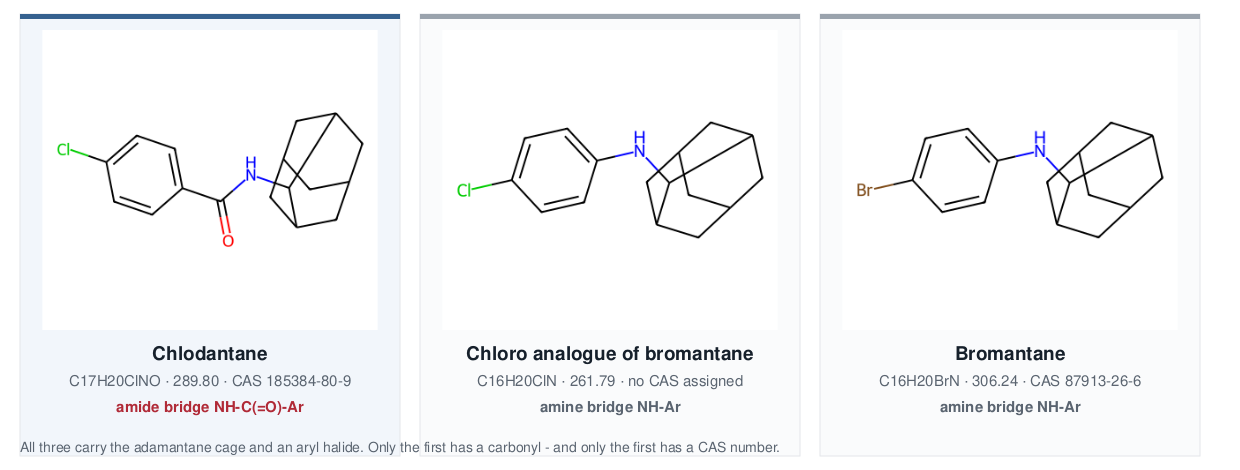
Three compounds that circulate under overlapping names. Only the first has a carbonyl, and only the first has a CAS number. Section 4 explains why this picture is the most useful thing on the page.
On this page
- What this material is
- Identity, and a register of what does not exist
- The name promises an amine; the molecule is an amide
- Three compounds, one name
- The empty shelf: measuring an absence properly
- What a standard is for when there is no library
- Structure and stereochemistry
- Computed descriptors, and what may not be inferred from them
- An analytical strategy against two look-alikes
- What the literature actually says
- Regulatory status
- Hazard: no classification exists
- Handling and storage
- What we certify and what we do not
- Terms of supply
- Questions and answers
1. What this material is
This page describes chlodantane supplied as an analytical reference material: a weighed quantity of a single identified substance, intended to serve as the point of comparison against which another sample is measured.
For most substances in this catalogue, that sentence is unremarkable. Here it is the whole problem. A reference material normally lets you confirm an unknown against something established — a deposited spectrum, a published retention time, a monograph limit. For this compound none of that exists. The public record contains a structure, a formula, a mass and a handful of computed descriptors, and after that it stops. That is not a gap in our research; it is the measured state of the record, and section 5 sets out exactly how it was measured and how we know the measurement is real rather than an artefact of looking in the wrong place.
Chlodantane belongs to a series of adamantane derivatives developed in Russia in the 1990s and investigated as actoprotectors and adaptogens — compounds studied for resistance to physical stressors [10][12]. Its better-known sibling, bromantane, reached the market as a medicine and, separately, the anti-doping literature [22]. Chlodantane did not. A 2012 review states plainly that it was halted at the clinical stage and never marketed [11], and that every pharmacological finding about it comes from animal or cell-culture work. No human study of this compound has been published.
That fact deserves emphasis, because side-effect lists and medical advice do circulate for this substance in commercial listings. They describe a body of human evidence that does not exist.
The terms on which this and every other reference material here is supplied are collected in the reference standards category. Chlodantane is the thinnest-documented entry in it, and this page is longer than most precisely because so little of the usual material exists to point at.
2. Identity, and a register of what does not exist
The convention on the rest of this site is a table of registry identifiers. Here the more informative table is the one listing which registries hold nothing. Both are given, because the second is the substance's most important characteristic.
| Systematic name | N-(2-adamantyl)-4-chlorobenzamide |
|---|---|
| Registry title | Chlodantane [1] |
| CAS Registry Number | 185384-80-9 |
| PubChem CID | 959689 [1] |
| EPA DSSTox | DTXSID201376531 [5] |
| Wikidata | Q129906140 [6] |
| Development code | ADK-910 — from the review literature [11], not from any chemical database |
| Alternative literature name | 2-(para-chlorobenzoylamino)adamantane [10] |
| Transliteration variant | Chlodantan |
| InChI | InChI=1S/C17H20ClNO/c18-15-3-1-12(2-4-15)17(20)19-16-13-6-10-5-11(8-13)9-14(16)7-10/h1-4,10-11,13-14,16H,5-9H2,(H,19,20) |
| InChIKey | VOHIYJJUKAUCCU-UHFFFAOYSA-N |
| SMILES | C1C2CC3CC1CC(C2)C3NC(=O)C4=CC=C(C=C4)Cl |
| Registry | Result | Control on the same instrument |
|---|---|---|
| EC number / European inventory | No record [4] | Formaldehyde returns EC 200-001-8; bromantane returns EC 687-739-8 [2][4] |
| UNII (FDA substance registration) | None | Bromantane has UNII N1ILS53XWK [2] |
| ChEMBL | None | Bromantane has CHEMBL4303520 [2] |
| ChEBI, DrugBank, KEGG, HMDB, NCI Thesaurus | None | — |
| Nikkaji (Japan chemical dictionary) | None | Bromantane has an entry [2] |
| MDL number | None | Bromantane has MFCD02101627 [2] |
| ATC code / INN | None — never marketed [11] | — |
| Experimental physical properties | Section absent from the record [1] | Bromantane's record has the section populated [2] |
| Deposited spectra, any technique | Section absent from the record [1] | Bromantane's record has spectral information [2] |
| GHS hazard classification | Section absent from the record [1] | Bromantane's record has GHS classification [2] |
| United States regulatory annotations | Section absent from the record [1] | Amphetamine's record carries schedule information |
The third column is not decoration. A search that returns nothing looks identical to a search that was never really run, and the difference between the two is the difference between a finding and an error. Every absence in the middle column was established by running the same query against a substance known to be present and confirming that it came back populated. Where that control did not fire, we say so instead of claiming a zero.
3. The name promises an amine; the molecule is an amide
Chlodantane is habitually described as the chloro analogue of bromantane. That phrase suggests a halogen swap on an otherwise identical skeleton: replace bromine with chlorine, change the mass, keep everything else. It is not what happened.
Bromantane is N-(2-adamantyl)-4-bromoaniline: the adamantane cage is bonded to nitrogen, and the nitrogen is bonded directly to the aromatic ring. An aryl amine. Chlodantane is N-(2-adamantyl)-4-chlorobenzamide: between the nitrogen and the ring there is a carbonyl group. An amide. A carbon and an oxygen have been inserted into the bridge, and that is a different functional group with different chemistry, not a substituent change. Functionally, the bridge in chlodantane is the same class of linkage found in modafinil — an amide — rather than the aniline-type nitrogen of bromantane.
| Property | Bromantane [2] | Chlodantane [1] | Direction |
|---|---|---|---|
| Formula | C16H20BrN | C17H20ClNO | +C, +O, Br→Cl |
| Molecular mass | 306.24 | 289.80 | falls by 16.4 |
| Bridge | aryl amine, NH–Ar | amide, NH–C(=O)–Ar | different functional group |
| Topological polar surface area | 12.0 Å2 | 29.1 Å2 | more than doubles |
| Computed logP (XLogP3-AA) | 5.0 | 4.2 | falls |
| Heavy atoms | 18 | 20 | rises |
| Complexity | 280 | 360 | rises |
| Hydrogen-bond acceptors | 0 | 1 (carbonyl oxygen) | appears |
| Halogen isotope pattern | M : M+2 ≈ 1 : 1 | M : M+2 ≈ 3 : 1 | different |
Read the direction column. Almost every entry moves against the intuition carried by the phrase same compound, lighter halogen. The mass goes down rather than up, despite an extra carbon and an extra oxygen, because chlorine is 45 Da lighter than bromine and that dominates. The polar surface area more than doubles, because an amide carbonyl is a hydrogen-bond acceptor and an aniline nitrogen in this arrangement is not. Lipophilicity falls rather than rising.
Why this matters for a method rather than for a textbook. A chromatographic method tuned for bromantane assumes a very lipophilic, weakly polar analyte: heavy retention on a C18 phase, a high organic fraction to elute it, and essentially no leverage from pH because there is no meaningfully ionisable group. Chlodantane is less lipophilic, more polar, and carries an amide NH whose hydrogen-bonding behaviour differs from an anilinic NH. It will not elute where the bromantane method puts it, and a method transferred without re-optimisation will not simply shift the peak — it can change the peak shape and the resolution from neighbouring components. This is the practical content of the sentence it is an amide, not an amine.
4. Three compounds, one name
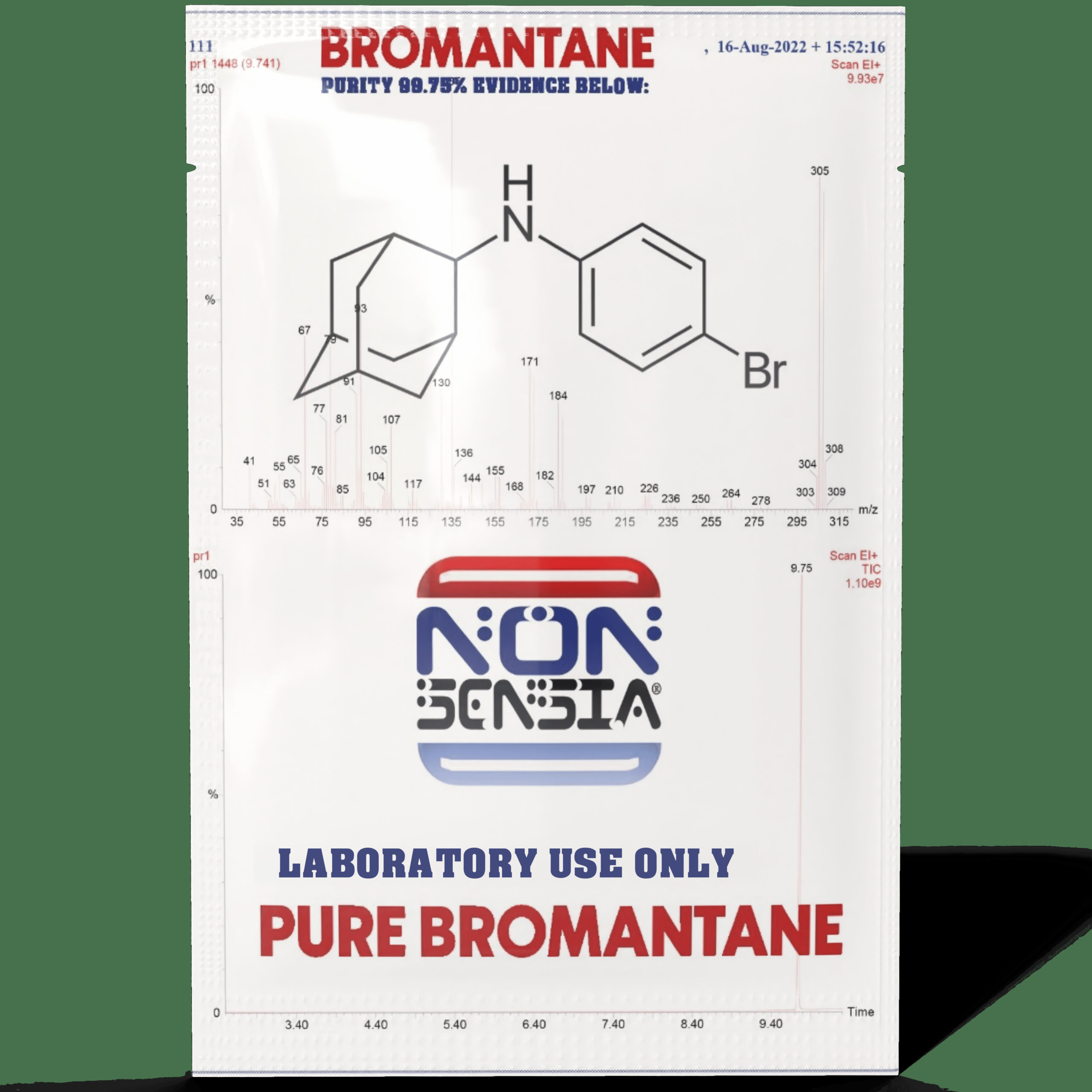
The figure at the top of this page shows three molecules. All three carry an adamantane cage joined through nitrogen to a para-halogenated benzene ring. In catalogues, forum posts and supplier listings they are not reliably distinguished, and two of them are routinely described by the same phrase: the chloro analogue of bromantane.
| Chlodantane | Chloro analogue of bromantane | Bromantane | |
|---|---|---|---|
| Formula | C17H20ClNO | C16H20ClN | C16H20BrN |
| Molecular mass | 289.80 | 261.79 | 306.24 |
| Bridge | amide | amine | amine |
| CAS | 185384-80-9 | none assigned | 87913-26-6 |
| Registry record | CID 959689 [1] | CID 15323874 [3] | CID 4660557 [2] |
| InChIKey | VOHIYJJUKAUCCU- | VIBPXDGVCYSTCI- | LWJALJDRFBXHKX- |
| Halogen isotope ratio | ≈ 3 : 1 | ≈ 3 : 1 | ≈ 1 : 1 |
| Published literature | two papers [10][11] | none | substantial [16]–[23] |
The two chlorinated compounds differ in mass by 28.01 Da — exactly the mass of carbon monoxide, which is precisely the fragment that distinguishes an amide from the corresponding amine. They share the adamantane cage, they share an aryl chloride, and consequently they share the chlorine isotope signature of roughly three parts M to one part M+2. A low-resolution mass spectrum that reports a chlorine pattern and an adamantane-consistent fragment series is compatible with either.
Two things separate them cleanly:
- Accurate mass. 289.1233 against 261.1284 for the protonated species is not a subtle difference and any instrument with a few thousand resolving power will settle it. This is the fast answer.
- The carbonyl. An amide carbonyl produces a 13C resonance in the region of 166–167 ppm and an amide I absorption near 1630–1650 cm−1. The amine has neither, because it has no carbonyl at all. This is the unambiguous answer, and it needs no calibration against anything.
Which of those two you should rely on. Prefer the carbonyl. The accurate-mass argument is sound but it depends on your calibration being right on the day; the infrared and carbon-13 arguments depend only on a functional group being present or absent, and the two techniques disagree with each other essentially never. If you hold material labelled chlodantane and you can run a single confirmatory measurement on it, run an infrared spectrum and look for the amide band. Its absence tells you immediately that you are holding the other compound — the one with no CAS number and no literature at all.
The value of an authentic standard here is narrow and concrete: it lets you establish, once, which of these three your instrument sees, and thereafter recognise it. Nothing in the public record does that job for you, which is the subject of the next section.
5. The empty shelf: measuring an absence properly
A claim that data does not exist is easy to make and easy to get wrong. It fails in two directions: you can look in the wrong place and report an absence that is really your own error, or you can look in the right place with a broken instrument and report a zero that means nothing. Both failures produce the same output — a confident nothing.
So the absences on this page were established the only way an absence can be: by running each query against a substance that is present and confirming that the query comes back populated before trusting the empty result.
| Question asked | Chlodantane | Control substance, same query |
|---|---|---|
| Does the record hold spectral information? | Section absent [1] | Bromantane: present [2] |
| Does it hold experimental properties? | Section absent [1] | Bromantane: present [2] |
| Does it hold a GHS classification? | Section absent [1] | Bromantane: present [2] |
| Does it hold regulatory annotations? | Section absent [1] | Amphetamine: present, with schedule |
| Is there a European inventory entry? | Zero records [4] | Formaldehyde: EC 200-001-8. Bromantane: EC 687-739-8 [4] |
| Is it a Polish authorised medicine? | Zero results [8] | Paracetamol: 43 results [8] |
| Is it in the Polish controlled schedules? | Zero occurrences [9] | Amphetamine stem: 27; cocaine stem: 2 [9] |
| Is it on the anti-doping list for 2026? | Zero occurrences [7] | Bromantan: 2; modafinil: 4 [7] |
Every control fired. The zeros are therefore findings about the world rather than artefacts of the search, and we are willing to state them as findings. Where a control did not fire, or where we could not construct one, the honest verdict is not established and it appears as such in section 14 rather than being quietly rounded to none.
One absence we deliberately did not claim
We found no crystal structure, no polymorph study and no salt form for chlodantane in the literature databases we can query. We are not writing that none exists, because the dedicated crystallographic database is not accessible to us and we could not build a working control for it. The correct statement is that we did not find one, and section 14 records it that way. There is a real difference between we checked a register that would have it and it was empty and we could not check, and collapsing the two is how a research note turns into a false claim.
Where the missing numbers most plausibly are
The compound was developed in Russia in the 1990s [10][12]. Melting point, solubility and synthetic procedure were certainly measured by the group that made it, because you cannot characterise 329 adamantane derivatives without measuring them. Those numbers are most likely in Russian-language sources that are not indexed in the databases available here — dissertations, the original journal series, internal monographs. We flag this as the probable location of the missing data rather than treating the compound as though the measurements were never made. What we will not do is reproduce plausible-looking values from an unnamed source. That is how unsourced solubility figures and odour descriptions come to be attached to molecules that have neither on record.
6. What a standard is for when there is no library
The ordinary argument for an analytical reference standard runs: the public record contains a spectrum, you measure your material, you compare, you conclude. That argument does not work here, because the first step is missing.
The argument that does work is different and, in a sense, stronger:
When no reference spectrum exists, the first well-characterised measurement made on authentic material becomes the reference. The standard does not confirm a library — it creates one. Everything your laboratory subsequently identifies as chlodantane will be identified against the data you generate from this vial, which means the provenance and identity of this vial propagate into every result downstream, permanently and without any external check to catch an error.
Two consequences follow, and both argue for more documentation rather than less.
First, record more than you would normally record. For a compound with a monograph, a retention time and two transitions are sufficient because the monograph carries the rest. Here there is no monograph. A full set — 1H and 13C with assignments, an infrared spectrum with the amide band identified, an accurate-mass measurement with the chlorine isotope cluster, and a melting range — costs one afternoon and becomes the only description of this substance your organisation will ever have. The specific values to anchor are in section 9.
Second, treat your own first measurement as provisional until it is internally consistent. Without an external comparison, the check available to you is agreement between independent techniques on the same material: does the accurate mass agree with the formula, does the carbon count in the 13C spectrum agree with the structure, does the infrared carbonyl agree with the amide assignment, does the isotope cluster agree with one chlorine. Four techniques that agree constitute a real identification. One technique that produces an expected number does not, and it is precisely the situation in which a mislabelled vial passes unnoticed — because there is nothing to notice it against.
This is the same discipline that applies to any compound whose identity rests on a single distinguishing feature. On the tadalafil card the feature is stereochemistry and the blind technique is mass spectrometry; here the feature is a carbonyl and the blind technique is any method that stops at the isotope pattern.
7. Structure and stereochemistry
Chlodantane is an adamantane cage substituted at the C-2 bridgehead-adjacent position, bearing an amide nitrogen that carries a 4-chlorobenzoyl group. The registry record states its stereochemistry without ambiguity [1]:
| Defined atom stereocentre count | 0 |
|---|---|
| Undefined atom stereocentre count | 0 |
| Defined bond stereocentre count | 0 |
| Undefined bond stereocentre count | 0 |
| Isotope atom count | 0 |
| Formal charge | 0 |
| Covalently bonded units | 1 — single molecule, no counter-ion |
| Rotatable bonds | 2 |
The molecule is achiral. The C-2 position of adamantane looks at first glance like a candidate stereocentre — it carries four different-looking connections — but it is not one, because the cage has a mirror plane passing through that carbon and the two ring branches on either side of it are equivalent. Swapping them maps the molecule onto itself.
This has a practical consequence that is entirely positive: there is no chiral method to develop, no enantiomeric excess to specify, no enantiomeric impurity to control, and no risk of inversion in storage. The whole analytical budget goes to selectivity against the two look-alikes in section 4 rather than being split with a chiral separation. It also means that any claim about optical rotation, a dextrorotatory form, or an L- or D- designation for this compound is fabricated by construction, because there is nothing for such a claim to refer to.
Achirality is not universal in this catalogue and the contrast is instructive: tadalafil has two defined centres and four separately registered stereoisomers, alpha-GPC has one that is the subject of an outright naming collision, while apigenin, coluracetam and aniracetam have none.
8. Computed descriptors, and what may not be inferred from them
Because no measured property exists, the only numbers available are computed ones. They are given here with that label attached to each, and they are useful for orientation. They are not substitutes for measurement,, and blurring it is how a computed descriptor turns into an asserted measurement.
| XLogP3-AA | 4.2 |
|---|---|
| Topological polar surface area | 29.1 Å2 |
| Hydrogen-bond donors | 1 — the amide NH |
| Hydrogen-bond acceptors | 1 — the carbonyl oxygen |
| Rotatable bonds | 2 |
| Heavy atoms | 20 |
| Complexity | 360 |
| Exact mass | 289.1233420 Da |
What may legitimately be taken from this table: the compound is lipophilic, has one donor and one acceptor, is conformationally rigid, and carries no ionisable group in any ordinary aqueous range. What may not be taken from it is a solubility number, a melting point, a density or a partition coefficient, because those are experimental quantities and no experiment is on record.
The one qualitative inference we are willing to draw is negative: a computed logP above 4 with no ionisable group makes appreciable water solubility implausible. Commercial descriptions of this compound sometimes call it soluble in water and ethanol but poor in benzene. Ethanol is plausible, benzene is implausible for a compact aromatic amide, and water is very unlikely. We give no figure rather than replace three guesses with three better ones. If you need the number, you will have to measure it — and if you do, you will have generated a datum that does not currently exist anywhere.
9. An analytical strategy against two look-alikes
This section is a starting point for method development, not a validated method. Nothing here has been through a collaborative trial, because no such trial exists for this compound.
| Measurement | Expected feature | What it distinguishes |
|---|---|---|
| Accurate mass, positive ionisation | [M+H]+ at m/z 290.1306, from a monoisotopic mass of 289.1233 | Separates chlodantane (289.12) from the amine analogue (261.13) and from bromantane (305.08) |
| Halogen isotope cluster | M : M+2 near 3 : 1 | Confirms one chlorine; excludes bromantane, which gives near 1 : 1. Does not separate the two chlorinated compounds |
| Infrared, amide I band | Strong absorption near 1630–1650 cm−1; N–H stretch near 3300 cm−1 | Decisive. Present for the amide, absent for both amines |
| 13C NMR, carbonyl region | Resonance near 166–167 ppm | Decisive, and independent of the infrared result |
| 13C NMR, carbon count | 17 carbons, with the adamantane cage giving a small set of signals because of its symmetry | Confirms the formula against C16 alternatives |
| 1H NMR, aromatic region | para-substituted pattern, two doublets, four protons total | Confirms para substitution; does not distinguish Cl from Br |
| 1H NMR, amide NH | Exchangeable proton, shifts with solvent and concentration | Supports the amide assignment; confirm by deuterium exchange |
| Reversed-phase retention | Retained but less strongly than bromantane, on the same conditions | Orientation only — not an identification |
| Ultraviolet detection | Chlorobenzamide chromophore; determine the maximum on your own instrument | Suitable for quantification once identity is settled by another technique |
The expected values in the second column are derived from structure and from general spectroscopic regularities for benzamides. They are predictions, not deposited data, and we label them as such because no deposited data exists to check them against. If your measurement disagrees with them, the reasonable first hypothesis is that the prediction is imprecise, not that the material is wrong — and the way to settle it is the internal-consistency test in section 6.
A note on the reversed-phase row: it is deliberately vague because a specific retention prediction would be worse than useless. Retention depends on your column chemistry, your gradient, your temperature and your mobile-phase composition. What section 3 does license is a comparative statement — on identical conditions, expect chlodantane to elute earlier than bromantane, because it is less lipophilic. If it elutes later, something is wrong and worth understanding before proceeding.
10. What the literature actually says
Two publications describe this compound. That is the complete list, and this section states what they contain and what they do not.
Morozov and colleagues, 1999 [10] report on adamantane derivatives that increase the body's resistance to extreme conditions, naming 2-(para-chlorobenzoylamino)adamantane — chlodantane — among them. The work is part of a programme in which several hundred adamantane derivatives were synthesised and screened. The described activities are adaptogenic and immunostimulant, in animals.
Oliynyk and Oh, 2012 [11] review the pharmacology of actoprotectors and place chlodantane, under the code ADK-910, in the series alongside bromantane. They report protection against hypoxia, temperature extremes and toxins, and membrane stabilisation through inhibition of lipid peroxidation. They also record two facts that constrain everything else on this page: the compound reached the clinical stage but was never marketed, and all pharmacological data derive from animal or cell-culture experiments, with no clinical research conducted.
Everything else in the bibliography below concerns bromantane or the wider adamantane series, and is included for a specific reason: it is the comparative material against which a laboratory working on chlodantane will inevitably calibrate its expectations. The bromantane record includes pharmacokinetics and tissue distribution [16][17], effects on striatal dopamine [18], a pharmacological survey [19], developmental and single-treatment toxicology [20][21], its emergence as a doping agent [22], and a validated quantitative assay in plasma [23]. Related synthetic work covers the adaptogen series generally [12], conformationally labile analogues built on a different adamantanyl-methyl scaffold [13], camphane-based analogues [14], and a synthetic route to bromantane itself [15].
The asymmetry of this bibliography is the finding. Twelve of the twenty-three sources listed below are about a different compound. That is not padding — it is what the literature looks like. When a supplier or a page presents chlodantane with the confidence normally reserved for a well-studied substance, the confidence is being borrowed from bromantane, and the borrowing is usually invisible. Here it is made explicit so you can discount it yourself.
11. Regulatory status
Each statement below was measured against a named document with a working control, as described in section 5.
| European chemicals inventory | No entry. No EC number, no registration, no notification, no harmonised classification, no candidate-list entry [4] |
|---|---|
| Polish controlled substances | Not scheduled in any of the narcotic or psychotropic schedules [9] |
| Polish medicinal products register | No product. No trade name, no authorisation, no ATC code, no marketing-authorisation holder [8] |
| United States | No controlled-substance schedule and no forensic-reporting entry [1] |
| Anti-doping, 2026 list | Not listed by name — see the caveat below [7] |
| Development status | Halted at the clinical stage; never marketed in any jurisdiction [11] |
The anti-doping caveat, stated precisely. Chlodantane does not appear by name on the 2026 Prohibited List, and the search was real: the same search of the same document returns bromantan twice and modafinil four times [7]. That is not the same as permitted. Bromantane is listed under stimulants, in competition, and the anti-doping framework also reaches substances by similarity of chemical structure or biological effect rather than only by name. Whether chlodantane falls within that clause is a legal question about a specific compound in a specific context, not a measurement, and we do not answer it. The defensible statement is exactly the one in the table: not listed by name on the 2026 list. Anyone whose interest in this compound is connected to competition should take advice rather than inference.
The trade name that travels with this compound
The name Ladasten, which is attached to material sold as chlodantane, deserves a specific warning. Ladasten is a registered trade name for bromantane in Russia, where that compound reached the market as a medicine. Attaching it to chlodantane transfers both a chemical identity and a regulatory status — the status of an authorised medicine — to a compound that has neither. It is one of several bromantane identifiers that travel under this name; the correct ones for this substance are in section 2.
12. Hazard: no classification exists
There is no GHS classification for chlodantane. Not an empty one, not a disputed one: the substance has no entry in the European inventory at all [4], and its registry record has no safety section [1]. There is no signal word, no hazard statement, no precautionary statement and no pictogram to reproduce.
Absence of classification is not evidence of safety. It is evidence that nobody has placed this substance on the European market in a quantity that triggers notification — which is a fact about commerce, not about toxicology. The compound has never been through a human study [11] and its animal data concern efficacy endpoints, not a full toxicological package. Listings for this substance sometimes describe it as safe for its intended applications. Nothing in the record supports that.
The working position we recommend, and the one we apply ourselves, is to handle unclassified material at least as carefully as the closest classified relative. For this compound that relative is bromantane, whose record does carry a classification [2]. Treating an unclassified adamantane amide as though it were at least an irritant is a defensible default; treating it as harmless because the box is empty is not.
13. Handling and storage
| Personal protection | Nitrile gloves, safety glasses, laboratory coat. Weigh in a fume hood or under local exhaust. This is the default for an unclassified solid, and it is the appropriate default precisely because no classification exists to relax it |
|---|---|
| Risk assessment | Because there is no safety data sheet grounded in a classification, your institutional risk assessment carries the whole weight here. Record explicitly that the substance is unclassified and that the assessment proceeds by analogy |
| Temperature | Ambient, closed container. We give no cold-chain instruction because no stability study exists to support one, and we will not invent a number |
| Light and moisture | Store dry and protected from light as a general precaution for an unstudied compound. This is prudence, not a finding — no photostability or hygroscopicity data exists |
| Solution preparation | Expect an organic solvent to be necessary. Computed logP 4.2 with no ionisable group makes an aqueous stock implausible, though this is inference from a calculated value, not a measurement |
| Incompatibilities | Not established. Amides are generally stable but hydrolyse under strong acid or base with heat; treat that as chemistry, not as a documented property of this substance |
| Waste | Halogenated organic chemical waste, in accordance with local regulations. Do not release to drains |
| Records | Record lot number and date opened, and archive whatever characterisation you generate. Per section 6, that characterisation is likely to be the only description of this substance your organisation will hold |
14. What we certify and what we do not
| Claim | Status |
|---|---|
| Chemical identity: CAS, formula, masses, InChI, InChIKey, stereodescriptors | Quoted from the registry record [1], each identifier traceable |
| The absences in sections 2, 5, 11 and 12 | Measured, each with a working control on the same instrument |
| Literature summarised in section 10 | Every claim carries a citation with a resolvable identifier |
| Diagnostic values in section 9 | Predictions from structure, not deposited data. Labelled as such throughout |
| Purity figure for the lot supplied | Not certified on this page. The previous version displayed ≥ 99.75%, a figure identical to the neighbouring bromantane product and carrying no method, no lot number and no analysis date. We have removed it rather than reprint a number we cannot source |
| Assay method | Not stated. No validated method for this compound exists in the public record |
| Melting point, solubility, density, logP | Not certified — no experimental value exists anywhere we can reach [1] |
| Crystal form, polymorphism, salt form | Not established. We found nothing, but we could not query the dedicated crystallographic database and therefore do not claim absence |
| Hazard classification | None exists. See section 12; handle by analogy |
| Pharmacological or physiological claims | None made. Section 10 reports what two papers state about animal experiments; that is a description of literature, not a property of this article |
15. Terms of supply
This material is supplied as a laboratory reagent and analytical reference material, for in-vitro laboratory use by qualified personnel in an appropriately equipped facility. It is not a medicinal product, not a dietary supplement, not a food, feed or cosmetic ingredient, and it is not supplied for administration to humans or animals in any form or by any route.
By ordering, the purchaser confirms that they are a professional user acquiring the material for laboratory purposes; that they will handle it in accordance with section 13 and their own institutional risk assessment, taking specific account of the fact that no hazard classification exists; that they will not administer it to humans or animals, nor supply it to any person who intends to; and that they are responsible for compliance with all laws applicable at the destination.
Nothing on this page is medical advice. Statements in section 10 describe published animal research; they describe neither this article nor any use of it.
16. Questions and answers
- Is chlodantane the chloro analogue of bromantane?
- Not in the sense that phrase implies. Bromantane is an aryl amine; chlodantane is an amide, with a carbonyl group inserted between the nitrogen and the ring. It has an extra carbon and an extra oxygen, and it is a different functional class. There is a true chloro analogue of bromantane — C16H20ClN, mass 261.79 — and it is a separate compound with no CAS number and no published literature.
- Why is the molecular mass lower than bromantane's if chlodantane has more atoms?
- Because chlorine is about 45 Da lighter than bromine, and that outweighs the added carbon and oxygen. Bromantane is 306.24; chlodantane is 289.80. The direction of that difference surprises people who expect an analogue with more atoms to be heavier, and it is a useful check that you are thinking about the right molecule.
- What reference spectra are available?
- None. No proton NMR, no carbon NMR, no mass spectrum, no infrared, no Raman, no ultraviolet. The registry record has no spectral section at all, verified against a control substance whose record does have one. For a product sold as a reference standard this is the single most important thing on the page, which is why it appears in the second paragraph rather than buried here.
- Then what is the point of buying a reference standard for it?
- Because the first characterisation of authentic material becomes your reference. You are not confirming against a library, you are building one. That is a legitimate and common reason to hold a standard for a poorly documented substance — and it raises rather than lowers the importance of the material actually being what the label says, since there is no external check downstream.
- How do I tell chlodantane apart from the compound it is most often confused with?
- Look for the carbonyl. An amide I band near 1630–1650 cm−1 in the infrared, or a carbon resonance near 166–167 ppm, is present in chlodantane and absent in both amine look-alikes. Accurate mass also settles it — 289.12 against 261.13 — but the carbonyl argument does not depend on your calibration.
- Will a chlorine isotope pattern identify it?
- No, and this is the trap. The M to M+2 ratio near 3 : 1 confirms one chlorine, which excludes bromantane but does not distinguish chlodantane from the other chlorinated adamantane. Both give the same pattern. A method that stops at the isotope cluster has answered a narrower question than it appears to have answered.
- Is it chiral? Do I need a chiral method?
- It is achiral, and you do not. The registry record gives zero defined and zero undefined stereocentres of either kind. The C-2 position of adamantane sits on a mirror plane of the cage, so it is not a stereocentre despite appearances. Any claim about optical rotation or a dextrorotatory form of this compound is fabricated by construction.
- What hazard classification applies?
- None exists. The substance has no entry in the European inventory and no safety section in its registry record. That reflects the absence of commercial notification, not a finding of safety. Handle it at least as carefully as bromantane, which does carry a classification, and record in your risk assessment that you are proceeding by analogy.
- Is it prohibited in sport?
- It is not listed by name on the 2026 Prohibited List, and the search was verified with controls that fired on bromantan and modafinil. That is not the same as permitted: bromantane is listed as a stimulant, and the framework can reach substances by structural or biological similarity. That is a legal question, not a measurement, and we do not answer it.
- Has it been tested in humans?
- No. The 2012 review states that all pharmacological data come from animal or cell-culture experiments and that no clinical research has been conducted. The compound was halted at the clinical stage and never marketed. Any side-effect list or medical advice attached to this substance describes evidence that does not exist.
- Why do bromantane's identifiers keep appearing under this name?
- Because they travel with the name. Catalogues and listings routinely attach bromantane's CAS number, its formula and its Russian trade name to material sold as chlodantane, while chlodantane's own CAS number appears nowhere. The correct identifiers for this substance are in section 2.
- What purity is guaranteed?
- Section 14 sets out exactly what is and is not certified. We print no catalogue purity figure, because a purity number without a named method, a lot number and an analysis date is not a specification. Lot documentation accompanies the material; we would rather state a narrow claim we can support than a wide one we cannot.
- Where might the missing physical data actually be?
- Most plausibly in Russian-language sources from the 1990s development programme, which are not indexed in the databases we can query. The compounds were certainly characterised by the group that made them. We flag that as the likely location rather than presenting the numbers as never having been measured.
References
Registry sources, and the records used as controls
- National Center for Biotechnology Information. 2026. "PubChem Compound Summary for CID 959689, Chlodantane." PubChem. https://pubchem.ncbi.nlm.nih.gov/compound/959689.
- National Center for Biotechnology Information. 2026. "PubChem Compound Summary for CID 4660557, Bromantane." PubChem. https://pubchem.ncbi.nlm.nih.gov/compound/4660557.
- National Center for Biotechnology Information. 2026. "PubChem Compound Summary for CID 15323874, N-(4-Chlorophenyl)adamantan-2-amine." PubChem. https://pubchem.ncbi.nlm.nih.gov/compound/15323874.
- European Chemicals Agency. 2026. "Search for chemicals — substance inventory." ECHA. https://chem.echa.europa.eu/.
- United States Environmental Protection Agency. 2026. "CompTox Chemicals Dashboard, DTXSID201376531." EPA. https://comptox.epa.gov/dashboard/chemical/details/DTXSID201376531.
- Wikidata. 2026. "Chlodantane (Q129906140)." https://www.wikidata.org/wiki/Q129906140.
- World Anti-Doping Agency. 2026. "World Anti-Doping Code International Standard: Prohibited List 2026." WADA. https://www.wada-ama.org/en/prohibited-list.
- Urząd Rejestracji Produktów Leczniczych, Wyrobów Medycznych i Produktów Biobójczych. 2026. "Rejestr Produktów Leczniczych." https://rejestry.ezdrowie.gov.pl/rpl/search/public.
- Minister Zdrowia. 2024. "Obwieszczenie w sprawie wykazu substancji psychotropowych, środków odurzających oraz nowych substancji psychoaktywnych." Dziennik Ustaw Rzeczypospolitej Polskiej. https://isap.sejm.gov.pl/.
The two publications that describe chlodantane
- Morozov, I. S., N. V. Klimova, S. A. Sergeeva, I. A. Ivanova, V. G. Barchukov, G. I. Kovalev, B. M. Piatin, and N. I. Avdiunina. 1999. "Adamantane Derivatives Enhancing the Body's Resistance to Emergencies." Vestnik Rossiĭskoĭ Akademii Meditsinskikh Nauk, no. 3: 28–32. https://pubmed.ncbi.nlm.nih.gov/10222828/.
- Oliynyk, S., and S. Oh. 2012. "The Pharmacology of Actoprotectors: Practical Application for Improvement of Mental and Physical Performance." Biomolecules & Therapeutics 20 (5): 446–456. https://doi.org/10.4062/biomolther.2012.20.5.446.
The adamantane adaptogen series and related synthesis
- Morozov, I. S., I. A. Ivanova, and T. A. Lukicheva. 2001. "Actoprotector and Adaptogen Properties of Adamantane Derivatives (A Review)." Pharmaceutical Chemistry Journal 35 (5): 235–238. https://doi.org/10.1023/A:1011905302667.
- Babushkin, A. S., M. B. Navrotskii, I. A. Novakov, B. S. Orlinson, M. I. Robinovich, and D. A. Sheikin. 2017. "Potential Synthetic Adaptogens. II. Synthesis and Pharmacological Activity of New Conformationally Labile Bromantane Analogs, N-[(Adamantan-1-Yl)Methyl]-4-Bromoanilines." Pharmaceutical Chemistry Journal 50 (12): 781–787. https://doi.org/10.1007/s11094-017-1531-5.
- Vernigora, A. N., L. L. Brunilina, A. A. Kazhberov, N. V. Bolokhov, A. A. Pokhlebin, and A. S. Sokolova. 2024. "Psychotropic Activity Evaluation of Bromantane — N-(Camphan-2-yl)anilines New Structural Analogues in In Vivo Experiments." Pharmacy & Pharmacology 12 (4): 295–308. https://doi.org/10.19163/2307-9266-2024-12-4-295-308.
- Kletnov, D. A., K. A. Biriukov, A. V. Nikolaev, et al. 2024. "Effect of Carbon Dioxide on Bromantane Syntesis [sic] by Reductive Amination without an External Hydrogen Source." INEOS OPEN. https://doi.org/10.32931/io2307a.
Bromantane: the comparative record
- Sergeeva, S. A., and L. M. Krasnykh. 1995. "Kinetics of Bromantane Distribution in Organs and Tissues of Rats for One-Time Administration of the Drug." Pharmaceutical Chemistry Journal 29 (4): 253–255. https://doi.org/10.1007/bf02219547.
- Sergeeva, S. A., S. V. Krapivin, A. S. Losev, and I. S. Morozov. 1995. "Correlations between the Pharmacokinetics and Dynamics of Pharmacological Effects of Bromantane." Bulletin of Experimental Biology and Medicine 119 (3): 297–300. https://doi.org/10.1007/bf02445841.
- Grekhova, T. V., R. R. Gainetdinov, T. D. Sotnikova, L. M. Krasnykh, V. S. Kudrin, and S. A. Sergeeva. 1995. "Effect of Bromantane, a New Immunostimulating Agent with Psychostimulating Activity, on the Release and Metabolism of Dopamine in the Dorsal Striatum of Freely Moving Rats." Bulletin of Experimental Biology and Medicine 119 (3). https://pubmed.ncbi.nlm.nih.gov/7795365/.
- Seredenin, S. B., and A. G. Miramedova. 1999. "Analysis of Bromantane Pharmacological Spectrum." Bulletin of Experimental Biology and Medicine 128 (5): 1116–1118. https://doi.org/10.1007/bf02433415.
- Iezhitsa, I. N., A. A. Spasov, and L. I. Bugaeva. 2001. "Effects of Bromantan on Offspring Maturation and Development of Reflexes." Neurotoxicology and Teratology 23 (2): 213–222. https://doi.org/10.1016/s0892-0362(01)00119-2.
- Iezhitsa, I. N., A. A. Spasov, L. I. Bugaeva, and I. S. Morozov. 2002. "Toxic Effect of Single Treatment with Bromantane on Neurological Status of Experimental Animals." Bulletin of Experimental Biology and Medicine 133 (4): 380–383. https://doi.org/10.1023/a:1016206306875.
- Burnat, P., A. Payen, C. Le Brumant-Payen, M. Hugon, and F. Ceppa. 1997. "Bromontan, a New Doping Agent." The Lancet 350 (9082): 963–964. https://doi.org/10.1016/s0140-6736(05)63310-7.
- Miroshnichenko, I. I., et al. 2013. "A Rapid and Sensitive LC-MS/MS Assay for the Quantitation of Bromantane in Human Plasma." Journal of Sports Medicine & Doping Studies. https://doi.org/10.4172/2161-0673.1000120.