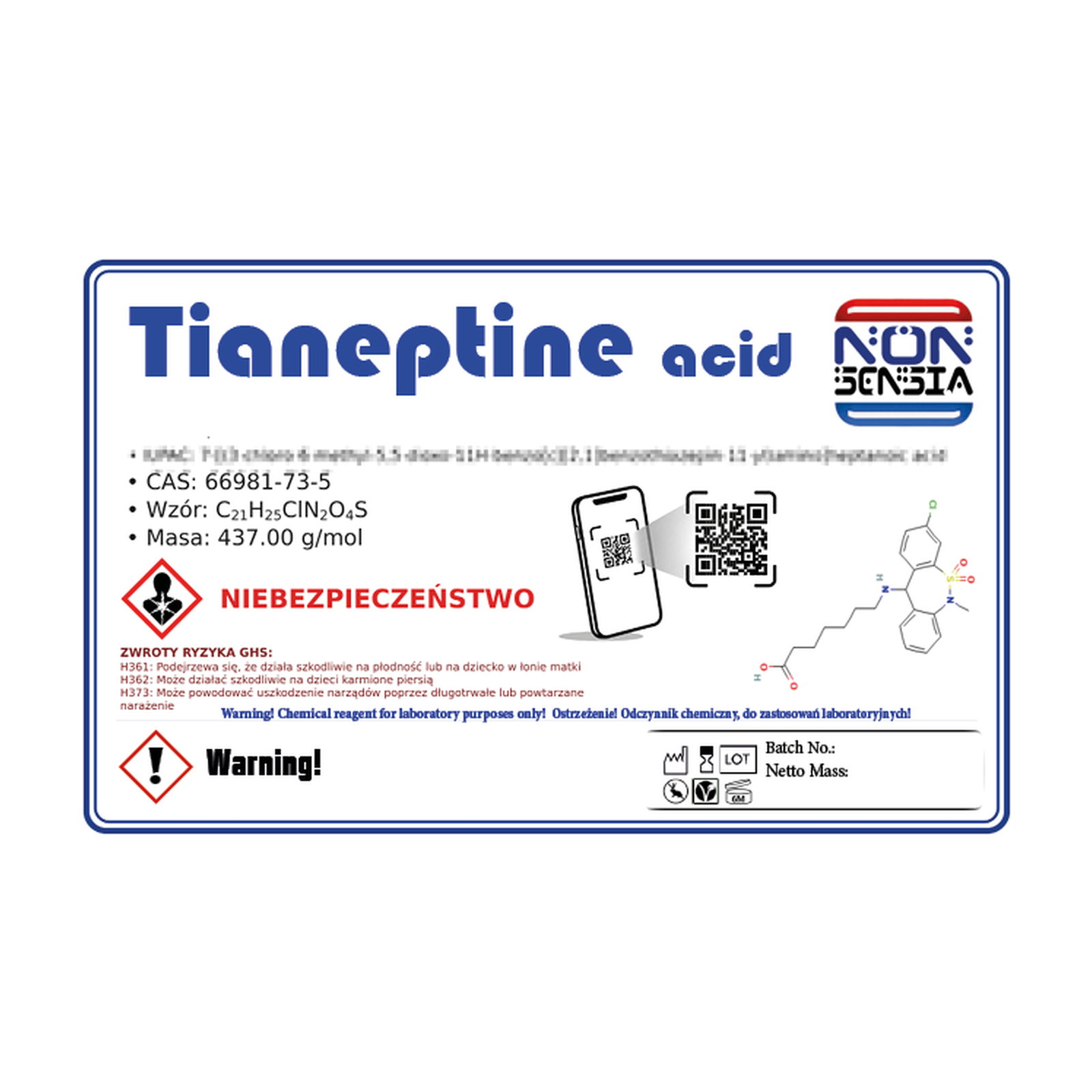
Product classification — read before ordering. This item is a chemical reagent and analytical reference material. It is not a medicinal product, dietary supplement, food, feed, novel food or cosmetic, and it is not intended for human or animal consumption or for any in-vivo administration whatsoever. It is supplied exclusively to laboratories, research institutions and professional users for in-vitro analytical, chromatographic and method-development work. Scientific findings summarised on this page describe substances investigated in published laboratory and clinical research; they are reported here as bibliographic facts about that literature and are not product claims, dosage guidance, or a recommendation of any use of this reagent.
Two chemically distinct articles are sold under the single word «tianeptine», and they differ by 5.03 per cent by mass. Read section 3 before ordering. The material described here is the free acid, C21H25ClN2O4S, CAS 72797-41-2, relative molecular mass 437.0 [1]. The monosodium salt is a separate registry record with a separate CAS number, a separate pair of EC numbers and a mass of 458.9 — C21H24ClN2NaO4S, CAS 30123-17-2 [2]. All six medicinal products authorised in Poland under this international nonproprietary name contain the sodium salt, not the acid [9]. The two forms are routinely described interchangeably in commercial listings, and the CAS number of the salt appears among the removed synonyms of the acid record itself [1]. A quantitative calibration built on the wrong form carries a systematic 5.03 per cent error that no chromatographic purity figure will reveal.
Key facts
- Substance
- Tianeptine (INN), free acid — 7-[(3-chloro-6-methyl-5,5-dioxo-11H-benzo[c][2,1]benzothiazepin-11-yl)amino]heptanoic acid
- CAS
- 72797-41-2 (current); 66981-73-5 also circulates and is carried in the same record as a deprecated number [1]
- EC numbers
- 276-851-9 and 614-004-0 — two, tracking the two CAS numbers [1]
- PubChem CID
- 68870 [1]
- UNII
- 0T493YFU8O
- Formula
- C21H25ClN2O4S
- Molecular mass
- 437.0 g·mol−1 (436.951 from IUPAC 2021 standard atomic weights)
- Monoisotopic mass
- 436.1223562 Da
- InChIKey
JICJBGPOMZQUBB-UHFFFAOYSA-N- Stereocentres
- 1 atom stereocentre, 0 defined, 1 undefined — a racemate; counters quoted verbatim in section 5 [1]
- Not the salt
- Sodium salt is CID 23663953, C21H24ClN2NaO4S, 458.9 g·mol−1, CAS 30123-17-2 [2]
- Conversion factor
- salt → acid ×0.95210; acid → salt ×1.05031
- Melting point
- 148 °C — single source, no method and no range stated [1]
- Deposited spectra
- Mass spectra only. No NMR for either form; no UV for either form; no infrared or Raman for the acid (section 9)
- GHS
- Warning — H361, H362, H373, resting on one notification (section 12)
- Controlled substance
- Not scheduled in Poland; not scheduled federally in the USA; Schedule I in Florida and in Minnesota (section 13)
- Anti-doping
- Not established — see the explicit statement in section 13
- Pack sizes
- As listed with this product
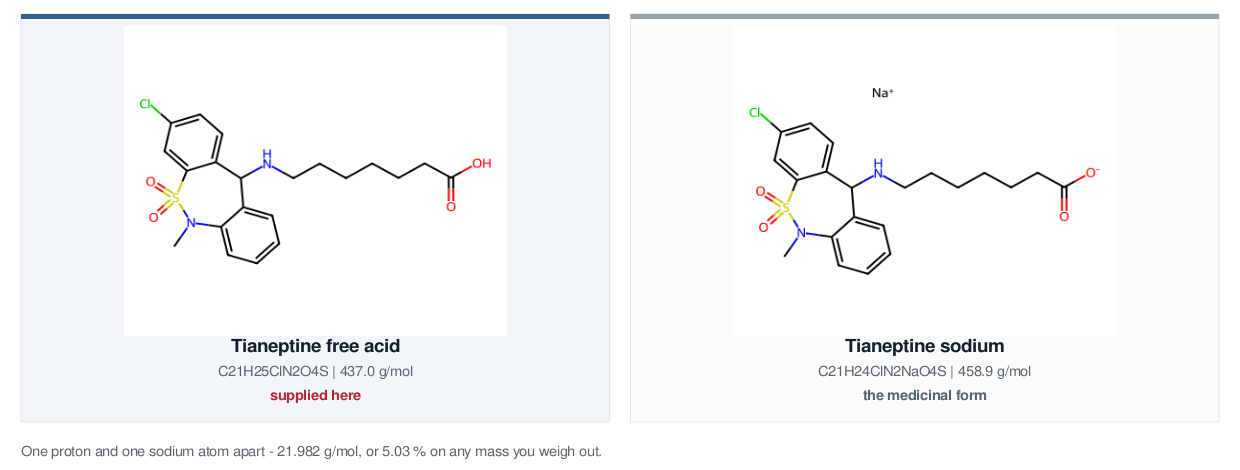
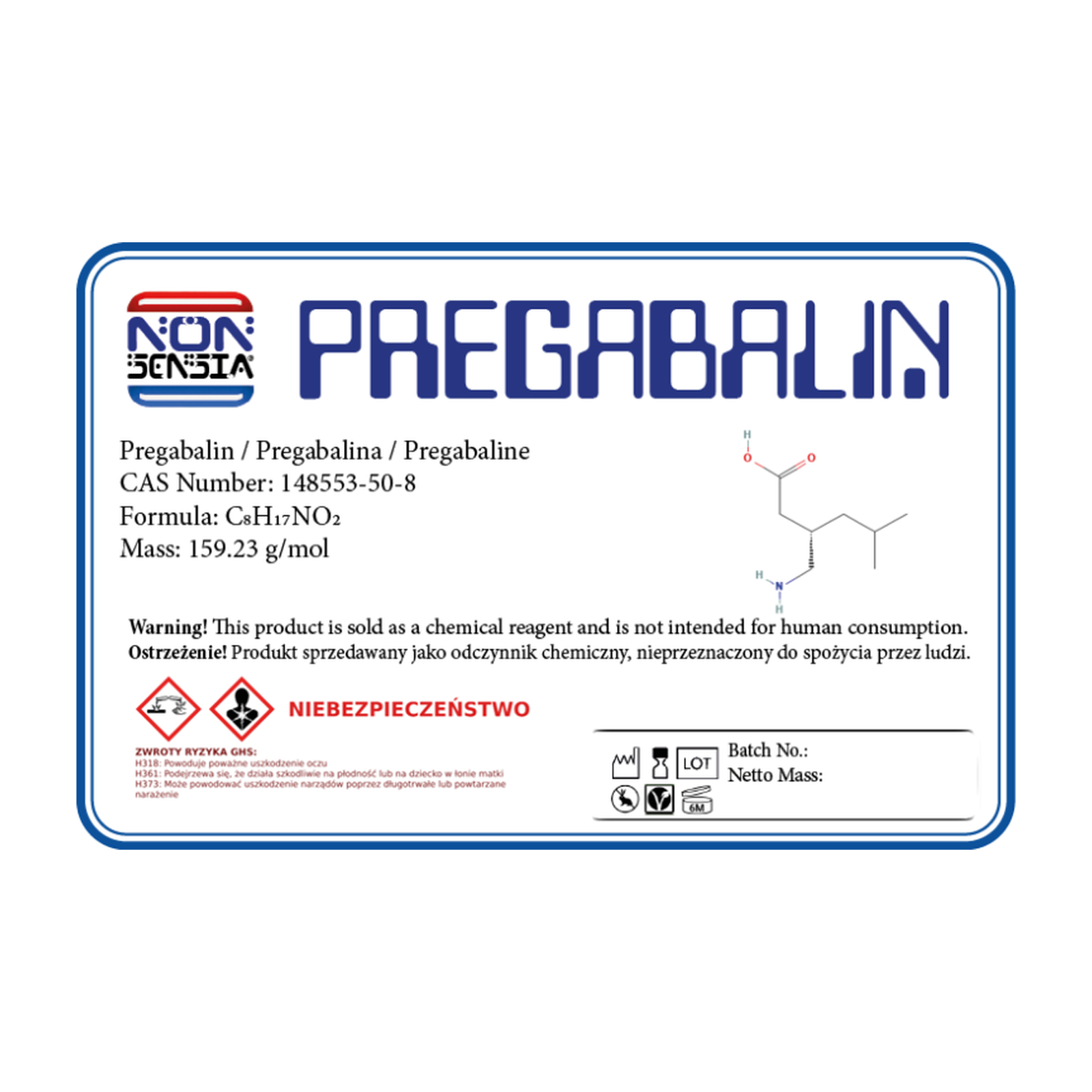
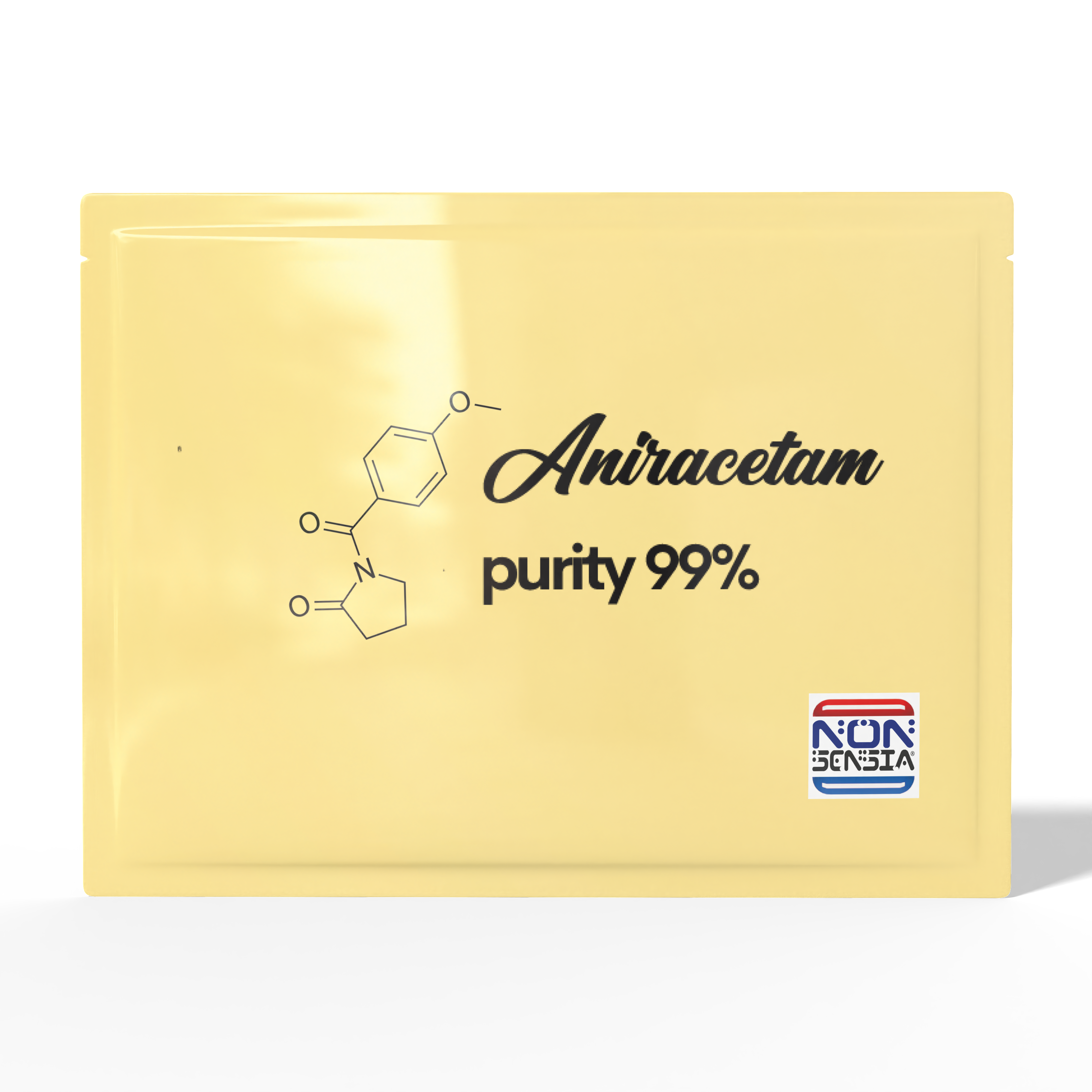
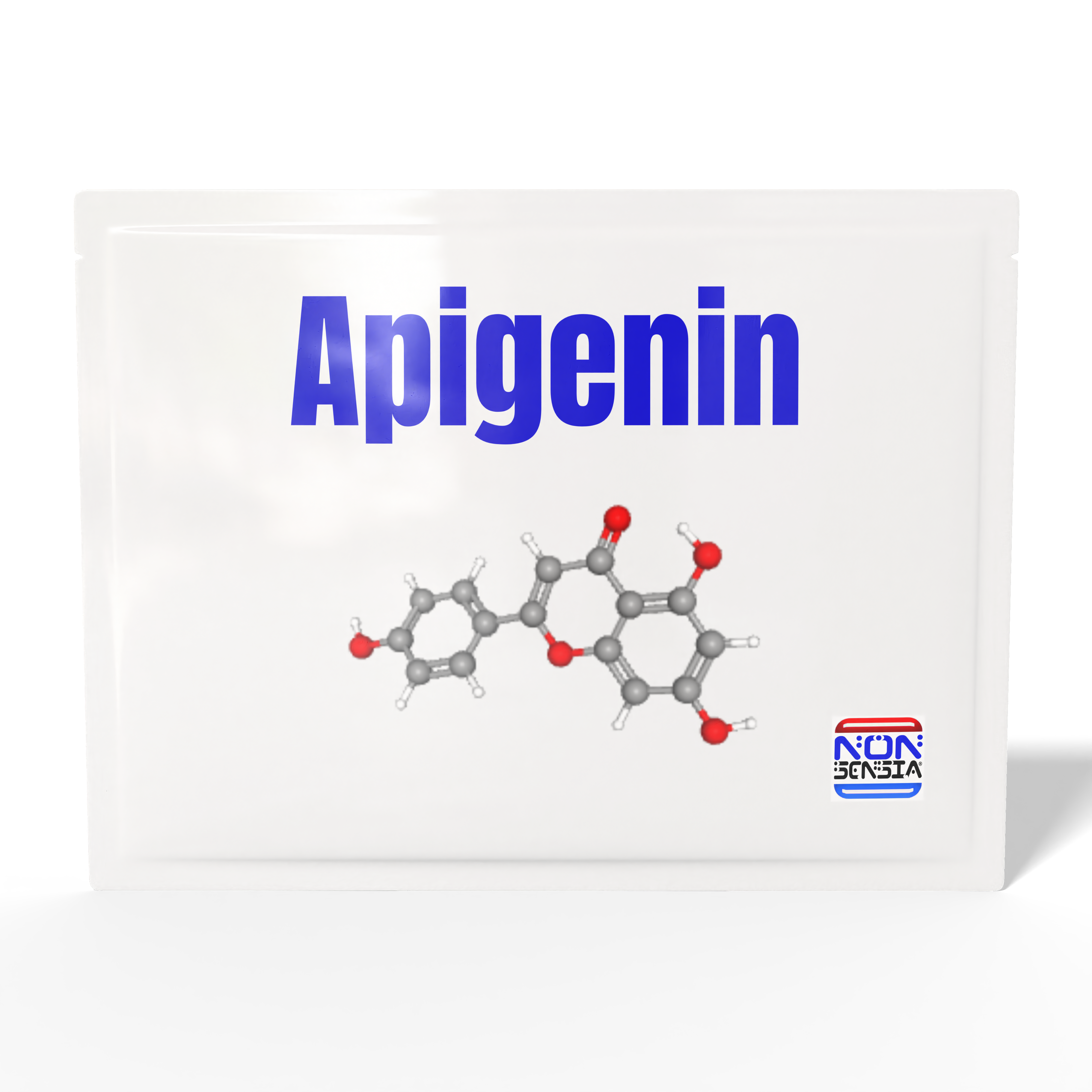
Left, the free acid supplied here (C21H25ClN2O4S, 437.0). Right, the monosodium salt that is the active substance of the authorised medicines (C21H24ClN2NaO4S, 458.9). One proton and one sodium atom apart; 21.982 g·mol−1 and two registry identities apart.
On this page
- What this material is
- Identity and registry codes
- Free acid and sodium salt: two articles, one name
- Identity traps in the numbers themselves
- Structure and stereochemistry
- Mass spectrometry: the molecular ion is not the base peak
- Methods that work, methods that fail, and why
- Physicochemical data, attributed value by value
- Spectra: what exists, what does not
- Metabolites and degradation products
- What the literature actually says
- Hazard classification, and how thin it is
- Regulatory status, measured jurisdiction by jurisdiction
- Handling and storage
- What we certify and what we do not
- Terms of supply
- Questions and answers
1. What this material is
This page describes tianeptine free acid supplied as an analytical reference material: a weighed quantity of one identified chemical substance, intended to serve as the fixed point against which another sample is measured. A reference material has a narrow job. When a forensic laboratory reports that a seized powder contains tianeptine, when a toxicology laboratory reports a plasma concentration, when a quality-control laboratory reports the content of a tablet, every one of those numbers inherits the identity, the form and the purity of one vial standing upstream of the instrument.
For most substances in a catalogue the identity question is answered by a CAS number and a formula, and the interesting analytical content lies elsewhere. Tianeptine is not one of those substances. Here the identity question is itself the difficult part, and it is difficult in a specific, arithmetically quantifiable way that no purity figure can express: the same name, the same international nonproprietary name and frequently the same catalogue entry cover two chemically distinct articles whose molar masses differ by 21.982 g·mol−1. Everything in sections 3 and 4 follows from that single fact, and it is the reason this card runs long.
Three further properties compound the problem, and each is measured rather than asserted in the sections below. The public spectral record for this molecule is lopsided: the vibrational spectra that exist belong to the salt, not to the acid, and no nuclear magnetic resonance spectrum exists for either form (section 9). The routine mass-spectrometric identification is not straightforward at ordinary source conditions, because at a high cone voltage the protonated molecule is not the base peak (section 6). And the legal position is genuinely heterogeneous across jurisdictions, in a pattern that cannot be inferred from any single national list, and in which the closest structural analogue of this molecule behaves in exactly the opposite way (section 13).
Those four facts together describe a substance for which laboratories carry real, documented analytical demand. There is a sustained methodological literature running from liquid chromatography with fluorescence detection [21] through differential-pulse and adsorptive stripping voltammetry [24], ion-pair spectrophotometry [26] and near-infrared tablet assay [25] to an enantiomeric separation described only in 2025 [16] — while the publicly available reference data are incomplete precisely on the side of the form sold as a reagent. That gap is what a characterised standard closes.
For the general terms on which this shop supplies reference materials, the surrounding reference standards category collects the rest of the catalogue on the same basis.
2. Identity and registry codes
Every identifier below is quoted from a public registry, with the registry named. Where the free acid and the sodium salt carry different values, both columns are given side by side, because presenting one column alone is exactly the failure mode this page exists to prevent.
| Identifier | Free acid — this product | Monosodium salt |
|---|---|---|
| PubChem CID | 68870 [1] | 23663953 [2] |
| Molecular formula | C21H25ClN2O4S | C21H24ClN2NaO4S |
| Molecular mass | 437.0 (436.951 calculated) | 458.9 (458.933 calculated) |
| Monoisotopic mass | 436.1223562 Da | 458.1043004 Da |
| InChIKey | JICJBGPOMZQUBB-UHFFFAOYSA-N | ZLBSUOGMZDXYKE-UHFFFAOYSA-M |
| CAS, current | 72797-41-2 | 30123-17-2 |
| CAS, secondary or superseded | 66981-73-5 — carried in the record as a deprecated number | 54317-11-2 |
| EC numbers | 276-851-9 and 614-004-0 | 250-059-3 and 259-091-2 |
| UNII | 0T493YFU8O (racemate); XV6773012I (−); AKU7QFL9ZT (+) | YG0E19592I; 7LI031265R; ROJ48D5596 |
| ChEBI | CHEBI:91749 | not present in the salt record |
| ChEMBL | CHEMBL1289110 | CHEMBL2361572 |
| DrugBank | DB09289 | not present in the salt record |
| DSSTox | DTXSID7048295 | DTXSID4046737 |
| KEGG | D02575 | D08589 |
| HMDB | HMDB0042038 | not present |
| NCI Thesaurus | C152599 | C218360 |
| Nikkaji | not present in the acid record | J260.562G |
| PharmGKB / DrugCentral | PA166186040 / 2650 | not present |
| Wikidata | Q424260 | Q60312243 |
| INN | TIANEPTINE | Tianeptinum natricum, the Latin form used in the Polish register [9] |
| ATC / ATCvet | N06AX14 / QN06AX14 — one code covers both forms [15] | |
| Development codes | S-1574, TPI-1062, JNJ-39823277 | — |
Machine-readable descriptors
| IUPAC name | 7-[(3-chloro-6-methyl-5,5-dioxo-11H-benzo[c][2,1]benzothiazepin-11-yl)amino]heptanoic acid |
|---|---|
| SMILES | CN1C2=CC=CC=C2C(C3=C(S1(=O)=O)C=C(C=C3)Cl)NCCCCCCC(=O)O |
| InChI | InChI=1S/C21H25ClN2O4S/c1-24-18-9-6-5-8-16(18)21(23-13-7-3-2-4-10-20(25)26)17-12-11-15(22)14-19(17)29(24,27)28/h5-6,8-9,11-12,14,21,23H,2-4,7,10,13H2,1H3,(H,25,26) |
| InChIKey | JICJBGPOMZQUBB-UHFFFAOYSA-N |
| XLogP3-AA | 1.2 — computed, not measured |
| Topological polar surface area | 95.1 Å2; the salt record gives 97.9 Å2 |
| Hydrogen-bond donors / acceptors | 2 / 6; the salt gives 1 / 6 |
| Rotatable bonds | 8 — the same in both forms |
| Heavy atoms / complexity | 29 / 654; the salt gives 30 / 660 |
| Formal charge | 0 in both records |
| Covalently bonded units | 1 for the acid; 2 for the salt |
| Isotope atom count | 0 in both records |
The simplest machine-readable test for form. Ignore the mass for a moment and read the last three rows. Covalently bonded units: 1 for the acid, 2 for the salt. A salt is by definition two units — an anion and a counter-ion — held together by nothing covalent. If your inventory system, your certificate archive or your data-import routine carries that field, it separates the two forms without arithmetic, without ambiguity, and without depending on which CAS number a supplier chose to print. If it does not carry that field, the InChIKey does the same job: the acid ends -UHFFFAOYSA-N, the salt ends -UHFFFAOYSA-M, and the terminal M is the standard InChIKey protonation flag for a species carrying one proton fewer than the neutral parent (N is zero, M is −1, L is −2), which is what a monobasic salt of this acid gives. Note also that the first block differs — JICJBGPOMZQUBB against ZLBSUOGMZDXYKE — so unlike the stereoisomer problem that afflicts tadalafil, skeleton-level indexing does not merge these two. The merge here happens one level up, in the human-readable name.
3. Free acid and sodium salt: two articles, one name
This is the analytical heart of the card, and it deserves stating in the bluntest available terms.
A weighed portion of tianeptine sodium and a weighed portion of tianeptine free acid do not contain the same number of moles of the same substance, and the discrepancy is 5.03 per cent. Working from IUPAC 2021 standard atomic weights: the acid C21H25ClN2O4S has a relative molecular mass of 436.951, the salt C21H24ClN2NaO4S has 458.933, and the difference is 21.982. Salt to acid is a factor of 0.95210; acid to salt is 1.05031. A stock solution prepared from 1000 mg of free acid corresponds to 1050.31 mg of salt equivalent — a gap of 50.31 mg. In the other direction, the 12.5 mg strength of the authorised tablet, expressed as the salt [9], is 11.9013 mg when expressed as the acid.
Five per cent is not a rounding matter. It is wider than the acceptance window of most content-uniformity specifications, wider than the accuracy criterion of most validated bioanalytical methods, and comparable in size to the entire permitted impurity load of a typical pharmaceutical substance. A laboratory that calibrates with the acid and reports against a salt-referenced specification, or the reverse, produces results that are internally consistent, fully documented and biased by an amount no system-suitability test will flag — because nothing in the chromatography is wrong. The chromatography is fine. What has failed is the arithmetic that converts peak area into mass.
| Quantity | As free acid | As sodium salt |
|---|---|---|
| Relative molecular mass | 436.951 | 458.933 |
| Monoisotopic mass | 436.1223562 Da | 458.1043004 Da |
| Multiplication factor from the other form | ×0.95210 | ×1.05031 |
| 1000 mg of the free acid corresponds to | 1000 mg | 1050.31 mg |
| The 12.5 mg authorised tablet strength [9] corresponds to | 11.9013 mg | 12.5 mg |
| Relative discrepancy when the forms are interchanged | +5.031 per cent when acid is reported as salt; −4.790 per cent in the other direction | |
Why the confusion is structural rather than accidental
It would be comfortable to treat this as a careless-supplier problem. The measured record does not support that reading. The ambiguity is present in the registries themselves, at four separate levels.
First, in the synonym lists. The removed-synonym list of the free-acid record CID 68870 includes the string 30123-17-2 — the CAS number of the sodium salt — together with tianeptine monosodium and Tianeptineacid [1]. Those entries were removed precisely because they were wrong, but their presence documents that the salt number has at some point been attached to the acid record by an upstream data source. A purchaser who validates a supplier certificate by matching the CAS number alone can therefore match successfully against the wrong form.
Second, in the state register itself. Of the six authorised Polish medicinal products, five carry Tianeptinum natricum in both the common-name field and the active-substance field. The sixth — authorisation 03702, held by Les Laboratoires Servier — carries Tianeptinum natricum as the common name and the bare Tianeptinum as the active-substance name [9]. This is a national medicines register, maintained under statutory obligation, recording the form inconsistently inside a single record. If that register does not hold the distinction uniformly, a commercial catalogue certainly will not.
Third, in the pharmacopoeial marker. Among the deposited synonyms of the salt record sits the string TIANEPTINE SODIUM [EP MONOGRAPH] [2]. If that marker is accurate, the European Pharmacopoeia monograph is written against the salt, which would mean a laboratory testing to a pharmacopoeial method needs salt-referenced quantities while holding acid-referenced material. We flag this as a marker present in an aggregated synonym list, not as a verified pharmacopoeial fact: it has not been confirmed against the issuing authority, and it should not be relied upon without that confirmation. The wider point survives either way, because the six Polish authorisations independently establish that the medicinal form is the salt [9].
Fourth, in the pharmacokinetic and formulation literature. The formulation papers name the salt explicitly — a sustained-release dual-layer tablet study [29], an orodispersible film [30], a bioequivalence assessment of two formulations [31] and a stability-indicating chromatographic assay [22] are all written on tianeptine sodium. The bioanalytical and pharmacokinetic papers, by contrast, generally name tianeptine without qualification [20][21][27]. Reading across those two bodies of work without tracking the form is how a five-per-cent bias enters a comparison silently.
This is not a rare class of problem, and the catalogue offers useful comparisons. Procaine hydrochloride and benzocaine sit either side of the same distinction from the other direction: one is supplied as a salt, one as a free base, and the names make it obvious. Sildenafil is authorised as a citrate, so anyone comparing a free-base standard against a citrate-referenced specification is doing the same arithmetic with a different factor. Methylene blue is a chloride in normal laboratory use and a bare cation on paper. What makes tianeptine harder than any of these is that the name does not change: nothing in the word tianeptine, in the international nonproprietary name, or in the ATC code N06AX14 [15] tells you which of the two you are holding. With procaine, the letters HCl are in the name; here the distinction lives only in the formula, the mass and the covalent-unit count.
Other salts that exist
The acid and the monosodium salt are not the only registry entries with this connectivity. Two further salt forms are recorded, and both would fail a mass-based identity check against either of the main forms:
| Form | CID | Formula | Molecular mass | InChIKey |
|---|---|---|---|---|
| Hydrochloride | 66524473 | C21H26Cl2N2O4S | 473.409 | VALUNVMGXVWSGM-UHFFFAOYSA-N |
| Sulfate | 68431515 | C21H27ClN2O8S2 | 535.023 | SKEOVGLOOAJSTG-UHFFFAOYSA-N |
Note the hydrochloride in particular. It contains two chlorine atoms rather than one, which changes the isotopic envelope in a way that is directly visible in a mass spectrum: a monochloro compound shows an M+2 satellite at roughly one third the height of the monoisotopic peak, a dichloro compound one at roughly two thirds. Section 6 returns to that pattern, because for this molecule the chlorine doublet is among the most useful confirmatory features available.
4. Identity traps in the numbers themselves
Beyond the salt question, the identifiers attached to this molecule carry three further traps. Each is documented in the registry record rather than inferred, and each has a concrete consequence for how a purchase order or a certificate should be written.
Trap one: two CAS numbers, one deprecated, both in circulation
The free-acid record lists two CAS Registry Numbers drawn from different reporting sources [1]:
| CAS number | Reported by | Paired EC number | Status |
|---|---|---|---|
| 72797-41-2 | CAS Common Chemistry, ChemIDplus, DrugBank, the EPA substance dashboard, the European chemicals inventory, and the United States substance registration system | 276-851-9 | Current — use this one |
| 66981-73-5 | The European chemicals inventory and the human metabolome database | 614-004-0 | Carried by ChemIDplus as a deprecated number, yet still present in live inventories |
This is not a case where the older number simply fell out of use. It is still emitted by live registry sources, it still has its own EC number attached, and it circulates widely in commercial listings. A laboratory searching an internal archive on 72797-41-2 alone will miss records filed under 66981-73-5, and a purchasing system that validates a certificate against a single expected CAS number will reject correct material. Search on both; write the current one on documentation.
The enantiomers carry their own registry numbers again, which matters for anyone specifying material for chiral work: 169293-31-6 for the (+) enantiomer and 191172-75-5 for the (−) enantiomer, with unique-ingredient identifiers AKU7QFL9ZT and XV6773012I respectively [1].
Trap two: the classification of the molecule contradicts itself between vocabularies
The medical subject heading vocabulary places tianeptine among Antidepressive Agents, Tricyclic. The anatomical therapeutic chemical code assigned to it is N06AX14 [15] — which sits in N06AX, other antidepressants, and specifically not in N06AA, the tricyclic group. Both classifications are attached to the same registry record [1].
Structurally, the second is the better description of what the molecule is: the core is a dibenzothiazepine S,S-dioxide, not a dibenzazepine or dibenzocycloheptene, and it carries a seven-carbon aminoheptanoic side chain that no tricyclic antidepressant possesses. The consequence for an analyst is practical rather than semantic: a screening panel assembled by therapeutic class from the medical subject heading vocabulary will file this compound with a group whose chromatographic behaviour and fragmentation it does not share, and a library search restricted to that group will be searching the wrong shelf.
Trap three: the closest structural analogue is a different, and differently regulated, substance
Amineptine is the compound this molecule is most likely to be confused with on paper, and the confusion runs in both the chemical and the legal direction. It carries the same 7-aminoheptanoic side chain on a tricyclic core; the difference is that its core is a dibenzo[a,d]cycloheptene rather than a dibenzothiazepine dioxide. That single substitution changes the formula from C21H25ClN2O4S to C22H27NO2 and the molecular mass from 436.951 to 337.463 [5].
| Property | Tianeptine, free acid | Amineptine |
|---|---|---|
| PubChem CID | 68870 [1] | 34870 [5] |
| Formula | C21H25ClN2O4S | C22H27NO2 |
| Molecular mass | 436.951 | 337.463 |
| Shared feature | 7-aminoheptanoic acid side chain on a tricyclic core | |
| Core | Dibenzothiazepine S,S-dioxide, one chlorine | Dibenzo[a,d]cycloheptene, no halogen |
| Polish controlled-substances schedule | Absent [10] | Present, psychotropic group II-P, item 11 [10] |
| United States federal schedule | Absent [12] | Schedule I, drug code 1219 [12] |
| Florida and Minnesota schedules | Schedule I in both [13][14] | Absent from both [13][14] |
| Deposited NMR, UV, infrared, Raman | None [1] | None [5] |
Read the last four rows together. The two molecules are structural cousins whose regulatory positions are mutually inverted in every jurisdiction measured, and neither has a deposited condensed-phase spectrum of any kind. Section 13 sets out how that inversion was measured, including the positive controls that make each negative statement meaningful.
5. Structure and stereochemistry
Tianeptine is built on a tricyclic dibenzo[c,f][1,2]thiazepine core bearing a sulfone, an N-methyl group on the ring nitrogen and a chlorine on one aromatic ring, with a seven-carbon aminoheptanoic acid chain attached through a secondary amine at position 11. The stereodescriptor counters are quoted verbatim from the registry record, with the counters of the two resolved enantiomers alongside for comparison [1][2][3][4]:
| Record | CID | Atom stereocentre count | Defined atom stereocentre count | Undefined atom stereocentre count | Bond stereocentre count | InChIKey |
|---|---|---|---|---|---|---|
| Tianeptine, free acid — this product | 68870 | 1 | 0 | 1 | 0 | JICJBGPOMZQUBB-UHFFFAOYSA-N |
| Tianeptine sodium | 23663953 | 1 | 0 | 1 | 0 | ZLBSUOGMZDXYKE-UHFFFAOYSA-M |
| (S)-tianeptine | 11704779 | 1 | 1 | 0 | 0 | JICJBGPOMZQUBB-NRFANRHFSA-N |
| (R)-tianeptine | 11640679 | 1 | 1 | 0 | 0 | JICJBGPOMZQUBB-OAQYLSRUSA-N |
The reading is unambiguous. There is exactly one atom stereocentre, zero bond stereocentres, and in the record corresponding to the commercial substance the single centre is undefined. Undefined, in registry terms, means the configuration is not specified, which for a substance sold as a single article means a racemate. The two resolved enantiomers have the same counter set with the definition moved from the undefined column to the defined column, which is exactly what a resolved single isomer looks like.
The stereocentre is the carbon at position 11 of the benzothiazepine ring — the one carrying the secondary amine that begins the heptanoic chain. That is visible directly in the systematic names of the resolved forms, which are written with the (11S)- and (11R)- prefixes.
Two independent statements in the same aggregated record confirm the racemic reading rather than merely restating it. The chemical-entities description quoted in the record reads: «Tianeptine is a racemate comprising of equimolar amounts of (R)- and (S)-tianeptine» [1]. And the naming used by the European chemicals inventory carries the racemic prefix explicitly: «(±)-7-[(3-chloro-6,11-dihydro-6-methyldibenzo[c,f][1,2]thiazepin-11-yl)amino]heptanoic acid S,S-dioxide» [8]. Three sources, three vocabularies, one conclusion.
What a racemic standard can and cannot do. A racemate calibrates a total-content method perfectly well. It cannot serve as the reference for an enantiomeric-purity determination, because it has no enantiomeric excess to certify and cannot establish which peak in a chiral separation belongs to which configuration. That distinction is not academic here: the two enantiomers hold separate registry numbers and separate unique-ingredient identifiers [1], the older pharmacological literature reports the (+) and (−) forms behaving differently in animal models [17][18], and a full enantiomeric separation with structural assignment was published only in 2025 [16]. If your work needs configuration, you need resolved material and this is not it. For contrast, modafinil presents the same arithmetic — one stereocentre, supplied as the racemate, with the resolved enantiomer holding its own international name — while aniracetam and bromantane have no stereocentres at all and the question does not arise.
Why the sulfone matters more than it looks
The two sulfone oxygens are the single most consequential feature of this molecule for analysis, and they are easy to overlook because they sit in the middle of the ring system rather than at a reactive periphery. Three consequences follow directly, and all three are used later on this page.
First, the sulfone accounts for a large share of the topological polar surface area — 95.1 Å2 for a molecule of only 29 heavy atoms [1] — which together with the free carboxylic acid explains why the computed partition coefficient is only 1.2 despite the extended aromatic system and the seven-carbon chain. Section 7 turns that number into a chromatographic prediction.
Second, the sulfone is the origin of the diagnostic 63.9619 Da neutral loss that dominates the fragmentation pattern in section 6. Very few structural motifs give that exact loss, which makes it a strong confirmatory feature rather than a generic one.
Third, the sulfone together with the carboxylic acid is why the boiling point quoted in section 8 is physically meaningless: a molecule carrying both an aryl sulfone and a carboxylic acid decomposes long before any distillation temperature is reached, so a predicted boiling point above 600 °C describes a computational model, not a substance.
6. Mass spectrometry: the molecular ion is not the base peak
Mass spectrometry is the technique most laboratories will reach for first, and for this molecule it works — but not in the way a method transcribed from a generic template expects. The deposited spectra show a compound that fragments readily in the source, and the consequence is that the identification anchor cannot be the protonated molecule alone.
At a cone voltage of 90 V, the base peak of tianeptine is m/z 228, not m/z 437. The deposited record MSBNK-Waters-WA000311 [7] is a positive-mode electrospray quadrupole spectrum acquired at a sampling-cone voltage of 90 V, and its five most intense signals are 228, 193, 165, 213 and 192. The protonated molecule is not among them. A companion record acquired under gentler conditions — MSBNK-Waters-WA000316 [7], the same series at 15 V — shows the expected series with 437 as the base peak followed by 439, 438, 440 and 292. Same compound, same instrument family, opposite-looking spectra — the difference is source energy, and a method that identifies this substance solely by the presence of m/z 437 will fail at high cone voltage while the compound is sitting in the flow cell.
The fragmentation series, assigned and checked against measurement
The ion assignments below are computed from monoisotopic masses with the electron-mass correction applied, and set against measured values from two different deposited records: the unit-resolution Waters series for the free acid [7], and one high-resolution qTof MS2 spectrum deposited under the sodium-salt record [2], which supplies the only six-decimal values quoted here:
| Ion | Formula | m/z computed | m/z reported | Agreement |
|---|---|---|---|---|
| [M+H]+, free acid | C21H26ClN2O4S+ | 437.1296 | 437 (unit resolution) | consistent |
| [M−H]−, free acid | C21H24ClN2O4S− | 435.1151 | 435 (unit resolution) | consistent |
| [M+H]+, sodium salt | C21H25ClN2NaO4S+ | 459.1116 | 459.110321 — base peak of the deposited qTof MS2 spectrum of the sodium salt [2] | 2.7 ppm |
| Tricyclic core | C14H11ClNO2S+ | 292.0194 | 292.019714 — same deposited qTof MS2 spectrum [2] | 1.2 ppm |
| Core after loss of SO2 | C14H11ClN+ | 228.0575 | 228, base peak at 90 V | consistent |
| After further loss of Cl | C14H11N+ | 193.0886 | 193 | consistent |
| Fluorenyl cation | C13H9+ | 165.0699 | 165 | consistent |
The pathway is coherent and easy to remember: the aminoheptanoic side chain is lost first to give the tricyclic core at 292, then sulfur dioxide departs as a neutral of 63.9619 Da to give 228, then chlorine departs as 34.9689 Da to give 193, and ring contraction gives the fluorenyl cation at 165. Four ions, three well-defined neutral losses, one chain.
Note what that pathway implies about specificity. The side chain leaves first. That means the ions at 292, 228, 193 and 165 are shared with anything that carries the same tricyclic core — including, by construction, the beta-oxidation metabolites in section 10, whose only difference from the parent is the length of that chain. Those fragments confirm the core; they do not distinguish the parent from its metabolites. The distinction lives in the precursor mass, which returns the burden to the molecular ion this section opened by warning about.
The chlorine doublet is the most useful free confirmation available
Chlorine has two stable isotopes in a roughly three-to-one abundance ratio, and this molecule carries exactly one chlorine atom. Every chlorine-containing ion in the series therefore appears as a pair separated by two mass units with the satellite at approximately one third the height of the main peak. The deposited spectra show the pairs plainly: 437/439 in the molecular-ion region, 292/294 for the core, 228/230 after sulfur dioxide loss [7]. The pair disappears at 193, which is precisely the point at which chlorine has been lost — internal confirmation that the assignment is right.
This gives a laboratory three independent checks that cost nothing extra: the count of chlorine atoms in the molecule, the identity of which fragments retain the halogen, and a quick discriminator against the dichloro hydrochloride salt form in section 3, whose satellite would sit at roughly two thirds rather than one third of the main peak height.
| Accession | Source | Instrument | Mode | Five most intense signals |
|---|---|---|---|---|
| MSBNK-Waters-WA000311 | MassBank Europe [7] | Single quadrupole, electrospray | Positive, 90 V | 228, 193, 165, 213, 192 |
| MSBNK-Waters-WA000312 | MassBank Europe [7] | Single quadrupole, electrospray | Positive, 75 V | 228, 193, 230, 165, 292 |
| MSBNK-Waters-WA000313 | MassBank Europe [7] | Single quadrupole, electrospray | Positive, 60 V | 292, 228, 294, 230, 122 |
| MSBNK-Waters-WA000314 | MassBank Europe [7] | Single quadrupole, electrospray | Positive, 45 V | 292, 294, 293, 228, 295 |
| MSBNK-Waters-WA000315 | MassBank Europe [7] | Single quadrupole, electrospray | Positive, 30 V | 292, 437, 294, 439, 293 |
| MSBNK-Waters-WA000316 | MassBank Europe [7] | Single quadrupole, electrospray | Positive, 15 V | 437, 439, 438, 440, 292 |
| MSBNK-Waters-WA000317 | MassBank Europe [7] | Single quadrupole, electrospray | Negative, 30 V | 435, 437, 436, 330, 438 |
| High-resolution record | Aggregated spectral library [1] | Orbitrap, higher-energy collisional dissociation | Not stated in the source record | — |
All seven MassBank records — WA000311 through WA000317 — were acquired on the same chromatographic system, a 2.1 mm, 3.5 µm C18 column with a retention time of 13.560 min, and are distributed under a non-commercial licence [7]. They are not seven independent measurements but one sampling-cone ladder run on one material: 90, 75, 60, 45, 30 and 15 V in positive mode, plus 30 V in negative mode. That single-laboratory provenance is worth noting for the same reason it is noted in section 9: seven spectra from one source are seven observations of one material, not seven independent confirmations.
7. Methods that work, methods that fail, and why
The computed descriptors in section 2 are not decoration; they predict chromatographic behaviour, and the predictions are testable against the published method literature. Reading them together gives a usable map of which approaches will work on this compound and which will disappoint.
| Descriptor [1] | Value | What follows |
|---|---|---|
| XLogP3-AA | 1.2, computed | Moderate retention on C18. Not so polar that it elutes at the void, not so lipophilic that it needs a strong organic wash. Reversed-phase methods are the mainstream, and the published record agrees [20][21][22] |
| Ionisable group | Carboxylic acid, plus a secondary amine | Retention is strongly pH-dependent and the molecule is amphoteric. Buffer control is not optional; a method transferred without its buffer will not reproduce |
| Topological polar surface area | 95.1 Å2 | High for the molecular size, driven by the sulfone and the acid. Predicts appreciable aqueous solubility for the salt and poor solubility for the acid at low pH |
| Rotatable bonds | 8 | A flexible molecule. Conformational averaging blunts the sharp vibrational fingerprints that rigid molecules give, and works against retention reproducibility on shape-selective phases |
| Chromophore | Two benzene rings conjugated into the thiazepine | Ultraviolet detection is workable — and is used in the published methods [22][26] — but no deposited reference ultraviolet spectrum exists (section 9), so the wavelength and absorptivity must come from a method paper, not from a registry |
| Native fluorescence | Present, exploited in the literature | Fluorescence detection is documented for plasma work [21] and in a dual fluorescence-and-ultraviolet stability-indicating assay [22]. This is a real sensitivity advantage over ultraviolet alone |
| Stereocentre | 1, undefined | Achiral columns cannot report enantiomeric composition. Chiral separation exists but was published only in 2025 [16] |
What the published methods actually are
The methodological literature on this compound is broader than for most substances of comparable obscurity, and it clusters into five families. Naming them is useful, because it tells a method developer where the prior art is.
Liquid chromatography with fluorescence detection is the best-established route for plasma. A determination in human plasma by that technique was published in 2006 [21], following an earlier reversed-phase method with conventional detection applied to pharmacokinetic work in 2000 [20]. A stability-indicating assay for the sodium salt runs fluorescence and ultraviolet detection simultaneously [22], which is the direct answer to the ultraviolet-reference gap noted above — the two channels cross-check each other within a single injection.
Tandem mass spectrometry is the modern route, and the reference method in the literature was developed to quantify the parent together with its active metabolite in a single run across several administration routes [27]. That paper matters for reasons beyond its own results: it establishes that parent and metabolite must be resolved chromatographically, since as section 6 showed they share their diagnostic fragments.
Electroanalysis is documented for tablets by differential pulse, square wave and adsorptive stripping voltammetry [24]. This is an unusual entry in a modern method list and it is a genuinely useful one: it needs no chromophore, no column and no organic solvent, and it is the kind of approach that survives when the reference spectra are missing.
Spectrophotometry and spectrofluorimetry cover the simple-laboratory end. An ion-pair spectrophotometric method for tablets was published in 2008 [26], and a spectrofluorimetric determination exploiting a quenching interaction appeared in 2021 [23].
Near-infrared spectroscopy has been applied to the content of coated tablets, with explicit treatment of model optimisation, calibration transfer between instruments and confidence intervals [25]. Calibration transfer is the operationally interesting part: it is the problem of making one instrument agree with another, which is the same problem a reference material solves in the chemical domain.
The method family that does not exist in the routine literature: enantiomeric separation. Until 2025 there was no published enantioselective separation of this compound with structural assignment; the work that supplied one appeared in Talanta that year [16]. Everything before it — every plasma assay, every tablet assay, every pharmacokinetic study — was measuring the racemate as a single analyte, which was the right thing to do given the material available, but it means that the historical literature is silent on enantiomeric composition by construction rather than by finding. Anyone building enantioselective work on this molecule is close to the front of the published record and should expect to characterise their own reference material rather than to inherit one.
8. Physicochemical data, attributed value by value
The experimental-properties section of the free-acid record contains three entries in total [1]. That is the whole of the measured physical record for this substance in the aggregated registry, and each of the three carries a caveat.
| Quantity | Value | Attribution | Status |
|---|---|---|---|
| Melting point | 148 °C | DrugBank, quoted in the record | Single value. No method stated, no range stated, no second source |
| Boiling point | 609.2 °C | DrugBank, quoted in the record | Computational prediction, not a measurement — see the note below |
| Collision cross-section | 197 Å2 for [M+H]+ | CCSbase; travelling-wave type; calibrated with a commercial ion-mobility calibration kit | A genuine ion-mobility figure, useful as an orthogonal identity check |
The predicted boiling point has no physical meaning for this molecule, and figures of this kind circulate widely. A value of 609.2 °C is a model output for a compound that carries both an aryl sulfone and a free carboxylic acid. Substances of that description decarboxylate, dehydrate or char long before any such temperature; there is no distillation to describe. Density, vapour pressure and boiling-point figures for this substance appear in commercial listings and aggregated data sheets without the annotation that they come from a structure-based estimation model rather than from a laboratory. They are not registry measurements and should not be transcribed onto a specification as if they were. If a physical constant matters to your work, measure it on the material in front of you.
What is absent, and why the absence is an established finding
The following quantities have no experimental value in the record for the free acid [1]: aqueous solubility, solubility in any organic solvent, acid dissociation constant, measured partition coefficient, density, decomposition temperature, hygroscopicity, and any description of polymorphic forms. The only partition coefficient available anywhere in the record is the computed XLogP3-AA value of 1.2, which is an estimate and is labelled as one.
For the sodium salt the position is starker still: the record for CID 23663953 has no experimental-properties section at all [2]. The form that is the active substance of every medicinal product authorised in Poland under this name [9] has no measured physical quantity of any kind deposited in the aggregated registry — not a melting point, not a solubility, nothing.
This is an unusual shape for a data record, and it is worth being precise about what it means. It does not mean that nobody has measured these things; formulation work of the kind published on the salt [29][30] cannot be done without solubility data. It means those measurements live in the primary literature and in unpublished development files, and have never been abstracted into the public registries. The practical consequence for a laboratory is identical either way: there is no authoritative public value to compare your own measurement against.
An absence is only informative if the instrument that found it can find presences. The comparison that makes this section meaningful is with substances whose records are richly populated. Query the same field of the same registry for a well-studied small molecule — paracetamol is the obvious control — and the experimental-properties section returns melting point, solubility, partition coefficient, dissociation constant and vapour pressure with multiple attributions each. The query is not broken and the field is not empty by construction. It is empty for this substance. Compare also chlodantane, where the same emptiness extends even further and covers the spectra as well.
9. Spectra: what exists, what does not
Spectral coverage is where the public record for this molecule is at its thinnest, and the shape of the gap is the single most operationally important fact on this page after the salt question. The measurement below was made by querying the spectral-information section of the registry for each record, with three substances of known-rich coverage included in the same query as controls.
| Record | 1H / 13C NMR | UV-Vis | Infrared | ATR-IR | Raman | Mass spectra |
|---|---|---|---|---|---|---|
| Tianeptine, free acid — this product [1] | No | No | No | No | No | Yes |
| Tianeptine sodium [2] | No | No | Yes | Yes | Yes | Yes |
| Amineptine, the structural analogue [5] | No | No | No | No | No | Yes |
| Control: caffeine | Yes, including two-dimensional | Yes | Yes | Yes | Yes | Yes |
| Control: acetylsalicylic acid | Yes, including two-dimensional | Yes | Yes | Yes | Yes | Yes |
| Control: paracetamol | Yes, including nitrogen-15 and oxygen-17 | Yes | Yes | Yes | Yes | Yes |
The controls fire. The same query, run in the same way against the same registry, returns nuclear magnetic resonance and ultraviolet headings for all three control substances. The zeros in the first three rows are therefore a finding about those substances, not an artefact of an instrument pointed at nothing.
Three consequences, each uncomfortable in a different way
First: there is no nuclear magnetic resonance spectrum for either form. Not proton, not carbon-13, not two-dimensional. For a molecule whose identity question is a question about a proton — whether the carboxyl group carries a hydrogen or a sodium — this is the missing measurement that would settle the matter most directly. A proton spectrum distinguishes the acid from the salt immediately, through the presence or absence of the exchangeable carboxylic proton and through the chemical shift of the methylene group adjacent to the carbonyl. Nobody has deposited one.
Second: the vibrational spectra that exist belong to the salt, and to one lot of it. Infrared in potassium bromide, attenuated-total-reflectance infrared, and Fourier-transform Raman are all deposited for the sodium salt [2]. All three were recorded on a single sample from a single supplier lot — catalogue item 17561, lot 0467324-1 — deposited by a forensic spectral research group. Three techniques applied to one material tell you three things about that material; they do not tell you that a second lot would look the same. And since the deposit is of the salt, a laboratory confirming the identity of the acid by infrared has no public reference spectrum at all. The carboxylic acid and the carboxylate differ sharply in exactly the region an analyst would look at: a free acid shows a carbonyl stretch near 1700 cm−1 and a broad hydroxyl envelope, a carboxylate shows the paired asymmetric and symmetric stretches near 1560 and 1400 cm−1 and no such envelope. Comparing an acid sample against the deposited salt spectrum will show a mismatch that is entirely correct and entirely misleading.
Third: there is no ultraviolet reference spectrum, while a substantial part of the quantitative literature uses ultraviolet detection [22][26]. The molecule has a perfectly serviceable chromophore; this is a gap in deposition, not in physics. It nonetheless means that the absorption maximum and the absorptivity used to build a calibration have to be taken from a method paper or measured in-house, and that two laboratories quoting different wavelengths for this compound cannot resolve the difference by appeal to a registry.
| Technique | Instrument and preparation | Material | Depositor |
|---|---|---|---|
| Infrared | Fourier-transform spectrometer, potassium bromide | Catalogue item 17561, lot 0467324-1 | Forensic spectral research group |
| ATR-IR | Same spectrometer, neat sample on a diamond-composite accessory | The same lot | The same depositor |
| Raman | Fourier-transform Raman | The same lot | The same depositor |
| Tandem mass spectrometry | Quadrupole time-of-flight; [M+H]+ 459.112 | — | Aggregated spectral library |
One more point about that provenance. The vibrational spectra come from a forensic depositor, not from a pharmacopoeial one. That tells you something about who has been characterising this compound and why: the reference material was made and measured to support the identification of seized samples, which is consistent with the substance appearing in the national forensic laboratory reporting system since 2018 (section 13). It is a useful spectrum and a legitimate source. It is not a pharmacopoeial reference, and it should not be cited as one.
10. Metabolites and degradation products
Two families of related compounds matter to anyone using this material: the metabolites, because they appear alongside the parent in any biological sample and share its diagnostic fragments; and the photodegradation products, because they bear on how the standard itself must be stored.
Beta-oxidation shortens the side chain in two-carbon steps
The registry record states the metabolic route plainly, quoting an aggregated pharmacology source: metabolism proceeds «primarily by beta-oxidation of its heptanoic side chain», and «three major metabolites result» [1]. Beta-oxidation removes C2H4 units, so the products are a homologous series differing by exactly 28.0313 Da each step, with the tricyclic core untouched.
| Compound | Side chain | Formula, neutral form | Molecular mass | Monoisotopic mass | Difference from the previous row |
|---|---|---|---|---|---|
| Tianeptine | Heptanoic acid, C7 | C21H25ClN2O4S | 436.951 | 436.122356 | — |
| MC5 | Pentanoic acid, C5 | C19H21ClN2O4S | 408.897 | 408.091056 | −28.0313 (C2H4) |
| MC3 | Propanoic acid, C3 | C17H17ClN2O4S | 380.843 | 380.059756 | −28.0313 (C2H4) |
MC5 is described in the title of the reference bioanalytical paper as an active metabolite [27], and that paper exists precisely because parent and metabolite have to be quantified together. Section 6 explains why they cannot be told apart by fragmentation alone: the side chain is the first thing lost in the source, so parent and both metabolites converge on the same core ion at m/z 292 and the same downstream series at 228, 193 and 165. The only mass-domain discriminator is the precursor. Chromatographic resolution is therefore not a nicety in this analysis; it is the entire basis of the separation between the three.
A defect in the public record for MC5, reported here rather than propagated. The registry entry for this metabolite [6] carries the molecular formula C19H21ClN2O4S-2 with a formal charge of −2, and its structure string renders the sulfone as S([O-])[O-] — two separate oxide anions — instead of the correct S(=O)(=O). That is a dianion with delocalised negative charge on the sulfur oxygens, not the neutral metabolite. The atomic composition happens to match, so the nominal mass looks right, but the charge state, the exact mass of any derived ion and every charge-dependent descriptor are wrong. The record carries no experimental-properties section and no spectral-information section of any kind; what it does carry is a set of computed descriptors derived from that same defective structure. The masses in the table above were therefore computed independently from the neutral formula, not transcribed from that record, and we recommend the same to anyone building a transition list.
Pharmacokinetic parameters, as description of the substance
The aggregated record carries a set of pharmacokinetic figures, reproduced here as bibliographic description of the molecule and not as information about this article or any use of it [1]: oral bioavailability approximately 99 per cent; plasma protein binding approximately 95 per cent; volume of distribution 0.8 L·kg−1 (reported as 0.77 ± 0.31); elimination half-life approximately 2.5 hours; biliary elimination as glucuronide and glutamine conjugates; approximately 66 per cent of a radiolabelled quantity recovered renally over one week, with approximately 3 per cent unchanged in urine. The short half-life and the extensive conjugation are the reason the metabolite question in this section is an analytical problem rather than a footnote.
Photodegradation, and what it means for storage
A non-targeted study published in 2024 identified the photodegradation products of tianeptine in water by ultra-high-performance chromatography coupled to quadrupole time-of-flight tandem mass spectrometry [28]. The work was environmental in motivation, but its findings are directly relevant to a reference material: they establish that this molecule is photolabile in aqueous media and that the transformation gives multiple products rather than one.
Read that alongside the stability-indicating chromatographic assay developed for the sodium salt [22], which exists because the compound needs a method capable of separating it from its own degradation products. The two papers together justify the storage guidance in section 14 without any need to extrapolate: protect from light, store dry, and do not leave aqueous stock solutions standing. No formal stability study on this material as a reference standard exists publicly, and we will not invent one; the photodegradation finding is the reason the precaution is stated as a documented requirement rather than a habit.
11. What the literature actually says
This section reports what has been published about this molecule. Every statement in it is a bibliographic fact about the literature — that a paper exists, in a named journal, reporting a named finding. None of it describes this article, and none of it is a claim about any use of this reagent.
An unusual pharmacology for the class, extensively documented
The molecule carries an anatomical therapeutic chemical code in the antidepressant group [15], and the older clinical and neurobiological reviews describe it in those terms [38][39]. Beginning in 2014, a separate body of work reported that the compound acts as an agonist at the mu-opioid receptor [32]; subsequent studies reported that its behavioural effects in animal models require that receptor [33], localised the relevant receptors to hippocampal inhibitory interneurons [34], described opioid-like adverse effects in rodents [36] and reported opioid-receptor-dependent oscillatory activity in the rat hippocampus [37]. A human-model study examined respiratory effects in the framework used for opioid-induced respiratory depression [35]. A narrative review published in 2023 collected the pharmacology and the abuse-potential literature together [55], and a 2024 review article in the Classics in Chemical Neuroscience series covered the compound's history and chemistry [19].
The reason this matters on a reference-material card is narrow and specific: a pharmacology that does not match the classification is what drives forensic and toxicological demand for an authentic standard. Laboratories that would never otherwise stock an antidepressant standard have reason to hold this one.
The forensic and toxicological record
There is a substantial published record of poisoning-centre reports, emergency presentations and fatal cases involving this substance, spanning two decades and several countries. A fatal intoxication was reported in 2007 [40]; a series of fatalities in the United States followed in 2018 [41]. In the same year, an analysis of exposures reported to a national poison data system between 2000 and 2017 appeared in a public-health weekly report [42], alongside a poison-centre experience paper [43]. Later series extended the record: exposures reported to United States poison centres between 2015 and 2023 [44], and emergency-department visits, fatal overdoses and substance seizures in one state between 2021 and 2023 [45]. Acute toxicity following intravenous use has been reported [46], as have dependence and withdrawal in case reports and reviews [47], including neonatal presentations following exposure in pregnancy [48][49].
Two systematic reviews have appeared very recently — one on misuse, withdrawal, toxicity and clinical management published in 2026 [50], and one in 2025 that analysed the phenomenon and its public perception [51]. A separate study analysed descriptions of use appearing on social platforms [52], and a French study used a reimbursement database with a doctor-shopping indicator as a quantitative measure of misuse [54].
The finding with the most direct bearing on analytical work: the products in circulation are not always what they claim to be. A 2025 case series described an outbreak in New Jersey in which products sold as tianeptine were found to be adulterated with a synthetic cannabinoid [53]. That is a laboratory identification problem before it is anything else, and it is the clearest possible statement of why an authentic reference material is needed: a laboratory presented with such a product has to establish both what is present and what is absent, and neither determination is possible without characterised standards for the compounds being looked for. This is a fact about products circulating in a market, reported in a peer-reviewed journal. It is not a statement about this reagent, which is supplied for exactly the analytical work such cases require.
Where the substance is monitored without being scheduled
Independently of any control schedule, the substance is carried as a monitored entry in the United States national forensic laboratory information system, recorded in the class antidepressants with an addition date of June 2018 [1][12]. That system reports what forensic laboratories identify; it is a record of analytical activity, not a control schedule, and the distinction is set out carefully in section 13. For present purposes it is the most direct available measure of the thing this card is about: laboratories are actively identifying this compound, and identification requires a standard.
The registry record additionally carries a dietary supplements section referencing a national label database, and a classification indicating the substance appears among ingredients declared on such labels [1]. It is also flagged as positive in a liver-toxicity knowledge base, and its development status is recorded as phase 3 in a curated bioactivity database [1]. All four are recorded here as registry facts about the molecule.
12. Hazard classification, and how thin it is
The classification data below are quoted as aggregated in the compound record from notifications made to the European classification and labelling inventory [1][2][8]. The number of notifications behind each classification matters at least as much as the classification itself, and for this substance those numbers are small.
| Signal word | Warning |
|---|---|
| H361 | Suspected of damaging fertility or the unborn child — Repr. 2 |
| H362 | May cause harm to breast-fed children — Lact. |
| H373 | May cause damage to organs through prolonged or repeated exposure — STOT RE 2 |
| Precautionary statements | P203, P260, P263, P264, P270, P280, P318, P319, P405, P501 |
| Basis | One notification; two company reports. Each statement is recorded at 100 per cent because there is nothing to disagree with it |
| Harmonised classification | None. No entry in the harmonised annex, therefore nothing legally binding across the Union |
| Registration status | Registered substance; dossier 25048, status active, record updated 16 July 2020, attached to EC 276-851-9 [8] |
The salt is classified differently from the acid, and the notifiers disagree with one another. Four notifications exist for the sodium salt, and they do not converge [2][8]. One of the four states that the substance does not meet the criteria for classification at all. Among the remainder, the acute oral toxicity assignment splits: H301, acute toxicity category 3, at 25 per cent of notifiers, against H302, acute toxicity category 4, at 50 per cent. H312, H332, H361, H362 and H373 each appear at 25 per cent. The signal word carried for the salt is Danger, one step above the Warning carried for the acid. With four notifications in total, no classification here is a consensus — the percentages are one, two or three filings expressed as fractions.
| Statement | Share of notifiers | Hazard class |
|---|---|---|
| H301 — Toxic if swallowed | 25 per cent | Acute Tox. 3 — the most severe assignment present |
| H302 — Harmful if swallowed | 50 per cent | Acute Tox. 4 |
| H312 — Harmful in contact with skin | 25 per cent | Acute Tox. 4 |
| H332 — Harmful if inhaled | 25 per cent | Acute Tox. 4 |
| H361 — Suspected reproductive toxicant | 25 per cent | Repr. 2 |
| H362 — May cause harm to breast-fed children | 25 per cent | Lact. |
| H373 — Organ damage on repeated exposure | 25 per cent | STOT RE 2 |
| No classification warranted | 25 per cent — one notifier of four | — |
How should a laboratory act on a classification that disagrees with itself? The defensible answer is the conservative one: plan the risk assessment against the most severe statement notified for either form — that is acute toxicity category 3 by the oral route, together with the reproductive, lactation and repeated-exposure statements — and record explicitly in the assessment that the classification is unharmonised, that it rests on one notification for the acid and four for the salt, and that one of those four disputes classification entirely. A percentage figure in this inventory is not a measurement of agreement among experts; it is a count of filings, and with a denominator of one or four the arithmetic is fragile.
Thin classification bases are common and worth recognising as a category. The same pattern appears elsewhere in this catalogue: mebicar carries a single hazard statement resting on one notification from one company, where a reader seeing only the 100 per cent figure would reasonably infer something far stronger than what is there. At the other end, chlodantane has no inventory entry at all, so there is no classification of any kind to read. Whenever a percentage appears in this inventory, the number that gives it meaning is the denominator, and the denominator is what a data sheet almost never prints.
One further note on provenance. The classification and registration data above were read from the aggregated compound record rather than from the inventory interface directly, and are attributed accordingly [1][2][8]. That distinction is worth preserving on a card of this kind: the values are reported as they are aggregated, and anyone relying on them for a regulatory filing should confirm them against the inventory itself rather than against this page.
13. Regulatory status, measured jurisdiction by jurisdiction
This is the section where a general statement would be actively harmful, because for this substance no general statement is true. The position differs between countries, differs between the federal and state level inside one country, and inverts entirely when compared against the closest structural analogue. Every statement below was measured against a named document, and every negative statement is accompanied by a positive control — the same search, on the same document, for substances that are certainly present. A zero without a firing control is not evidence of absence; it is evidence of nothing.
Poland: not scheduled, while the closest analogue is
| Documents examined | The consolidated text of the schedules of narcotic drugs, psychotropic substances and new psychoactive substances [10], together with both subsequent amending regulations, the later of which is dated 7 July 2026 [11] |
|---|---|
| Completeness check | All three annexes present in the consolidated text, including the annex listing new psychoactive substances |
| Result for this substance | Zero occurrences across all three documents, on every stem tested |
| Positive controls, same documents | Buprenorphine 1, ketamine 3, fentanyl 38, morphine 50, midazolam 1, phenobarbital 2, amfetamine 27 — all fire |
| Paired structural control | Amineptine is present, psychotropic group II-P, item 11, entered under its systematic name as the 7-aminoheptanoic acid derivative of the dibenzocycloheptene [10] |
| Verdict | Not scheduled in Poland as a narcotic, psychotropic or new psychoactive substance |
The paired control is the strongest form this evidence can take. Amineptine shares the seven-carbon aminoheptanoic side chain and the tricyclic architecture; it is the nearest structural neighbour this molecule has in the pharmacopoeia of controlled substances. The instrument that failed to find tianeptine found its closest analogue in the same document, in a named group, at a named item number. The zero is therefore a measurement rather than a silence.
A second control establishes that the schedule is actively maintained rather than dormant. The July 2026 amendment added carisoprodol to psychotropic group IV-P at item 81; hexahydrocannabinol, 2-methylmethcathinone and N-ethylnorpentedrone to group II-P at items 83 to 85; and five nitazene-type opioids to narcotic group I-N at items 212 to 216, transposing a delegated directive of the European Union adopted in 2025 [11]. Two further entries, items 67 and 68, were added to the annex of new psychoactive substances, and two existing entries were repealed. A list that gained eleven entries and lost two in its most recent revision is a live document, and this substance is not among the entries it gained.
Poland: authorised as a medicine, in the salt form only
The second Polish measurement runs in the opposite direction and returns a positive. Querying the national register of medicinal products on the common name returns six authorisations, all of them for the sodium salt at a strength of 12.5 mg [9]:
| Product | Authorisation holder | Authorisation number | Active substance as recorded | Form | Procedure | Validity |
|---|---|---|---|---|---|---|
| Atinepte | Zakłady Farmaceutyczne Polpharma S.A. | 20425 | Tianeptinum natricum | Film-coated tablet | Decentralised | Indefinite |
| Coaxil | Les Laboratoires Servier | 03702 | Tianeptinum natricum in the common-name field; Tianeptinum in the active-substance field | Film-coated tablet | National | Indefinite |
| Coaxil | InPharm Sp. z o.o., parallel import | 164/16 | Tianeptinum natricum | Coated tablet | Parallel import | To 16 March 2026 |
| Coaxil | Delfarma Sp. z o.o., parallel import | 381/16 | Tianeptinum natricum | Coated tablet | Parallel import | To 17 August 2026 |
| Tialera | Zentiva, k.s. | 18933 | Tianeptinum natricum | Film-coated tablet | Decentralised | Indefinite |
| Tianesal | Adamed Pharma S.A. | 18354 | Tianeptinum natricum | Film-coated tablet | Decentralised | Indefinite |
Three things in that table deserve explicit statement. Six of six are the sodium salt — the medicinal form in Poland is not the acid, which is the point section 3 rests on. Two of the six are parallel imports whose stated validity ran out during 2026, on 16 March and 17 August, so the count is not a permanent fact and carries a time stamp rather than a guarantee. And one record spells the form inconsistently across its own two fields, which is the inconsistency discussed in section 3.
The instrument was checked in both directions. Positive controls on the same interface and the same common-name field: sertraline returns 32 records, mirtazapine 43, buprenorphine 20, paracetamol 291. A query on the product-name field for paracetamol returns 43; the two fields are different instruments and are not interchangeable [9]. A negative control was also run and failed, which is reported here rather than concealed: a query against the active-substance field returned 22,871 records, that is to say the entire register including sodium chloride and gentian violet. That field does not function as a filter, the query was discarded as an invalid instrument, and its output was not used. Only the name and common-name queries are relied upon.
Being the active substance of an authorised medicine is not a status that transfers. The authorisations above attach to those finished products and to their holders. They do not attach to the material on this page, which is supplied as a laboratory reagent under the terms in section 16. An authorised medicine and an analytical reference material are two different legal articles even when the molecule is the same — and here the molecule is not even quite the same, since the authorisations are for the salt and this is the acid. The same distinction applies to pregabalin and to levodopa, both of which are active substances of authorised medicines and neither of which is supplied here as one.
European Union
At Union level the substance is the active ingredient of nationally authorised medicinal products, several of them approved through the decentralised procedure, and carries the anatomical therapeutic chemical code N06AX14 [15][9]. It is a registered substance under the chemicals regulation, dossier 25048, status active, with the record last updated in July 2020 [8]. It does not appear among the substances added by the most recent transposition of the 2025 delegated directive, whose additions are enumerated above [11].
Not established, and stated as such. Whether the European medicines agency or the European drugs agency have issued procedures, referrals or communications concerning this substance was not determined. Both agency sites returned access-control responses rather than content when queried, and no substitute material was used in their place. This is recorded as an open gap rather than filled with an inference. Nothing on this page should be read as a statement about the position of either agency.
United States: unscheduled federally, Schedule I in at least two states
| Documents examined | The alphabetical list of controlled substances published by the federal drug enforcement authority, 24 pages, together with the full associated schedule compilation |
|---|---|
| Result for this substance | Zero occurrences in both documents |
| Positive controls, same documents | Buprenorphine 1 and 7, fentanyl 83 and 542, amfetamine 26 and 142, carisoprodol 1 and 5, ketamine 2 and 10 — all fire |
| Paired structural control | Amineptine is present, quoted from the document as drug code 1219, Schedule I, narcotic flag N, with its systematic name printed in full [12] |
| Verdict | Not a federally controlled substance under the United States federal statute |
| Separate finding | Carried as a monitored entry in the national forensic laboratory information system, class antidepressants, added June 2018 — a reporting system, not a control schedule [1][12] |
The state-level position is different, and it is where a reading based on the federal list alone goes wrong.
| State | Statute | Schedule | Position in the text | Positive controls on the same document |
|---|---|---|---|---|
| Florida | Section 893.03 of the Florida Statutes, 2026 edition — the current edition; the 2024 and 2025 editions carry the identical entry [13] | Schedule I | Item 57, in the opioid subsection, immediately between thiofentanyl at item 56 and tilidine at item 58, with trimeperidine and acetylfentanyl following | Carisoprodol 1, buprenorphine 1, fentanyl 38, ketamine 1 |
| Minnesota | Section 152.02 of the Minnesota Statutes [14] | Schedule I | Item (6), in the depressants subsection, immediately before clonazolam, etizolam, flubromazolam and flubromazepam | Fentanyl 48, buprenorphine 1, carisoprodol 1 |
The placement inside each statute is worth reading, because the two states classify the same substance by reference to different neighbours: one files it among opioids, the other among depressants. That is not an inconsistency to be resolved on this page; it is a fact about how two legislatures chose to categorise the same compound, and it tells an analyst that the substance sits at a genuine taxonomic boundary.
And the inversion holds. Amineptine returns zero occurrences in both state documents [13][14], while being federally Schedule I [12]. Tianeptine is the exact reverse. Four documents, two substances, two levels of government, and the pattern is crossed at every point.
A warning aimed at the market, not at any particular seller. Commercial descriptions frequently characterise this substance as unscheduled on the strength of the federal list alone. The measurement above shows that description to be incomplete: at least two states place it in Schedule I, and the two verified here were verified because their statutes could be read directly, not because they are the only ones. Several other state statutes could not be retrieved during this assessment and their position is therefore unknown — specifically, no reading was obtained for Michigan, Ohio, Tennessee, Indiana or Alabama, and no extrapolation was made from the two states that were read to any state that was not. Status must be checked against the law of the recipient's own jurisdiction before ordering, and a supplier statement is not a substitute for that check.
Federal United States warnings: not established directly. The content of any warning communications issued by United States federal health agencies concerning this substance was not read, because the relevant sites returned access-control responses rather than content. No wording is quoted and none is paraphrased. What remains available and is used instead are the peer-reviewed publications cited in section 11, including the national poison data system analysis published in a public-health weekly report [42].
Anti-doping status: not established
This card makes no statement about the anti-doping status of this substance, in either direction. The current prohibited list could not be retrieved: the issuing organisation's site returned a bot-verification page rather than the document, its list subdomain did not respond, and copies held by eight national anti-doping organisations returned not-found or no-response — including one apparent success that proved on inspection to be a localised error page rather than the document, and was discarded rather than counted. A search of the national legal gazette, where the list appears as a treaty annex, returned no current publication. An older edition of the list was deliberately not substituted, because a superseded prohibited list is exactly the kind of document that reads as authoritative while being wrong. Network access from the same point at the same time reached three other government and registry sources without difficulty, so the failure is on the document's side rather than the instrument's. Until the current list is read directly, the honest status is not established, and anyone with a competition-compliance question must obtain the current list themselves.
14. Handling and storage
| Personal protection | Nitrile gloves, safety glasses, laboratory coat. Weigh in a fume hood or under local exhaust. The controlling routes are hand-to-mouth transfer and airborne fines from a low-density powder |
|---|---|
| Risk assessment | Plan against the most severe statement notified for either form — acute toxicity category 3 by the oral route, with the reproductive, lactation and repeated-exposure statements. Record in the assessment that the classification is unharmonised, that it rests on one notification for the acid and four for the salt, and that one of those four disputes classification entirely (section 12) |
| Light | Protect from light. This is a documented requirement rather than a habit: photodegradation in aqueous media has been characterised and gives multiple products [28]. Amber glass, or clear glass in a closed opaque container |
| Moisture | Store dry, in a closed container. Hygroscopicity has not been measured for either form [1][2], so dryness is a precaution rather than a documented requirement — and the absence of the measurement is itself the reason to take the precaution |
| Temperature | Cool, or refrigerated for long-term storage. No stability study on this substance as a reference material exists publicly and we will not invent one; the reasoning is the photolability finding plus the existence of a stability-indicating assay developed because the compound needs one [22][28] |
| Solution preparation | The free acid is expected to dissolve readily in methanol, acetonitrile, dimethyl sulfoxide and in aqueous buffer above the dissociation point of the carboxyl group, and poorly in water at low pH. No measured solubility exists for either form in any registry we can reach (section 8), so determine it on your own material rather than quoting a figure |
| Stock solutions | Prepare fresh, protect from light, and do not leave aqueous solutions standing. If a stored solution is unavoidable, run a stability-indicating separation on it before use rather than assuming |
| Form declaration | Record on every internal document whether a quantity is expressed as acid or as salt equivalent. The two forms differ by 5.03 per cent (section 3), so the annotation is what keeps a figure readable after it leaves the notebook |
| Waste | Halogenated organic chemical waste, in accordance with local regulations. The molecule carries one chlorine and one sulfur; do not release to drains, the more so given the published environmental photodegradation work [28] |
| Records | Archive any spectrum you record, particularly a proton spectrum or a condensed-phase infrared spectrum of the acid — neither exists publicly (section 9), so yours has value beyond your own laboratory |
| Legal check before shipment | Confirm the position in the recipient's own jurisdiction (section 13). This substance is scheduled in at least two United States states while being unscheduled federally, and the position in several further states is unknown |
15. What we certify and what we do not
| Claim | Status |
|---|---|
| Chemical identity of the supplied form: formula, masses, InChI, InChIKey, covalent-unit count | Quoted from the named registry record for the free acid [1], each identifier traceable |
| That the supplied material is the free acid and not the sodium salt | Asserted, and it is the central assertion of this page. Stated on lot documentation and verifiable by the tests in sections 2, 3 and 6 |
| Registry codes for both forms in section 2 | Quoted from named records [1][2]; the deprecated CAS number is flagged as deprecated rather than omitted |
| Conversion arithmetic in section 3 | Computed from IUPAC 2021 standard atomic weights. Reproducible from the formulae alone |
| Stereodescriptor counts in section 5 | Quoted verbatim from four registry records [1][2][3][4] |
| Ion assignments in section 6 | Computed from monoisotopic masses and set against deposited spectra [7]; the two high-resolution comparisons agree to within 2.7 ppm |
| Regulatory statements in section 13 | Measured against named documents [9][10][11][12][13][14], every negative accompanied by a firing positive control and by a paired structural control |
| Anti-doping status | Not certified and not stated. The current list could not be read and an older one was deliberately not substituted (section 13) |
| Position of the European medicines and drugs agencies; content of United States federal warnings | Not established. No wording quoted, no inference drawn (section 13) |
| Position in United States states other than Florida and Minnesota | Not established, and not extrapolated from the two states that were read |
| Pharmacopoeial monograph status | Not certified. The monograph marker is present in an aggregated synonym list [2] and has not been confirmed against the issuing authority |
| Melting point, boiling point, density, solubility, dissociation constant, measured partition coefficient | Not certified. One single-source melting point with no method and no range, one predicted boiling point with no physical meaning, and nothing else exists in the registry for either form (section 8) |
| Solid form, polymorphism, water content, hygroscopicity | Not certified. No public data of any kind describes the solid-state behaviour of either form |
| Enantiomeric composition | Not certified as anything other than racemic. The registry counters give one undefined stereocentre [1]; this material is not suitable as a reference for enantiomeric purity (section 5) |
| Reference spectra for identity confirmation | Not supplied and not available publicly for this form. No NMR for either form; no UV for either form; the infrared and Raman spectra that exist belong to the salt and to one lot of it (section 9) |
| Purity figure for the lot supplied | Not asserted in catalogue copy. Stated on lot documentation together with the method used, because a purity number without a named method is not a specification |
| Metabolite masses in section 10 | Computed independently from neutral formulae. Deliberately not transcribed from the defective registry record, whose defect is described in the same section [6] |
| Pharmacological claims | None made. Section 11 describes published literature; that is a description of a body of research, not a property of this article and not a proposed use of it |
16. Terms of supply
This material is supplied as a laboratory reagent and analytical reference material, for in-vitro laboratory use by qualified personnel in an appropriately equipped facility. It is not a medicinal product, not a dietary supplement, not a food, feed or cosmetic ingredient, and it is not supplied for administration to humans or animals in any form or by any route.
By ordering, the purchaser confirms that they are a professional user acquiring the material for laboratory purposes; that they will handle it in accordance with section 14 and their own institutional risk assessment; that they will not administer it to humans or animals, nor supply it to any person who intends to; and that they are responsible for compliance with all laws applicable at the destination.
That last point carries unusual weight for this substance and should not be treated as boilerplate. Section 13 documents a position that is unscheduled in Poland, unscheduled federally in the United States, and Schedule I in at least two United States states, with the position in several further states unknown and deliberately not extrapolated. The purchaser, not the supplier, is in a position to know which law applies to a given delivery address, and the responsibility for that determination sits with them.
Nothing on this page is medical advice, nor an offer of a medicinal product. Statements in sections 11 and 13 describe research literature and medicines authorised elsewhere; they describe neither this article nor any use of it.
17. Questions and answers
- Is this the free acid or the sodium salt?
- The free acid: C21H25ClN2O4S, CAS 72797-41-2, relative molecular mass 437.0, monoisotopic mass 436.1223562 Da, InChIKey
JICJBGPOMZQUBB-UHFFFAOYSA-N. The sodium salt is a different article with a different CAS number, a different pair of EC numbers and a mass of 458.9. If you need the salt, this is not it. - Why does the difference between the two forms matter so much?
- Because it is 5.03 per cent by mass, and because nothing in the chromatography reveals it. Salt to acid is a factor of 0.95210, acid to salt 1.05031. One thousand milligrams of the acid is 1050.31 mg of salt equivalent. That bias is larger than most content-uniformity windows and larger than most bioanalytical accuracy criteria, and it survives every system-suitability test because nothing in the separation is wrong.
- How do I check which form I am holding, without weighing anything?
- Three ways, in increasing order of instrument requirement. Read the covalently-bonded-unit count in your data record: 1 is the acid, 2 is the salt. Read the last block of the InChIKey:
-Nis the acid,-Mis the salt. Or run a positive-mode mass spectrum under gentle source conditions and look at the molecular-ion region: the acid gives [M+H]+ at m/z 437.1296, the salt gives 459.1116, and the two are 22 units apart. - Which CAS number should appear on my documentation?
- 72797-41-2, with EC 276-851-9. A second number, 66981-73-5 with EC 614-004-0, is carried in the same record as deprecated but is still emitted by live registry sources and circulates widely in commerce. Search your archives on both; write the current one on paperwork. And be aware that the salt number, 30123-17-2, has historically been attached to the acid record in error — it appears among the removed synonyms — so CAS matching alone does not confirm form.
- Is this material chiral?
- It has one stereocentre and it is racemic. The registry counters read: atom stereocentre count 1, defined 0, undefined 1, bond stereocentre count 0. The chemical-entities description in the same record calls it a racemate comprising equimolar amounts of the two enantiomers, and the European inventory names it with the plus-or-minus prefix. The centre is carbon 11, the one bearing the amine.
- Can I use it to determine enantiomeric purity?
- No. A racemate has no enantiomeric excess to certify and cannot establish which peak in a chiral separation belongs to which configuration. You need resolved material for that, and the enantiomers have their own registry numbers — 169293-31-6 and 191172-75-5. A full enantioselective separation with structural assignment was published only in 2025, so this is an area near the front of the literature rather than a settled routine.
- Why is there no reference NMR spectrum?
- Because none has been deposited, for either form. That is a measured finding rather than a search failure: the same query against caffeine, acetylsalicylic acid and paracetamol returns proton, carbon-13 and in two cases two-dimensional spectra. It is a genuine gap in the public record, and it is the gap that would most directly settle the acid-versus-salt question if it were filled.
- There are infrared spectra listed. Can I use them?
- With care, and probably not for the purpose you want. The infrared, attenuated-total-reflectance and Raman spectra deposited for this molecule are all of the sodium salt, and all three come from one sample of one supplier lot. Comparing acid material against a salt spectrum will show real differences in the carbonyl region — roughly 1700 cm−1 for the free acid against the paired carboxylate bands near 1560 and 1400 cm−1 — which are correct chemistry and a misleading identity result.
- My mass spectrometer shows a base peak at 228 and almost nothing at 437. Is the material wrong?
- Probably not; check your cone voltage. A deposited spectrum acquired at 90 V has its base peak at m/z 228 with 193 and 165 following, and the protonated molecule absent from the top five. A companion spectrum of the same compound under gentler conditions has 437 as base peak. Anchor identification on the whole series — 437, 292, 228, 193, 165 — together with the chlorine doublet, rather than on the molecular ion alone.
- What is the chlorine doublet and why does it help?
- The molecule carries exactly one chlorine, whose two stable isotopes occur in roughly a three-to-one ratio. Every chlorine-bearing ion therefore appears as a pair two mass units apart with the satellite at about one third the height of the main peak: 437 and 439, 292 and 294, 228 and 230. The pair vanishes at 193, which is where chlorine is lost. It costs nothing, it confirms the halogen count, and it distinguishes the compound from the dichloro hydrochloride salt form, whose satellite would be nearer two thirds.
- Will my fragments distinguish the parent from its metabolites?
- No, and this is worth planning for. Beta-oxidation shortens the heptanoic chain in C2H4 steps to give MC5 at 408.091056 Da monoisotopic and MC3 at 380.059756 Da. Since the side chain is the first thing lost in the source, parent and both metabolites converge on the same core ion at 292 and the same downstream series. The precursor mass is the only mass-domain discriminator, so chromatographic resolution carries the whole separation.
- What is the melting point?
- One source gives 148 °C, with no method stated, no range stated and no second source. Treat it as an orientation figure rather than a specification. The boiling point of 609.2 °C that appears in the same record is a computational prediction and is physically meaningless for a molecule carrying both an aryl sulfone and a carboxylic acid, which decomposes long before any such temperature.
- Is it a controlled substance?
- It depends entirely on where you are, and the pattern is not intuitive. Not scheduled in Poland, though its closest structural analogue amineptine is, in psychotropic group II-P. Not federally scheduled in the United States, though amineptine is, in Schedule I with drug code 1219. But it is Schedule I in Florida and in Minnesota, where amineptine in turn is absent. Several other state positions could not be read and were not extrapolated. Check the law that applies to your delivery address.
- Is it on the anti-doping prohibited list?
- We do not say, in either direction. The current list could not be retrieved from the issuing organisation or from eight national anti-doping organisations, and an older edition was deliberately not substituted, because a superseded prohibited list reads as authoritative while being wrong. If you have a competition-compliance question, obtain the current list directly.
- What does the hazard classification actually rest on?
- For the acid, one notification, which is why every statement shows at 100 per cent — one out of one is not a consensus. For the salt, four notifications that disagree with each other, including one asserting that no classification is warranted and a split between acute toxicity category 3 and category 4 on the oral route. Neither form has a harmonised classification, so nothing here is legally binding across the Union and another supplier may lawfully classify differently.
- Why does this card say «not established» in several places instead of giving an answer?
- Because in those places the source document could not be read, and substituting an older edition or a secondary summary would produce a statement that looks authoritative and is not verifiable. The specific gaps are the anti-doping list, the position of the European medicines and drugs agencies, the content of United States federal warnings, the state schedules beyond Florida and Minnesota, and the pharmacopoeial monograph marker. Each is named in section 15 rather than quietly omitted.
- Do other products in this catalogue have the same salt-form problem?
- The distinction is common; what is unusual here is that the name does not signal it. Alpha-GPC, CDP-choline and noopept each have their own identity question, set out on their own pages, and the general lesson is the same on all of them: a single confirmatory technique, and a single identifier, are rarely enough.
- What purity is guaranteed?
- Section 15 sets out what is and is not certified. Kilogram-scale orders come with a batch Certificate of Analysis stating the method used. We do not print a catalogue purity figure, because a purity number without a named method is not a specification — and for this substance a purity figure is read against a declared form, and this page declares one: the free acid.
References
Registry records
- National Center for Biotechnology Information. 2026. "PubChem Compound Summary for CID 68870, Tianeptine." PubChem. https://pubchem.ncbi.nlm.nih.gov/compound/68870.
- National Center for Biotechnology Information. 2026. "PubChem Compound Summary for CID 23663953, Tianeptine Sodium." PubChem. https://pubchem.ncbi.nlm.nih.gov/compound/23663953.
- National Center for Biotechnology Information. 2026. "PubChem Compound Summary for CID 11704779, (S)-Tianeptine." PubChem. https://pubchem.ncbi.nlm.nih.gov/compound/11704779.
- National Center for Biotechnology Information. 2026. "PubChem Compound Summary for CID 11640679, (R)-Tianeptine." PubChem. https://pubchem.ncbi.nlm.nih.gov/compound/11640679.
- National Center for Biotechnology Information. 2026. "PubChem Compound Summary for CID 34870, Amineptine." PubChem. https://pubchem.ncbi.nlm.nih.gov/compound/34870.
- National Center for Biotechnology Information. 2026. "PubChem Compound Summary for CID 128660, Tianeptine MC(5)." PubChem. https://pubchem.ncbi.nlm.nih.gov/compound/128660.
- MassBank Europe. 2026. "Record MSBNK-Waters-WA000311, Tianeptine; LC-ESI-Q; MS; POS; 90 V" and companion records WA000312, WA000313, WA000314, WA000315, WA000316 and WA000317. https://massbank.eu/MassBank/RecordDisplay?id=MSBNK-Waters-WA000311.
- European Chemicals Agency. 2026. "Information on Chemicals — classification and labelling inventory and registered-substance dossier 25048, EC 276-851-9." Values on this page are quoted as aggregated in reference [1] and [2]. https://echa.europa.eu/information-on-chemicals.
Regulatory documents
- Urząd Rejestracji Produktów Leczniczych, Wyrobów Medycznych i Produktów Biobójczych. 2026. "Rejestr Produktów Leczniczych — public search interface." Queried on the common name Tianeptinum. https://rejestry.ezdrowie.gov.pl/rpl/search/public.
- Minister Zdrowia. 2024. "Obwieszczenie Ministra Zdrowia z dnia 17 czerwca 2024 r. w sprawie ogłoszenia jednolitego tekstu rozporządzenia w sprawie wykazu substancji psychotropowych, środków odurzających oraz nowych substancji psychoaktywnych." Dziennik Ustaw 2024, poz. 1139. https://dziennikustaw.gov.pl/DU/2024/1139.
- Minister Zdrowia. 2026. "Rozporządzenie Ministra Zdrowia z dnia 7 lipca 2026 r. zmieniające rozporządzenie w sprawie wykazu substancji psychotropowych, środków odurzających oraz nowych substancji psychoaktywnych." Dziennik Ustaw 2026, poz. 934. https://dziennikustaw.gov.pl/DU/2026/934.
- United States Drug Enforcement Administration, Diversion Control Division. 2026. "Controlled Substances — Alphabetical Order." https://www.deadiversion.usdoj.gov/schedules/orangebook/c_cs_alpha.pdf.
- Florida Legislature. 2026. "Florida Statutes, Section 893.03 — Standards and Schedules." 2026 edition. https://www.flsenate.gov/Laws/Statutes/2026/893.03.
- Minnesota Office of the Revisor of Statutes. 2026. "Minnesota Statutes, Section 152.02 — Schedules of Controlled Substances." https://www.revisor.mn.gov/statutes/cite/152.02.
- World Health Organization Collaborating Centre for Drug Statistics Methodology. 2026. "ATC/DDD Index — N06AX14 tianeptine." https://atcddd.fhi.no/atc_ddd_index/.
Stereochemistry and the enantiomers
- Aslani, S., J. Nafie, M. F. Wahab, et al. 2025. "Tianeptine: Enantiomeric Separations, Structural Assignment, and Biological Interactions." Talanta 294: 128197. https://doi.org/10.1016/j.talanta.2025.128197.
- Oluyomi, A. O., K. P. Datla, and G. Curzon. 1997. "Effects of the (+) and (−) Enantiomers of the Antidepressant Drug Tianeptine on 5-HTP-Induced Behaviour." Neuropharmacology 36 (3): 383–387. https://doi.org/10.1016/s0028-3908(97)00016-6.
- Morris, R. G., S. Kelly, D. Burney, et al. 2001. "Tianeptine and Its Enantiomers: Effects on Spatial Memory in Rats with Medial Septum Lesions." Neuropharmacology 41 (2): 272–281. https://doi.org/10.1016/s0028-3908(01)00058-2.
- Nishio, Y., C. W. Lindsley, and A. M. Bender. 2024. "Classics in Chemical Neuroscience: Tianeptine." ACS Chemical Neuroscience 15 (21): 3863–3873. https://doi.org/10.1021/acschemneuro.4c00519.
Analytical methods
- Gaulier, J. M., P. Marquet, E. Lacassie, et al. 2000. "High-Performance Liquid Chromatographic Determination of Tianeptine in Plasma Applied to Pharmacokinetic Studies." Journal of Chromatography B 748 (2): 407–414. https://doi.org/10.1016/s0378-4347(00)00368-6.
- Tatar Ulu, S. 2006. "Determination of Tianeptine in Human Plasma Using High-Performance Liquid Chromatography with Fluorescence Detection." Journal of Chromatography B 834 (1–2): 62–67. https://doi.org/10.1016/j.jchromb.2006.02.027.
- Khedr, A. 2007. "High-Performance Liquid Chromatographic Stability Indicating Assay Method of Tianeptine Sodium with Simultaneous Fluorescence and UV Detection." Journal of Chromatographic Science 45 (6): 305–310. https://doi.org/10.1093/chromsci/45.6.305.
- Abdullatef, O. A., S. Morshedy, Y. M. Khalifa, et al. 2021. "Spectrofluorimetric Determination of Tianeptine Using Its Quenching Effect on Vilazodone." Spectrochimica Acta Part A 251: 119412. https://doi.org/10.1016/j.saa.2020.119412.
- Gazy, A. A., H. Mahgoub, E. F. Khamis, et al. 2006. "Differential Pulse, Square Wave and Adsorptive Stripping Voltammetric Quantification of Tianeptine in Tablets." Journal of Pharmaceutical and Biomedical Analysis 41 (4): 1157–1163. https://doi.org/10.1016/j.jpba.2006.02.039.
- Boiret, M., L. Meunier, and Y. M. Ginot. 2011. "Tablet Potency of Tianeptine in Coated Tablets by Near Infrared Spectroscopy: Model Optimisation, Calibration Transfer and Confidence Intervals." Journal of Pharmaceutical and Biomedical Analysis 54 (3): 510–516. https://doi.org/10.1016/j.jpba.2010.09.029.
- Ulu, S. T., and Z. Aydogmus. 2008. "A New Spectrophotometric Method for the Determination of Tianeptine in Tablets Using Ion-Pair Reagents." Chemical and Pharmaceutical Bulletin 56 (12): 1635–1638. https://doi.org/10.1248/cpb.56.1635.
- Szafarz, M., A. Wencel, K. Pociecha, et al. 2018. "Pharmacokinetic Study of Tianeptine and Its Active Metabolite MC5 in Rats Following Different Routes of Administration Using a Novel Liquid Chromatography Tandem Mass Spectrometry Analytical Method." Naunyn-Schmiedeberg's Archives of Pharmacology 391 (2): 185–196. https://doi.org/10.1007/s00210-017-1448-2.
Degradation, formulation and pharmacokinetics
- Cruz Muñoz, E., V. Termopoli, M. Orlandi, et al. 2024. "Non-Targeted Identification of Tianeptine Photodegradation Products in Water Samples by UHPLC-QTOF MS/MS." Chemosphere 361: 142534. https://doi.org/10.1016/j.chemosphere.2024.142534.
- Lee, Y. J., and J. E. Kim. 2022. "In Vitro–In Vivo Correlation of Tianeptine Sodium Sustained-Release Dual-Layer Tablets." Molecules 27 (9): 2828. https://doi.org/10.3390/molecules27092828.
- El-Setouhy, D. A., and N. S. Abd El-Malak. 2010. "Formulation of a Novel Tianeptine Sodium Orodispersible Film." AAPS PharmSciTech 11 (3): 1018–1025. https://doi.org/10.1208/s12249-010-9464-2.
- Zheng, R., and B. H. Kim. 2014. "Pharmacokinetic and Bioequivalence Assessment of Two Formulations of Tianeptine Sodium in Healthy Male Volunteers." International Journal of Clinical Pharmacology and Therapeutics 52 (9): 817–823. https://doi.org/10.5414/cp202128.
Pharmacological literature
- Gassaway, M. M., M. L. Rives, A. C. Kruegel, et al. 2014. "The Atypical Antidepressant and Neurorestorative Agent Tianeptine Is a μ-Opioid Receptor Agonist." Translational Psychiatry 4: e411. https://doi.org/10.1038/tp.2014.30.
- Samuels, B. A., K. M. Nautiyal, A. C. Kruegel, et al. 2017. "The Behavioral Effects of the Antidepressant Tianeptine Require the Mu-Opioid Receptor." Neuropsychopharmacology 42 (10): 2052–2063. https://doi.org/10.1038/npp.2017.60.
- Han, J., V. Andreu, C. Langreck, et al. 2022. "Mu Opioid Receptors on Hippocampal GABAergic Interneurons Are Critical for the Antidepressant Effects of Tianeptine." Neuropsychopharmacology 47 (7): 1387–1397. https://doi.org/10.1038/s41386-021-01192-2.
- Algera, H., R. van der Schrier, D. Cavalla, et al. 2022. "Respiratory Effects of the Atypical Tricyclic Antidepressant Tianeptine in Human Models of Opioid-Induced Respiratory Depression." Anesthesiology 137 (4): 446–458. https://doi.org/10.1097/ALN.0000000000004324.
- Baird, T. R., H. I. Akbarali, W. L. Dewey, et al. 2022. "Opioid-like Adverse Effects of Tianeptine in Male Rats and Mice." Psychopharmacology 239 (7): 2187–2199. https://doi.org/10.1007/s00213-022-06093-w.
- Burt, S. G., G. D. Phillips, J. J. Lambert, et al. 2026. "The Atypical Antidepressant Tianeptine Causes Opioid-Receptor-Dependent Beta Oscillations in the Rat Hippocampus." Neuropharmacology 294: 110953. https://doi.org/10.1016/j.neuropharm.2026.110953.
- McEwen, B. S., S. Chattarji, D. M. Diamond, et al. 2010. "The Neurobiological Properties of Tianeptine (Stablon): From Monoamine Hypothesis to Glutamatergic Modulation." Molecular Psychiatry 15 (3): 237–249. https://doi.org/10.1038/mp.2009.80.
- Wagstaff, A. J., D. Ormrod, and C. M. Spencer. 2001. "Tianeptine: A Review of Its Use in Depressive Disorders." CNS Drugs 15 (3): 231–259. https://doi.org/10.2165/00023210-200115030-00006.
Forensic and toxicological literature
- Proença, P., H. Teixeira, J. Pinheiro, et al. 2007. "Fatal Intoxication with Tianeptine (Stablon)." Forensic Science International 170 (2–3): 200–203. https://doi.org/10.1016/j.forsciint.2007.03.035.
- Bakota, E. L., W. C. Samms, T. R. Gray, et al. 2018. "Case Reports of Fatalities Involving Tianeptine in the United States." Journal of Analytical Toxicology 42 (7): 503–509. https://doi.org/10.1093/jat/bky023.
- El Zahran, T., J. Schier, E. Glidden, et al. 2018. "Characteristics of Tianeptine Exposures Reported to the National Poison Data System — United States, 2000–2017." MMWR. Morbidity and Mortality Weekly Report 67 (30): 815–818. https://doi.org/10.15585/mmwr.mm6730a2.
- Marraffa, J. M., C. M. Stork, R. S. Hoffman, et al. 2018. "Poison Control Center Experience with Tianeptine: An Unregulated Pharmaceutical Product with Potential for Abuse." Clinical Toxicology 56 (11): 1155–1158. https://doi.org/10.1080/15563650.2018.1476694.
- Quadir, M., N. I. Rine, J. Badeti, et al. 2025. "Tianeptine Exposures Reported to United States Poison Centers, 2015–2023." Journal of Medical Toxicology 21 (1): 30–41. https://doi.org/10.1007/s13181-024-01053-6.
- Hershey, H. L., E. M. Onyango, K. Durst, et al. 2024. "Tianeptine-Involved Emergency Department Visits, Fatal Overdoses, and Substance Seizures in Tennessee, 2021–2023." Drug and Alcohol Dependence Reports 12: 100272. https://doi.org/10.1016/j.dadr.2024.100272.
- Dempsey, S. K., J. L. Poklis, K. Sweat, et al. 2017. "Acute Toxicity from Intravenous Use of the Tricyclic Antidepressant Tianeptine." Journal of Analytical Toxicology 41 (6): 547–550. https://doi.org/10.1093/jat/bkx034.
- Lauhan, R., A. Hsu, A. Alam, et al. 2018. "Tianeptine Abuse and Dependence: Case Report and Literature Review." Psychosomatics 59 (6): 547–553. https://doi.org/10.1016/j.psym.2018.07.006.
- Bence, C., A. Bonord, C. Rebillard, et al. 2016. "Neonatal Abstinence Syndrome Following Tianeptine Dependence During Pregnancy." Pediatrics 137 (1): e20151414. https://doi.org/10.1542/peds.2015-1414.
- Ikeri, K., A. Anderson, F. Eyal, et al. 2024. "Neonatal Opioid Withdrawal Syndrome Following Prenatal Use of Supplements Containing Tianeptine." Pediatrics 153 (2): e2023062382. https://doi.org/10.1542/peds.2023-062382.
- Anand, A., M. R. Alessi, R. A. Toussi, et al. 2026. "Tianeptine Misuse and Addiction: A Systematic Review of Withdrawal, Toxicity, and Clinical Management." Drug and Alcohol Dependence 285: 113196. https://doi.org/10.1016/j.drugalcdep.2026.113196.
- Parnia, S., L. Jain, M. Ali, et al. 2025. "Gas Station Heroin — Tianeptine and Its Impact: A Systematic Review and Exploratory Analysis." BMC Public Health 25: 3591. https://doi.org/10.1186/s12889-025-24666-0.
- Smith, K. E., J. M. Rogers, J. C. Strickland, et al. 2021. "When an Obscurity Becomes Trend: Social-Media Descriptions of Tianeptine Use and Associated Atypical Drug Use." The American Journal of Drug and Alcohol Abuse 47 (4): 455–466. https://doi.org/10.1080/00952990.2021.1904408.
- Counts, C. J., A. V. Spadaro, T. A. Cerbini, et al. 2025. "An Outbreak of Synthetic Cannabinoid-Adulterated Tianeptine Products in New Jersey — Case Series." Journal of Medical Toxicology 21 (2): 253–259. https://doi.org/10.1007/s13181-025-01068-7.
- Rouby, F., V. Pradel, E. Frauger, et al. 2012. "Assessment of Abuse of Tianeptine from a Reimbursement Database Using 'Doctor-Shopping' as an Indicator." Fundamental & Clinical Pharmacology 26 (2): 286–294. https://doi.org/10.1111/j.1472-8206.2010.00906.x.
- Edinoff, A. N., S. Sall, S. P. Beckman, et al. 2023. "Tianeptine, an Antidepressant with Opioid Agonist Effects: Pharmacology and Abuse Potential, a Narrative Review." Pain and Therapy 12 (5): 1121–1134. https://doi.org/10.1007/s40122-023-00539-5.