Sunifiram – Analytical Reference Standard | CAS 314728-85-3
- Home
- Sunifiram – Analytical Reference Standard | CAS 314728-85-3
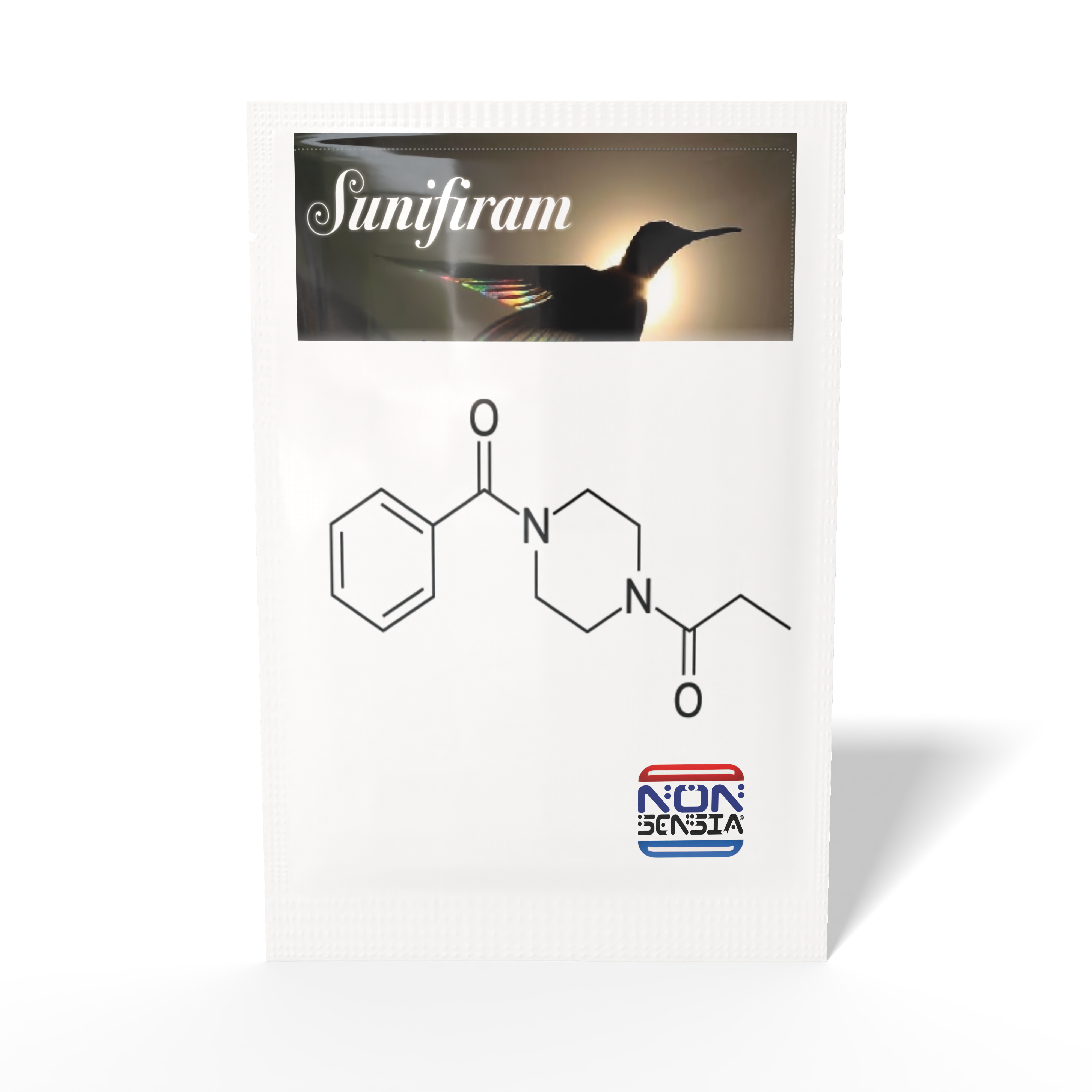
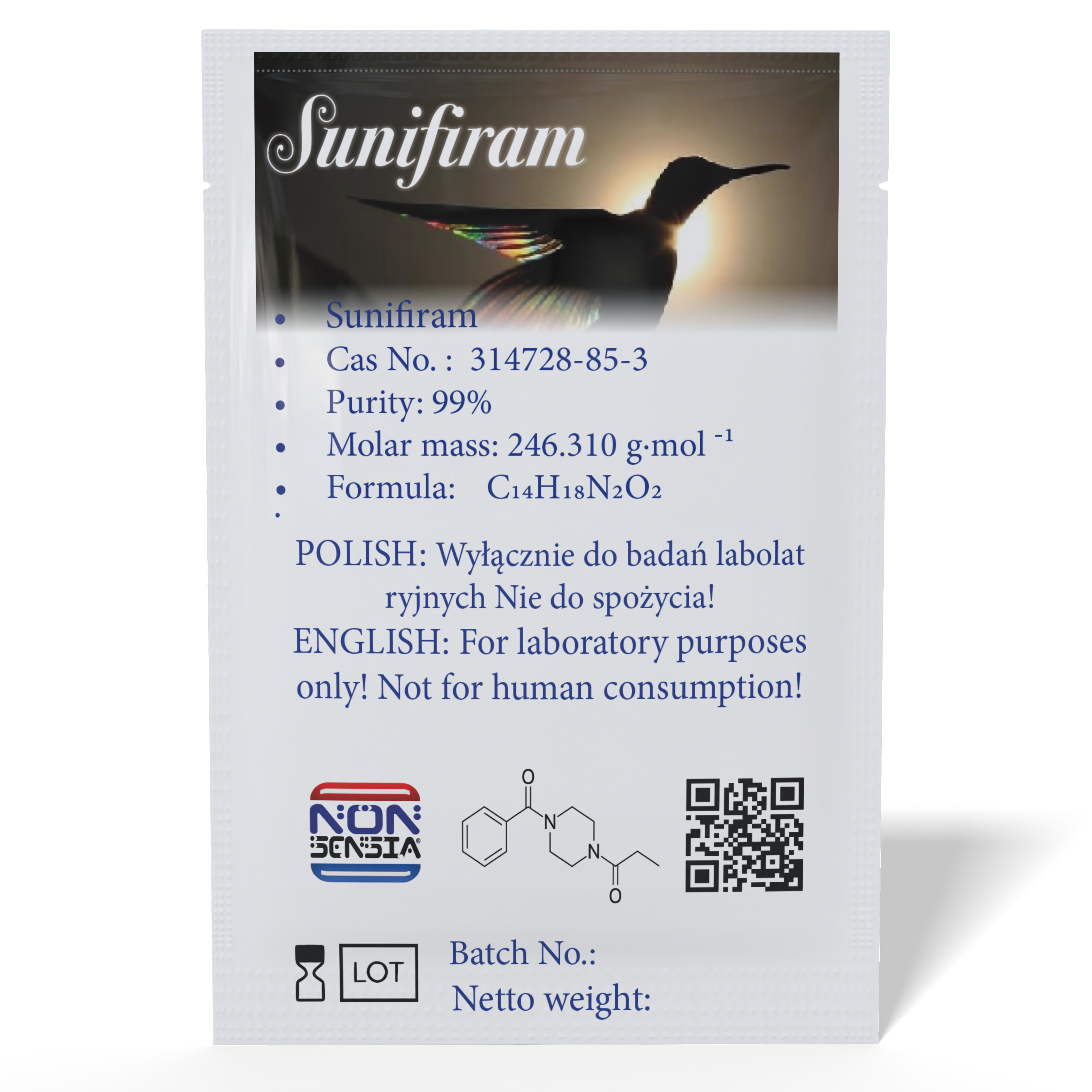
Sunifiram – Analytical Reference Standard | CAS 314728-85-3
30,85 zł – 1158,42 złPrice range: 30,85 zł through 1158,42 zł
Sunifiram (DM-235) Reference Standard — CAS 314728-85-3, C14H18N2O2
1-(4-Benzoylpiperazin-1-yl)propan-1-one supplied for identity confirmation and method development. Laboratory reagent and analytical reference material only — not for human or animal consumption, not a medicinal product, and not registered as a medicine in any jurisdiction.
- Read this first: no validated analytical method for this compound has ever been published — no 1H NMR, no 13C NMR, no LC-MS/MS, no UV spectrum, no high-resolution mass spectrum, no crystal structure. The reference record holds exactly three spectra
- And two of those three share a lot number: the ATR-infrared and the FT-Raman spectra are both annotated to Sigma-Aldrich catalogue D5689, lot 51K4707. They are two techniques applied to one sample, not two independent characterisations
- CAS / CID / UNII / ChEMBL: 314728-85-3 · PubChem 4223812 · 66924E735K · CHEMBL309176 — the CAS number is confirmed by three sources independent of the compound database
- Formula / mass: C14H18N2O2 · 246.31 g·mol−1 on current IUPAC atomic weights (the registry prints 246.30 from an older table) · monoisotopic 246.1368 Da · [M+H]+ 247.1441
- Structural class: a 1,4-diacylpiperazine. It is not a pyrimidine derivative and not a homologue of modafinil; both descriptions circulate in commercial listings and neither is compatible with the deposited structure
- The isomer trap: 1-(4-benzoyl-2-methylpiperazin-1-yl)ethanone has the same formula, the same exact mass, the same polar surface area and the same computed logP — and shares two of sunifiram’s four principal product ions, including the obvious 247 → 105 transition
- What separates them: the propanoyl-side pair. Sunifiram gives 57.0335 and 191.1179; the isomer gives 43.0178 and 205.1335. Build the method on 247 → 191 as well as 247 → 105
- Stereochemistry: achiral — four zero stereodescriptor counts plus an explicit achiral ruling in the FDA substance registry. That makes a chiral column a free correctness test: one peak is expected, and two peaks mean an impurity or a different compound
- No salt form is possible: both nitrogens are amide nitrogens, zero hydrogen-bond donors, no basic centre to protonate. Any hydrochloride, citrate or maleate offered under this name is a different substance
- Hazards: no classification exists at all — zero notifications, no EC number, no REACH registration, no harmonised entry. That is a fact about commerce, not about toxicology
- Status: unscheduled in Poland on the consolidated schedules and on both amendments issued since, most recently that of 7 July 2026; unscheduled in the United States; not named on the WADA 2026 list — but recorded in US forensic casework since June 2018
No experimental melting point, solubility, density or pKa exists in any registry, and one of the sixteen published records on this compound was retracted in August 2026. Full registry data, the isomer analysis, calculated fragmentation, the regulatory measurements with their positive controls, and 38 cited sources are set out below.
Quick Payment
100% New
Fast Delivery
- Additional Information
Product classification — read before ordering. This item is a chemical reagent and analytical reference material. It is not a medicinal product, dietary supplement, food, feed, novel food or cosmetic, and it is not intended for human or animal consumption or for any in-vivo administration whatsoever. It is supplied exclusively to laboratories, research institutions and professional users for in-vitro analytical, chromatographic and method-development work. Scientific findings summarised on this page describe substances investigated in published laboratory research; they are reported here as bibliographic facts about that literature and are not product claims, dosage guidance, or a recommendation of any use of this reagent.
No validated method for this compound has ever been published, and the reference spectra that do exist come from a single commercial sample. Read sections 6 and 7 before ordering. The registry record for sunifiram carries three deposited spectra: one gas-chromatographic mass spectrum, one attenuated-total-reflectance infrared spectrum and one Fourier-transform Raman spectrum. There is no 1H NMR, no 13C NMR, no two-dimensional NMR, no LC-MS/MS, no ultraviolet spectrum and no high-resolution mass spectrum of any kind [1]. The infrared and the Raman spectra are annotated to the same supplier, the same catalogue number and the same lot — Sigma-Aldrich D5689, lot 51K4707 [1]. There is no crystal structure: the crystallographic data centre holds nothing for this substance, on a query that returns a hit for piracetam [10]. There is no entry in the European chemicals inventory at all, and therefore no hazard classification, harmonised or self-declared [8]. Meanwhile the compound has been recorded in United States forensic casework since June 2018 [1]. Sections 6 and 7 set out what that combination means for a laboratory that receives a sample.
Key facts
- Substance
- Sunifiram; development code DM-235; systematically 1-(4-benzoylpiperazin-1-yl)propan-1-one [1]
- Structural class
- 1,4-diacylpiperazine — a fully saturated six-membered ring with nitrogen at positions 1 and 4, each nitrogen carrying an acyl group
- CAS
- 314728-85-3 [1][12][13]
- PubChem CID
- 4223812 [1]
- UNII
- 66924E735K [9]
- ChEMBL
- CHEMBL309176 [11]
- DSSTox
- DTXSID10400996 [12]
- NCI Thesaurus
- C220969 [13]
- Nikkaji
- J1.445.767D [1]
- EC number
- None — no entry in the European inventory [8]
- ChEBI / DrugBank / KEGG / HMDB / DrugCentral / ATC / INN
- None of these exist for this substance [10]
- Formula
- C14H18N2O2 [1][9][11][14]
- Molecular mass
- 246.31 g·mol−1 on current IUPAC atomic weights; the registry prints 246.30, computed from an older table [1][11]
- Monoisotopic mass
- 246.1368 Da (the record carries it as 246.136827821) [1]
- InChIKey
DGOWDUFJCINDGI-UHFFFAOYSA-N[1]- Stereocentres
- None — four zeros in the record, and an explicit achiral ruling in the substance registration system (section 4) [1][9]
- Computed descriptors
- XLogP3 1.1 · TPSA 40.6 Å2 · donors 0 · acceptors 2 · rotatable bonds 2 · heavy atoms 18 [1]
- Experimental properties
- None on record — no melting point, no solubility, no measured logP, no density, no pKa (section 9) [1][7]
- Deposited spectra
- GC-MS, ATR-IR, FT-Raman. No NMR of any kind, no LC-MS/MS, no UV-Vis [1]
- Crystal structure
- None — no entry at the crystallographic data centre [10]
- GHS classification
- None exists — zero notifications, zero registrations (section 13) [1][8]
- WADA 2026
- Not listed by name — and that is not the same as permitted; read section 12 [15]
- Pack sizes
- Eight, from 1 g to 100 g (section 16)
On this page
- What this material is
- Identity and registry codes
- Registers that hold nothing, and the controls that prove the search was real
- Structure and stereochemistry
- The isomer with the same mass, the same logP and one extra stereocentre
- Three spectra, effectively one sample
- Fragmentation predicted from structure, and the transitions nobody published
- What works, what fails, and why
- Physicochemical data: computed only
- Eight hundred and seventy screening results, and the seven that are not negative
- What the literature actually says
- Regulatory status
- Hazard: no classification exists
- Handling and storage
- What we certify and what we do not
- Terms of supply
- Questions and answers
1. What this material is
This page describes sunifiram supplied as an analytical reference material: a weighed quantity of a single identified substance, intended to serve as the point of comparison against which another sample is measured.
Sunifiram is a 1,4-diacylpiperazine — a saturated piperazine ring carrying a benzoyl group on one nitrogen and a propanoyl group on the other. It was reported in 2000 by the medicinal-chemistry group in Florence as compound 13 in a series obtained by molecular simplification of a bicyclic parent, and it was given the laboratory code DM-235 [21]. It has never been registered as a medicine anywhere. It has no international nonproprietary name and no anatomical-therapeutic-chemical code; it holds no marketing authorisation in Poland [19], no entry of any kind in the European chemicals inventory [8], and no place on the United States schedule of controlled substances [20]. Section 12 sets out each of those measurements with its control. All of its published pharmacology is animal, cell or screening work.
That combination is exactly what makes a reference standard for this compound hard to substitute. A substance with a marketing authorisation acquires a pharmacopoeial monograph, an assay method, a limit test and a chain of official reference standards. Sunifiram acquired none of those, because none of the regulatory machinery ever attached to it — and yet it is a real compound that turns up in real samples. The United States forensic laboratory information system records it as an identified substance from June 2018, in the class reserved for substances that are not scheduled [1]. A forensic, customs or quality-control laboratory that meets it therefore has a genuine identification problem and, as the next sections show, remarkably little public material with which to solve it.
The chemist who first synthesised the compound wrote about exactly this situation. In a 2016 retrospective titled “Unifi nootropics from the lab to the web: a story of academic (and industrial) shortcomings”, Gualtieri records that the compounds “were not protected by a patent”, that no company took them into development, and that twelve years after publication he “casually found that on the web, there were dozens of sites offering Unifiram and Sunifiram as drugs that improve cognition in healthy individuals even if only few preclinical studies were done and their long-term toxicity was unknown” [28]. That is the author of the molecule describing the distance between what was measured and what is asserted about it. It is quoted here because it is the most authoritative available statement about the limits of the evidence, and because it is the correct frame for what this article is: a chemical, sold to laboratories, for measurement.
The terms on which this and every other reference material here is supplied are collected in the reference standards category.
2. Identity and registry codes
The identity of this compound is unusually well anchored for a substance with so little else on record. The registry number, the structure key and the regulatory substance identifier all agree, and several of the sources carrying them are independent of the compound database itself.
| Common name | Sunifiram |
|---|---|
| Development code | DM-235 (also written DM 235, DM235) — from the depositor synonym list, not from memory [1] |
| IUPAC name (computed) | 1-(4-benzoylpiperazin-1-yl)propan-1-one [1] |
| Registry title | 1-(4-Benzoyl-1-piperazinyl)-1-propanone [1] |
| Other literature name | 1-benzoyl-4-propanoylpiperazine — the form used in the spectral database [1] |
| CAS Registry Number | 314728-85-3 — carried four times in the record, with no obsolete or superseded variant [1]; independently in the environmental substance dashboard [12], the cancer-institute thesaurus [13] and the structured-data project [14] |
| UNII | 66924E735K — confirmed directly in the regulatory substance registration system, not only through the compound record [9] |
| ChEMBL | CHEMBL309176 [11] |
| DSSTox | DTXSID10400996 (DTXCID90351851) [12] |
| NCI Thesaurus | C220969 [13] |
| Nikkaji | J1.445.767D [1] |
| Wikidata | Q6590525 [14] |
| MDL number | MFCD04112755 — among depositor synonyms only; it does not appear in the record’s identifier section [1] |
| InChI | InChI=1S/C14H18N2O2/c1-2-13(17)15-8-10-16(11-9-15)14(18)12-6-4-3-5-7-12/h3-7H,2,8-11H2,1H3 [1] |
| InChIKey | DGOWDUFJCINDGI-UHFFFAOYSA-N [1] |
| SMILES | CCC(=O)N1CCN(CC1)C(=O)C2=CC=CC=C2 [1] |
One detail in that table is worth pulling out. The record’s connectivity string and its stereochemistry-bearing string are character-for-character identical [1]. For a compound that carries stereochemistry the two differ — the stereo-bearing form contains the bracketed chirality markers that the connectivity form omits. Here they do not differ, and that is a direct, checkable indicator that the deposited structure has no stereochemical layer at all. It is one of four independent lines of evidence for the achirality discussed in section 4, and unlike the InChIKey suffix it is an indicator that actually discriminates.
Names that describe a different molecule
Two descriptions of sunifiram circulate widely in secondary and commercial sources, and both are incompatible with the deposited structure. They are set out here because a laboratory that inherits a sample described in those terms needs to know that the description constrains nothing about the chemistry.
“A pyrimidine derivative.” The ring in sunifiram is a piperazine: fully saturated, with nitrogen atoms at the 1 and 4 positions. Pyrimidine is an aromatic 1,3-diazine. The connectivity string in the table above settles the point without interpretation — the fragment ...15-8-10-16(11-9-15)... describes a six-membered ring in which the two nitrogens are separated by two carbons on either side, with every ring carbon carrying two hydrogens. Wrong ring, wrong nitrogen positions, wrong saturation state. The title of the Florence group’s own 2017 paper places the compound in its class without ambiguity: “Piperazines as nootropic agents: New derivatives of the potent cognition-enhancer DM235 carrying hydrophilic substituents” [29].
“A homologue of modafinil.” Modafinil is C15H15NO2S, monoisotopic mass 273.0823 Da, a diphenylmethylsulfinylacetamide carrying a sulfur atom and a stereocentre at that sulfur [1]. Sunifiram is C14H18N2O2, 246.1368 Da, contains no sulfur, carries two nitrogens rather than one, and is achiral. Homologues differ by a methylene unit on a preserved skeleton; these two skeletons share no common core. The practical consequence is that no chromatographic or mass-spectrometric expectation transfers between them in either direction — protonated modafinil sits at m/z 274.0896 against 247.1441 for sunifiram, and the two are unrelated in retention behaviour as well as in mass.
Descriptions of this kind are not harmless labelling slips. Section 5 shows that there is a real, registered compound which shares sunifiram’s molecular formula, its exact mass, its polar surface area and its computed partition coefficient, and which differs from it in the position of a single methyl group. Against that background, an identification resting on a name rather than on a measurement is not an identification.
3. Registers that hold nothing, and the controls that prove the search was real
Most of what can be said about the public record of this compound is a list of absences. An absence is the easiest kind of finding to get wrong: a query aimed at the wrong place and a query run against a broken instrument produce the same output, a confident nothing. Every negative result below was therefore paired with the same query run against a substance known to be present, and the negative is reported only where the control came back populated.
| Question asked | Sunifiram | Control, same query, same instrument |
|---|---|---|
| Is there an entry in the European chemicals inventory? | Zero records, whether searched by CAS number or by name [8] | Formaldehyde, CAS 50-00-0: full record, 14 items, EC 200-001-8, index number 605-001-00-5 [8] |
| Is there an experimental-properties section in the compound record? | Section absent entirely; only computed values are held. Read from the complete section listing, 90 entries [1] | Piracetam, same listing endpoint: 199 entries, experimental-properties section present [1] |
| Is there a safety and hazards section? | Section absent entirely [1] | Piracetam, same listing endpoint: safety and hazards section present [1] |
| Is there a phase-change or thermochemical entry in the national standards database? | Not found; the CAS-number lookup returns nothing [7] | Formaldehyde, same lookup form: record returned [7] |
| Does a crystal structure exist? | No entry at the crystallographic data centre [10] | Piracetam: entry present [10] |
| Is the substance in the chemical entities ontology, the drug database, the metabolite database, the pharmacology guide, the binding database, the clinical-trial index or the drug-central index? | Absent from all seven [10] | Piracetam: present in all seven, from the same cross-reference service [10] |
| Is it an authorised medicine in Poland? | Zero results [19] | Paracetamol: 43 results; piracetam: 2; the brand Nootropil: 15 [19] |
| Is it in the Polish controlled schedules, on the law as currently amended? | Zero occurrences in the consolidated text and in both subsequent amending regulations [16][17][18] | Consolidated text: amphetamine stem 27 occurrences, cocaine 2, and six substances that appear only on the new-psychoactive-substances annex all present [16] |
| Is it a controlled substance in the United States? | Zero occurrences in the alphabetical schedule listing [20] | Same document, counted as matching lines: amphetamine 25, fentanyl 68, modafinil 1 (Schedule IV); piracetam 0, as expected for an uncontrolled compound [20] |
| Is it on the anti-doping list for 2026? | Zero occurrences by name or by development code [15] | Same document: bromantan 2, modafinil 4, meldonium 2 [15] |
| How large is the published literature? | 16 records in the biomedical index, for the name and every code variant combined [1] | Piracetam, same index and same query form: 4032 records |
Every control fired. The zeros above are therefore findings about the world rather than artefacts of the search. Where a control could not be constructed, the honest verdict is not established, and it appears as such in section 15 rather than being quietly rounded down to none.
Two absences worth naming individually
The cross-reference count. A structure-key lookup across the major chemistry resources returns eight sources for sunifiram and eighteen for piracetam [10]. The ten that piracetam has and sunifiram does not are, precisely: the crystallographic data centre, the binding database, the chemical entities ontology, the clinical-trial index, the drug database, the drug-central index, the pharmacology guide, the human metabolome database, and both protein-structure archives. That list is not a rhetorical flourish. It is a map of the things a laboratory would normally consult and will find empty here: no solved solid-state structure, no measured binding constants, no curated metabolism, no trial record.
The Polish legal position was measured on the law as it currently stands. The consolidated text of the Polish schedules dates from 2024 [16], and it has since been amended twice — by the regulation of 30 April 2025 [17] and by the regulation of 7 July 2026, promulgated on 13 July 2026 [18]. A consolidated text cannot, by construction, show anything added after it was consolidated, so all three documents were searched. Sunifiram, unifiram, the code DM-235 and the CAS number return zero occurrences in each of the three. The controls are described in the table above and in section 12.
4. Structure and stereochemistry
Sunifiram is a piperazine ring acylated on both nitrogen atoms: a benzoyl group on one, a propanoyl group on the other. Both nitrogens are therefore amide nitrogens. There is no basic nitrogen anywhere in the molecule and no hydrogen-bond donor of any kind, which has consequences that run through the whole of the analytical discussion below.
| Defined atom stereocentre count | 0 |
|---|---|
| Undefined atom stereocentre count | 0 |
| Defined bond stereocentre count | 0 |
| Undefined bond stereocentre count | 0 |
| Isotope atom count | 0 |
| Formal charge | 0 |
| Covalently bonded units | 1 — a single molecule, no counter-ion |
| Rotatable bonds | 2 |
The molecule is achiral, and unusually for a compound this thinly documented, that conclusion rests on more than one instrument. Four zeros in the compound record [1]. An explicit ruling in the regulatory substance registration system, which records the substance as achiral, with no optical activity and zero stereocentres — a registrar’s determination rather than an automated count [9]. The identity of the connectivity and stereo-bearing structure strings noted in section 2 [1]. And the absence of any second registry entry that would correspond to a resolved enantiomer [1].
What does not prove achirality, and why it matters. The final block of the InChIKey for sunifiram is UHFFFAOYSA, which is often read as meaning “no stereochemistry”. It does not carry that meaning reliably. Modafinil, which has an undefined stereocentre at sulfur, has the key YFGHCGITMMYXAQ-UHFFFAOYSA-N; unifiram, which has an undefined stereocentre of its own, has SNRTZFZAFBIBJP-UHFFFAOYSA-N [1]. Both end in the same block as sunifiram. The suffix says something about how the standard key was generated, not about whether the molecule is chiral. A test that returns the same answer for a chiral compound as for an achiral one is not a test. The four counts and the registrar’s ruling are what carry the conclusion here.
Why there is no stereocentre, and where the one in the parent compound went
Sunifiram was obtained by opening the bicyclic framework of an earlier compound. Its direct predecessor, unifiram (code DM-232), is a 1,4-diazabicyclo[4.3.0]nonanone bearing a stereogenic ring-fusion carbon; simplifying that bicycle to a plain piperazine removed the carbon that carried the stereochemistry [21]. What remains is a ring with a mirror plane through the two nitrogen atoms, two sp2 amide nitrogens that cannot invert as chirality elements, and no carbon bearing four different substituents. There is nothing left to be stereogenic.
The contrast with unifiram is not academic. Unifiram is C13H15FN2O3S with one undefined atom stereocentre in its record [2], and its enantiomers were prepared separately from (S)- and (R)-5-(hydroxymethyl)-2-pyrrolidinone, resolved to better than 99.9 % enantiomeric excess and checked by capillary electrophoresis; the (R)-(+) form was reported as three- to tenfold more potent than the (S)-(−) form in the animal assay used [25]. That paper is the only stereochemical work in the entire corpus on this compound family, and it is about the other compound.
A test you can run on the material in front of you. Because sunifiram is achiral, a chiral stationary phase should give one peak. If your sample resolves into two on a chiral column, you have not found enantiomers of sunifiram, because sunifiram has none. You have found either an impurity, or a different compound — and section 5 describes a same-formula, same-mass candidate that does carry a stereocentre and would be expected to behave exactly that way. This is a rare thing in analytical chemistry: a cheap, structure-derived correctness test with an unambiguous expected outcome. It requires only a chiral column and a reference material whose achirality is documented, which is one concrete reason to hold an authenticated standard rather than an unverified sample.
Achirality also disposes of a class of claim outright. There is no dextrorotatory sunifiram, no laevorotatory form, no R or S designation, no enantiomeric excess to specify, no racemate, and no chiral impurity to control. Any specification, certificate or listing that quotes an optical rotation for this compound is describing something that cannot exist for it. The situation is the reverse of tadalafil, where two defined centres generate four separately registered stereoisomers and the whole analytical burden falls on separating them; here the entire chiral budget is free, and it should be spent on the constitutional problem instead.
5. The isomer with the same mass, the same logP and one extra stereocentre
Accurate mass is the reflex answer to an identity question, and for this compound it is a much weaker answer than it looks. A formula search of the compound registry for C14H18N2O2 returns 27 746 records [1]. Every one of them has the monoisotopic mass 246.1368 Da, because they are the same set of atoms. Accurate mass does not identify sunifiram; it narrows the field to roughly twenty-eight thousand candidates.
Most of those are chemically remote and would never be confused with it. A small number are not. Searching that formula space for diacylpiperazines specifically — the same structural class, built from the same two-step chemistry — returns registered compounds that a method built around mass alone will not separate from the target.
| Compound | CID | Acyl groups | Stereocentres | XLogP3 | TPSA |
|---|---|---|---|---|---|
| Sunifiram | 4223812 [1] | benzoyl + propanoyl, on N1 and N4 | 0 / 0 | 1.1 | 40.6 Å2 |
| 1-(4-Benzoyl-2-methylpiperazin-1-yl)ethanone | 10824330 [4] | benzoyl + acetyl, on a 2-methylpiperazine | 0 defined, 1 undefined | 1.1 | 40.6 Å2 |
| 1-Acetyl-4-[(4-methylphenyl)carbonyl]piperazine | 27046747 [5] | 4-methylbenzoyl + acetyl | 0 / 0 | 1.0 | 40.6 Å2 |
| 1-[4-(2-Methylbenzoyl)piperazin-1-yl]ethanone | 71684148 [6] | 2-methylbenzoyl + acetyl | 0 / 0 | 1.7 | 40.6 Å2 |
| 1-(4-Acetylpiperazin-1-yl)-2-phenylethanone | 71684146 [6] | phenylacetyl + acetyl | 0 / 0 | 0.6 | 40.6 Å2 |
Read the second row carefully. 1-(4-Benzoyl-2-methylpiperazin-1-yl)ethanone has the same molecular formula as sunifiram, the same monoisotopic mass to all twelve figures the registry prints, the same topological polar surface area, the same computed partition coefficient to the decimal place, and an InChIKey ending in the same final block [4]. It differs from sunifiram in one respect that a mass spectrometer cannot see: the methyl group that sunifiram carries on the propanoyl chain sits instead on the piperazine ring, at the 2-position. That single relocation creates a stereogenic carbon, which is why its record shows one undefined atom stereocentre where sunifiram shows zero.
The two facts in that row belong together. First: the compound is invisible to accurate mass, to polar-surface-area reasoning and to logP-based retention prediction, because it matches sunifiram on all three. Second: it is visible to a chiral column, because it has a stereocentre and sunifiram does not. This is why the chiral-column test in section 4 is worth running even though nobody expects sunifiram to be chiral. The test is not looking for enantiomers of the target — it is looking for the thing that would resolve into two peaks where the target gives one. A single measurement answers a question that mass spectrometry cannot reach.
Section 7 sets out the second discriminator: the two acyl groups fragment to different ions, and one pair of transitions separates sunifiram from this isomer while another pair does not. Getting that distinction right is the practical content of the whole analytical section.
The label under which this compound travels
Sunifiram is sold, discussed and shipped under the collective label racetams. That label groups compounds with quite different formulas, masses and functional groups, and the grouping is commercial rather than chemical — sunifiram is a diacylpiperazine and contains no 2-pyrrolidinone ring at all, which is the structural feature the name refers to.
| Compound | Formula | Monoisotopic mass | Protonated m/z |
|---|---|---|---|
| Sunifiram | C14H18N2O2 | 246.1368 | 247.1441 |
| Aniracetam | C12H13NO3 | 219.0895 [3] | 220.0968 |
| Oxiracetam | C6H10N2O3 | 158.0691 | 159.0764 |
| Pramiracetam | C14H27N3O2 | 269.2103 | 270.2176 |
| Noopept | C17H22N2O4 | 318.1580 | 319.1652 |
| Coluracetam | C19H23N3O3 | 341.1739 | 342.1812 |
| Unifiram (DM-232) | C13H15FN2O3S | 298.0787 [2] | 299.0860 |
Those masses are far apart, and any instrument of ordinary resolving power separates them without effort. That is precisely the point worth making: the risk in this family is not that the measurement cannot distinguish them, but that no measurement is made. When a sample arrives labelled with a trade name and the assignment is taken from the label, the mass differences never come into play. Cohen and colleagues measured what that produces in this exact category of product: of twelve items examined by untargeted liquid chromatography with quadrupole time-of-flight detection, 75 % (9 of 12) of declared quantities were inaccurate, undeclared drugs were present, and declared drugs were absent [33]. Their study looked for omberacetam, aniracetam, phenylpiracetam and oxiracetam — sunifiram was not among the analytes and was neither sought nor found — so it is cited here as a measurement of how reliable labelling is in this product class, not as a finding about this substance.
Two further surveys describe the same market from a different angle. Schifano and colleagues place unifiram analogues among the compounds most often encountered in this space and record that reported benefits in healthy individuals are “uncertain and any reported improvement temporary”, alongside cardiovascular and psychopathological risks [34]. Napoletano and colleagues describe the online supply chain through which these compounds move [35]. A Polish group surveyed the domestic supplement market and catalogued 120 synthetic substances with claimed effects on cognition, 45 of them with unclear status, concluding that the term used to market them “currently serves more as a marketing tool than as a concept describing a group of substances with scientifically proven cognitive effects” [36]. We cite that last work from its abstract only; we were not able to search its full text with a working control, and we do not claim that sunifiram appears in its tables. A separate study on a different compound from the same market demonstrates the analytical approach that such work requires [37].
6. Three spectra, effectively one sample
For a substance sold as an analytical reference material, the state of the deposited spectral record is the most important thing on the page. Here it is short enough to print in full.
| Technique | Present | Provenance as recorded |
|---|---|---|
| GC-MS, electron ionisation | Yes | Technique GC/MS; source of spectrum DigiLab GmbH, 2024; copyright DigiLab and Wiley-VCH, 2024–2025. No sample provenance recorded |
| Infrared, ATR | Yes | Instrument Bio-Rad FTS; technique ATR-Neat (DuraSamplIR II); source of spectrum Forensic Spectral Research; source of sample Sigma-Aldrich, catalogue D5689, lot 51K4707 |
| Raman | Yes | Technique FT-Raman; source of spectrum Forensic Spectral Research; source of sample Sigma-Aldrich, catalogue D5689, lot 51K4707 — the same catalogue number and the same lot as the infrared |
| 1H NMR | No | No NMR subsection exists in the record at all |
| 13C NMR | No | — |
| Two-dimensional NMR (COSY, HSQC, HMBC) | No | — |
| LC-MS and LC-MS/MS | No | No electrospray fragmentation spectrum, no product-ion transitions |
| High-resolution mass spectrum | No | — |
| Ultraviolet-visible | No | No absorption maximum, no molar absorptivity |
| Powder diffraction, solid-state NMR | No | No polymorph information of any kind; consistent with the absence of a crystal structure [10] |
The table was read from a complete listing of the record’s sections, not from a keyword search, so the absences are structural rather than inferred: the spectral part of the record contains exactly three subsections, and none of them is an NMR subsection [1].
The provenance line is the finding, not a footnote. Two of the three spectra — the infrared and the Raman — are annotated to the same supplier, the same catalogue number and the same lot number, 51K4707. Whatever material was in that container is the material behind both spectra. They are not two independent characterisations of sunifiram; they are two techniques applied to one sample. If that sample were misidentified, mislabelled or impure, both spectra would carry the error and would agree with each other perfectly, because agreement between an infrared and a Raman spectrum of the same vial tells you nothing about what is in the vial. There is no second, independently sourced solid-phase spectrum anywhere in the record against which to check it.
This is a different kind of gap from a simple absence, and it deserves the distinction. A missing spectrum announces itself: you look, nothing is there, you know where you stand. A spectral record consisting of one sample presented as a reference looks complete from a distance. A laboratory that matches its material against the deposited infrared spectrum and gets a good fit has established that its material resembles the contents of a Sigma-Aldrich container from lot 51K4707 — which is useful, and is not the same as establishing that its material is sunifiram.
The comparison across this catalogue makes the scale clear. Chlodantane has no deposited spectrum of any kind, which at least leaves no room for false confidence. Mebicar has proton NMR, carbon NMR and an electron-ionisation spectrum, but only a vapour-phase infrared, so nothing describes it as a solid. Sunifiram sits between them and is in some ways the more awkward case: it has two solid-phase spectra of good technique, and they share a single origin.
What follows for a laboratory that buys a standard
Because there is no independent reference, the first well-characterised measurement made on authenticated material effectively becomes the reference for the organisation that makes it. Two things follow.
Record more than you normally would. For a compound with a monograph, a retention time and two transitions suffice, because the monograph carries the rest. Here nothing carries the rest. A full set — 1H and 13C with assignments, an accurate-mass measurement, a product-ion spectrum with collision energies, a solid-phase infrared, and a melting range — costs an afternoon and becomes the only description of this substance your organisation will hold. Every one of those measurements is currently absent from the public record, which means yours has value beyond your own laboratory.
Check your first measurement against itself. With no external comparison available, the only available check is agreement between independent techniques on the same material: does the accurate mass match the formula, does the 13C spectrum account for all fourteen carbons once the ring symmetry is allowed for — and note that restricted rotation about the two amide bonds commonly broadens or doubles the piperazine ring signals, so a clean count is not guaranteed at room temperature — does the product-ion spectrum show both acyl fragments predicted in section 7, and does a chiral column give one peak. Four techniques that agree constitute an identification. One technique returning an expected number does not — and with an isomer that matches on mass, on polar surface area and on computed logP (section 5), a single expected number is precisely the situation in which a mislabelled vial passes unnoticed.
7. Fragmentation predicted from structure, and the transitions nobody published
Sunifiram has an unusually convenient fragmentation logic and, at present, no published fragmentation data at all. The molecule is a piperazine carrying two different acyl groups. Cleaving either amide bond gives an acylium ion and a complementary protonated amine fragment, so the four principal product ions come in two complementary pairs whose masses add up in a way that can be checked arithmetically.
| Ion | Composition | m/z | Origin |
|---|---|---|---|
| Precursor, [M+H]+ | C14H19N2O2+ | 247.1441 | Protonation, most plausibly at a carbonyl oxygen |
| Benzoyl acylium | C7H5O+ | 105.0335 | Cleavage of the benzoyl amide bond |
| Complement of the above | C7H15N2O+ | 143.1179 | Protonated 1-propanoylpiperazine; 247.1441 − 143.1179 = 104.0262, a neutral of composition C7H4O. Note that the benzoyl group has no α-hydrogen, so the ketene route open on the propanoyl side is not available here; expect this complement to be the weaker of the two, with the charge preferentially retained on the acylium at 105.0335 |
| Propanoyl acylium | C3H5O+ | 57.0335 | Cleavage of the propanoyl amide bond |
| Complement of the above | C11H15N2O+ | 191.1179 | Protonated 1-benzoylpiperazine; 247.1441 − 191.1179 = 56.0262, the mass of methylketene |
| Phenyl cation | C6H5+ | 77.0386 | Secondary loss of carbon monoxide from the benzoyl acylium |
Note the internal arithmetic: 105.0335 and 143.1179 sum to 248.1514, which is the precursor plus one proton, as they must, because the pair partitions the protonated molecule with charge retention on either side. The same holds for 57.0335 and 191.1179. That consistency is a check you can apply to your own spectrum before you trust it.
Which transitions to use, and which one is a trap. The obvious choice, 247.1441 → 105.0335, is a strong and characteristic transition — and on its own it does not separate sunifiram from 1-(4-benzoyl-2-methylpiperazin-1-yl)ethanone [4], the same-formula isomer from section 5. That isomer also carries a benzoyl group, and therefore also produces the benzoyl acylium at 105.0335 from the same precursor mass. Worse, its complementary fragment — protonated 1-acetyl-2-methylpiperazine — has the composition C7H15N2O+, which is the same composition and therefore the same m/z, 143.1179, as sunifiram’s propanoyl-side complement. Two of the four principal transitions are shared. The pair that does discriminate is the other one: sunifiram gives the propanoyl acylium at 57.0335 and protonated benzoylpiperazine at 191.1179, whereas the isomer gives an acetyl acylium at 43.0178 and protonated benzoyl-2-methylpiperazine at 205.1335. A quantitative method for this compound should be built on 247 → 191 as well as 247 → 105, and not on 247 → 105 alone.
| Compound | Acylium A | Acylium B | Complement A | Complement B |
|---|---|---|---|---|
| Sunifiram [1] | 105.0335 benzoyl | 57.0335 propanoyl | 191.1179 | 143.1179 |
| Benzoyl-2-methylpiperazine acetyl [4] | 105.0335 benzoyl — shared | 43.0178 acetyl | 205.1335 | 143.1179 — shared |
| 4-Methylbenzoyl acetyl [5] | 119.0491 toluoyl | 43.0178 acetyl | 205.1335 | 129.1022 |
| 2-Methylbenzoyl acetyl [6] | 119.0491 toluoyl | 43.0178 acetyl | 205.1335 | 129.1022 |
| Phenylacetyl acetyl [6] | 119.0491 phenylacetyl | 43.0178 acetyl | 205.1335 | 129.1022 |
Two of those isomers, the toluoyl and the phenylacetyl compounds, give an acylium of the same nominal and the same exact composition, C8H7O+ at 119.0491, so accurate mass does not separate them from each other either. They should, however, differ in secondary fragmentation: a phenylacetyl group has a benzylic bond and would be expected to give a tropylium ion at 91.0542, while a methylbenzoyl group would not do so readily. That expectation is a structural inference and is not backed by any deposited spectrum, which is exactly the point of this section.
One further caution at unit resolution. Sunifiram’s complementary fragment at 143.1179 sits at the same nominal mass as protonated piracetam, 143.0815. The difference is 0.036 Da — comfortably resolved above about four thousand resolving power, and not resolved at all on a unit-resolution quadrupole. In a mixed sample from this product category, a nominal m/z 143 signal is therefore ambiguous between a sunifiram fragment and a piracetam precursor. Use the accurate mass, or use 191.1179 instead.
Every number in this section is calculated from the molecular formula using standard nuclide masses, and every one is labelled as such. None of it is a deposited measurement, because no deposited measurement exists. If your spectrum disagrees with these predictions, the first hypothesis to test is that the prediction is incomplete — collision energies, adduct formation and in-source fragmentation all shift what is actually observed — and the way to settle it is the internal-consistency check described in section 6.
8. What works, what fails, and why
The computed descriptors read as an instruction manual for method development if they are read in the right order: XLogP3 1.1, TPSA 40.6 Å2, zero hydrogen-bond donors, two acceptors, two rotatable bonds, formal charge zero, and no ionisable group in any ordinary aqueous range [1].
| Approach | Verdict | Reason |
|---|---|---|
| Reversed-phase C18 retention | Workable | logP 1.1 is modest but sufficient for retention on a well-chosen gradient. Expect early-to-middle elution; the compound is far more polar than most of this catalogue |
| pH manipulation of retention or of ionisation | Unavailable | Both nitrogens are amide nitrogens. There is no basic centre, so there is nothing to protonate and mobile-phase pH is not a lever |
| Ion-pairing | Unavailable | No permanent or accessible charge to pair with |
| Salt formation | Impossible | Zero hydrogen-bond donors and no basic nitrogen. There is no site for acid addition, so hydrochloride, citrate, fumarate and maleate forms of this compound cannot exist. Any listing offering one is describing a different substance |
| Derivatisation at N–H | Unavailable | There is no N–H. Both nitrogens are fully acylated. Compare procaine hydrochloride or L-DOPA, where a free amine offers exactly this handle |
| Ultraviolet detection | Workable but undocumented | The benzamide chromophore absorbs, but no ultraviolet spectrum is deposited: no absorption maximum, no molar absorptivity [1]. Determine both on your own instrument. Contrast methylene blue, where the chromophore is the identity |
| Electrospray mass spectrometry | The sensible detector | Protonation at a carbonyl oxygen is straightforward and gives 247.1441. Section 7 sets out the transitions — but note that no product-ion spectrum has ever been deposited |
| Gas chromatography with electron ionisation | Viable | A reference spectrum exists [1]. It is the only deposited mass spectrum of any kind for this compound |
| Chiral chromatography | Diagnostic, not separative | Sunifiram is achiral, so one peak is the expected result. Two peaks indicate an impurity or a different compound — see sections 4 and 5 |
| Quantitative 1H NMR | Well suited, and unanchored | The molecule has no exchangeable protons at all, so integration is not complicated by solvent exchange, and the aromatic multiplet and the ethyl triplet-quartet pair are well separated. Expect the four piperazine methylenes to be broadened by restricted amide rotation. There is no deposited proton spectrum to compare against |
| Infrared or Raman identity check | Possible, with the caveat in section 6 | Both reference spectra trace to a single supplier lot |
| Powder diffraction identity check | Unavailable | No crystal structure, no reference pattern, no polymorph data [10] |
Three of those rows deserve a sentence apiece, because they are the ones most often got wrong.
Zero donors is a structural statement, not a computed guess. The count of zero hydrogen-bond donors follows directly from the structure: both nitrogens carry acyl groups, so neither has a hydrogen. That is why no salt form is possible, why no pH lever exists, and why the exchangeable-proton experiments that resolve many identity questions have nothing to work with here. It is one of the few descriptor values on this page that is not merely a calculation but a direct consequence of the connectivity.
The absent ultraviolet spectrum is a practical obstacle, not a curiosity. Diode-array detection is the default in most quality-control laboratories, and it requires a reference absorption maximum. There is none on record for this compound. You can measure it in an afternoon, and until you do, a peak identified by ultraviolet retention alone has been identified against nothing.
Gas chromatography carries the only deposited mass spectrum. That makes it the technique with a genuine external reference — the single point in this whole discussion where a library comparison is available. Its provenance is not annotated with a sample source, unlike the infrared and Raman entries, so its independence from the same commercial material cannot be established either way.
9. Physicochemical data: computed only
The compound record contains no experimental properties section. Under physical and chemical properties there are computed values and a chemical-class annotation, and nothing else [1]. The national standards database holds nothing for this compound at all: the registry-number lookup returns “Registry Number Not Found”, while the same lookup for formaldehyde returns a full record including phase-change data [7]. There is no melting point, no boiling point, no density, no measured partition coefficient, no pKa, no vapour pressure, no refractive index, no measured solubility in water or in any organic solvent, and no stability or reactivity study.
| XLogP3 | 1.1 |
|---|---|
| Topological polar surface area | 40.6 Å2 |
| Hydrogen-bond donors | 0 — both nitrogens fully acylated |
| Hydrogen-bond acceptors | 2 — the two carbonyl oxygens |
| Rotatable bonds | 2 |
| Heavy atoms | 18 |
| Complexity | 303 |
| Formal charge | 0 |
| Isotope atom count | 0 |
| Covalently bonded units | 1 |
| Exact and monoisotopic mass | 246.136827821 Da — identical values, as expected with no isotopic labelling |
Two molecular masses, both defensible
The average molecular mass of this compound is quoted in two forms, and the difference is real rather than a transcription error. The compound record prints 246.30 [1]. Recomputing the formula from the current IUPAC abridged atomic weights — carbon 12.011, hydrogen 1.008, nitrogen 14.007, oxygen 15.999 — gives 246.310, which rounds to 246.31; the bioactivity database independently lists 246.31 [11]. Using an older atomic-weight table (carbon 12.0107, hydrogen 1.00794, nitrogen 14.0067, oxygen 15.9994) reproduces 246.305, which rounds to the registry value. Both numbers are arithmetically correct; they differ because they rest on different editions of the same table.
We print both rather than choosing, because a certificate quoting one and a downstream system reconciling against the other will report a mismatch that is not a mismatch. The monoisotopic mass is unaffected by this and is the value to use for any mass-spectrometric work: 246.1368 Da. The record carries it to twelve significant figures; that precision has no physical meaning for a laboratory measurement and we do not reproduce it in working contexts.
What may and may not be inferred
From the computed set it is legitimate to conclude that the compound is moderately lipophilic, conformationally fairly rigid, incapable of donating a hydrogen bond, and non-ionisable across the usual aqueous range. From the same set it is not legitimate to derive a melting point, a numerical solubility, a density or a shelf life, because those are experimental quantities and no experiment is on record.
Figures that circulate without a source. Descriptions of physical appearance, purity values quoted to two decimal places, and open-container stability periods for this compound appear in commercial listings and in secondary compilations. None of them can be traced to a registry, a monograph or a published method, and no assay method for this substance exists in the public literature at all, which makes a purity figure specified to a hundredth of a percentage point technically unsupportable regardless of who prints it. The physical characterisation of the compound is most plausibly in the experimental section of the 2000 synthesis paper [21], which sits behind a paywall and which we have not read. We do not reproduce a number we have not seen, and we do not replace an unsourced figure with a better-sounding one.
10. Eight hundred and seventy screening results, and the seven that are not negative
The only body of experimental data attached to this compound in any public database is high-throughput screening. The bioassay summary for the compound contains 870 rows, distributed as follows [1]:
| Outcome | Rows | Share |
|---|---|---|
| Inactive | 793 | 91.1 % |
| Unspecified | 46 | 5.3 % |
| Inconclusive | 24 | 2.8 % |
| Active | 7 | 0.8 % |
| Total | 870 | 100 % |
The counter that produced those figures was checked against piracetam through the same interface, which returns ten active assay identifiers where sunifiram returns seven — so the instrument distinguishes an active outcome from an inactive one, and the number seven is a measurement rather than a default.
Those seven are worth naming, because a screening panel that is 91 % inactive is easy to summarise as “nothing found”, and that summary would be false.
| Assay | Target or organism | Reported value | Type |
|---|---|---|---|
| Five antiplasmodial assays | Plasmodium falciparum, strains 3D7, D10, GB4, HB3 and W2 | IC50 3.16–3.98 µM | Confirmatory, from a published genetic-mapping study [32] |
| One receptor screen | Human muscarinic acetylcholine receptor M4 (gene identifier 1132, protein NP_000732) — recorded as an antagonist outcome | No value recorded | Primary fluorescence-based cell screen |
| One enzyme screen | Human quiescin sulfhydryl oxidase 1 | No value recorded | Primary high-throughput screen |
How much weight these carry, stated plainly. Very little on their own, and that is not a way of dismissing them. Five of the seven come from one published survey in which a large compound collection was profiled against malaria parasites [32]; a mid-micromolar IC50 in such a screen is a weak result and is common among structurally unremarkable compounds. The remaining two are primary screens — the first pass of a campaign, before any confirmation, dose-response or counter-screen. Primary screening data carries a well-known false-positive rate, and an unconfirmed hit is a candidate for follow-up, not a property of the molecule. We report them because they exist and because reporting the panel as uniformly negative would be inaccurate. We attach no pharmacological conclusion to them whatsoever, and neither should anyone else without the confirmatory work that has not been done.
One point about the muscarinic screen is worth recording for completeness, because it is the sort of detail that gets lost when a panel is summarised: the recorded outcome is an antagonist outcome at a cholinergic receptor. The published animal literature on this compound describes activity in the opposite direction, against experimentally induced amnesia including amnesia induced by the muscarinic antagonist scopolamine [22]. An unconfirmed primary screening hit does not overturn a body of animal work, and a body of animal work does not make a screening hit disappear. Both are on the record, they point in different directions, and neither has been followed up. That is the honest state of the evidence.
There is one more absence to record here. A search of the United States adverse-event reporting system returns no reports for this substance, against 111 340 for paracetamol on the same query. That is a fact about reporting rather than about safety: an unapproved substance that is not dispensed as a medicine generates no pharmacovigilance record, whatever its properties. No toxicological package for this compound has been published; the 2016 retrospective by its originator states that long-term toxicity was unknown [28], and the encyclopaedic summary of the compound records that as of 2016 it “had not been subjected to toxicology testing, nor to any human clinical trials, and is not approved for use anywhere in the world” [38].
11. What the literature actually says
The corpus on sunifiram is small enough to count. The biomedical index returns 16 records for the name and every code variant combined; a cross-publisher bibliographic search returns 10. Both counts were reproduced with a working control on the same query form. For comparison, the same index returns 4032 records for piracetam. This is not a body of literature with a review layer, a controversy and a consensus; it is a short shelf, produced almost entirely by one group over about seventeen years.
The primary series
Manetti and colleagues, 2000 [21] is the paper in which the compound first appears, as compound 13 in a series obtained by simplifying a 1,4-diazabicyclo[4.3.0]nonan-9-one framework to a piperazine. The abstract states that compound 13 “shows outstanding potency, being active at a dose of 0.001 mg kg(-1) sc.” in the animal assay used. This is also the most likely location of any physical characterisation of the substance — melting point, synthetic yield, elemental analysis — but the experimental section is behind a paywall and we have not read it, so we quote no number from it.
Ghelardini and colleagues, 2002 [22] is the first full pharmacological description. It reports activity in the mouse passive-avoidance test at 0.001–0.1 mg per kilogram intraperitoneally and 0.01–0.1 mg per kilogram orally, against amnesia induced by scopolamine, mecamylamine, baclofen and clonidine, and states that “its potency is about 1,000 times higher than that of the most active piracetam-like compounds”. Every measurement in it is in mice.
Galeotti and colleagues, 2003 [23] implicates AMPA-receptor activation in the antiamnesic effect of both compounds in the series. Scapecchi and colleagues, 2004 [24] is the structure-activity study and is discussed separately below. Martini and colleagues, 2005 [25] is the enantioselective synthesis of unifiram, discussed in section 4. Romanelli and colleagues, 2006 [26] reviews both compounds, describes them as four orders of magnitude more potent than piracetam in the assays used, and adds a constraint that is easy to miss: they act “although not showing affinity in binding studies for the most important central receptors or channels”.
Moriguchi and colleagues, 2013 [27] reports enhancement of hippocampal synaptic efficacy through the glycine-binding site of the NMDA receptor, with a bell-shaped concentration-response peaking near 10 nM, blocked by 7-chlorokynurenate and unaffected by ifenprodil. Martino and colleagues, 2017 [29] is the most recent synthetic work from the group and carries two mass-spectrometrists among its authors — the closest this corpus comes to analytical chemistry, and a measure of how far from a validated assay it remains.
The single most useful thing in this literature for a laboratory is a negative result. Scapecchi and colleagues found that within the same structure-activity series, two closely related compounds were amnesic rather than antiamnesic — the opposite sign of effect — and nearly equipotent with scopolamine in the assay used [24]. That is not a quantitative gradation across a series; it is a reversal produced by a small substituent change. The practical consequence is severe and specific: an identification of the form “something from the sunifiram series” carries no information at all about what the material does. Identification has to be to the structure, and identification to the structure requires a reference material with a closed identity chain.
The literature gets the skeleton wrong too
The 2013 paper referred to above opens by describing sunifiram as a “pyrrolidone nootropic drug” [27]. The compound contains no pyrrolidinone ring; it is a diacylpiperazine, as the group that made it states in the title of its own later paper [29]. The error is minor in its context and does not affect the electrophysiology reported, but it is worth recording for a reason that has nothing to do with criticising the paper: if a peer-reviewed journal can misassign the ring system, then a sample description that names the ring system is not evidence about the ring system. The only durable anchor is the identity chain — CAS 314728-85-3, InChIKey DGOWDUFJCINDGI-UHFFFAOYSA-N, UNII 66924E735K — tied to a material you have measured.
One paper in this corpus has been retracted
Do not cite Agha and colleagues, 2022. The paper “Novel Sunifiram-carbamate hybrids as potential dual acetylcholinesterase inhibitor and NMDAR co-agonist”, published in the Journal of Enzyme Inhibition and Medicinal Chemistry [30], was retracted on 7 August 2026 by a statement of retraction in the same journal [31]. The retraction is confirmed in both directions in the publisher metadata: the article record carries the prefix “RETRACTED ARTICLE” and an update pointer to the retraction notice, and the notice carries a matching pointer back to the article. In a corpus of sixteen records, one retraction is more than six per cent of everything published about this compound. Anyone assembling a bibliography from a title search will pick it up, because retracted work continues to appear in search results; it is listed in the references below solely so that it is recognisable, and it should not be used as a source for any claim.
What the literature does not contain
No validated analytical method. No pharmacokinetic study of any kind. No metabolism or metabolite identification. No toxicological package. No human study. No crystal structure or polymorph screen. No stability or forced-degradation data. Each of those is a measured absence, established as described in section 3, and together they are the reason this page spends more space on how to measure the compound than on what the compound does.
12. Regulatory status
Every statement in this section was measured against a named document with a positive control on the same document. The documents and the controls are listed in section 3.
| European chemicals inventory | No entry at all. No EC number, no registration, no notification, no harmonised classification, no candidate-list entry. The substance is not in the database, searched both by CAS number and by name [8] |
|---|---|
| European Union — medicine | No authorisation. No international nonproprietary name, no anatomical-therapeutic-chemical code, and no entry in the clinical-trial or drug indices consulted [10][14]. We did not query the European medicines agency database directly, and we state this as an inference from those absences rather than as a direct measurement |
| European Union — food and supplements | Not an authorised ingredient. Again an inference from the absence of any authorisation, not a direct query of the food-safety register |
| Poland — controlled substances | Not scheduled. Zero occurrences of the name, the development code or the CAS number in the consolidated text of the schedules [16] or in either of the two subsequent amending regulations [17][18] |
| Poland — medicinal products register | No product. No trade name, no authorisation number, no responsible party, no summary of product characteristics [19] |
| United States — controlled substances | Not scheduled. Zero occurrences in the alphabetical schedule listing, on a document where amphetamine returns 25 matching lines, fentanyl 68 and modafinil 1 [20] |
| United States — forensic reporting | Recorded since June 2018, verbatim: “Sunifiram (Class: Other Substances, Added Date: 06-2018)” [1]. This is a reporting system, not a schedule — see below |
| Anti-doping, 2026 list | Not listed by name — and read the caveat below before drawing any conclusion from that [15] |
| Environmental monitoring | The development code appears on a suspect-substance list used for environmental screening [1] |
| Development status | Never taken into clinical development; never marketed anywhere [28][38] |
The Polish position was measured on the law as it currently stands
This deserves setting out in detail, because it is the kind of statement that goes stale silently. The Polish schedules of narcotic drugs, psychotropic substances and new psychoactive substances are published as a regulation of the Minister of Health. The consolidated text in force is that published in 2024 [16]. A consolidated text is a snapshot: it cannot show anything added after the date it was consolidated. Since that date the regulation has been amended twice — by the regulation of 30 April 2025 [17] and by the regulation of 7 July 2026, promulgated on 13 July 2026 [18]. Measuring only the consolidated text would have produced a correct answer for the wrong reason, and would have missed anything added in either amendment.
All three documents were searched. The controls are as follows. In the consolidated text, the amphetamine stem returns 27 occurrences and cocaine 2; six substances that appear only on the new-psychoactive-substances annex — among them 4-CMC, HHC and bromazolam — are all present, which establishes that the annex is included in the document and is searchable rather than an image. In the 2025 and 2026 amendments, which are short instruments listing only changes, the controls are the substances those instruments add. In all three, sunifiram, unifiram, the code DM-235 and the CAS number 314728-85-3 return zero.
A control that makes the negative result meaningful. The Polish schedules are not silent on piperazines. The consolidated text carries the piperazine stem seventeen times, covering fourteen distinct scheduled substances — the difference is three entries listed twice, once under a common name and once systematically. They include benzylpiperazine, 1-(3-chlorophenyl)piperazine, 1-(4-fluorophenyl)piperazine, 1-(4-methoxyphenyl)piperazine and dibenzylpiperazine [16]. The absence of sunifiram is therefore not the absence of the whole structural class from the legislator’s attention. The class is scheduled in parts, and this particular member is not among the parts. That is a more informative negative than a bare zero, and it is the reason the search is worth reporting rather than merely asserting.
Forensic reporting is not scheduling
The compound record carries an entry from the United States drug enforcement administration reading, verbatim, “Sunifiram (Class: Other Substances, Added Date: 06-2018)” [1]. This comes from the national forensic laboratory information system, which is a reporting system: it records what forensic laboratories actually identify in submitted evidence. The class “Other Substances” is the bucket for substances that are not scheduled. An entry there means the compound has been found and identified in casework. It does not mean the compound is controlled, and it confers no schedule. The direct measurement on the schedule listing itself returns zero [20].
For a laboratory, the entry is nonetheless the single most operationally relevant fact on this page: it is documentary evidence that samples containing this substance reach forensic laboratories, and have done since 2018, in a jurisdiction that publishes such counts.
The anti-doping caveat, stated precisely
Not listed by name is not the same as permitted. Sunifiram does not appear on the 2026 Prohibited List, and the search was real: the same search of the same document returns bromantan twice, modafinil four times and meldonium twice [15]. But that list opens with a class, S0, Non-approved substances, whose text reads verbatim: “Any pharmacological substance which is not addressed by any of the subsequent sections of the List and with no current approval by any governmental regulatory health authority for human therapeutic use (e.g. drugs under pre-clinical or clinical development or discontinued, designer drugs, substances approved only for veterinary use) is prohibited at all times.” [15] Sunifiram has no approval from any governmental health authority anywhere — that is established in the table above and stated in the encyclopaedic summary of the compound [38]. Whether a specific substance falls inside S0 in a specific case is a legal determination, not a text search, and we do not make it. The defensible statement is exactly the one in the table: not listed by name on the 2026 list. Anyone whose interest in this compound touches competitive sport should take advice rather than draw an inference. Contrast bromantane, which is on the same list by name and therefore raises no interpretive question at all.
13. Hazard: no classification exists
There is no hazard classification for sunifiram. Not an incomplete one, not a disputed one, not a single-notifier one: the compound record contains no safety and hazards section whatsoever [1], and the substance has no entry in the European chemicals inventory at all [8]. There is no signal word, no hazard statement, no precautionary statement, no pictogram and no notification count to quote, because there are zero notifications.
| Signal word | None — no classification exists |
|---|---|
| Hazard statements | None |
| Number of notifications to the classification inventory | Zero. The substance is absent from the database entirely, verified by CAS number and by name, against a control that returns a full record for formaldehyde [8] |
| Harmonised classification | None. No Annex VI entry, no index number |
| REACH registration | None. No EC number, so no registration dossier and no physicochemical or toxicological section [8] |
| Candidate list of substances of very high concern | Not listed — the substance is not in the database at all |
| Published acute toxicity values | None found. No median lethal dose in any species is recorded in the sources searched |
| Adverse-event reports | None in the United States reporting system, against 111 340 for paracetamol on the same query (section 10) |
Absence of classification is not evidence of safety. It is evidence that nobody has placed this substance on the European market in a quantity that triggers notification — a fact about commerce, not about toxicology. This compound has never been through a human study, and its originator recorded in 2016 that its long-term toxicity was unknown [28]; the encyclopaedic summary states that as of 2016 it had not been subjected to toxicology testing at all [38]. The screening panel in section 10 consists of in-vitro assays against discrete targets and is not a safety assessment of any kind. There is, in short, no basis on which anyone could responsibly describe this substance as well tolerated, low in toxicity, or safe, and this page makes no such statement.
The working position we recommend, and apply ourselves, is to handle unclassified material at least as carefully as the most closely comparable classified substance, and to record in the risk assessment that the assessment proceeds by analogy. Treating an unclassified organic solid as though it were at least an irritant, and possibly harmful if swallowed, is a defensible default. Treating it as harmless because the box is empty is not.
14. Handling and storage
| Personal protection | Nitrile gloves, safety glasses, laboratory coat. Weigh in a fume hood or under local exhaust. This is the default for an unclassified solid, and it is the appropriate default precisely because no classification exists to relax it |
|---|---|
| Risk assessment | Because no classification and no safety data sheet grounded in one exists, your institutional risk assessment carries the whole weight. Record explicitly that the substance is unclassified, that zero notifications exist, and that the assessment proceeds by analogy |
| Temperature | Ambient, closed container, unless your own data indicates otherwise. We give no cold-chain instruction because no stability study exists to support one, and we will not invent a number |
| Shelf life after opening | Not established. No forced-degradation, photostability or hygroscopicity data exists for this compound. Any specific period quoted for it is unsourced |
| Light and moisture | Store dry and protected from light as a general precaution for an unstudied solid. This is prudence, not a finding |
| Solution preparation | Computed logP 1.1 with no ionisable group suggests that polar organic solvents are the sensible first choice and that limited aqueous solubility is plausible. No measured solubility exists in any registry, so determine it on your own material and record what you find |
| Solid form | Unknown and undocumented. There is no crystal structure, no powder pattern and no polymorph screen [10]. If your work depends on solid form, thermal analysis and diffraction on the material in front of you are the only route |
| Incompatibilities | Not established. Tertiary amides are generally robust but hydrolyse under strong acid or base with heat; treat that as general chemistry rather than as a documented property of this substance |
| Waste | Halogen-free organic chemical waste, in accordance with local regulations. Do not release to drains — note that the development code appears on a suspect-substance list used for environmental screening [1] |
| Records | Record lot identity and date opened, and archive every spectrum you generate. Per section 6, a proton spectrum, a product-ion spectrum or an independently sourced infrared spectrum of this compound does not currently exist in the public record |
15. What we certify and what we do not
| Claim | Status |
|---|---|
| Chemical identity: CAS, formula, masses, InChI, InChIKey, stereodescriptors | Quoted from named registries [1][9][11][12][13][14], each identifier traceable and confirmed by at least one source independent of the compound database |
| The absences in sections 3, 6, 9, 11 and 13 | Measured, each with a working positive control on the same instrument and the same query |
| The Polish legal position | Measured on the consolidated text and on both subsequent amending regulations [16][17][18], with controls described in section 12 |
| Screening outcomes in section 10 | Counted from the complete summary, sum verified against the row count, counter checked against a control compound [1] |
| Fragmentation values in section 7 | Calculated from the molecular formula. Not deposited data, not measured. Labelled as predictions throughout, because no product-ion spectrum for this compound exists anywhere in the public record |
| Method suggestions in section 8 | Starting points, not validated methods. No validated method for this compound has ever been published |
| Melting point, boiling point, density, solubility, pKa, measured logP | Not certified — no experimental value exists in any registry we can reach [1][7]. The likely location of a melting point is the experimental section of the 2000 synthesis paper [21], which we have not read |
| Physical description of the solid | Not certified. No registry holds an experimental description, and no crystal structure or powder pattern exists [1][10] |
| Purity figure for the lot supplied | Not asserted in catalogue copy. Purity is stated on the lot documentation accompanying the material, together with the method used. A purity figure without a named method, a lot identity and an analysis date is not a specification, whoever prints it |
| Assay method | Not stated as a public standard method, because none exists. The method used for lot release is named on the lot documentation |
| Hazard classification | None exists. See section 13; handle by analogy and record that you are doing so |
| European medicines and food-safety status | Inferred, not directly measured. We did not query those two databases; the conclusion rests on the absence of an international nonproprietary name, an anatomical-therapeutic-chemical code and any authorisation record [10][14] |
| Whether the Polish market survey [36] lists this compound in its tables | Not established. We could not search the full text with a working control and therefore cite that work from its abstract only |
| Pharmacological or physiological claims about this article | None made. Sections 10 and 11 report what published animal, cell and screening studies state; that is a description of literature, not a property of this reagent |
16. Terms of supply
This material is supplied as a laboratory reagent and analytical reference material, for in-vitro laboratory use by qualified personnel in an appropriately equipped facility. It is not a medicinal product, not a dietary supplement, not a food, feed or cosmetic ingredient, and it is not supplied for administration to humans or animals in any form or by any route.
Eight pack sizes are catalogued, from 1 g to 100 g. At the time of writing all eight are out of stock; the page remains published so that the identity data, the analytical discussion and the citations stay reachable, and because the specification does not change with stock level. Where a lot is available, lot documentation accompanies the material and names the assay method used.
By ordering, the purchaser confirms that they are a professional user acquiring the material for laboratory purposes; that they will handle it in accordance with section 14 and their own institutional risk assessment, taking specific account of the fact that no hazard classification exists; that they will not administer it to humans or animals, nor supply it to any person who intends to; and that they are responsible for compliance with all laws applicable at the destination.
Nothing on this page is medical advice, and nothing on it is an offer of a medicinal product. Statements in sections 10, 11 and 12 describe published research and the content of named regulatory documents; they describe neither this article nor any use of it.
17. Questions and answers
- What reference spectra exist for sunifiram?
- Three: a gas-chromatographic mass spectrum, an attenuated-total-reflectance infrared spectrum and a Fourier-transform Raman spectrum. There is no proton NMR, no carbon NMR, no two-dimensional NMR, no LC-MS/MS, no ultraviolet spectrum and no high-resolution mass spectrum. For a substance sold as a reference material this is the single most important fact on the page, which is why it appears in the second paragraph rather than here.
- Why does it matter that the infrared and Raman spectra share a lot number?
- Because they are then two techniques applied to one sample rather than two independent characterisations. Both are annotated to Sigma-Aldrich catalogue D5689, lot 51K4707. If that material were misidentified or impure, both spectra would carry the error and would agree with each other perfectly. Agreement between an infrared and a Raman spectrum of the same vial says nothing about what is in the vial, and there is no independently sourced solid-phase spectrum in the record to check it against.
- Is accurate mass enough to identify it?
- No. Roughly 27 700 registered compounds share the molecular formula C14H18N2O2 and therefore share the monoisotopic mass 246.1368 Da exactly. At least four of them are diacylpiperazines built from the same chemistry, and one of those matches sunifiram on formula, exact mass, polar surface area and computed logP simultaneously. Accurate mass narrows the field; it does not close it.
- Which isomer is the awkward one, and how do I rule it out?
- 1-(4-Benzoyl-2-methylpiperazin-1-yl)ethanone. It carries the same benzoyl group as sunifiram, with the methyl relocated from the propanoyl chain onto the piperazine ring. Two of the four principal product ions are shared, including the obvious 247 → 105 transition. Rule it out with the propanoyl-side pair: sunifiram gives 57.0335 and 191.1179; the isomer gives 43.0178 and 205.1335. Alternatively, run a chiral column — that isomer has a stereocentre and sunifiram does not.
- Is sunifiram chiral? Do I need a chiral method?
- It is achiral, and you do not need a chiral method to separate anything. You may still want to run one as a check. The compound record shows zero defined and zero undefined stereocentres of both atom and bond type, and the regulatory substance registration system records it explicitly as achiral, with no optical activity and zero stereocentres. Any claim about a dextrorotatory form, an optical rotation or an enantiomeric excess for this compound is fabricated by construction.
- Then why would I put an achiral compound on a chiral column?
- Because the expected result is one peak, and two peaks are informative. Sunifiram cannot resolve into enantiomers, so a chiral column that gives two peaks has found something else: an impurity, or a different compound — possibly the same-formula isomer above, which does have a stereocentre. It is a cheap correctness test with an unambiguous expected outcome, and it needs a reference material whose achirality is documented.
- Does the InChIKey ending in UHFFFAOYSA prove it is achiral?
- No, and this is a common trap. Modafinil and unifiram both have an undefined stereocentre and both have InChIKeys ending in the same block. The suffix reflects how the key was generated, not whether the molecule is chiral. What carries the conclusion here is the four zero counts, the registrar’s explicit achiral ruling, and the fact that the record’s connectivity and stereo-bearing structure strings are identical — a comparison that does discriminate, because for a chiral compound the two differ.
- Is there a hydrochloride or another salt form?
- There cannot be. Both nitrogens are amide nitrogens, there is no basic centre anywhere in the molecule, and the record shows zero hydrogen-bond donors. With no site to protonate, an acid-addition salt is not chemically available. A listing offering a hydrochloride, citrate, fumarate or maleate of this compound is describing a different substance, and the masses quoted here apply to the free base and to nothing else.
- What is the melting point?
- Unknown to us. The compound record has no experimental properties section at all, and the national standards database has no entry for this compound at all — the registry-number lookup returns “not found”, where the same lookup for formaldehyde returns a full record with phase-change data. A value most plausibly exists in the experimental section of the 2000 synthesis paper, which sits behind a paywall and which we have not read. We do not quote numbers we have not seen. If you measure one on this material, you will have generated a datum that is not currently public.
- What hazard classification applies?
- None exists. The substance has no entry in the European chemicals inventory, so there are zero notifications, no signal word, no hazard statement and no harmonised classification. That reflects the absence of commercial notification in Europe, not a finding about toxicology. Handle it as an unclassified organic solid, and record in your risk assessment that you are proceeding by analogy.
- Is it a controlled substance?
- Not in Poland, measured on the consolidated schedules and on both amending regulations issued since, most recently the regulation of 7 July 2026. Not in the United States, measured directly on the alphabetical schedule listing where amphetamine, fentanyl and modafinil all return hits. It does have an entry in the United States forensic reporting system dated June 2018 — that records what laboratories identify in evidence, and it is not a schedule.
- Is it prohibited in sport?
- It is not listed by name on the 2026 Prohibited List, and the search was verified with controls that fired on bromantan, modafinil and meldonium. That is not the same as permitted. The list contains a class covering non-approved substances — those with no current approval by any governmental health authority for human therapeutic use — and sunifiram has no approval anywhere. Whether it falls inside that class in a given case is a legal determination, not a text search, and we do not make it.
- Has it been tested in humans?
- No. There is no human study, no pharmacokinetic data and no published toxicological package. Its originator wrote in 2016 that long-term toxicity was unknown, and the encyclopaedic summary of the compound records that as of 2016 it had not been subjected to toxicology testing, nor to any human clinical trials, and was not approved for use anywhere in the world.
- Are the screening results a safety assessment?
- No. The panel contains 870 rows, of which 793 are inactive, and 7 are active. Five of the seven are mid-micromolar antiplasmodial results from a single published survey; the other two are unconfirmed primary screening hits, one at a muscarinic receptor and one at an enzyme. Primary screening data has a substantial false-positive rate and an unconfirmed hit is a candidate for follow-up, not a property of the molecule. We report all seven because reporting the panel as uniformly negative would be inaccurate, and we draw no pharmacological conclusion from any of them.
- Which paper in the bibliography should I not cite?
- The 2022 study on sunifiram-carbamate hybrids in the Journal of Enzyme Inhibition and Medicinal Chemistry. It was retracted on 7 August 2026 by a statement of retraction in the same journal, with the retraction confirmed in both directions in the publisher metadata. It is listed in the references below only so that it can be recognised and avoided.
- Why is this compound worth holding as a standard if nobody sells a method for it?
- That is the reason rather than an objection to it. Where a monograph exists, the monograph carries the identity and a standard mostly confirms it. Here there is no monograph, no validated method, no NMR spectrum, no product-ion spectrum and no independently sourced solid-phase spectrum — so the first well-characterised measurement made on authenticated material becomes the reference for the organisation that makes it. That raises rather than lowers the importance of the material actually being what the label says, because nothing downstream will catch an error.
- What purity is guaranteed?
- Section 15 sets out exactly what is and is not certified. Purity is stated on the lot documentation together with the method used, and not in catalogue copy. Figures specified to a hundredth of a percentage point circulate in commercial listings for this compound; with no published assay method for it in existence, such precision cannot be supported by anything, and we do not print it.
References
Compound records: the target and the compounds used for comparison
- National Center for Biotechnology Information. 2026. "PubChem Compound Summary for CID 4223812, 1-(4-Benzoyl-1-piperazinyl)-1-propanone (Sunifiram)." PubChem. https://pubchem.ncbi.nlm.nih.gov/compound/4223812.
- National Center for Biotechnology Information. 2026. "PubChem Compound Summary for CID 9861054, Unifiram." PubChem. https://pubchem.ncbi.nlm.nih.gov/compound/9861054.
- National Center for Biotechnology Information. 2026. "PubChem Compound Summary for CID 2196, Aniracetam." PubChem. https://pubchem.ncbi.nlm.nih.gov/compound/2196.
- National Center for Biotechnology Information. 2026. "PubChem Compound Summary for CID 10824330, 1-(4-Benzoyl-2-methylpiperazin-1-yl)ethanone." PubChem. https://pubchem.ncbi.nlm.nih.gov/compound/10824330.
- National Center for Biotechnology Information. 2026. "PubChem Compound Summary for CID 27046747, 1-Acetyl-4-[(4-methylphenyl)carbonyl]piperazine." PubChem. https://pubchem.ncbi.nlm.nih.gov/compound/27046747.
- National Center for Biotechnology Information. 2026. "PubChem Compound Summaries for CID 71684148, 1-[4-(2-Methylbenzoyl)piperazin-1-yl]ethanone, and CID 71684146, 1-(4-Acetylpiperazin-1-yl)-2-phenylethanone." PubChem. https://pubchem.ncbi.nlm.nih.gov/compound/71684148; https://pubchem.ncbi.nlm.nih.gov/compound/71684146.
Registry, cross-reference and substance-registration sources
- National Institute of Standards and Technology. 2026. "NIST Chemistry WebBook, SRD 69." https://webbook.nist.gov/chemistry/.
- European Chemicals Agency. 2026. "Search for Chemicals — ECHA CHEM Substance Inventory." https://chem.echa.europa.eu/.
- United States Food and Drug Administration. 2026. "Substance Registration System — UNII 66924E735K, Sunifiram." https://precision.fda.gov/uniisearch/srs/unii/66924E735K.
- European Bioinformatics Institute. 2026. "UniChem — Compound Cross-References." EMBL-EBI. https://www.ebi.ac.uk/unichem/.
- European Bioinformatics Institute. 2026. "ChEMBL Compound Report Card CHEMBL309176." EMBL-EBI. https://www.ebi.ac.uk/chembl/compound_report_card/CHEMBL309176/.
- United States Environmental Protection Agency. 2026. "CompTox Chemicals Dashboard, DTXSID10400996." https://comptox.epa.gov/dashboard/chemical/details/DTXSID10400996.
- National Cancer Institute. 2026. "NCI Thesaurus, Concept C220969, Sunifiram." https://ncithesaurus.nci.nih.gov/ncitbrowser/ConceptReport.jsp?dictionary=NCI_Thesaurus&code=C220969.
- Wikidata. 2026. "Sunifiram (Q6590525)." https://www.wikidata.org/wiki/Q6590525.
Regulatory documents measured for this page
- World Anti-Doping Agency. 2026. "World Anti-Doping Code International Standard: Prohibited List 2026." WADA. https://www.wada-ama.org/en/prohibited-list.
- Minister Zdrowia. 2024. "Obwieszczenie Ministra Zdrowia z dnia 17 czerwca 2024 r. w sprawie ogłoszenia jednolitego tekstu rozporządzenia w sprawie wykazu substancji psychotropowych, środków odurzających oraz nowych substancji psychoaktywnych." Dziennik Ustaw 2024, poz. 1139. https://api.sejm.gov.pl/eli/acts/DU/2024/1139/text.pdf.
- Minister Zdrowia. 2025. "Rozporządzenie Ministra Zdrowia z dnia 30 kwietnia 2025 r. zmieniające rozporządzenie w sprawie wykazu substancji psychotropowych, środków odurzających oraz nowych substancji psychoaktywnych." Dziennik Ustaw 2025, poz. 598. https://api.sejm.gov.pl/eli/acts/DU/2025/598/text.pdf.
- Minister Zdrowia. 2026. "Rozporządzenie Ministra Zdrowia z dnia 7 lipca 2026 r. zmieniające rozporządzenie w sprawie wykazu substancji psychotropowych, środków odurzających oraz nowych substancji psychoaktywnych." Dziennik Ustaw 2026, poz. 934, promulgated 13 July 2026. https://api.sejm.gov.pl/eli/acts/DU/2026/934/text.pdf.
- Urząd Rejestracji Produktów Leczniczych, Wyrobów Medycznych i Produktów Biobójczych. 2026. "Rejestr Produktów Leczniczych." https://rejestry.ezdrowie.gov.pl/rpl/search/public.
- United States Drug Enforcement Administration, Diversion Control Division. 2026. "Controlled Substances — Alphabetical Order." https://www.deadiversion.usdoj.gov/schedules/orangebook/c_cs_alpha.pdf.
The primary literature on sunifiram and its immediate series
- Manetti, Dina, Carla Ghelardini, Alessandro Bartolini, Silvia Dei, Nicoletta Galeotti, Fulvio Gualtieri, Maria Novella Romanelli, and Elisabetta Teodori. 2000. "Molecular Simplification of 1,4-Diazabicyclo[4.3.0]nonan-9-ones Gives Piperazine Derivatives That Maintain High Nootropic Activity." Journal of Medicinal Chemistry 43 (23): 4499–4507. https://doi.org/10.1021/jm000972h.
- Ghelardini, Carla, Nicoletta Galeotti, Fulvio Gualtieri, Maria Novella Romanelli, Corrado Bucherelli, Elisabetta Baldi, and Alessandro Bartolini. 2002. "DM235 (Sunifiram): A Novel Nootropic with Potential as a Cognitive Enhancer." Naunyn-Schmiedeberg's Archives of Pharmacology 365 (6): 419–426. https://doi.org/10.1007/s00210-002-0577-3.
- Galeotti, Nicoletta, Carla Ghelardini, Anna Pittaluga, Anna Maria Pugliese, Alessandro Bartolini, Dina Manetti, Maria Novella Romanelli, and Fulvio Gualtieri. 2003. "AMPA-Receptor Activation Is Involved in the Antiamnesic Effect of DM 232 (Unifiram) and DM 235 (Sunifiram)." Naunyn-Schmiedeberg's Archives of Pharmacology 368 (6): 538–545. https://doi.org/10.1007/s00210-003-0812-6.
- Scapecchi, Serena, Elisabetta Martini, Dina Manetti, Carla Ghelardini, Cecilia Martelli, Silvia Dei, Nicoletta Galeotti, Luca Guandalini, Maria Novella Romanelli, and Elisabetta Teodori. 2004. "Structure–Activity Relationship Studies on Unifiram (DM232) and Sunifiram (DM235), Two Novel and Potent Cognition Enhancing Drugs." Bioorganic & Medicinal Chemistry 12 (1): 71–85. https://doi.org/10.1016/j.bmc.2003.10.025.
- Martini, Elisabetta, Carla Ghelardini, Carlo Bertucci, Silvia Dei, Fulvio Gualtieri, Luca Guandalini, Dina Manetti, Serena Scapecchi, Elisabetta Teodori, and Maria Novella Romanelli. 2005. "Enantioselective Synthesis and Preliminary Pharmacological Evaluation of the Enantiomers of Unifiram (DM232), a Potent Cognition-Enhancing Agent." Medicinal Chemistry 1 (5): 473–480. https://doi.org/10.2174/1573406054864142.
- Romanelli, Maria Novella, Nicoletta Galeotti, Carla Ghelardini, Dina Manetti, Elisabetta Martini, and Fulvio Gualtieri. 2006. "Pharmacological Characterization of DM232 (Unifiram) and DM235 (Sunifiram), New Potent Cognition Enhancers." CNS Drug Reviews 12 (1): 39–52. https://doi.org/10.1111/j.1527-3458.2006.00039.x.
- Moriguchi, Shigeki, Tomoya Tanaka, Toshio Narahashi, and Kohji Fukunaga. 2013. "Novel Nootropic Drug Sunifiram Enhances Hippocampal Synaptic Efficacy via Glycine-Binding Site of N-Methyl-D-Aspartate Receptor." Hippocampus 23 (10): 942–951. https://doi.org/10.1002/hipo.22150.
- Gualtieri, Fulvio. 2016. "Unifi Nootropics from the Lab to the Web: A Story of Academic (and Industrial) Shortcomings." Journal of Enzyme Inhibition and Medicinal Chemistry 31 (2): 187–194. Published online 2015. https://doi.org/10.3109/14756366.2015.1021252.
- Martino, Maria Vittoria, Luca Guandalini, Lorenzo Di Cesare Mannelli, Marta Menicatti, Gianluca Bartolucci, Silvia Dei, Dina Manetti, Elisabetta Teodori, Carla Ghelardini, and Maria Novella Romanelli. 2017. "Piperazines as Nootropic Agents: New Derivatives of the Potent Cognition-Enhancer DM235 Carrying Hydrophilic Substituents." Bioorganic & Medicinal Chemistry 25 (6): 1795–1803. https://doi.org/10.1016/j.bmc.2017.02.019.
The retracted paper and its retraction notice — listed so they can be recognised, not used
- Agha, Khalid A., Nader E. Abo-Dya, Abdul Rashid Issahaku, Clement Agoni, Mahmoud E. S. Soliman, Eatedal H. Abdel-Aal, Zakaria K. Abdel-Samii, and Tarek S. Ibrahim. 2022. "RETRACTED ARTICLE: Novel Sunifiram-Carbamate Hybrids as Potential Dual Acetylcholinesterase Inhibitor and NMDAR Co-Agonist: Simulation-Guided Analogue Design and Pharmacological Screening." Journal of Enzyme Inhibition and Medicinal Chemistry 37 (1): 1241–1256. Retracted 7 August 2026. https://doi.org/10.1080/14756366.2022.2068147.
- Journal of Enzyme Inhibition and Medicinal Chemistry. 2026. "Statement of Retraction: Novel Sunifiram Carbamate Hybrids as Potential Dual Acetylcholinesterase Inhibitor and NMDAR Co-Agonist Simulation-Guided Analogue Design and Pharmacological Screening." 41 (1): 2712703. https://doi.org/10.1080/14756366.2026.2712703.
The screening study behind the antiplasmodial results
- Yuan, Jing, Ronald L. Johnson, Ruili Huang, Jennifer Wichterman, Hongying Jiang, Karen Hayton, David A. Fidock, Thomas E. Wellems, James Inglese, Christopher P. Austin, and Xin-zhuan Su. 2009. "Genetic Mapping of Targets Mediating Differential Chemical Phenotypes in Plasmodium falciparum." Nature Chemical Biology 5 (10): 765–771. https://doi.org/10.1038/nchembio.215.
The product category, and what measurement finds in it
- Cohen, Pieter A., Bharathi Avula, Yan Hong Wang, Igor Zakharevich, and Ikhlas A. Khan. 2021. "Five Unapproved Drugs Found in Cognitive Enhancement Supplements." Neurology Clinical Practice 11 (3): e303–e307. https://doi.org/10.1212/CPJ.0000000000000960.
- Schifano, Fabrizio, Valeria Catalani, Safia Sharif, Flavia Napoletano, John Martin Corkery, Davide Arillotta, Suzanne Fergus, Alessandro Vento, and Amira Guirguis. 2022. "Benefits and Harms of 'Smart Drugs' (Nootropics) in Healthy Individuals." Drugs 82 (6): 633–647. https://doi.org/10.1007/s40265-022-01701-7.
- Napoletano, Flavia, Fabrizio Schifano, John Martin Corkery, Amira Guirguis, Davide Arillotta, Caroline Zangani, and Alessandro Vento. 2020. "The Psychonauts' World of Cognitive Enhancers." Frontiers in Psychiatry 11: 546796. https://doi.org/10.3389/fpsyt.2020.546796.
- Pokrywka, Andrzej, Olga Surała, Konstancja Grabowska, Marta Przybyła, Dominika Granda, Andrzej Małecki, Raphael Faiss, and Marta Nowacka-Chmielewska. 2025. "'Brain Doping' Substances: Prohibited or Not in Sports?" Biology of Sport 42 (4): 189–202. https://doi.org/10.5114/biolsport.2025.150047.
- Upmanis, Toms, Eduards Sevostjanovs, Liga Zvejniece, Helena Kazoka, Vadims Kisis, Osvalds Pugovics, and Maija Dambrova. 2024. "Purchasing 'Nootropics' Online: Identification and Quantification of Ingredients in Phenibut-Containing Products." Medicina 60 (10): 1561. https://doi.org/10.3390/medicina60101561.
Tertiary source, quoted verbatim
- Wikipedia. 2026. "Sunifiram." https://en.wikipedia.org/wiki/Sunifiram.