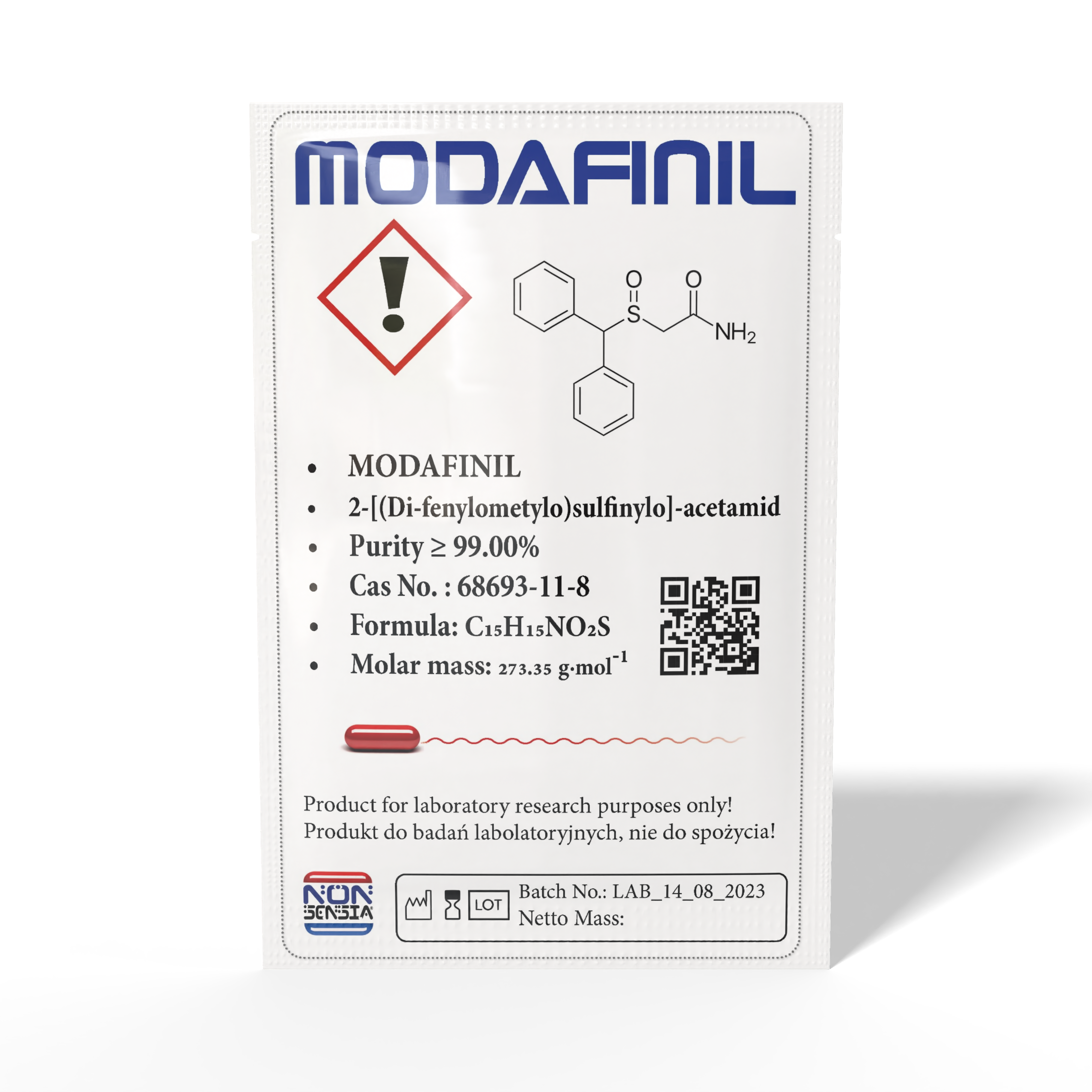
Product classification — read before ordering. This item is a chemical reagent and analytical reference material. It is not a medicinal product, dietary supplement, food, feed, novel food or cosmetic, and it is not intended for human or animal consumption or for any in-vivo administration whatsoever. It is supplied exclusively to laboratories, research institutions and professional users for in-vitro analytical, chromatographic and method-development work. Scientific findings summarised on this page describe substances investigated in published laboratory and clinical research; they are reported here as bibliographic facts about that literature and are not product claims, dosage guidance, or a recommendation of any use of this reagent.
Regulatory status — this substance is more tightly controlled than most items in this catalogue. Read section 14 before ordering. Modafinil is the active substance of authorised prescription medicines, including Actimodan in Poland [6]. It is a Schedule IV controlled substance in the United States [5] and is listed by name in class S6.A of the WADA 2026 Prohibited List, prohibited in-competition [2]. Supply of the bulk substance is restricted to laboratory and analytical use under the terms in section 15. It is the purchaser's responsibility to confirm the position under the law applying to them, and in several jurisdictions that position will prohibit purchase.
Key facts
- Substance
- Modafinil (INN, USAN) — 2-[(diphenylmethyl)sulfinyl]acetamide, supplied as the racemate
- CAS
- 68693-11-8 (superseded registry number 112111-49-6)
- Formula / mass
- C15H15NO2S · 273.4 g·mol−1 · monoisotopic 273.08235 Da
- Grade
- Analytical reference standard, ≥99.5% by HPLC (area normalisation); batch value on Certificate of Analysis
- Quantity
- Nine pack sizes from 1 g to 250 g, crystalline powder
- Stereochemistry
- Chiral at sulfur — one stereocentre on the sulfoxide, supplied as the racemate. The (R)-enantiomer is armodafinil
- Melting point
- 164–166 °C (experimental value published in the registry record)
- Key analytical trap
- Base fragment m/z 167.086 is the benzhydryl cation — shared with diphenhydramine, a documented source of misattribution
- Hazards
- GHS Warning: H302, H332, H361d (suspected of damaging the unborn child), H373
- ATC code
- N06BA07
- Regulatory flags
- Authorised medicine (PL, EU national); US DEA Schedule IV; WADA 2026 S6.A, in-competition
- Intended use
- In-vitro analytical chemistry, HPLC and LC-MS/MS identity and purity work, chiral method development, doping-control and forensic reference material
- Excluded use
- Any human or animal administration; any consumable, medicinal or cosmetic product; any use in sport
- Substance identity and registry data
- Molecular structure
- Physicochemical data, measured and computed
- Stereochemistry: modafinil, armodafinil and the sulfur centre
- Solid-state behaviour and polymorphism
- Use as an analytical reference standard
- Reference spectral data
- Batch specification and Certificate of Analysis
- Handling, storage and stability
- Hazard classification
- Discovery and development history
- Receptor-level and preclinical pharmacology
- Clinical research literature
- Regulatory status
- Permitted use and terms of supply
- Frequently asked questions
- How this page is sourced and verified
- References
1. Substance identity and registry data
Modafinil is the international nonproprietary name for 2-[(diphenylmethyl)sulfinyl]acetamide, a benzhydryl sulfoxide bearing a primary acetamide. Formally it is dimethyl sulfoxide in which two hydrogens of one methyl group are replaced by phenyl rings and one hydrogen of the other is replaced by a carbamoyl group [1]. That description is worth keeping in mind, because the two halves of the molecule behave very differently in the mass spectrometer, and the consequences are the subject of section 6.
Modafinil, armodafinil, Provigil — what is the difference?
Modafinil is the racemate and the substance supplied here. Armodafinil is the (R)-enantiomer, a separate substance with its own registry entries and its own marketing authorisations [20]. Provigil, Modiodal, Alertec, Modasomil and, in Poland, Actimodan are trade names of authorised medicinal products whose active substance is modafinil [6]. CRL-40476 and CEP-1538 are development codes from the original programme. A laboratory inventory should carry the CAS number, not any of the names.
| INN / USAN | modafinil (Latin: modafinilum) |
|---|---|
| IUPAC name | 2-benzhydrylsulfinylacetamide |
| CAS index name | Acetamide, 2-[(diphenylmethyl)sulfinyl]- |
| Common synonyms | 2-(benzhydrylsulfinyl)acetamide; CRL-40476; CEP-1538; Provigil; Modiodal; Alertec; Modasomil; Actimodan |
| CAS Registry Number | 68693-11-8 |
| Superseded CAS Number | 112111-49-6 — deprecated; do not use on new records |
| EC Number | 640-968-7 |
| UNII (FDA GSRS) | R3UK8X3U3D |
| ATC code | N06BA07 |
| PubChem CID | 4236 |
| ChEBI ID | CHEBI:77585 |
| ChEMBL ID | CHEMBL1373 |
| DrugBank ID | DB00745 |
| KEGG ID | D01832 |
| DSSTox Substance ID | DTXSID0023329 |
| HMDB ID | HMDB0014883 |
| NCI Thesaurus code | C26661 |
| DEA Code Number | 1680 (Schedule IV controlled substance) |
| Molecular formula | C15H15NO2S |
| Average molecular mass | 273.4 g·mol−1 |
| Monoisotopic mass | 273.08235 Da |
| InChIKey | YFGHCGITMMYXAQ-UHFFFAOYSA-N |
| InChI | InChI=1S/C15H15NO2S/c16-14(17)11-19(18)15(12-7-3-1-4-8-12)13-9-5-2-6-10-13/h1-10,15H,11H2,(H2,16,17) |
| SMILES | C1=CC=C(C=C1)C(C2=CC=CC=C2)S(=O)CC(=O)N |
Every identifier in Table 1 comes from a public authoritative registry [1][4], so a receiving laboratory can reconcile the material against its own inventory system without ambiguity.
The InChIKey suffix UHFFFAOYSA signals a structure recorded without a stereochemical layer, which for a molecule that does possess a stereocentre means the registry entry describes the substance with that centre unspecified — the racemate. Section 4 explains why that matters more here than on almost any other page in this catalogue.
2. Molecular structure
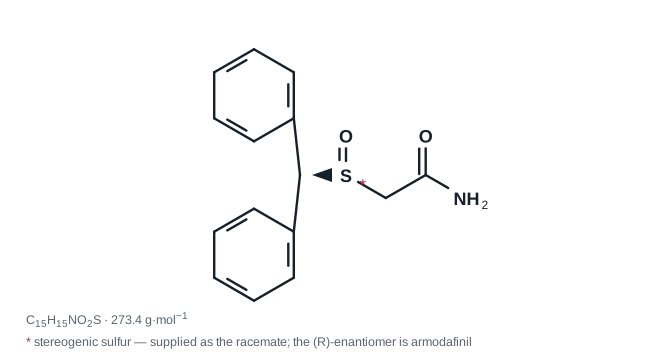
Three regions govern the laboratory behaviour of this molecule, and unusually for a small molecule each one dominates a different analytical technique.
The benzhydryl group — two phenyl rings on one carbon — supplies the ultraviolet chromophore and, more importantly, an exceptionally stable cation on fragmentation. In the mass spectrometer this group leaves as C13H11+ at m/z 167.086 and dominates the product-ion spectrum [1]. That single ion is both the greatest convenience and the greatest hazard in modafinil analysis, for reasons set out in section 6.2.
The sulfinyl sulfur carries the S=O bond, a lone pair, and two different carbon substituents. Four different groups around one atom make it a stereogenic centre — the molecule's only one. Sulfoxides are a well-established class of chiral pharmaceuticals, reviewed by Wojaczyńska and Wojaczyński [13], and modafinil is among the most widely used members of it.
The primary acetamide is the polar terminus: two hydrogen-bond donors on nitrogen, an acceptor at the carbonyl. Together with the sulfoxide oxygen it accounts for essentially all of the molecule's polarity, and it is the reason modafinil is far more retained on polar stationary phases than its two phenyl rings would suggest.
Structural neighbours in this catalogue
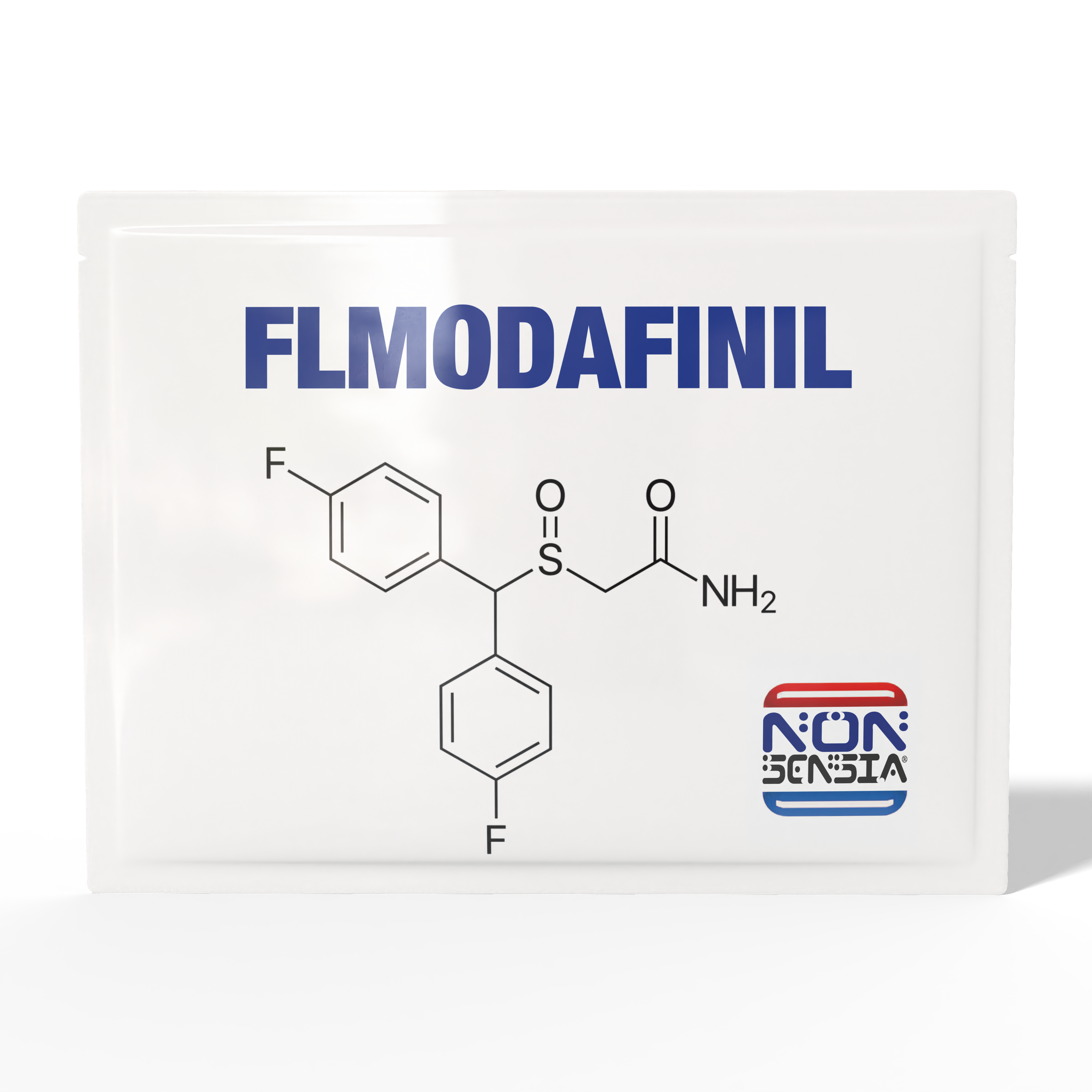
FLModafinil (bisfluoromodafinil, CRL-40,940) is the closest analogue offered here: the same benzhydryl sulfinyl acetamide skeleton with fluorine at both para positions. It and fladrafinil were both characterised for sports-testing purposes by Krug and colleagues in 2026 [15], and both appear alongside modafinil in class S6.A of the 2026 Prohibited List [2]. A method that must distinguish the three needs all of them in authenticated form.
Bromantane shares no chemistry with modafinil but shares its regulatory class, and the pair makes an instructive contrast: bromantane is achiral and carries a bromine isotope signature, modafinil is chiral and carries none. The oxiracetam standard is the third member of the same S6.A-adjacent shelf that a stimulant screen typically needs.
3. Physicochemical data, measured and computed
Modafinil differs from most substances in this catalogue in a way that is worth stating up front: experimental values exist. The registry record carries a measured melting point, measured solubility and a measured partition coefficient, and this page prints them as measurements rather than predictions [1].
| Physical description | Solid; white to off-white crystalline powder |
|---|---|
| Melting point | 164–166 °C (three concordant entries) |
| Water solubility | 0.622 g/L; practically insoluble in water and in cyclohexane |
| Organic solubility | Sparingly to slightly soluble in methanol and acetone |
| Partition coefficient (experimental) | logP 0.6 |
| XLogP3-AA | 1.7 |
|---|---|
| Topological polar surface area | 79.4 Å2 |
| Hydrogen-bond donors | 1 |
| Hydrogen-bond acceptors | 3 |
| Rotatable bonds | 5 |
| Heavy atoms | 19 |
| Formal charge | 0 |
| Complexity (Cactvs) | 302 |
| Defined / undefined atom stereocentres | 0 / 1 |
| Defined / undefined bond stereocentres | 0 / 0 |
Why the measured and computed logP disagree, and which to use
The experimental logP is 0.6; the computed XLogP3-AA is 1.7 [1]. A gap of more than one log unit is large, and it is not noise — it is a systematic weakness of fragment-based logP algorithms with sulfoxides. The S=O group is strongly polar and poorly represented by additive fragment schemes, which tend to under-count its hydrophilicity. Anyone estimating retention or extraction recovery from the computed value will predict a more lipophilic compound than the one in the vial.
The practical rule follows directly: use 0.6. It predicts what the compound actually does — moderate retention on C18 with a mid-range organic mobile phase, workable recovery from aqueous matrices into ethyl acetate or dichloromethane at neutral pH, and no ion-exchange behaviour to exploit, since neither the amide nor the sulfoxide ionises in any usable pH window.
The polar surface area of 79.4 Å2 and three hydrogen-bond acceptors also mean the compound is well behaved on polar-embedded and pentafluorophenyl phases, which is worth knowing when C18 selectivity against a co-eluting interference proves insufficient — a scenario section 6.2 shows is not hypothetical.
4. Stereochemistry: modafinil, armodafinil and the sulfur centre
Modafinil has one stereocentre, and it is not a carbon. The registry record reports zero defined and one undefined atom stereocentre [1]: the sulfinyl sulfur.
Sulfur in a sulfoxide is tetrahedral in the relevant sense. It carries four different things — the doubly bonded oxygen, a lone pair, the benzhydryl carbon and the methylene of the acetamide arm — and unlike a tertiary amine it does not invert at room temperature. The barrier to pyramidal inversion at sulfoxide sulfur is high enough that the two configurations are isolable, stable compounds. Sulfoxides are for that reason a substantial class of chiral drugs in their own right [13].
The consequences for this material are concrete:
- The article supplied is the racemate, a nominally equimolar mixture of (R)- and (S)-modafinil. That is the same composition as the authorised medicinal products, which are racemic.
- The (R)-enantiomer is a different substance with a different name and its own authorisations: armodafinil [20]. It is not offered on this page and is not interchangeable with this material.
- An enantiomeric purity figure is meaningful here and, unlike the achiral standards in this catalogue, a chiral method is a legitimate part of full characterisation.
Why this makes the material useful. A racemate whose enantiomers are separable, stable and independently authorised is exactly the sample needed to qualify a chiral separation: it gives two peaks of nominally equal area, so it demonstrates both resolution and the absence of a response bias. It is the correct system-suitability sample for a method whose purpose is to detect (R)-enrichment — that is, to tell modafinil from armodafinil. Reviews of stereoisomer handling in doping control set out why that distinction matters in practice [14].
The reverse is also true and worth stating: this material cannot substitute for enantiopure armodafinil when a single-enantiomer reference is required. For an achiral counterpart on which no chiral method can be validated at all, see the bromantane standard.
5. Solid-state behaviour and polymorphism
Modafinil is one of the better-studied polymorphic systems in the pharmaceutical literature, largely through the work of Coquerel and colleagues at Rouen. Pauchet and co-workers resolved the crystal structure of a metastable polymorph of (±)-modafinil using a derived crystal-packing model [8], and Mahieux, Sanselme and Coquerel later demonstrated access to several polymorphic forms of the racemate through different solvation and desolvation routes [9]. More recent work has extended the system to co-crystals [10].
What polymorphism means for a reference standard, stated plainly. Different crystal forms of the same substance are the same molecule and give the same chromatographic result once dissolved. They are not the same in the solid state: melting behaviour, dissolution rate, hygroscopicity, infrared spectrum and powder X-ray diffractogram all differ between forms. Two consequences follow. First, an infrared or Raman identity test against a library spectrum can fail on authentic material simply because the form differs from the one in the library — that is a form mismatch, not an identity failure, and it should be investigated by X-ray diffraction rather than treated as an out-of-specification result. Second, the melting point below is a property of the form as characterised in the registry record, and a batch crystallised by a different route may legitimately melt elsewhere. Where crystal form matters to a procedure, it must be determined for the batch; this page does not assert a form.
The measured melting point, 164–166 °C, is reported concordantly by three independent registry entries [1], which is unusual and makes it a genuinely useful identity check. Solubility is likewise measured rather than predicted: practically insoluble in water (0.622 g/L) and in cyclohexane, sparingly to slightly soluble in methanol and acetone [1].
Preparing stock solutions
Methanol and acetone are the solvents the registry record supports directly; acetonitrile and dimethyl sulfoxide are used routinely in bioanalytical practice for this compound. Note that "sparingly to slightly soluble" in methanol is a real constraint — concentrated stocks may need warming and should be checked for completeness of dissolution rather than assumed. Aqueous working dilutions are feasible at analytical concentrations, since the compound is far more water-tolerant than a two-phenyl-ring structure suggests, but 0.622 g/L is the ceiling and precipitation in the autosampler is the failure mode to design against.
6. Use as an analytical reference standard
6.1 Identity and purity confirmation
Modafinil is well behaved under reversed-phase HPLC with ultraviolet detection: two phenyl rings provide a competent chromophore, an experimental logP of 0.6 places it in a comfortable mid-range retention window on C18, and the absence of any ionisable group in a usable pH range removes mobile-phase pH as a source of inter-laboratory drift. Ramachandra's review of the properties of modafinil and the analytical and bioanalytical methods published for it is the natural starting point for method selection [11].
6.2 The m/z 167.086 trap — the strongest reason to keep this standard
Under positive electrospray, protonated modafinil at m/z 274.089 fragments overwhelmingly to a single product ion at m/z 167.086, with minor ions at 165.069 and 152.062 [1]. That base peak is the benzhydryl cation, C13H11+ — the two phenyl rings and the carbon joining them, leaving as a resonance-stabilised species.
The problem is that the benzhydryl group is not unique to modafinil. Diphenhydramine, an extremely common over-the-counter antihistamine, is a benzhydryl ether and produces the same cation at the same accurate mass. Nowak, Zawadzki and Szpot documented the practical consequence in Forensic Toxicology: cases positive for diphenhydramine can be misattributed to modafinil [12].
This is a false-positive mechanism that accurate mass alone does not solve. The interfering ion is not merely isobaric with the modafinil fragment — it is the same ion, with the same elemental composition and the same exact mass. No amount of mass resolution separates them. What separates them is chromatography, the precursor mass, and the minor product ions. A method that identifies modafinil on the 274 → 167 transition alone, without confirming retention time against an authentic standard and without a second qualifier transition, is not a specific method. The role of a reference standard here is not convenience; it is the only way to establish the retention time and the qualifier-ion ratios that make the assignment defensible.
Negative-mode data provide an independent handle: deprotonated modafinil at m/z 272.075 gives a very different pattern, with base peak 58.030 and a strong ion at 222.092 [1]. Acquiring both polarities against an authentic standard is the cheapest available insurance against the benzhydryl ambiguity.
6.3 Reference material for doping control and forensic toxicology
Modafinil is a named entry in class S6.A, Non-Specified Stimulants, of the WADA 2026 Prohibited List, prohibited in-competition [2]. Its prevalence among stimulating agents encountered in sport has been surveyed directly [16], and the ethical debate around its use in sport dates back two decades [27]. Laboratories operating under ISO/IEC 17025 and the WADA International Standard for Laboratories need authenticated material to establish retention, acquire a reference spectrum, select and calibrate qualifier transitions, spike blank matrix for a measured limit of detection, and prepare quality-control samples.
The same requirement applies in forensic toxicology, where the diphenhydramine ambiguity described above turns a reference standard from a convenience into a control against a documented misidentification pathway [12].
A laboratory building or revalidating a stimulant screen normally needs more than one entry from the same class on the bench at once. The bromantane standard and the flmodafinil standard are the two other S6.A-listed materials in this catalogue, and between them they cover the achiral, the halogen-tagged and the fluorinated-analogue cases that a single method has to handle.
6.4 Distinguishing modafinil from its analogues
Selectivity claims need named alternatives. Three matter here:
| Property | Modafinil | Armodafinil | FLModafinil | Diphenhydramine |
|---|---|---|---|---|
| Relationship | racemate | (R)-enantiomer | bis-4-fluoro analogue | unrelated drug |
| Same molecular mass? | — | yes, identical | no (+36 Da) | no |
| Gives m/z 167.086? | yes, base peak | yes | no (fluorinated) | yes |
| Separated by | — | chiral phase only | mass and retention | retention and precursor mass |
| WADA 2026 | S6.A [2] | not listed by name | S6.A [2] | not listed |
| In this catalogue | this page | — | flmodafinil | — |
The armodafinil row is the one that catches people out: same formula, same mass, same fragments, same retention on every achiral phase. Only a chiral separation distinguishes them, which is precisely why section 4 treats the racemate as a system-suitability asset rather than a limitation. The flmodafinil standard covers the fluorinated analogue, whose metabolism and elimination were characterised for testing purposes by Krug and colleagues [15].
7. Reference spectral data
Unusually for this catalogue, the registry record carries experimentally acquired, openly licensed tandem mass spectra with full instrument metadata [1]. They are listed here with attribution so a laboratory can compare against an independent source. They are not the spectra of the batch supplied.
| Technique | Conditions and attribution | Principal ions |
|---|---|---|
| LC-MS/MS, positive | MSBNK-ACES_SU-AS000528; ACESx, National Facility for Exposomics. Exploris 480 Orbitrap, LC-ESI-QFT, HCD ramp 20–70%. Acquity UPLC BEH C18, 3.0 × 100 mm, 1.7 µm. Licence CC BY | Precursor [M+H]+ 274.0889; products 167.086 (base), 165.069, 152.062, 168.089, 212.126 |
| LC-MS/MS, negative | MSBNK-ACES_SU-AS001400; same facility and instrument, negative ESI. Licence CC BY | Precursor [M−H]− 272.0751; products 58.030 (base), 222.092, 167.087 |
| MS/MS (library) | Spectra ID 2248348, positive mode | 167.086 (100), 152.064 (28), 165.069 (22), 166.080 (7), 128.059 (1) |
| GC-MS | Mass Spectrometry Committee of the Toxicology Section, American Academy of Forensic Sciences; copyright John Wiley & Sons with portions provided by AAFS | Electron-ionisation reference spectrum |
Both liquid-chromatographic spectra carry SPLASH identifiers, so a laboratory can verify that it is comparing against the same deposited spectrum rather than a re-processed copy. No 1H or 13C NMR spectrum is deposited in this record; a laboratory requiring either must acquire it, and the batch material is suitable for that purpose.
8. Batch specification and Certificate of Analysis
| Parameter | Method | Specification |
|---|---|---|
| Identity — chromatographic | HPLC, retention against reference | Conforms |
| Identity — spectroscopic | IR and/or MS against reference spectrum | Conforms; see the note on polymorphism in section 5 |
| Melting range | Capillary | Batch value reported; registry value 164–166 °C |
| Assay | HPLC, area normalisation | ≥99.5% |
| Related substances | HPLC, area normalisation | Batch value reported |
| Residual solvents | GC headspace | Batch value reported |
| Water content | Karl Fischer titration | Batch value reported |
| Enantiomeric composition | Chiral HPLC | Racemic — applicable to this substance, unlike the achiral standards in this catalogue |
The layout of the certificate and the method stated against each parameter can be reviewed in advance on the specimen Certificate of Analysis.
Scope of the specification, stated plainly. This is an analytical reference standard; kilogram-scale orders come with a batch Certificate of Analysis. It is not a certified reference material in the ISO 17034 sense — no metrologically traceable certified value with an assigned uncertainty budget, and not produced by an accredited reference-material producer. It is also not a pharmacopoeial reference standard: a chemical reference substance for pharmacopoeial testing must be obtained from the relevant pharmacopoeia, not from this catalogue. Where either is required, this article does not meet the requirement.
9. Handling, storage and stability
- Storage. Sealed, cool, dry, protected from light.
- Oxidation. This is the stability point specific to modafinil. A sulfoxide sits midway between a sulfide and a sulfone, and further oxidation to modafinil sulfone is the chemically obvious degradation route. Avoid oxidising conditions, avoid prolonged exposure to air at elevated temperature, and treat an unexpected later-eluting peak as a candidate sulfone rather than an unknown.
- Crystal form. Because the compound is polymorphic [8][9], avoid recrystallising or drying the material by an undocumented route if the solid-state form matters to the intended use; the form delivered is not necessarily preserved through such treatment.
- Solution stability. Prepare stocks in methanol, acetonitrile or acetone, store refrigerated and protected from light, and re-verify rather than assume stability across long intervals.
- Personal protection. Gloves, eye protection and containment of dust. See section 10: the hazard profile of this substance is materially more serious than that of most items in this catalogue, and includes a reproductive-toxicity classification.
10. Hazard classification
| Signal word | Warning |
|---|---|
| Hazard statements | H302 (100%) — Harmful if swallowed H332 (16.7%) — Harmful if inhaled H361d (16.7%) — Suspected of damaging the unborn child H373 (33.3%) — May cause damage to organs through prolonged or repeated exposure |
| Hazard classes | Acute Tox. 4 (oral); Acute Tox. 4 (inhalation); Repr. 2; STOT RE 2 |
| Precautionary statements | P203, P260, P261, P264, P270, P271, P280, P301+P317, P304+P340, P317, P318, P319, P330, P405, P501 |
| Basis of the aggregate | Six reports from companies, from five notifications to the ECHA C&L Inventory |
The reproductive-toxicity entry deserves separate attention. H361d — suspected of damaging the unborn child — is a hazard class that changes who should handle a substance and under what controls, independently of how the material is used. It is reported by a minority of notifiers (16.7%), which means it is not unanimous, but a minority classification in this hazard class is a reason for caution rather than for discounting. Precautionary statement P203 (obtain, read and follow all safety instructions before use) is triggered by it. Anyone who is or may become pregnant should review the Safety Data Sheet before handling this material, and the employer's risk assessment should treat the classification as applying until shown otherwise.
The aggregate rests on five notifications — a stronger basis than many entries in this catalogue, though still small, and there is no harmonised classification under Annex VI of the CLP Regulation. The Safety Data Sheet shipped with the batch is the controlling document.
11. Discovery and development history
Modafinil came out of French pharmaceutical chemistry in the 1970s, from work on benzhydryl sulfinyl compounds at Laboratoire L. Lafon. The development codes preserved in the registry synonyms — CRL-40476 for modafinil and, later, CEP-1538 from the Cephalon era — trace that lineage [1]. The immediate predecessor in the same series was adrafinil, which is metabolised to modafinil in the body and which appears alongside it in class S6.A of the current Prohibited List [2].
The therapeutic target was narcolepsy, a disorder later shown to arise from loss of the orexin (hypocretin) signalling system [21]. Modafinil became the first-line wakefulness-promoting agent for excessive daytime sleepiness in narcolepsy and remains in that role in current clinical practice guidelines [23], though newer agents acting on different targets have since been compared against it directly — pitolisant, a histamine H3 receptor antagonist, in a randomised trial against both placebo and modafinil [22].
The fluorinated analogues of the same series, offered here as flmodafinil, arrived much later and were added to the Prohibited List for 2026 [2][15]. The single-enantiomer follow-up, armodafinil, was developed and authorised separately [20][25]. That is the commercial reason the chiral chemistry described in section 4 is not an academic detail: two distinct authorised products differ only in the configuration at one sulfur atom.
Two other threads run through the literature and explain why this substance turns up in analytical work far outside sleep medicine. The first is off-label and non-medical use for cognitive performance, which generated a large investigative and review literature [26] and a debate in sports medicine that began well before the substance was named on the Prohibited List [27]. The second is pharmacological: modafinil's atypical relationship to the dopamine transporter placed it in a class of compounds studied specifically because they do not behave like classical stimulants [19]. Section 12 summarises that work.
12. Receptor-level and preclinical pharmacology
How to read this section. What follows summarises published research on the substance modafinil, reported as bibliographic fact and attributed to the experimental system that produced it. None of it describes, predicts or claims any effect of the reagent supplied on this page, which is not administered to anything. Nothing here is dosage guidance, a health claim, or a representation that the substance is safe or effective for any purpose.
Modafinil is unusual among wakefulness-promoting agents in that its mechanism was contested for decades after it entered clinical use, and the contest is itself analytically informative.
The best-characterised molecular interaction is with the dopamine transporter. In-vitro work established that modafinil binds the transporter and inhibits dopamine reuptake, producing an increase in extracellular dopamine [1]. What made this finding difficult to interpret is that modafinil's behavioural profile does not resemble that of classical transporter blockers such as cocaine or amphetamine. Reith and colleagues reviewed this class of atypical dopamine transporter ligands — compounds that occupy the same site while producing markedly different behavioural and reinforcing effects — and modafinil is a central example [19].
Beyond the transporter, the registry record summarises reported effects on glutamatergic and GABAergic transmission and on orexin-expressing neurons [1]. The orexin connection is mechanistically attractive because the therapeutic indication, narcolepsy, is itself a disorder of orexin signalling [21], but activation of orexin neurons by modafinil has generally been read as downstream of its primary action rather than as the primary action itself.
Pharmacokinetics are, by contrast, well characterised and uncontroversial. Robertson and Hellriegel reviewed the clinical pharmacokinetic profile in detail [17], and Sousa and Dinis-Oliveira surveyed the pharmacokinetics and pharmacodynamics together with the forensic aspects relevant to analytical laboratories [18]. Two metabolic products matter to anyone building an assay: modafinil acid and modafinil sulfone, the latter being the further-oxidised species already flagged in section 9 as the chemically obvious degradation product.
What is and is not established. The dopamine transporter interaction is established and reproducible. What remains unresolved is why occupancy of that transporter by this compound produces a different behavioural profile from occupancy by classical stimulants — a question the atypical-ligand literature frames rather than answers [19]. Any summary that presents modafinil as simply "a dopamine reuptake inhibitor" is compressing a genuine and open scientific question into a slogan.
13. Clinical research literature
Medicinal product and laboratory reagent are different things. The studies below investigated authorised medicinal products containing modafinil, administered to patients under medical supervision within approved clinical research and clinical practice. They are reported here as bibliographic facts about that literature. They describe neither the article supplied on this page nor any use of it. This reagent is not a medicinal product, has no marketing authorisation, has not been assessed by any medicines regulator, and must not be administered to any human or animal.
The authorised indication is narrow and is worth quoting rather than paraphrasing. The Polish Summary of Product Characteristics for Actimodan states that the product is indicated in adults for the treatment of excessive sleepiness associated with narcolepsy, with or without cataplexy [6]. That is the whole of the authorised indication in Poland.
The evidence base behind it, and the disorder itself, are reviewed comprehensively by Kornum and colleagues [21]. Current treatment guidance from the American Academy of Sleep Medicine places modafinil among the recommended options for central disorders of hypersomnolence [23]. Dauvilliers and colleagues compared pitolisant against both placebo and modafinil in a double-blind randomised trial in narcolepsy [22], which is the most direct head-to-head evidence available for the substance.
A considerably larger secondary literature exists on uses outside the authorised indication — in schizophrenia [24], in excessive sleepiness of other origins [25], and as a non-medical cognitive-performance agent in healthy people, reviewed critically by Schifano and colleagues [26]. That last body of work is the reason the substance appears so often in forensic and doping-control samples, and therefore the reason a reference standard for it is in continuous demand.
14. Regulatory status
This section is the most important one on the page for a prospective purchaser. Modafinil is not an unregulated research chemical. It is the active substance of authorised prescription medicines, it is scheduled in the United States, and it is named on the WADA Prohibited List. In several jurisdictions the lawful routes to obtaining it are narrower than for other items in this catalogue, and in some they exclude purchase by the reader entirely.
| Instrument / jurisdiction | Status |
|---|---|
| Poland — medicinal products | Authorised medicine. Actimodan, 200 mg tablets, active substance Modafinilum, ATC N06BA07, marketing authorisation numbers 26146 and 26147, holder Aflofarm Farmacja Polska Sp. z o.o. Indication: excessive sleepiness associated with narcolepsy, with or without cataplexy, in adults. Verified against the Summary of Product Characteristics in the national Register of Medicinal Products [6] |
| Poland — narcotics, psychotropics and new psychoactive substances | Not listed. Modafinil, adrafinil and armodafinil do not appear in Annexes 1, 2 or 3 of the consolidated regulation, Dz.U. 2024 poz. 1139 [7]. Being outside that list does not make the substance freely tradeable: the medicines legislation applies to it independently |
| United States — DEA | Schedule IV controlled substance, DEA drug code 1680 [1][5]. Unlike the NFLIS reporting categories that apply to some substances in this catalogue, this is an actual scheduling action under the Controlled Substances Act |
| WADA Prohibited List 2026 | Listed. Named entry "Modafinil" in class S6.A, Non-Specified Stimulants; prohibited in-competition. Verified against the text of the 2026 International Standard, page 15 [2] |
| European Union | Authorised as a medicinal product through national procedures in EU member states under trade names including Modiodal and Provigil. No centralised EMA authorisation |
| EU — CLP harmonised classification | No harmonised classification under Annex VI. Five self-classification notifications exist in the ECHA C&L Inventory (section 10) [3] |
| Other jurisdictions | Not assessed. Modafinil is scheduled or prescription-restricted in many countries beyond those listed. Status must be verified locally before import, purchase or possession |
Is modafinil legal to buy in Poland?
As a medicine, modafinil is available in Poland only on prescription, for the authorised indication, dispensed through pharmacies [6]. As a laboratory chemical, the substance is not on the Polish list of narcotic drugs, psychotropic substances or new psychoactive substances [7], and it is supplied here strictly as an analytical reference material under the terms in section 15. Those are two different legal routes and they must not be confused: nothing on this page provides access to a medicine, and this material is not a substitute for one.
Is modafinil banned in sport?
Yes. It is a named entry in S6.A of the WADA 2026 Prohibited List and is prohibited in-competition [2]. Because it sits in S6.A rather than S6.B it is a non-Specified substance, which carries different consequences under the World Anti-Doping Code. This material is supplied so that laboratories can detect it; it must not be used by or supplied to athletes.
Limits of this section. The Polish entries are verified positives and negatives: the marketing authorisation was confirmed by retrieving the official Summary of Product Characteristics from the national register, and the absence from the controlled-substances list was confirmed by retrieving the consolidated regulation and searching it, with substances known to be listed confirmed present in the same search before the absence was recorded. Those checks are valid for the documents cited and the date stated. Jurisdictions marked "not assessed" are genuinely not assessed, and for this substance that gap is more consequential than usual.
15. Permitted use and terms of supply
Research use only. Not for human or animal consumption.
- Supplied solely for in-vitro laboratory research, analytical chemistry, chromatographic and mass-spectrometric method development, forensic and doping-control reference applications.
- Not a medicinal product, investigational medicinal product, dietary supplement, food, feed, novel food or cosmetic. It is not a substitute for an authorised modafinil medicine and provides no route to one.
- Must not be ingested, inhaled, injected, applied to the body, or administered to any human or animal, under any circumstances and irrespective of quantity.
- Must not be used in the manufacture, compounding, formulation or repackaging of any product intended for human or animal consumption, and must not be presented or resold as a medicine or supplement.
- Must not be used by, supplied to, or administered to any athlete, or used in any manner connected with sporting competition. The substance is prohibited in-competition under the WADA Prohibited List [2].
- Because the substance carries a reproductive-toxicity classification (H361d, section 10), handling requires a workplace risk assessment; anyone who is or may become pregnant should review the Safety Data Sheet before handling.
- Intended for purchase and use exclusively by, or under the direct supervision of, persons professionally qualified to handle laboratory chemicals, at premises suitable for chemical storage.
- The purchaser is responsible for verifying the legal status of modafinil in their own jurisdiction before ordering. In the United States it is a Schedule IV controlled substance and purchase without the applicable registration is unlawful. Comparable restrictions apply in other jurisdictions.
- No information on this page constitutes medical advice, dosage guidance, a health claim, or a representation that the substance is safe or effective for any purpose in humans.
By placing an order the purchaser confirms acceptance of these conditions and confirms the material will be used exclusively as described above.
16. Frequently asked questions
- What is modafinil used for in a laboratory?
- As an analytical reference standard: to establish retention time and reference product-ion spectra, to calibrate qualifier-ion ratios, to spike blank matrix so that a real limit of detection can be measured, to prepare quality-control samples, and to qualify a chiral separation capable of distinguishing modafinil from armodafinil. Doping-control and forensic-toxicology laboratories are the main users, the latter because a documented misidentification pathway exists between modafinil and diphenhydramine.
- Is this product intended for human consumption?
- No. It is a chemical reagent and analytical reference material supplied for in-vitro laboratory use only. It is not a medicinal product, supplement or food, it is not a substitute for an authorised modafinil medicine, and it must not be ingested or administered to any human or animal.
- Is modafinil a controlled substance?
- In the United States, yes: modafinil is a Schedule IV controlled substance under the Controlled Substances Act, DEA drug code 1680, and purchase without the applicable registration is unlawful. In Poland it is not on the list of narcotic drugs, psychotropic substances or new psychoactive substances, but it is the active substance of an authorised prescription medicine and the medicines legislation applies to it independently. Status differs widely between countries and must be verified locally before ordering.
- Is modafinil a prescription medicine in Poland?
- Yes. Actimodan, 200 mg tablets, containing modafinil, is authorised in Poland under marketing authorisation numbers 26146 and 26147 held by Aflofarm Farmacja Polska. Its authorised indication is the treatment of excessive sleepiness associated with narcolepsy, with or without cataplexy, in adults. The material on this page is a laboratory reagent and provides no route to that medicine.
- Is modafinil on the WADA Prohibited List?
- Yes. Modafinil is a named entry in class S6.A, Non-Specified Stimulants, of the World Anti-Doping Agency 2026 Prohibited List, prohibited in-competition. Adrafinil, flmodafinil and fladrafinil appear in the same class. This reference material is supplied for laboratories that need an authenticated standard to detect and confirm the substance, and must not be used by or supplied to athletes.
- Is the material racemic, and what is the difference from armodafinil?
- Racemic. For an achiral counterpart on which no chiral method can be validated at all, compare the bromantane standard. Modafinil has one stereocentre, at the sulfinyl sulfur, and this article is supplied as the racemate, the same composition as the authorised medicines. Armodafinil is the (R)-enantiomer, a separate substance with its own name and its own marketing authorisations. The two have identical molecular formula, identical mass and identical fragmentation, and are not separated by any achiral chromatographic method. Only a chiral separation distinguishes them, which is what makes a racemic standard the correct sample for qualifying such a method.
- What is the melting point of modafinil?
- 164 to 166 degrees Celsius, reported concordantly by three independent entries in the registry record. Because the substance is polymorphic, a batch crystallised by a different route may legitimately melt elsewhere; the value measured for the batch supplied is stated on its Certificate of Analysis.
- Is modafinil soluble in water?
- Barely. The measured water solubility is 0.622 grams per litre and the compound is described as practically insoluble in water and in cyclohexane, and sparingly to slightly soluble in methanol and acetone. Prepare stock solutions in methanol, acetonitrile or acetone and verify that dissolution is complete rather than assuming it.
- Why does the computed logP differ from the measured one?
- The measured logP is 0.6 and the computed XLogP3 value is 1.7. The gap is systematic rather than random: fragment-based prediction algorithms handle sulfoxides poorly, because the strongly polar sulfur-oxygen bond is under-represented in additive schemes. Use the measured value of 0.6 for anything that depends on partition behaviour, including retention estimates and extraction recovery.
- Why can modafinil be confused with diphenhydramine in mass spectrometry?
- Because both molecules contain a benzhydryl group and both produce the same fragment ion, the benzhydryl cation at mass-to-charge 167.086. That ion is the base peak of protonated modafinil. It is not merely isobaric with the diphenhydramine fragment, it is the same ion with the same elemental composition, so no amount of mass resolution separates them. A published forensic report documents cases positive for diphenhydramine being misattributed to modafinil. Reliable identification requires the correct precursor mass, a confirmed retention time against an authentic standard, and at least one qualifier transition.
- What purity is guaranteed, and is this a certified reference material?
- Not less than 99.5% by HPLC using area normalisation, with the batch value stated on the Certificate of Analysis together with related substances, residual solvents and water content; the specimen certificate shows every parameter reported and the method behind each one. It is an analytical reference standard, not a certified reference material: it carries no metrologically traceable certified value with an assigned uncertainty budget and is not produced under ISO 17034. It is also not a pharmacopoeial reference standard, which must be obtained from the relevant pharmacopoeia.
- What are the hazards?
- The aggregated ECHA Classification and Labelling entry is GHS Warning with H302 harmful if swallowed, H332 harmful if inhaled, H361d suspected of damaging the unborn child, and H373 may cause damage to organs through prolonged or repeated exposure. The reproductive-toxicity entry is the one that most affects who should handle the material and under what controls, and anyone who is or may become pregnant should review the Safety Data Sheet before handling. The Safety Data Sheet shipped with the batch is the controlling document.
- How should the material be stored, and what degrades it?
- Sealed, cool, dry and protected from light. The specific chemical risk is further oxidation: a sulfoxide sits between a sulfide and a sulfone, so modafinil sulfone is the chemically obvious degradation product. An unexpected later-eluting peak should be treated as a candidate sulfone rather than an unknown. Avoid recrystallising or drying by an undocumented route if solid-state form matters, because the compound is polymorphic.
- What pack sizes are available?
- Nine: 1 g, 3 g, 5 g, 10 g, 20 g, 40 g, 80 g, 100 g and 250 g, each supplied as crystalline powder; kilogram-scale orders come with a batch Certificate of Analysis. Catalogue numbers follow the CAS-based scheme NSA-68693-11-8 with the pack size appended, for example NSA-68693-11-8-10G.
17. How this page is sourced and verified
| Document scope | Technical and regulatory description of modafinil supplied as an analytical reference material |
|---|---|
| Last reviewed | 22 August 2026 |
| Primary data sources | PubChem (NCBI) compound record CID 4236; ECHA Classification and Labelling Inventory; FDA GSRS (UNII); WADA International Standard — Prohibited List 2026; Polish Register of Medicinal Products (Summary of Product Characteristics for Actimodan); Polish Ministry of Health consolidated regulation Dz.U. 2024 poz. 1139 |
| Bibliographic verification | Every cited work was checked against PubMed and Crossref metadata. Each DOI was resolved and its registered title, journal, volume, issue and pagination confirmed against the citation printed here. Where a publisher landing page returned an access refusal to an automated request, the DOI was confirmed as registered in Crossref and retained. Where Crossref's registration year differs from the printed issue year because of online-first publication, the issue year is used |
| Regulatory verification | The WADA entry was confirmed by retrieving the text of the 2026 Prohibited List and reading the S6.A section directly. The Polish marketing authorisation was confirmed by retrieving the official Summary of Product Characteristics from the national register and reading the indication and authorisation number from it. The absence from the Polish controlled-substances list was confirmed by retrieving the consolidated regulation and searching it, with substances known to be listed confirmed present in the same search first, so that a failed search could not be mistaken for a negative result |
| Rule on numerical values | Measured values are labelled as experimental and computed values as computed, and the two are never mixed in the same table. Where they disagree — as they do for logP — the disagreement is stated and explained rather than resolved silently |
| Rule on biological claims | Findings from the pharmacological and clinical literature are attributed to the experimental system or authorised medicinal product that produced them. No finding is transferred to this reagent article, and no effect in humans is claimed for it |
| Corrections | Documented errors are corrected and the review date updated. Reports of factual error, including disputed citations, are welcome and acted on |
Limitations named directly
- The computed descriptors are predictions, and one of them is demonstrably wrong for this molecule. The XLogP3 value of 1.7 overstates lipophilicity against a measured 0.6. This page prints both and says which to use; it is a worked example of why computed values are labelled throughout this catalogue.
- No crystal form is asserted. The substance is polymorphic and this page does not state which form is supplied. Where form matters it must be determined for the batch.
- The hazard classification is not harmonised. It rests on five ECHA notifications, and the reproductive-toxicity entry is reported by a minority of notifiers. Section 10 explains what that does and does not support.
- Regulatory coverage is partial. Poland, the United States and the WADA List were verified from primary documents. Other jurisdictions were not assessed, and for a scheduled substance that gap is more consequential than for an unregulated one.
- The clinical literature cited is deliberately narrow. Modafinil has a very large clinical literature, most of it concerning uses outside the authorised indication. This page cites the authorised indication from the Summary of Product Characteristics, the disease review, current treatment guidance and one head-to-head trial, and does not attempt to summarise the off-label evidence base.
Not yet on this page
This page does not currently carry a named author with stated professional qualifications, a named technical reviewer, or laboratory data generated in-house for a specific batch — no chromatogram, no spectrum, no measured retention or melting data of our own. Those are real gaps in the evidence a reader might reasonably want, and they are named here because a page that sets out verification rules should apply them to itself first.
18. References
Citations follow the Chicago author–date convention. All external links carry rel="nofollow". Access to full texts is governed by the policies of the respective publishers.
Registry, regulatory and reference-data sources
- National Center for Biotechnology Information. 2026. "PubChem Compound Summary for CID 4236, Modafinil." PubChem. Accessed August 22, 2026. https://pubchem.ncbi.nlm.nih.gov/compound/4236.
- World Anti-Doping Agency. 2025. World Anti-Doping Code International Standard: Prohibited List 2026. Effective 1 January 2026. Modafinil listed in class S6.A, Non-Specified Stimulants, page 15. https://www.wada-ama.org/en/prohibited-list.
- European Chemicals Agency. 2026. "Classification and Labelling Inventory: Aggregated Notifications for Modafinil, EC 640-968-7." Accessed August 22, 2026. https://echa.europa.eu/information-on-chemicals/cl-inventory-database.
- U.S. Food and Drug Administration. 2026. "Global Substance Registration System: UNII R3UK8X3U3D, Modafinil." Accessed August 22, 2026. https://gsrs.ncats.nih.gov/ginas/app/beta/substances/R3UK8X3U3D.
- U.S. Drug Enforcement Administration. "Controlled Substances Schedules: Modafinil, Schedule IV, DEA drug code 1680." Annotation reproduced in the PubChem record for CID 4236. https://www.deadiversion.usdoj.gov/schedules/.
- Urząd Rejestracji Produktów Leczniczych, Wyrobów Medycznych i Produktów Biobójczych. 2026. "Charakterystyka Produktu Leczniczego: Actimodan, 200 mg, tabletki (Modafinilum). Pozwolenia nr 26146, 26147; Aflofarm Farmacja Polska Sp. z o.o." Rejestr Produktów Leczniczych. Accessed August 22, 2026. https://rejestry.ezdrowie.gov.pl/rpl/search/public.
- Minister Zdrowia. 2024. Obwieszczenie Ministra Zdrowia z dnia 17 czerwca 2024 r. w sprawie ogłoszenia jednolitego tekstu rozporządzenia Ministra Zdrowia w sprawie wykazu substancji psychotropowych, środków odurzających oraz nowych substancji psychoaktywnych. Dziennik Ustaw 2024, poz. 1139. https://eli.gov.pl/eli/DU/2024/1139.
Solid-state chemistry, physicochemistry and analytical methodology
- Pauchet, M., C. Gervais, L. Courvoisier, and G. Coquerel. 2004. "Successful Application of the Derived Crystal Packing (DCP) Model in Resolving the Crystal Structure of a Metastable Polymorph of (±) Modafinil." Crystal Growth & Design 4 (6): 1143–1151. https://doi.org/10.1021/cg030069t.
- Mahieux, J., M. Sanselme, and G. Coquerel. 2016. "Access to Several Polymorphic Forms of (±)-Modafinil by Using Various Solvation–Desolvation Processes." Crystal Growth & Design 16 (1): 396–405. https://doi.org/10.1021/acs.cgd.5b01384.
- Hussain, Z., M. N. Umar, A. Khan, Haseena, S. A. Shah, and M. Ghias. 2026. "Fabrication of a Modafinil Co-crystal for Enhanced Dissolution, Anti-depressant Potential and Density Functional Theory Studies." RSC Advances 16 (38): 42955–42965. https://doi.org/10.1039/d6ra05176f.
- Ramachandra, B. 2016. "A Critical Review of Properties of Modafinil and Analytical, Bioanalytical Methods for Its Determination." Critical Reviews in Analytical Chemistry 46 (6): 482–489. https://doi.org/10.1080/10408347.2016.1153948.
- Nowak, K., M. Zawadzki, and P. Szpot. 2025. "Beware of Misattributing 'Modafinil' in Diphenhydramine-Positive Cases." Forensic Toxicology 43 (2): 349–355. https://doi.org/10.1007/s11419-025-00716-5.
- Wojaczyńska, E., and J. Wojaczyński. 2023. "Sulfoxides in Medicine." Current Opinion in Chemical Biology 76: 102340. https://doi.org/10.1016/j.cbpa.2023.102340.
- Thomas, A., and M. Thevis. 2022. "Stereoisomers in Sports Drug Testing: Analytical Strategies and Applications." Journal of Chromatography A 1674: 463154. https://doi.org/10.1016/j.chroma.2022.463154.
- Krug, O., S. Guddat, C. Görgens, K. Walpurgis, F. Toma, A. Thomas, and M. Thevis. 2026. "Investigations into the Metabolism and Elimination of Flmodafinil and Fladrafinil for Sports Drug Testing Purposes." Drug Testing and Analysis 18 (8): 1076–1087. https://doi.org/10.1002/dta.70100.
- Deventer, K., K. Roels, F. T. Delbeke, and P. Van Eenoo. 2011. "Prevalence of Legal and Illegal Stimulating Agents in Sports." Analytical and Bioanalytical Chemistry 401 (2): 421–432. https://doi.org/10.1007/s00216-011-4863-0.
Pharmacology and pharmacokinetics
- Robertson, P., and E. T. Hellriegel. 2003. "Clinical Pharmacokinetic Profile of Modafinil." Clinical Pharmacokinetics 42 (2): 123–137. https://doi.org/10.2165/00003088-200342020-00002.
- Sousa, A., and R. J. Dinis-Oliveira. 2020. "Pharmacokinetic and Pharmacodynamic of the Cognitive Enhancer Modafinil: Relevant Clinical and Forensic Aspects." Substance Abuse 41 (2): 155–173. https://doi.org/10.1080/08897077.2019.1700584.
- Reith, M. E. A., B. E. Blough, W. C. Hong, K. T. Jones, K. C. Schmitt, M. H. Baumann, J. S. Partilla, R. B. Rothman, and A. H. Katz. 2015. "Behavioral, Biological, and Chemical Perspectives on Atypical Agents Targeting the Dopamine Transporter." Drug and Alcohol Dependence 147: 1–19. https://doi.org/10.1016/j.drugalcdep.2014.12.005.
- Garnock-Jones, K. P., S. Dhillon, and L. J. Scott. 2009. "Armodafinil." CNS Drugs 23 (9): 793–803. https://doi.org/10.2165/11203290-000000000-00000.
Clinical research literature
- Kornum, B. R., S. Knudsen, H. M. Ollila, F. Pizza, P. J. Jennum, Y. Dauvilliers, and S. Overeem. 2017. "Narcolepsy." Nature Reviews Disease Primers 3: 16100. https://doi.org/10.1038/nrdp.2016.100.
- Dauvilliers, Y., C. Bassetti, G. J. Lammers, I. Arnulf, G. Mayer, A. Rodenbeck, P. Lehert, C. Ding, J. M. Lecomte, and J. C. Schwartz. 2013. "Pitolisant versus Placebo or Modafinil in Patients with Narcolepsy: A Double-Blind, Randomised Trial." The Lancet Neurology 12 (11): 1068–1075. https://doi.org/10.1016/S1474-4422(13)70225-4.
- Maski, K., L. M. Trotti, S. Kotagal, R. Robert Auger, J. A. Rowley, S. R. Hashmi, and K. A. Watson. 2021. "Treatment of Central Disorders of Hypersomnolence: An American Academy of Sleep Medicine Clinical Practice Guideline." Journal of Clinical Sleep Medicine 17 (9): 1881–1893. https://doi.org/10.5664/jcsm.9328.
- Morein-Zamir, S., D. C. Turner, and B. J. Sahakian. 2007. "A Review of the Effects of Modafinil on Cognition in Schizophrenia." Schizophrenia Bulletin 33 (6): 1298–1306. https://doi.org/10.1093/schbul/sbm090.
- Bogan, R. K. 2010. "Armodafinil in the Treatment of Excessive Sleepiness." Expert Opinion on Pharmacotherapy 11 (6): 993–1002. https://doi.org/10.1517/14656561003705738.
- Schifano, F., V. Catalani, S. Sharif, F. Napoletano, J. M. Corkery, D. Arillotta, S. Fergus, A. Vento, and A. Guirguis. 2022. "Benefits and Harms of 'Smart Drugs' (Nootropics) in Healthy Individuals." Drugs 82 (6): 633–647. https://doi.org/10.1007/s40265-022-01701-7.
- Kaufman, K. R. 2005. "Modafinil in Sports: Ethical Considerations." British Journal of Sports Medicine 39 (4): 241–244. https://doi.org/10.1136/bjsm.2004.016303.