Product classification — read before ordering. This item is a chemical reagent and analytical reference material. It is not a medicinal product, dietary supplement, food, feed, novel food or cosmetic, and it is not intended for human or animal consumption or for any in-vivo administration whatsoever. It is supplied exclusively to laboratories, research institutions and professional users for in-vitro analytical, chromatographic and method-development work. Scientific findings summarised on this page describe substances investigated in published laboratory and clinical research; they are reported here as bibliographic facts about that literature and are not product claims, dosage guidance, or a recommendation of any use of this reagent.
This molecule is invisible to the default pharmaceutical method. Read sections 5 and 6 before ordering. Mebicar has a computed logP of −0.9, zero hydrogen-bond donors, zero rotatable bonds, no ionisable group and no useful chromophore [1]. On a conventional reversed-phase column with ultraviolet detection it neither retains nor absorbs — the method that works for most of this catalogue simply does not see it. The only dedicated quantitative method in the indexed literature is a cerimetric titration published in 1979 [21]; searches of the biomedical and cross-publisher indices return no validated liquid chromatography–tandem mass spectrometry method at all. Section 6 sets out what does work.
Key facts
- Substance
- Mebicar; international nonproprietary name temgicoluril; 1,3,4,6-tetramethylglycoluril
- CAS
- 10095-06-4
- PubChem CID
- 122282 [1]
- EC number
- 682-123-5 — an ECHA list number, not an EINECS number [5]
- UNII
- 55FE6NPG89
- ATC
- N06BX21 [6]
- Formula
- C8H14N4O2
- Molecular mass
- 198.22 g·mol−1 (registry); 198.2224 (reference database [4])
- Monoisotopic mass
- 198.11167570 Da
- InChIKey
XIUUSFJTJXFNGH-UHFFFAOYSA-N- Stereocentres
- None — achiral, but not for the reason usually given (section 7)
- Computed logP
- XLogP3 −0.9; TPSA 47.1 Å2; donors 0; acceptors 2; rotatable bonds 0
- Melting point, density, solubility
- No experimental value in any registry — see section 5 for what does exist
- Deposited spectra
- 1H NMR, 13C NMR, EI mass spectrum, vapour-phase infrared. No LC-MS, no MS/MS, no condensed-phase infrared, no Raman, no ultraviolet, no 2D NMR
- GHS
- Warning — H302; from one notification by one company, the weakest basis the inventory allows
- WADA 2026
- Not listed by name; read the caveat in section 11 [7]
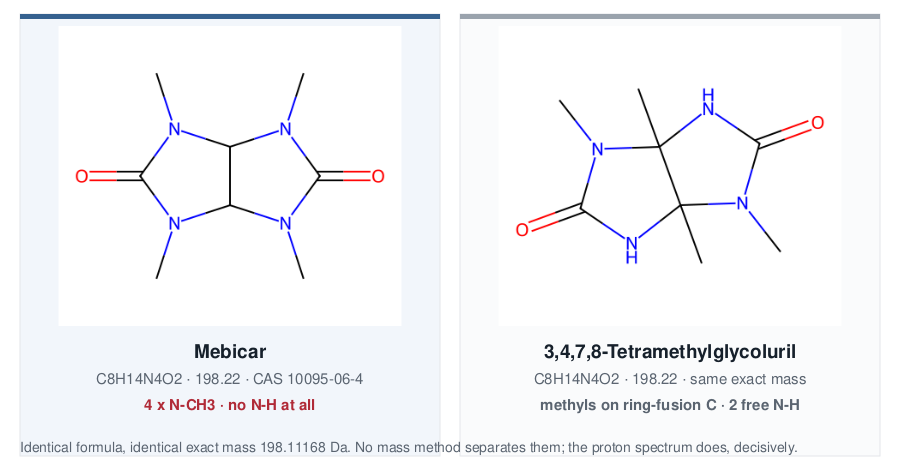
Two arrangements of the same atoms. Left: mebicar, four methyls on nitrogen, no N–H. Right: 3,4,7,8-tetramethylglycoluril, methyls on the ring-fusion carbons, two free N–H. Same formula, same exact mass, same nominal mass spectrum. Section 4 explains what separates them.
On this page
- What this material is
- Identity and registry codes
- Identity traps in the numbers themselves
- The isomer that mass spectrometry cannot see
- Missing data, and data that exists where nobody looks
- Why the default method fails, and what to do instead
- Stereochemistry, and a correction to the usual explanation
- Spectra: what exists, what does not
- The deuterated standard already exists
- What the literature actually says
- Regulatory status
- Hazard classification, and how thin it is
- Handling and storage
- What we certify and what we do not
- Terms of supply
- Questions and answers
1. What this material is
This page describes mebicar supplied as an analytical reference material: a weighed quantity of a single identified substance, intended as the point of comparison against which another sample is measured.
Mebicar is a bicyclic bis-urea — glycoluril with a methyl group on each of its four nitrogen atoms. It carries the international nonproprietary name temgicoluril and the anatomical-therapeutic-chemical code N06BX21 [6], and it is marketed as a medicine in Latvia and Russia under the brand Adaptol, with a clinical trial of the 500 mg tablet published in 2025 [24]. It has no marketing authorisation in Poland, none in the European Union centrally, and none in the United States [8][9][10]. That combination — a real medicine somewhere, an unregistered substance here, and no controlled-substance status anywhere — is precisely the profile a customs or forensic laboratory encounters in a parcel: nothing to seize, but an obligation to identify.
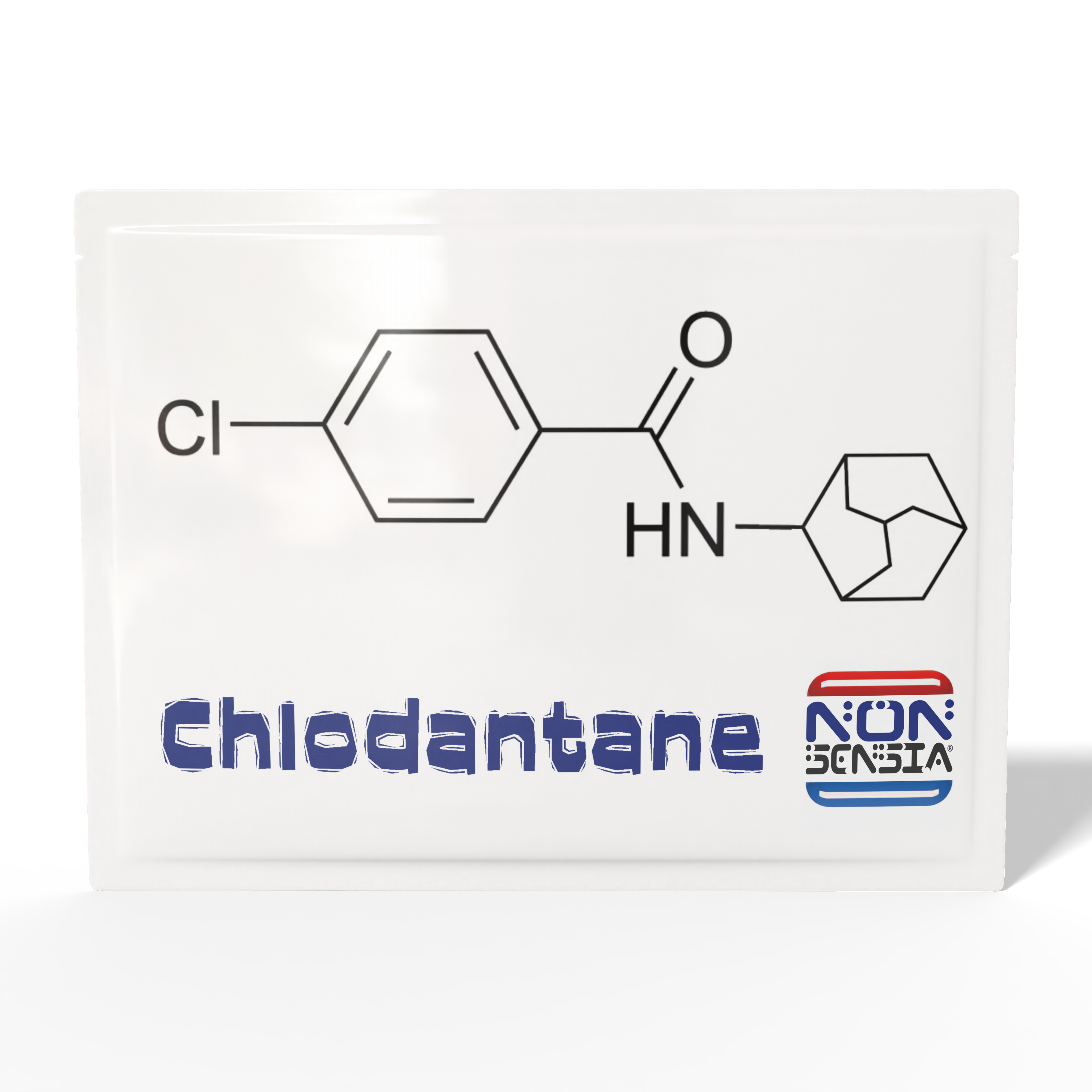
Two other cards in this catalogue turn on the same class of problem from different angles: chlodantane, where an amide is routinely mistaken for an amine, and tadalafil, where four stereoisomers share one exact mass. Mebicar’s version is constitutional isomerism.
Identification is where this compound becomes difficult, and it is difficult in three independent ways. It has a constitutional isomer with the same formula and the same exact mass that mass spectrometry does not resolve (section 4). Its electron-ionisation base peak is analytically useless (section 8). And it is transparent to the reversed-phase chromatography with ultraviolet detection that most laboratories reach for first (section 6). Each of these is a reason to hold authenticated material rather than to rely on a library match.
The terms on which this and every other reference material here is supplied are collected in the reference standards category.
2. Identity and registry codes
| INN | Temgicoluril [6] |
|---|---|
| Common names | Mebicar; Mebikar; Adaptol (trade name) |
| CAS Registry Number | 10095-06-4 |
| EC number | 682-123-5 — ECHA list number, not EINECS [5] |
| ECHA registry entry | 100.207.264 [5] |
| PubChem CID | 122282 [1] |
| UNII (FDA) | 55FE6NPG89 |
| ChEBI | CHEBI:136038 |
| ChEMBL | CHEMBL3707390 |
| DrugBank | DB13522 |
| KEGG | D10508 |
| NCI Thesaurus | C179125 |
| DSSTox | DTXSID60143588 and DTXSID101363121 — the record carries two (section 3) |
| Nikkaji | J22.257G and J3.573.531C — two numbers |
| MDL number | MFCD00184215 |
| Metabolomics Workbench | 154321 |
| Wikidata | Q4286560 |
| ATC | N06BX21; veterinary QN06BX21 [6] |
| IUPAC (computed) | 1,3,4,6-tetramethyl-3a,6a-dihydroimidazo[4,5-d]imidazole-2,5-dione |
|---|---|
| CAS index name | Tetrahydro-1,3,4,6-tetramethylimidazo(4,5-d)imidazole-2,5(1H,3H)-dione |
| Bicyclic name | 2,4,6,8-Tetramethyl-2,4,6,8-tetraazabicyclo[3.3.0]octane-3,7-dione [4] |
| SMILES | CN1C2C(N(C1=O)C)N(C(=O)N2C)C |
| Isomeric SMILES | Identical to the above — the record carries no stereochemical layer |
| InChI | InChI=1S/C8H14N4O2/c1-9-5-6(11(3)7(9)13)12(4)8(14)10(5)2/h5-6H,1-4H3 |
| InChIKey | XIUUSFJTJXFNGH-UHFFFAOYSA-N |
| Computed descriptors | XLogP3 −0.9 · TPSA 47.1 Å2 · donors 0 · acceptors 2 · rotatable bonds 0 · heavy atoms 14 · complexity 252 · formal charge 0 |
Two of those rows deserve attention before anything else. Zero hydrogen-bond donors is unusual for a molecule with four nitrogen atoms, and it is the single most diagnostic thing about mebicar: every nitrogen carries a methyl group, so there is no N–H anywhere in the structure. Zero rotatable bonds means the molecule is completely rigid. Both facts return in section 4, where they turn out to be the only practical way of telling this compound from its isomer.
3. Identity traps in the numbers themselves
Before the chemistry, the bookkeeping — because three separate identifier problems attach to this substance, and each of them can put the wrong number on a document.
Two superseded CAS numbers that behave differently
The registry lists two deprecated CAS numbers, and they are not equivalent [1]:
| Number | Status | Behaviour when looked up |
|---|---|---|
| 10095-06-4 | Current | Resolves to the correct record |
| 106780-29-4 | Listed as deprecated, but still active | Still resolves to the same record, and still appears among the record's own synonyms — it may legitimately turn up on a supplier document |
| 65407-24-1 | Deprecated | Resolves to nothing — a dead number |
Treating those two as interchangeable is a small error with a practical edge: a certificate quoting 106780-29-4 is quoting a superseded but functioning number, while one quoting 65407-24-1 is quoting a number that leads nowhere.
A fourth number that belongs to something else
A widely used hazardous-properties reference carries entries for both Mebicar and Mebicar-A under the single number 101809-59-0. That number is well formed — its check digit is arithmetically correct — but it does not belong to the substance sold here. It resolves only in the registry's substance space, as a depositor entry from a discontinued toxicology index whose synonyms are exactly Mebicar-A and the number itself, carrying no deposited structure and no compound record. The correct record for the substance on this page mentions 10095-06-4 ten times and 101809-59-0 not once. The reference work has collapsed two headings under one number; the registries have not lost anything.
Duplicated identifiers within one record
The record carries two substance identifiers from the United States environmental database and two numbers from the Japanese chemical dictionary. This is ordinary registry housekeeping rather than a contradiction, but it matters when a document template expects exactly one value per field: whichever is chosen, a downstream system reconciling against the other will report a mismatch that is not real.
And a name that exists nowhere
The name Mebicarate circulates for this substance in commercial listings. It is not among the seventy synonyms the registry holds, is not the international nonproprietary name, and is not a trade name. There is a real Latin pharmacopoeial form, Mebicarum, used in the countries where the medicine is registered — but that is a different word, and it is not what the page said.
4. The isomer that mass spectrometry cannot see
Mebicar is one of many compounds with the formula C8H14N4O2. A formula search of the registry returns more than two hundred records. Most are irrelevant. One is not.
3,4,7,8-Tetramethylglycoluril is the same glycoluril core carrying the same four methyl groups — but placed on the ring-fusion carbons instead of on the nitrogen atoms. Same molecular formula. Same monoisotopic mass, 198.11168 Da. Same nominal molecular ion. It is a real, characterised compound with a solved crystal structure [12], it arises from the same glycoluril chemistry, and derivatives of it — the mono-acetyl and the 1,6-dipivaloyl — have been prepared and structurally analysed [13], which is only possible because it has free N–H groups that mebicar does not have.
No mass measurement separates them. Accurate mass gives the same number to five decimal places, because it is the same set of atoms. Electron-ionisation fragmentation of the molecular ion is unlikely to be decisive either, because both are bis-ureas built on the same bicyclic skeleton.
What separates them cleanly is proton nuclear magnetic resonance, and the difference is stark rather than subtle:
| Feature | Mebicar (methyls on N) | 3,4,7,8-isomer (methyls on C) |
|---|---|---|
| Hydrogen-bond donors | 0 — no N–H anywhere | 2 — two free N–H |
| Methyl signals in 1H NMR | One singlet, four equivalent N–CH3 | Two distinct methyl environments |
| Methine protons at ring fusion | Two equivalent protons at C3a and C6a | None — those carbons bear methyls |
| Exchangeable protons | None | Two, which disappear on deuterium exchange |
| Infrared N–H stretch | Absent | Present |
| Molecular formula and exact mass | identical — no mass method separates them | |
Compare how differently this plays out elsewhere in the catalogue. For bromantane the halogen isotope pattern settles identity without any chromatography at all; for modafinil and flmodafinil a single stereocentre at sulfur is the open question; for alpha-GPC it is a positional isomer resolvable only by phosphorus NMR. Mebicar is the case where the mass spectrometer, the ultraviolet detector and the reversed-phase column all fail at once, and the proton spectrum carries the entire burden.
The decisive observation is the simplest one in the table: mebicar has no exchangeable proton at all. A single proton spectrum showing one methyl singlet, one methine signal and nothing that vanishes on deuterium exchange settles the question. The isomer shows the opposite pattern in every respect.
This is the practical argument for holding authenticated material. The distinction cannot be anchored on a mass spectrum, and there is no deposited two-dimensional NMR data for either compound to fall back on (section 8). Someone has to record the spectrum of a known sample, once, and that sample has to be a known sample.
5. Missing data, and data that exists where nobody looks
The registry record for mebicar has no experimental properties section at all. Under physical and chemical properties there are only computed values [1]. That absence was checked against three further sources, each of which would carry the numbers if anyone had deposited them:
| Source | What it holds for mebicar |
|---|---|
| PubChem [1] | Computed properties only; no experimental section exists |
| NIST Chemistry WebBook [4] | Identity only — formula, mass 198.2224, InChI, names. No phase-change data, no thermochemistry |
| ECHA [5] | One notification to the classification inventory; no registration dossier, therefore no physicochemical section |
| Wikidata / encyclopaedic infobox | No melting point, no boiling point, no density property recorded |
So there is no published melting point, no boiling point, no density and no tabulated water solubility. Figures for all four circulate in commercial listings; none of them has a traceable source.
But the data is not simply missing — it is in the wrong place. One research group has published a sustained series on mebicar's behaviour in aqueous solution: partial molar volumes and interaction parameters [15][19], the effect of temperature on glycine in aqueous mebicar [16], enthalpies of interaction with the simplest amino acids [17] and with sugars [18], and an earlier study of intermolecular interactions in aqueous mebicar [20]. The molecular geometry has been determined by gas-phase electron diffraction [11]. This is a real physicochemical literature — it is simply solution thermodynamics and structural chemistry rather than the quality-control constants a laboratory looks for, and none of it has been abstracted into the registries. A compound can be well studied and still have no melting point on file.
One measurement that is real, and where it actually lives
The only experimental data the registry surfaces for mebicar is acute toxicity: a median lethal dose in the rat of 3450 mg·kg−1 and in the mouse of 3800 mg·kg−1, both by intraperitoneal administration, both traceable to a German patent application. Those values are worth stating precisely because they are among the very few hard numbers attached to this substance — and worth qualifying, because they do not live in the record itself. The record carries only a pointer to an external table maintained separately. A cited number that lives outside the record it appears to belong to can disappear without the record changing, which is a reason to archive the value rather than the link.
6. Why the default method fails, and what to do instead
Look again at the computed descriptors: logP −0.9, zero hydrogen-bond donors, zero rotatable bonds, no formal charge, no ionisable group, no extended conjugation [1]. Each one closes off a standard analytical lever.
| Standard technique | Why it fails |
|---|---|
| C18 reversed-phase retention | logP −0.9. The compound is more polar than the mobile phase is designed for and elutes at or near the void volume |
| Ultraviolet detection | Two isolated carbonyls in a saturated bicyclic frame — no useful chromophore above the solvent cut-off |
| pH manipulation of retention | No ionisable group. Mobile-phase pH is not a lever |
| Ion-pairing | No charge to pair with |
| Derivatisation at N–H | There is no N–H. All four nitrogen atoms are fully methylated |
The single dedicated quantitative method in the indexed literature is a cerimetric titration from 1979 [21] — a wet-chemical assay requiring milligram quantities, published before most of the instruments in a modern laboratory existed. A clinical pharmacokinetic study from 1985 measured the compound in patients [22], so a bioanalytical method existed at the time, but neither it nor any successor appears as a validated liquid chromatography–mass spectrometry procedure in the sources we can search.
What does work
These are starting points for method development, not validated procedures:
- Hydrophilic-interaction chromatography rather than reversed phase. A very polar, neutral, non-ionisable analyte is the textbook case for it, and it converts logP −0.9 from a problem into the retention mechanism.
- Porous graphitic carbon as an alternative stationary phase, which retains rigid polar molecules that C18 will not hold.
- Mass-spectrometric detection instead of ultraviolet, which sidesteps the absent chromophore entirely. The molecule ionises as an even-electron species with two carbonyls available for protonation.
- Gas chromatography with electron ionisation, which is viable because a reference spectrum exists (section 8) — with the important caveat about its base peak.
- Derivatisation is unavailable here in a way worth stating explicitly: with no N–H and no other reactive handle, the usual trick of attaching a chromophore has nothing to attach to. Compare L-DOPA or procaine hydrochloride, where an amine group offers exactly that handle.
- Quantitative proton NMR, which is unusually well suited here: four equivalent methyl groups give a single sharp twelve-proton singlet with no exchangeable protons to complicate integration, and it settles the isomer question from section 4 at the same time.
7. Stereochemistry, and a correction to the usual explanation
The registry record states the stereochemistry unambiguously [1]:
| Defined atom stereocentre count | 0 |
|---|---|
| Undefined atom stereocentre count | 0 |
| Defined bond stereocentre count | 0 |
| Undefined bond stereocentre count | 0 |
| Isotope atom count | 0 |
| Covalently bonded units | 1 |
The molecule is achiral, there are no enantiomers, chiral separation is pointless, and any claim about a dextrorotatory or laevorotatory form would be fabricated by construction. Some depositor synonyms carry the labels cis- and (3aS,6aS)-; those describe the single possible diastereomeric form and are not evidence that optical isomers exist.
Why we are not giving the usual reason. Two explanations circulate for those four zeros: that the compound is a meso form, and that the ring fusion in a bicyclo[3.3.0] system is forced to be cis so the geometry is not a degree of freedom. Both are wrong as explanations, and it is straightforward to show it. Registries do count stereocentres in meso compounds — meso-tartaric acid is recorded with two defined atom stereocentres. They also count them in bicyclics whose fusion is geometrically forced — cis-4-cyclohexene-1,2-dicarboxylic anhydride is recorded with two. Neither proposed mechanism produces zeros anywhere else, so neither can be what produces them here.
The actual reason is constitutional symmetry. At each ring-fusion carbon the two nitrogen branches are identical in constitution: each nitrogen carries a methyl group and leads through a carbonyl to the other fusion carbon. Two identical substituents means the atom is not a stereocentre in the first place, so there is nothing to count. The confirmation is the parent compound: unmethylated glycoluril [3] has the same four zeros. The symmetry comes from the core, not from the methylation and not from any meso relationship.
We set this out at length because it is the kind of plausible reasoning that survives repetition without ever being checked — and because the conclusion is unaffected. The molecule is achiral either way; only the explanation changes.
8. Spectra: what exists, what does not
| Technique | Present | Provenance and limitation |
|---|---|---|
| 1H NMR | Yes | Database deposit. No frequency, no solvent, no catalogue or lot number recorded |
| 13C NMR | Yes | Database deposit, University of Vienna; cross-linked to a shift database |
| GC-MS, electron ionisation | Yes | Reference mass-spectrometry library, 88 peaks. See the base-peak problem below |
| Infrared | Yes, but vapour phase only | No condensed-phase spectrum — see below |
| LC-MS | No | — |
| MS/MS | No | — |
| Raman | No | — |
| Ultraviolet-visible | No | Consistent with the absent chromophore (section 6) |
| 2D NMR (COSY, HSQC, HMBC) | No | — |
| Solid-state NMR, powder diffraction | No | No polymorph information of any kind |
The base peak is useless
The deposited electron-ionisation spectrum has its base peak at m/z 42. The molecular ion at m/z 198 is only the second most intense signal, and m/z 112 the third. A fragment at 42 is low-mass and entirely non-specific — it appears in the spectrum of a great many nitrogen-containing compounds and drowns in any matrix. A library match weighted towards the base peak therefore rests on the least informative ion in the spectrum.
The informative pair is 198 → 112, a loss of 86 Da corresponding to symmetric cleavage of the bis-urea core into two halves. That transition, not the base peak, is what should anchor a gas-chromatographic identification.
Vapour-phase infrared is the wrong phase
The only infrared data is a vapour-phase spectrum. For identity control of a crystalline solid this is close to useless: band positions and intensities shift between the gas phase and the solid, and it is precisely the intermolecular hydrogen bonding and packing effects — the things a solid-phase spectrum reports — that a vapour-phase spectrum has by definition removed. There is no attenuated-total-reflectance and no potassium bromide spectrum deposited, which means the most routine identity check in a quality-control laboratory has no reference to compare against.
Combined with the absence of powder diffraction and solid-state NMR, the position is this: nothing in the public record describes mebicar as a solid. Every deposited measurement describes it in solution, in the gas phase, or as an ion.
9. The deuterated standard already exists
A deuterium-labelled mebicar is registered: mebicar-d12 [2], carrying four trideuteriomethyl groups, with a molecular mass of 210.30 against 198.22 — twelve mass units higher, and an InChIKey that differs from the unlabelled compound only in its second block.
The existence of that record is informative in itself. A twelve-deuterium internal standard is not made for curiosity; it is made because someone intended to quantify mebicar by isotope dilution mass spectrometry, which is the correct approach for a compound with no chromophore. The labelled half of that method exists in the catalogues. The unlabelled, characterised reference material is the missing half — and it is the half that determines whether the calibration is anchored to the right molecule, since the internal standard corrects for recovery and suppression but says nothing about which isomer from section 4 is actually in the vial.
10. What the literature actually says
The literature on mebicar divides into three unequal parts, and the division is worth seeing plainly.
Structural chemistry. The molecular geometry has been determined by gas-phase electron diffraction [11]. The parent glycoluril has a solved crystal structure [14], as does the constitutional isomer discussed in section 4 [12], whose acetyl and pivaloyl derivatives were studied as twisted amides [13].
Solution thermodynamics. This is where most of the physical-chemistry effort has gone: partial molar volumes and interaction properties [15][19], the behaviour of glycine in aqueous mebicar as a function of temperature [16], enthalpies of interaction with amino acids [17] and with sugars [18], and earlier work on intermolecular interactions in aqueous solution [20]. Read together, this is a body of work about how mebicar perturbs water structure and interacts with biological solutes.
Pharmacology and clinical use. A survey of the psychotropic profile in animals dates from 1980 [25], a monograph entry appeared in 1985 [23], clinical pharmacokinetics with individualised regimens were published the same year [22], and a study combining mebicar with a ginsenoside on neurobehavioural and immunological endpoints appeared in 2018 [26]. The most recent entry is a 2025 clinical trial of the marketed 500 mg tablet in patients with anxiety and somatic symptoms [24], which is what establishes that this molecule is a currently used medicine somewhere.
Analytical chemistry is almost entirely absent from that list. One titration from 1979 [21], and nothing modern.
11. Regulatory status
| Poland — medicinal product | None. No trade name, no authorisation, no responsible party [8]. Control: a common analgesic returns 43 records from the same query |
|---|---|
| Poland — controlled substances | Not scheduled in any narcotic, psychotropic or new-psychoactive schedule [9]. Controls: the amphetamine stem returns 27 occurrences, cocaine 2 |
| European Union | No central authorisation, no REACH registration, no harmonised classification, no candidate-list entry, no restriction. The only European regulatory process attached to this substance is a notification to the classification inventory [5] |
| United States | Unscheduled. Not in the controlled-substances list [10]. Control on the same document: amphetamine and cocaine both return hits |
| Where it is a medicine | Latvia and Russia, as Adaptol; the 500 mg tablet was the subject of a 2025 clinical trial [24]. We report this from the literature rather than from a national register we could not query directly |
| ATC code | N06BX21 [6]. An ATC code is a classification, not an authorisation |
| Anti-doping, 2026 | Not listed by name; controls fire on bromantan and modafinil in the same document [7] |
A caveat on the anti-doping position that we will not resolve. The 2026 list contains a class covering non-approved substances — those with no current approval from any governmental health authority for human therapeutic use. A substance that is a registered medicine in one country and unregistered elsewhere sits in genuinely ambiguous territory with respect to that clause. Whether mebicar falls inside it is a legal question about a specific person in a specific jurisdiction, not something a text search settles, and we do not answer it. The measured statement is the one in the table: not listed by name.
12. Hazard classification, and how thin it is
| Signal word | Warning |
|---|---|
| Hazard statement | H302 — Harmful if swallowed (acute oral toxicity), reported by 100% of notifiers |
| Precautionary statements | P264, P270, P301+P317, P330, P501 |
| Number of notifications | One notification, from one company |
| Harmonised classification | None. No Annex VI entry, no index number, no REACH registration [5] |
The hundred per cent agreement in the second row means one company out of one, which is the weakest basis the inventory permits. It is not a consensus; it is a single opinion expressed as a percentage. Where other substances in this catalogue carry classifications aggregated from dozens of notifications, this one rests on a single filing, and a reader who sees only H302, 100% would reasonably infer something much stronger than what is actually there.
Two further points. First, the classification is not harmonised, so it is not legally binding anywhere in the European Union and another supplier may lawfully classify differently. Second, the acute-toxicity values behind an oral hazard classification are intraperitoneal in the record (section 5), which is a different route; if the oral figures exist, they are not where the classification points.
13. Handling and storage
| Personal protection | Nitrile gloves, safety glasses, laboratory coat. Weigh in a fume hood or under local exhaust. The classification is harmful if swallowed, so the controlling risk is hand-to-mouth transfer and airborne fines |
|---|---|
| Risk assessment | Record that the classification derives from a single notification and is not harmonised. Do not treat the single H302 statement as a complete hazard profile |
| Temperature | Ambient, closed container. No stability study exists to justify anything else, and we will not invent one |
| Moisture | Store dry. The compound is highly polar and the solution literature is entirely about its interaction with water [15]–[20]; hygroscopicity has not been measured, so treat dryness as a precaution rather than a documented requirement |
| Solution preparation | Water and polar organic solvents are the sensible first choices, given logP −0.9. No numerical solubility exists in any registry, so determine it on your own material |
| Solid form | Unknown and undocumented (section 8). If your work depends on it, thermal analysis and powder diffraction on the material in front of you are the only route |
| Waste | Halogen-free organic chemical waste, in accordance with local regulations. Do not release to drains |
| Records | Archive any spectrum you record, particularly a condensed-phase infrared or a proton spectrum — neither exists publicly, so yours has value beyond your own laboratory |
14. What we certify and what we do not
| Claim | Status |
|---|---|
| Chemical identity: CAS, formula, masses, InChI, InChIKey, stereodescriptors | Quoted from named registries [1][4][5], each identifier traceable |
| Regulatory statements in section 11 | Measured against named documents [7][8][9][10], each negative with a positive control |
| Literature in sections 5 and 10 | Every claim carries a citation with a resolvable identifier |
| Isomer discrimination in section 4 | Structural reasoning plus published characterisation of the isomer [12][13]. The predicted spectral differences are predictions, not deposited data |
| Method suggestions in section 6 | Starting points, not validated methods. No modern validated method for this compound exists publicly |
| Melting point, boiling point, density, solubility | Not certified — no experimental value exists in any registry we can reach. Figures that circulate for these constants have no traceable source |
| Purity figure for the lot supplied | Not asserted in catalogue copy. Stated on lot documentation, with the method used |
| Solid form, polymorphism, water content | Not certified. No public data of any kind describes this substance as a solid |
| Pharmacological claims | None made. Section 10 describes published research; that is a description of literature, not a property of this article |
15. Terms of supply
This material is supplied as a laboratory reagent and analytical reference material, for in-vitro laboratory use by qualified personnel in an appropriately equipped facility. It is not a medicinal product, not a dietary supplement, not a food, feed or cosmetic ingredient, and it is not supplied for administration to humans or animals in any form or by any route.
By ordering, the purchaser confirms that they are a professional user acquiring the material for laboratory purposes; that they will handle it in accordance with section 13 and their own institutional risk assessment; that they will not administer it to humans or animals, nor supply it to any person who intends to; and that they are responsible for compliance with all laws applicable at the destination. That last point carries weight for this substance in particular, because it is an authorised medicine in some jurisdictions and an unregistered chemical in others.
Nothing on this page is medical advice, nor an offer of a medicinal product. Statements in sections 10 and 11 describe medicines authorised elsewhere and the research literature; they describe neither this article nor any use of it.
16. Questions and answers
- What is the correct molecular formula?
- C8H14N4O2, molecular mass 198.22, monoisotopic mass 198.11168 Da. Two other formulas circulate for this substance: one containing the letter G, which is not a chemical element, and one that is the formula of paracetamol. Neither is correct.
- Is mebicar the same thing as temgicoluril and Adaptol?
- Yes. Mebicar is the common name, temgicoluril is the international nonproprietary name, and Adaptol is a trade name under which the substance is marketed as a medicine in Latvia and Russia. The material on this page is a laboratory reagent and is none of those medicines.
- Why can I not see it on my usual reversed-phase method?
- Because there is nothing for that method to work with. The computed logP is −0.9, so it does not retain on C18; there is no ionisable group, so pH gives no leverage; and there is no useful chromophore, so ultraviolet detection has nothing to detect. Hydrophilic-interaction chromatography or porous graphitic carbon with mass-spectrometric detection is the sensible direction.
- What is the isomer problem?
- 3,4,7,8-Tetramethylglycoluril has the same formula and the same exact mass, differing only in whether the four methyl groups sit on the nitrogen atoms or on the ring-fusion carbons. No mass measurement separates them. Proton NMR does, decisively: mebicar has no exchangeable proton at all, one methyl singlet and two equivalent methine protons; the isomer has two free N–H, no methine protons and two methyl environments.
- Can I identify it by GC-MS library match?
- With care. A reference electron-ionisation spectrum exists, but its base peak is at m/z 42 — a low-mass, non-specific fragment. The molecular ion at 198 is only the second most intense signal. Anchor the identification on the 198 → 112 transition, a loss of 86 Da from symmetric cleavage of the bis-urea core, rather than on the base peak.
- What is the melting point?
- Unknown. No registry we can reach carries one, nor a boiling point, a density or a numerical water solubility. Figures for all four circulate in commercial listings; none has a traceable source. If you measure a melting point on this material you will have generated a datum that is not currently public.
- So has nobody studied this compound physically?
- They have, extensively — just not in the form a quality-control laboratory looks for. There is a sustained series on partial molar volumes, interaction parameters and enthalpies of interaction with amino acids and sugars in aqueous solution, plus a gas-phase electron-diffraction determination of the molecular geometry. None of it has been abstracted into the registries, which is why the record looks empty.
- Is it chiral?
- No. Zero defined and zero undefined stereocentres of either kind. Worth knowing, though: the usual explanations for those zeros — that it is a meso compound, or that the ring fusion is forced cis — are both wrong, because registries do count stereocentres in both of those situations. The real reason is that at each ring-fusion carbon the two nitrogen branches are constitutionally identical, so the atom is not a stereocentre at all. Unmethylated glycoluril shows the same four zeros.
- What does the GHS classification actually rest on?
- One notification, from one company. The 100% figure attached to H302 means one out of one, not a consensus. There is no harmonised classification, so nothing about it is legally binding in the European Union and another supplier may classify differently.
- Is it a controlled substance?
- Not in Poland, not in the United States, and it does not appear by name on the 2026 anti-doping list. Each of those was checked with a control that fired on substances known to be present in the same document. It is, separately, an authorised medicine in Latvia and Russia — which is a different matter from being controlled.
- Which CAS number should appear on my documentation?
- 10095-06-4. Two superseded numbers exist and behave differently: 106780-29-4 still resolves to the correct record and may legitimately appear on supplier paperwork, while 65407-24-1 resolves to nothing. A fourth number, 101809-59-0, appears in one hazardous-properties reference under the headings Mebicar and Mebicar-A; it does not belong to this substance.
- Why does an internal standard exist if there is no method?
- Because someone intended to build one. Mebicar-d12 is registered, with four trideuteriomethyl groups and a mass twelve units higher. A labelled standard is made for isotope-dilution quantification, which is the right approach for a compound with no chromophore. What is missing is the characterised unlabelled material to anchor it — and the internal standard cannot supply that, because it shares the analyte's inability to distinguish the isomer in section 4.
- Does the same problem affect other products here?
- The specific isomer problem is unique to this compound, but the general lesson is not. Noopept, coluracetam and apigenin each have their own identity question, set out on their own pages. What they share is that a single confirmatory technique is rarely enough.
- What purity is guaranteed?
- Section 14 sets out what is and is not certified. Kilogram-scale orders come with a batch Certificate of Analysis stating the method used. We do not print a catalogue purity figure, because a purity number without a named method is not a specification.
References
Registry and regulatory sources
- National Center for Biotechnology Information. 2026. "PubChem Compound Summary for CID 122282, Mebicar." PubChem. https://pubchem.ncbi.nlm.nih.gov/compound/122282.
- National Center for Biotechnology Information. 2026. "PubChem Compound Summary for CID 172990390, Mebicar-d12." PubChem. https://pubchem.ncbi.nlm.nih.gov/compound/172990390.
- National Center for Biotechnology Information. 2026. "PubChem Compound Summary for CID 62347, Glycoluril." PubChem. https://pubchem.ncbi.nlm.nih.gov/compound/62347.
- National Institute of Standards and Technology. 2026. "Mebicar, NIST Chemistry WebBook, SRD 69, ID C10095064." https://webbook.nist.gov/cgi/cbook.cgi?ID=C10095064.
- European Chemicals Agency. 2026. "Substance information — EC 682-123-5, registry entry 100.207.264." ECHA. https://chem.echa.europa.eu/100.207.264.
- World Health Organization Collaborating Centre for Drug Statistics Methodology. 2026. "ATC/DDD Index — N06BX21 temgicoluril." https://atcddd.fhi.no/atc_ddd_index/.
- World Anti-Doping Agency. 2026. "World Anti-Doping Code International Standard: Prohibited List 2026." https://www.wada-ama.org/en/prohibited-list.
- Urząd Rejestracji Produktów Leczniczych, Wyrobów Medycznych i Produktów Biobójczych. 2026. "Rejestr Produktów Leczniczych." https://rejestry.ezdrowie.gov.pl/rpl/search/public.
- Minister Zdrowia. 2024. "Obwieszczenie w sprawie wykazu substancji psychotropowych, środków odurzających oraz nowych substancji psychoaktywnych." Dziennik Ustaw. https://isap.sejm.gov.pl/.
- United States Drug Enforcement Administration, Diversion Control Division. 2026. "Controlled Substances — Alphabetical Order." https://www.deadiversion.usdoj.gov/schedules/orangebook/c_cs_alpha.pdf.
Structure and the constitutional isomer
- Atavin, E. G., A. V. Golubinskii, A. N. Kravchenko, O. V. Lebedev, and L. V. Vilkov. 2005. "Electron Diffraction Study of Molecular Structure of Mebicar." Journal of Structural Chemistry 46 (3): 417–421. https://doi.org/10.1007/s10947-006-0119-9.
- Sun, S., J. F. Britten, C. N. Cow, C. F. Matta, and P. H. M. Harrison. 1998. "The Crystal Structure of 3,4,7,8-Tetramethylglycoluril." Canadian Journal of Chemistry 76 (3): 301–306. https://doi.org/10.1139/cjc-76-3-301.
- Matta, C. F., C. C. Cow, S. Sun, J. F. Britten, and P. H. M. Harrison. 2000. "Twisted Amides: Crystal and Optimized Structures, and Molecular Geometry Analysis of 1-Acetyl- and 1,6-Dipivaloyl-3,4,7,8-tetramethylglycoluril." Journal of Molecular Structure 523 (1–3): 241–255. https://doi.org/10.1016/s0022-2860(99)00397-x.
- Xu, S., P. K. Gantzel, and L. B. Clark. 1994. "Glycoluril." Acta Crystallographica Section C 50 (12): 1988–1989. https://doi.org/10.1107/s0108270194006955.
Solution thermodynamics — the physicochemical literature that exists
- Ivanov, E. V., and E. Yu. Lebedeva. 2025. "Volume-Related Interaction Properties of the Pharmaceutical Mebicar (N-Tetramethylglycoluril) in Aqueous Solution." Journal of Molecular Liquids 425: 127189. https://doi.org/10.1016/j.molliq.2025.127189.
- Ivanov, E. V., and E. Yu. Lebedeva. 2017. "Effect of Temperature on Volumetric Behavior of Glycine in Aqueous Mebicar (N-Tetramethylglycoluril) Solution." Journal of Molecular Liquids 242: 235–243. https://doi.org/10.1016/j.molliq.2017.07.015.
- Ivanov, E. V., and D. V. Batov. 2019. "Enthalpy-Related Parameters of Interaction of Simplest α-Amino Acids with the Pharmaceutical Mebicar in Water." The Journal of Chemical Thermodynamics 128: 159–163. https://doi.org/10.1016/j.jct.2018.08.022.
- Ivanov, E. V., and D. V. Batov. 2022. "Enthalpy-Related Parameters of Interaction of Sucrose, Lactose and Their Monosaccharide Constituents with Mebicar in Water." Journal of Molecular Liquids 367: 120375. https://doi.org/10.1016/j.molliq.2022.120375.
- Ivanov, E. V., and E. Yu. Lebedeva. 2021. "Interaction-Related Volumetric and Some Other Properties of Urea Solutions in Aqueous N-Tetramethylglycoluril." Journal of Molecular Liquids 331: 115812. https://doi.org/10.1016/j.molliq.2021.115812.
- Khurgin, Yu. I., O. V. Lebedev, E. Yu. Maksareva, and V. A. Zavizion. 1995. "Intermolecular Interactions in Aqueous Solutions of Mebicar." Russian Chemical Bulletin 44 (6): 1138–1139. https://doi.org/10.1007/bf00707074.
Analysis, pharmacology and clinical use
- Pavlova, V. M., A. S. Berliand, and A. Z. Knizhnik. 1979. "Quantitative Ceriometric Determination of Mebicar" (in Russian). Farmatsiia 28: 31–34. https://pubmed.ncbi.nlm.nih.gov/35380/.
- Treskov, V. G., A. S. Berliand, N. V. Serov, and A. A. Sidorov. 1985. "Clinical Pharmacokinetics of Mebikar. Computation of Individual Dosage Regimens" (in Russian). Farmakologiia i Toksikologiia 48: 46–48. https://pubmed.ncbi.nlm.nih.gov/3979535/.
- "Mebicar." 1985. Drugs of the Future 10 (6): 464. https://doi.org/10.1358/dof.1985.010.06.74625.
- Taube, M., G. Dansone, Y. Troshina, et al. 2025. "Efficacy of Adaptol 500 mg Tablets in Patients with Anxiety and Somatic Symptoms of Anxiety." Journal of Clinical Medicine 14 (22): 7972. https://doi.org/10.3390/jcm14227972.
- Val'dman, A. V., I. V. Zaikonnikova, M. M. Kozlovskaya, and I. E. Zimakova. 1980. "A Study of the Spectrum of Psychotropic Action of Mebicar." Bulletin of Experimental Biology and Medicine 89 (5): 621–624. https://doi.org/10.1007/bf00835799.
- Kim, C. Y., Y. G. Kim, S. J. Sin, H. Koo, K. Cheon, and D. Kim. 2018. "Preventive Effect of Mebicar and Ginsenoside Rg1 on Neurobehavioral and Immunological Disturbances." Neuroimmunomodulation 25 (1): 49–58. https://doi.org/10.1159/000489634.