
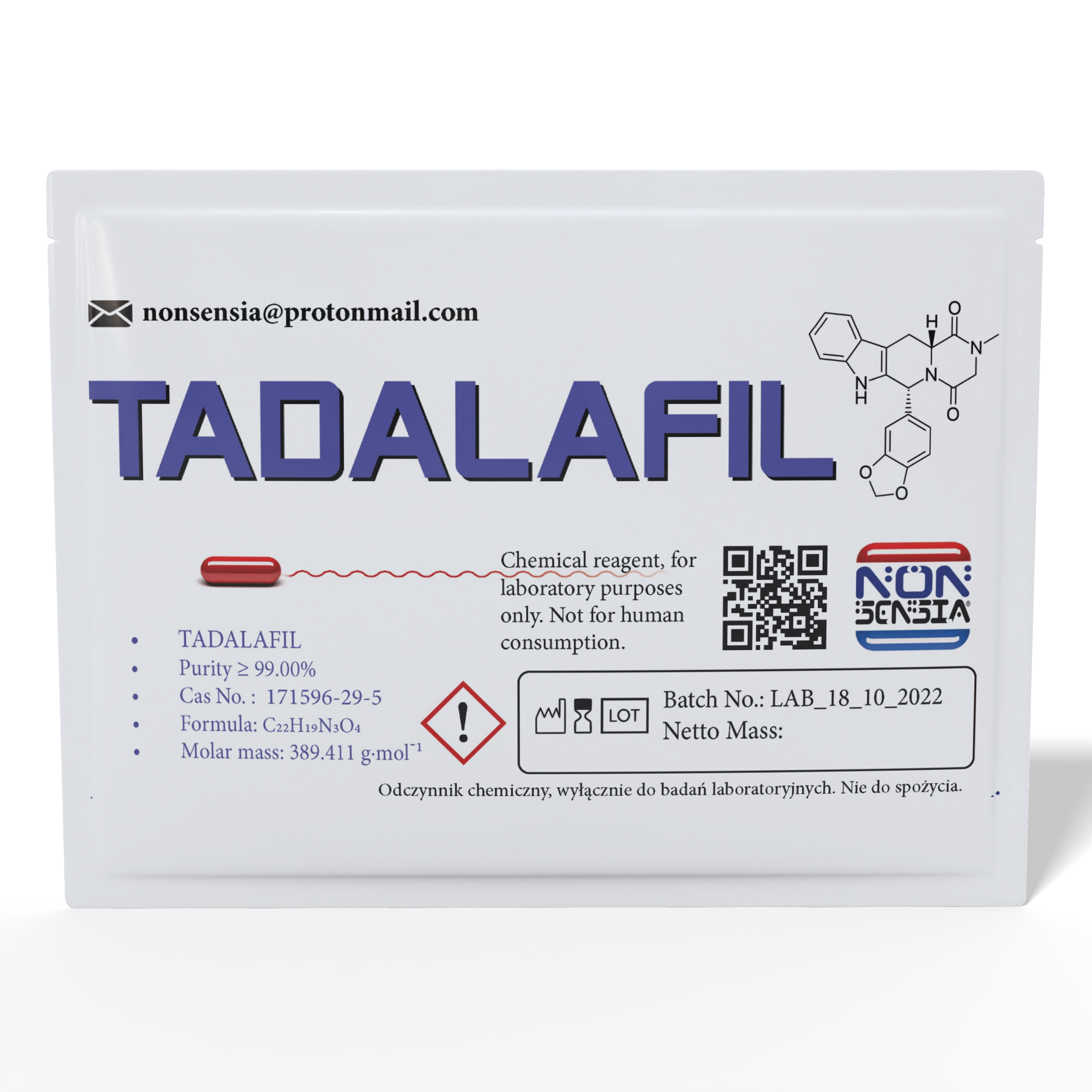
Product classification — read before ordering. This item is a chemical reagent and analytical reference material. It is not a medicinal product, dietary supplement, food, feed, novel food or cosmetic, and it is not intended for human or animal consumption or for any in-vivo administration whatsoever. It is supplied exclusively to laboratories, research institutions and professional users for in-vitro analytical, chromatographic and method-development work. Scientific findings summarised on this page describe substances investigated in published laboratory and clinical research; they are reported here as bibliographic facts about that literature and are not product claims, dosage guidance, or a recommendation of any use of this reagent.
This molecule is the active substance of authorised medicines. Read section 12 before ordering. Tadalafil is the active substance of centrally authorised European medicinal products including Cialis and Adcirca [5][6], and of 87 records in the Polish Register of Medicinal Products [7]. That status attaches to those finished products and to their marketing-authorisation holders. It does not attach to the material on this page, which is supplied as a laboratory reagent under the terms in section 15. An authorised medicine and an analytical reference material are two different legal articles even when the molecule is identical, and the difference is not a formality: it determines who may supply the article, to whom, under what documentation, and for what purpose.
Key facts
- Substance
- Tadalafil (INN, USAN, BAN, JAN; tadalafilum), single stereoisomer (6R,12aR)
- CAS
- 171596-29-5
- EC / ECHA
- 687-782-2 · registry entry 100.214.024 [4]
- PubChem CID
- 110635 [1]
- UNII
- 742SXX0ICT
- Formula
- C22H19N3O4
- Molecular mass
- 389.4 g·mol−1
- Monoisotopic mass
- 389.13755610 Da
- InChIKey
WOXKDUGGOYFFRN-IIBYNOLFSA-N- Stereocentres
- 2 defined, 0 undefined — trans, fully specified
- Melting point
- 301–302 °C (two aggregator sources in agreement; see section 8)
- Water solubility
- 3.2 µg·mL−1 at pH 7.4 (measured); estimates in the same record run to 250 mg·L−1
- GHS
- Warning — GHS07; H315, H319, H335 (self-classification only; no CLP Annex VI entry)
- WADA 2026
- Not prohibited [8]
- Pack
- 1000 mg
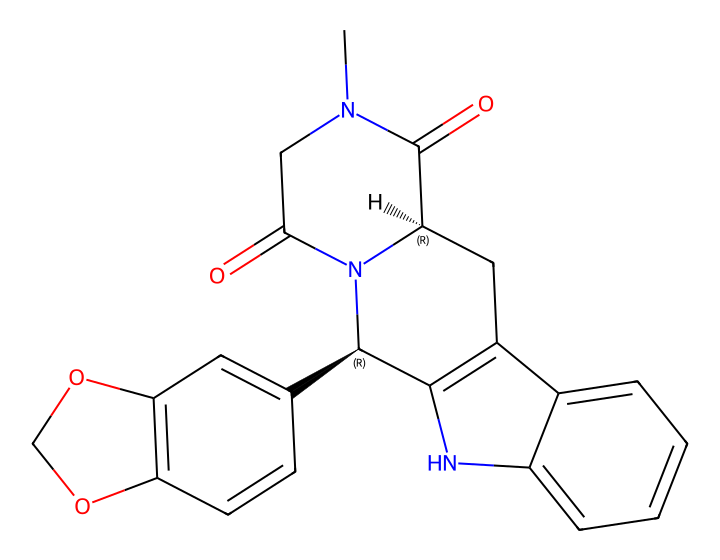
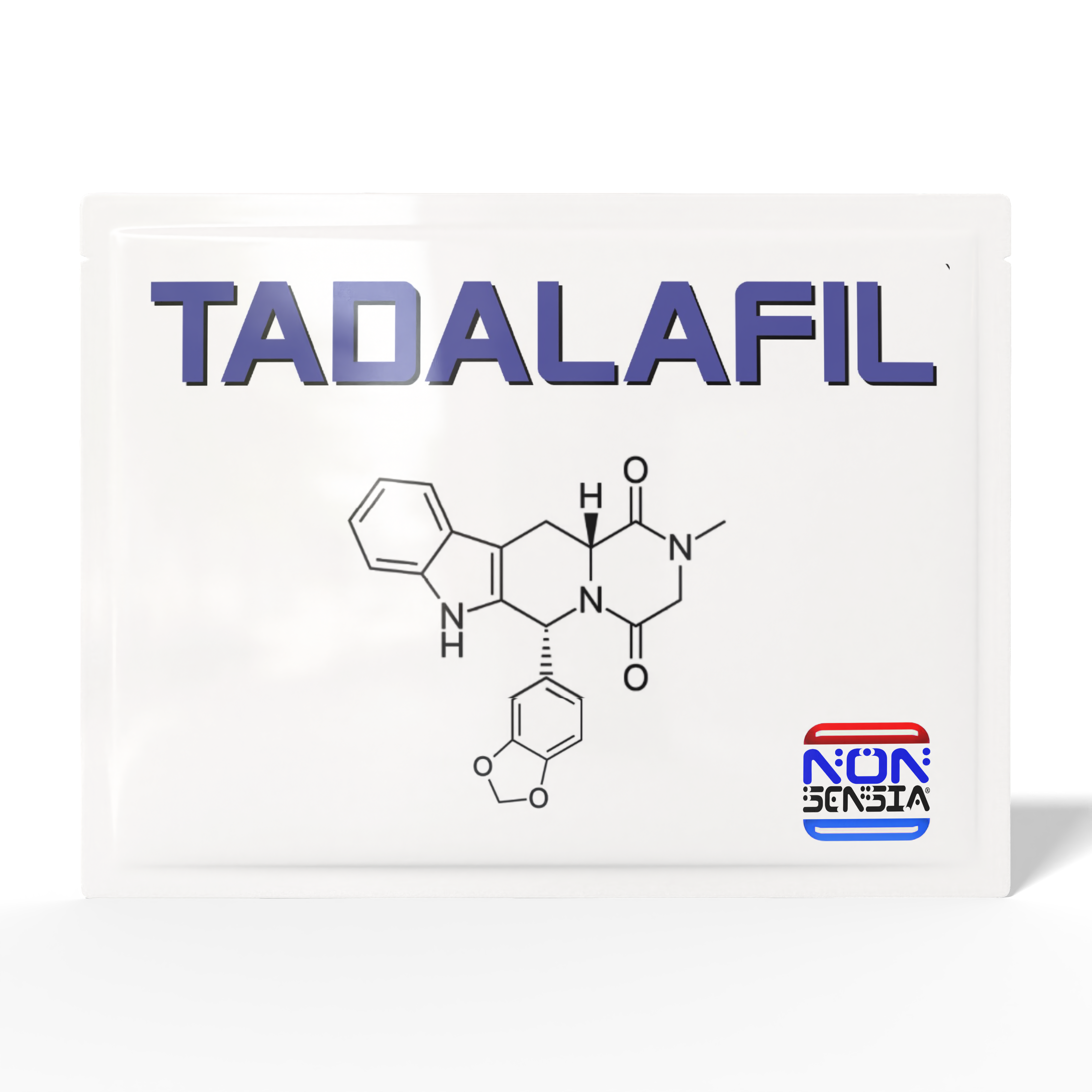
Tadalafil, (6R,12aR). Both stereocentres are drawn explicitly because, as section 4 explains, they are the only thing separating this substance from three other compounds that share its formula, its exact mass and the first fourteen characters of its InChIKey.
On this page
- What this material is
- Identity and registry codes
- Structure and stereochemistry
- The blind spot: why mass spectrometry cannot see the difference
- Methods that do resolve configuration
- How the standard turns into its own impurity
- Solid form: one molecule, many solids
- Physicochemical data, and where the sources disagree
- Spectra: what exists, what does not
- Why an authentic standard matters: the falsification literature
- Hazard classification
- Regulatory status
- Handling, storage and documentation
- What we certify and what we do not
- Terms of supply
- Questions and answers
1. What this material is
This page describes tadalafil supplied as an analytical reference material: a weighed quantity of a single, identified chemical substance, intended to serve as the point of comparison against which another sample is measured. A reference material has one job, and it is a narrow one. When a laboratory reports that a tablet contains tadalafil, or that a herbal preparation has been adulterated with it, or that an active-ingredient batch conforms to specification, that report is only as good as the material the instrument was calibrated against. Everything downstream inherits the identity, the purity and the stability of one vial.
Tadalafil is a selective inhibitor of phosphodiesterase type 5, first described in a 2003 medicinal-chemistry paper by the group that developed it [9]. That paper is worth naming precisely because of what this page is not about: the pharmacology is the reason the molecule exists and the reason it is counterfeited, but it has no bearing on the reagent. What matters here is a different and much less discussed problem, and it is why this card runs longer than most.
Tadalafil has an identity problem that mass spectrometry cannot solve. The molecule carries two stereocentres. All four stereoisomers exist as separate registry records. They share the same molecular formula, the same exact mass to eight decimal places, and the same fragmentation behaviour. A laboratory that confirms identity by liquid chromatography with tandem mass spectrometry — which is to say most laboratories, most of the time — can produce a spectrum entirely consistent with tadalafil while holding its enantiomer, or either of its two cis diastereoisomers, in the vial. Sections 3 to 6 set out what follows from that, including the uncomfortable fact that the substance can convert into one of those isomers after manufacture and release.
For the general terms on which this shop supplies reference materials, the surrounding reference standards category collects the rest of the catalogue on the same basis.
2. Identity and registry codes
Every identifier below is quoted from a public registry, with the registry named. Where two registries use different numbering conventions for the same structure, both are given rather than a choice being made silently — a habit that matters more here than usual, because this molecule has two competing systematic names in wide circulation.
| Preferred name | Tadalafil (INN, USAN, BAN, JAN); Latin tadalafilum |
|---|---|
| CAS Registry Number | 171596-29-5 |
| EC number | 687-782-2 |
| ECHA registry entry | 100.214.024 [4] |
| PubChem CID | 110635 [1] |
| UNII (FDA) | 742SXX0ICT |
| ChEBI | CHEBI:71940 |
| ChEMBL | CHEMBL779 |
| DrugBank | DB00820 |
| KEGG | D02008 |
| DSSTox | DTXSID9046786 |
| HMDB | HMDB0014958 |
| NCI Thesaurus | C47743 |
| Nikkaji | J1.662.659G |
| MDL number | MFCD07771966 |
| Wikidata | Q424156 |
| ATC code | G04BE08; the macitentan combination product is classified separately as C02KX54 [7] |
| Development codes | IC-351, GF-196960, LY-450190, ICOS 351 |
| Pharmacopoeial standard | Tadalafil CRS, catalogue number Y0001417 (see the caveat in section 14) |
Two systematic names for one structure
Automated name generation and pharmacopoeial convention disagree here, and both names are encountered in the literature and in supplier documentation:
| Fused-ring nomenclature (pharmacopoeial, CAS index style) | (6R,12aR)-6-(1,3-benzodioxol-5-yl)-2,3,6,7,12,12a-hexahydro-2-methylpyrazino[1′,2′:1,6]pyrido[3,4-b]indole-1,4-dione |
|---|---|
| von Baeyer nomenclature (computer-generated) | (2R,8R)-2-(1,3-benzodioxol-5-yl)-6-methyl-3,6,17-triazatetracyclo[8.7.0.03,8.011,16]heptadeca-1(10),11,13,15-tetraene-4,7-dione |
The practical consequence is that the same compound is legitimately described as (6R,12aR) in one document and (2R,8R) in another. Neither is wrong. A search that assumes one convention will silently miss records written in the other, and an analyst comparing two certificates written in different conventions may conclude that the materials differ when they do not. This card uses the pharmacopoeial numbering throughout, because that is the convention the impurity designations in section 6 are written in.
Machine-readable descriptors
| Canonical SMILES (no stereochemistry) | CN1CC(=O)N2C(C1=O)CC3=C(C2C4=CC5=C(C=C4)OCO5)NC6=CC=CC=C36 |
|---|---|
| Isomeric SMILES | CN1CC(=O)N2[C@@H](C1=O)CC3=C([C@H]2C4=CC5=C(C=C4)OCO5)NC6=CC=CC=C36 |
| InChI | InChI=1S/C22H19N3O4/c1-24-10-19(26)25-16(22(24)27)9-14-13-4-2-3-5-15(13)23-20(14)21(25)12-6-7-17-18(8-12)29-11-28-17/h2-8,16,21,23H,9-11H2,1H3/t16-,21-/m1/s1 |
| InChIKey | WOXKDUGGOYFFRN-IIBYNOLFSA-N |
| XLogP3-AA | 2.3 |
| Topological polar surface area | 74.9 Å2 |
| Hydrogen-bond donors / acceptors | 1 / 4 |
| Rotatable bonds | 1 |
| Heavy atoms / complexity | 29 / 702 |
Note the two SMILES strings. The first carries no stereochemical information at all; the second encodes both centres. If a supplier record, a database import or a laboratory information system stores the first, the stereochemistry is simply gone, and nothing downstream will flag its absence. This is not a hypothetical failure mode: a flat, stereochemistry-free record for this connectivity exists in the registry in its own right, and any process that rounds a structure to its connectivity will land on it.
The single rotatable bond is worth a second look. With one rotatable bond, 29 heavy atoms and a complexity score of 702, this is a rigid, densely fused molecule. Rigidity is why its crystal forms are so numerous and so well studied (section 7), and it is also why its infrared and Raman spectra are sharp and highly diagnostic — a property the falsification literature in section 10 exploits heavily.
3. Structure and stereochemistry
Tadalafil is a tetracyclic compound built on a β-carboline core fused to a piperazine-2,5-dione, carrying a 1,3-benzodioxol-5-yl substituent at C-6. The registry record states its stereochemistry without ambiguity [1]:
| Defined atom stereocentre count | 2 |
|---|---|
| Undefined atom stereocentre count | 0 |
| Defined bond stereocentre count | 0 |
| Undefined bond stereocentre count | 0 |
| InChI stereo layer | /t16-,21-/m1/s1 |
| Isotope atom count | 0 |
| Formal charge | 0 |
| Covalently bonded units | 1 — free base, no counter-ion |
Two defined centres, none undefined. The substance is a single, fully specified stereoisomer in the trans arrangement, not a mixture and not a partially resolved material. The last two rows dispose of the hydrochloride claim that circulates for this substance: a single covalently bonded unit at formal charge zero is a free base by definition, and the composition sections of the authorised product information for both Cialis and Adcirca declare tablet content as tadalafil, not as a salt [5][6].
Two centres mean four stereoisomers, and here is what makes this molecule unusual among the compounds in this catalogue: every one of the four has its own registry record, and so do a flat record and a partially specified one.
| Record | Configuration | InChIKey |
|---|---|---|
| CID 110635 | (6R,12aR) — this product | WOXKDUGGOYFFRN-IIBYNOLFSA-N |
| CID 9908373 | (6S,12aS) — ent-tadalafil, the mirror image | WOXKDUGGOYFFRN-KKSFZXQISA-N |
| CID 9821704 | (6R,12aS) — cis diastereoisomer | WOXKDUGGOYFFRN-HRAATJIYSA-N |
| CID 9865139 | (6S,12aR) — cis diastereoisomer, mirror image of the row above | WOXKDUGGOYFFRN-IERDGZPVSA-N |
| CID 4687521 | no stereochemistry recorded | WOXKDUGGOYFFRN-UHFFFAOYSA-N |
| CID 57702110 | partially defined; titled by the registry as tadalafil EP Impurity A [3] | WOXKDUGGOYFFRN-BJQOMGFOSA-N |
Read the third column. Every record shares the same first fourteen characters: WOXKDUGGOYFFRN. The InChIKey is built in two blocks, and the first block encodes connectivity only — which atoms are bonded to which. Stereochemistry lives entirely in the second block. Six different substances, one of them the mirror image of the product and one of them a designated pharmacopoeial impurity, are indistinguishable on the first block alone.
A concrete failure mode. It is common practice to index or deduplicate chemical databases on the InChIKey skeleton, precisely because the skeleton is robust to tautomers, salt forms and drawing conventions. Applied to this molecule, that practice merges the active substance, its enantiomer, both cis diastereoisomers, a stereochemistry-free record and a named pharmacopoeial impurity into a single entity. If your inventory system, your certificate archive or your spectral library keys on the skeleton, it has already discarded the only distinction that matters here. Compare bromantane, which is achiral and has no stereoisomers to confuse, or apigenin, a flat aromatic flavone — for those, skeleton-level indexing loses nothing at all.
Where tadalafil sits among chiral reference materials
Stereochemistry is not a curiosity confined to this molecule, and the contrast across a catalogue is instructive. Modafinil carries a single stereocentre at sulfur and is supplied as the racemate, which is why its single-enantiomer form holds a separate international name; flmodafinil inherits the same centre. Noopept has one defined centre. Alpha-GPC has one, and is the subject of a naming collision in which the opposite enantiomer's registry record carries the product's own common name as its first synonym. Coluracetam and aniracetam have none at all, despite older marketing copy for the former having claimed an optical rotation the molecule cannot possess.
Tadalafil is the hardest case in that group, for a reason that is arithmetic rather than chemical: with two centres, the wrong material is not merely a mirror image but may be a diastereoisomer — a genuinely different compound, with different physical properties, different crystal behaviour, and a different retention time even on an achiral column. That last point cuts both ways, and section 5 returns to it.
4. The blind spot: why mass spectrometry cannot see the difference
This is the central analytical fact about tadalafil as a reference material, and it deserves stating in the bluntest available terms.
Nine separate registry records for this connectivity carry the monoisotopic mass 389.13755610 Da — identical to the final decimal place. All nine report an isotope atom count of zero. Among them are the active substance, its enantiomer, both cis diastereoisomers and the flat record. No mass measurement, at any resolution, separates them. An instrument capable of resolving 389.13755610 from 389.13755611 would still report all nine as the same number, because it is the same number.
Nor does fragmentation help. The published product-ion spectra for the protonated molecule, [M+H]+ at m/z 390.1459, are a function of connectivity, and connectivity is precisely what these substances share. The deposited transitions are:
| Conditions | Principal product ions (m/z) |
|---|---|
| Q-TOF, collision energy 20 V | 302.1289 (base peak), 348.1343, 390.1450, 305.1149, 232.0510 |
| Q-TOF, collision energy 40 V | 232.0543 (base peak), 258.0701, 231.0461, 244.0531, 234.0346 |
| Orbitrap, MS2 | 135.0433 (base peak), 268.1084, 262.0866, 250.0873, 240.1137 |
| Negative ionisation | [M−H]− at 388.1246, with 328.1026 as base peak |
Every stereoisomer produces this series. A laboratory reporting tadalafil confirmed by LC-MS/MS, retention time and two transitions within tolerance has confirmed connectivity and nothing more. If the reference standard used to fix that retention time and those transitions was itself the wrong isomer, the tolerance window closes around the wrong answer, and the resulting report is internally consistent, fully documented and wrong.
The base peak at m/z 135.0433 in the Orbitrap spectrum is worth naming, because it is shared far more widely than the parent. It corresponds to the methylenedioxybenzyl cation from the benzodioxole ring — a fragment carried by every compound in this family that retains that ring, including several of the designed analogues in section 10. A transition list built around it is a class marker, not an identity.
The one record that breaks the pattern, and why
There is a further record with this connectivity, and it is the exception that explains the rule. Tadalafil-12,13,14,15-d4 [2] carries four deuterium atoms in place of four hydrogens. Its monoisotopic mass is 393.16266308 Da — greater by 4.02510698 Da, four times the mass difference between deuterium and protium. Its InChI ends in an isotopic layer, /i2D,3D,4D,5D, and its isotope atom count is 4 rather than 0.
That offset is not incidental to the compound; it is the entire reason the compound exists. A deuterated analogue is synthesised to serve as an internal standard: it co-elutes with the analyte, ionises and fragments in the same way, suffers the same matrix suppression, and is nonetheless separately countable because the mass spectrometer can see the four-dalton gap. The only member of this family that mass spectrometry can reliably distinguish is the one deliberately built to be distinguishable — and it was built that way by moving mass, not by moving stereochemistry, because moving stereochemistry would not have worked.
The point generalises beyond this molecule. When a technique cannot separate two things, the working solution is to make them differ in a dimension the technique can see. That is sound and standard analytical engineering. It is also a standing admission that the original distinction was invisible.
Practical note on internal standards. A d4 internal standard controls for recovery, injection volume and ion suppression. It does not control for stereochemical identity, because it shares the analyte's stereo-blindness: a deuterated (6R,12aR) standard quantifies the wrong isomer exactly as faithfully as the right one. Quantitative rigour and identity rigour are separate problems and need separate controls.
5. Methods that do resolve configuration
Four families of technique are documented as capable of distinguishing tadalafil from its stereoisomers. Each has a published method, and each carries the same prerequisite: a reference material of confirmed configuration. None of them is self-calibrating.
Chiral chromatography
Enantioseparation of tadalafil and of its synthetic intermediate has been characterised on chitin-derived chiral stationary phases [12], and the diastereoisomeric and enantiomeric impurities of the (1R,3R) tetrahydro-β-carboline intermediate have been determined in a dedicated simultaneous method [11]. The intermediate matters as much as the product: stereochemical error introduced at the Pictet–Spengler ring-forming step propagates unchanged through the rest of the synthesis, and controlling it at that step is the subject of a continuing body of asymmetric-catalysis work [10].
An important subtlety follows from section 3. The two cis diastereoisomers are separable on ordinary achiral columns, because diastereoisomers differ in physical properties. The enantiomer is not. A validated achiral impurity method — and fast ultra-high-performance methods with diode-array and mass-spectrometric detection have been published for exactly this purpose [39] — therefore controls half the problem while remaining silent on the other half. That silence is easy to mistake for a clean result.
Capillary electrophoresis with cyclodextrins
Because tadalafil is uncharged across the accessible pH range, its separation by capillary electrophoresis depends entirely on differential complexation with a chiral selector rather than on any intrinsic difference in mobility. The interactions of the non-charged stereoisomers with cyclodextrins have been characterised by electrophoresis and nuclear magnetic resonance together [13], and single-isomer carboxymethyl-β-cyclodextrin has been developed as a selector for this class of separation [14]. These are among the most economical routes to a stereochemical purity figure, but they are acutely sensitive to selector batch composition — which is why single-isomer selectors were pursued in the first place.
Chiroptical spectroscopy
Vibrational and electronic circular dichroism respond directly to absolute configuration rather than inferring it from retention behaviour. A study of genuine and counterfeit medicines containing tadalafil applied chiroptical and vibrational spectroscopy together and discriminated materials that other techniques treated as equivalent [15]; a companion study compared genuine, generic and counterfeit tablets by vibrational spectroscopy with multivariate statistics [17]. These methods answer the configuration question most directly of any listed here, and they are also the least likely to be available in a routine laboratory.
Mass spectrometry made chiral by complexation
The most elegant answer to section 4 is to change what the mass spectrometer is being asked. Direct electrospray ionisation with nickel(II) complexation has been shown to differentiate and quantify tadalafil enantiomers [16]: the metal centre together with a chiral auxiliary forms diastereomeric complexes, and diastereomers — unlike enantiomers — genuinely differ in mass-spectrometric behaviour. The instrument that could not see the difference is made to see it by being presented with a different question.
What every one of these methods needs. Chiral chromatography needs a standard to assign which peak is which. Cyclodextrin electrophoresis needs a standard to establish migration order. Chiroptical spectroscopy needs a standard to fix the sign convention for a given solvent and concentration. Nickel-complexation mass spectrometry needs a standard to identify the complex. Not one of these techniques tells you which enantiomer you are holding without something of known configuration to compare against. That is what an analytical reference standard is for, and it is why the configuration statement on a certificate is not a decorative detail.
6. How the standard turns into its own impurity
Everything above assumes the material is stereochemically stable once made. For tadalafil in aqueous media under light, it is not.
A study of the phototransformation of tadalafil in aqueous media found 6-epimerisation competing with solvent-trapping reactions [18]. In plain terms: irradiation inverts the configuration at C-6, converting the (6R,12aR) substance into a cis diastereoisomer. That diastereoisomer is not an exotic degradant. It is CID 57702110, which the registry titles as tadalafil EP Impurity A, also catalogued as Related Compound C [3] — a compound carrying a pharmacopoeial impurity designation, which is to say a compound that a pharmacopoeial monograph exists in order to limit.
The consequence for a reference material. A vial of tadalafil exposed to light in the presence of water can generate its own principal stereochemical impurity in storage. A certificate of analysis states the material's condition at the moment of testing. It does not, and cannot, state its condition after six months on a bench near a window with a residual-moisture problem. Stereochemical purity is therefore not a property to be verified once at goods-in and thereafter assumed; for this substance it is a property with a decay path, and the decay product is the one thing the routine identity test cannot detect (section 4).
This closes a loop worth following deliberately, because each step is individually unremarkable and the combination is not:
- Tadalafil epimerises at C-6 under light in aqueous media [18].
- The product of that epimerisation is a designated pharmacopoeial impurity [3].
- That impurity carries the same formula and the same exact mass as the parent [1][3].
- The routine confirmatory technique for this compound class is mass spectrometry.
- Therefore the degradation is invisible to the test most likely to be run on it.
The practical response is not exotic: amber glass, dry storage, protection from light in solution, and a stereochemically capable method from section 5 run periodically rather than never. The reason for setting it out at this length is that none of those precautions look necessary if the only characterisation data on file is a mass spectrum — and the mass spectrum will continue to look correct for exactly as long as the material continues to degrade.
7. Solid form: one molecule, many solids
Tadalafil is a textbook poorly soluble crystalline solid, and the pharmaceutical-technology literature on its solid state is unusually deep for a single molecule. That literature exists because the compound's behaviour in a dissolution test is governed less by the molecule than by which solid the molecule happens to be sitting in.
| Form | What was characterised | Source |
|---|---|---|
| Amorphous | Prepared and characterised alongside four crystalline polymorphs, with stability compared across all five | [19] |
| Four crystalline polymorphs | Characterised and ranked for stability in the same study | [19] |
| Three crystal habits | Deliberately designed and separately characterised; the three differ in pharmaceutical performance despite being the same crystal form | [20] |
| Acetone monosolvate | Crystal structure solved; desolvation behaviour studied | [21] |
| Methyl ethyl ketone monosolvate | Crystal structure solved; desolvation behaviour studied | [21] |
| Polymer solid dispersions | Apparent solubility and dissolution rate shown to depend on the choice of polymer | [22] |
| Molecular arrangement in dispersions | Probed by inverse gas chromatography and Raman mapping | [23] |
| Coamorphous with finasteride | Two-drug amorphous system with altered pharmaceutical performance | [24] |
Two entries in that table deserve emphasis. The solvates [21] are the operational warning: acetone and methyl ethyl ketone are among the most ordinary recrystallisation solvents in a synthetic laboratory, and both form stoichiometric monosolvates with this molecule whose structures have been solved. A batch recrystallised from either can be a solvate rather than the anhydrous form, and the difference will not appear in a mass spectrum, in an elemental analysis rounded to the usual tolerances, or in a chromatographic purity figure. It appears in thermal analysis, in the powder diffraction pattern, and in the mass on the balance.
The three crystal habits [20] make an even finer point. Habit is not polymorphism — the internal crystal structure is the same, only the external shape of the crystals differs. Three materials that are identical by diffraction, identical by spectroscopy and identical by mass spectrometry nonetheless behaved differently in pharmaceutical testing. For a reference material this is mostly a handling matter, since habit affects flow, static behaviour and how a small sample weighs out; but it is a reminder that a certificate stating white crystalline powder has said less than it appears to.
Underneath all of this sits solubility. Tadalafil is a classic Biopharmaceutics Classification System class II compound — permeable but poorly soluble — which is the reason an entire research programme on solid dispersions exists [22][23][24]. At the measured value in section 8, the dissolution result is determined by the solid form, not by the molecule.
8. Physicochemical data, and where the sources disagree
The registry record contains a populated experimental-properties section, and it also contains contradictions that a careful reader should see rather than have resolved for them. Values below carry their attribution, and where sources conflict, the conflict is reported rather than averaged.
| Property | Value | Attribution |
|---|---|---|
| Physical description | Solid | HMDB |
| Melting point | 301–302 °C | DrugBank and HMDB, in agreement |
| Water solubility | Practically insoluble | DrugBank, qualitative |
| Water solubility | 3.2 µg·mL−1, mean at pH 7.4 | Sanford-Burnham; the only value flagged as a measurement |
| Water solubility | 220 mg·L−1 at 25 °C | HSDB, marked estimated |
| Water solubility | 250 mg·L−1 | HMDB |
| logP | 2.89 | DrugBank, experimental |
| log Kow | 1.42 | HSDB, marked estimated |
| logP | 1.7 | HMDB |
| XLogP3-AA | 2.3 | computed |
| pKa | 0.85 | HSDB, marked estimated |
| Vapour pressure | 2.2 × 10⁻¹⁴ mm Hg at 25 °C | HSDB, marked estimated |
| Henry's law constant | 5.0 × 10⁻¹⁸ atm·m3·mol−1 | HSDB, marked estimated |
| Collision cross-section | 188.12 / 188.7 / 189.4 Å2 for [M+H]+ | CCSbase, travelling-wave |
| Collision cross-section | 198.72 Å2 [M+Na]+; 199.71 Å2 [M+K]+ | CCSbase, travelling-wave |
The solubility spread is roughly seventy-eightfold
Read the four solubility rows together. The single value marked as a measurement is 3.2 µg·mL−1, which is 3.2 mg·L−1. The estimates in the same record are 220 and 250 mg·L−1 — some seventy-eight times higher. This is not a subtle discrepancy and it is not a rounding issue; it is the difference between a compound whose dissolution is a serious formulation problem and one whose dissolution is unremarkable. The qualitative DrugBank entry, practically insoluble, sides with the measurement.
Anyone preparing a stock solution should work from the measured figure and expect to use an organic co-solvent. Anyone quoting a solubility on a document should quote which of the four values they mean and where it came from.
The gap that matters most: no specific rotation
The registry record contains no specific rotation, [α]D. It also contains no density, no boiling point, no flash point and no refractive index — but the missing rotation is in a different category from the rest. Optical rotation is the oldest, cheapest and most widely available chiroptical measurement in existence; a polarimeter is standard equipment where the instruments in section 5 are not. For a compound whose entire identity problem is stereochemical, the one measurement that a routine laboratory could actually make to address that problem has no reference value deposited in the public record. A laboratory measuring a rotation on this material therefore has a number with nothing to compare it against, unless it holds a standard of confirmed configuration — which returns to the closing note of section 5.
9. Spectra: what exists, what does not
Deposited spectroscopic data is where the public record for tadalafil is at its thinnest, and the pattern of the gaps is not random.
| Technique | Present | Provenance |
|---|---|---|
| 13C NMR | Yes | Institute of Organic Chemistry, University of Vienna |
| 1H NMR | No | — |
| 2D NMR (COSY, HSQC, HMBC) | No | — |
| UV-Vis | No | — |
| FTIR (KBr) | Yes | Forensic Spectral Research; sample Cayman 14024, lot 0455537-1 |
| ATR-IR | Yes | same sample, Cayman 14024, lot 0455537-1 |
| FT-Raman | Yes | same sample, Cayman 14024, lot 0455537-1 |
| GC-MS | Yes | Mass Spectrometry Committee, Toxicology Section, AAFS |
| MS-MS | Yes, six spectra | HMDB; four positive mode, two negative |
| LC-MS | Yes | MoNA; Q-TOF, [M+H]+ 390.1459 at 20 and 40 V |
| High-resolution MS2 | Yes | MoNA; Orbitrap |
Three observations follow, and each is uncomfortable in a different way.
First, there is no proton spectrum. Only carbon. This matters because the falsification literature in section 10 detects and quantifies tadalafil in seized and marketed products predominantly by 1H NMR — a survey of 150 herbal preparations was conducted that way [25], and portable benchtop instruments have been evaluated for the same purpose in the field [34]. The technique of choice for identifying this compound in the wild has no reference spectrum deposited for it in the public record.
Second, there is no UV-Vis spectrum, while a substantial fraction of published quantitative work on tadalafil uses high-performance liquid chromatography with diode-array or ultraviolet detection [39][40]. The molecule has a strong chromophore — an indole fused into an extended system — so this is a gap in deposition, not in physics. It is nonetheless a gap, and it means the wavelength of maximum absorbance and the absorptivity used to build a calibration have to come from the method paper rather than from a reference record.
Third, and least obvious: the three vibrational spectra are not three independent confirmations. The FTIR, the ATR-IR and the Raman spectrum were all recorded on one sample, from one supplier, from one lot — Cayman 14024, lot 0455537-1. Three techniques applied to a single material tell you three things about that material. They do not tell you that a second lot would look the same. Given section 7, where the same molecule is documented in an amorphous form, four polymorphs, three habits and two solvates, and given that vibrational spectra are precisely the techniques most sensitive to solid form, the single-lot provenance is a real limitation rather than a pedantic one. A material in a different solid form would legitimately give a different infrared spectrum while being the same substance — and a comparison against these deposited spectra would flag it.
Also deposited are the SPLASH hashed identifiers for the two Q-TOF spectra, which allow a spectrum to be matched exactly rather than by eye: splash10-0udi-0019000000-989b326813e322333fa5 at 20 V and splash10-001i-0191000000-d354efe7f924359a7da6 at 40 V. As section 4 established, matching either of them confirms connectivity and not configuration.
10. Why an authentic standard matters: the falsification literature
Tadalafil is among the most frequently falsified substances in the world, and it is one of the two most common undeclared additions to preparations sold for sexual performance — the other being sildenafil, whose card covers the same problem from the other side. The published record on this is large, methodologically serious, and directly relevant to why a laboratory would hold a reference standard at all.
The scale of the problem
A single study analysed 150 herbal preparations marketed for sexual performance by quantitative 1H NMR and reported detection, identification and quantification of the adulterants found [25]. Review articles have since catalogued the class systematically [26][27], and a broad survey framed the practice as a worldwide public-health problem rather than a local one [28]. Falsified tadalafil tablets distributed through the internet have been characterised as a distinct category of product [35].
Designed analogues: the hard part
The falsification problem is not simply that tadalafil is added where it is not declared. It is that modified analogues are synthesised specifically to evade screening methods built around the parent compound. The literature documents these being isolated and structurally elucidated one after another:
| Analogue | Isolated and characterised in |
|---|---|
| Cyclopentynafil and N-octylnortadalafil | [29] |
| N-cyclohexyl nortadalafil | [30] |
| Further new analogues, reported 2026 | [31] |
Each of these retains the tadalafil skeleton with a modification — typically at the amide nitrogen — that shifts the molecular mass away from 389 while leaving the pharmacological core intact. A screening method that looks for the exact mass of tadalafil will not see them. A method that looks for the benzodioxole fragment at m/z 135.0433 (section 4) will see them all, but will not distinguish them from each other or from the parent.
One paper in this group goes further than the rest and is the reason the whole of sections 3 to 6 is not an academic exercise. Researchers examined the configuration of tadalafil and of tadalafil analogues found in dietary supplements [32] — that is, they asked not merely which compound was present but which stereoisomer. That question is only answerable with stereochemically characterised reference materials, and it is a question almost no routine screening asks.
Methods deployed against the problem
| Approach | What it achieves | Source |
|---|---|---|
| Quantitative 1H NMR | Detection, identification and quantification without a compound-specific calibrant for every analyte | [25] |
| Benchtop NMR | Brings the same approach to field and border settings at low cost | [34] |
| LC with tribrid Orbitrap | High-resolution screening across the inhibitor class and its analogues | [33] |
| Vibrational spectroscopy with chemometrics | Discriminates genuine, generic and counterfeit tablets | [17] |
| Chiroptical plus vibrational spectroscopy | Adds configuration to the discrimination | [15] |
| Chromatographic impurity fingerprinting | Identifies source by trace impurity profile rather than by the active substance | [37][38] |
| Clustering of active-ingredient samples by manufacturer | Assigns an unknown batch to a production origin | [36] |
The last two rows are the most interesting from a reference-materials standpoint, because they invert the usual logic. Impurity fingerprinting does not ask is this tadalafil; it asks whose tadalafil is this, reading the trace-level profile as a signature of a particular synthesis and a particular plant. Feasibility was established first [38], then developed into a comparison of detection modes for the specific case of counterfeit tablets [37], and then extended to clustering active-ingredient samples by manufacturer [36]. These methods depend on chromatographic reproducibility at trace levels, which in turn depends on a stable, well-characterised standard to anchor the retention axis.
11. Hazard classification
The registry carries an aggregated GHS classification for tadalafil, and it is important to read what that aggregation actually is before relying on it.
| Code | Statement | Class | Share of notifiers |
|---|---|---|---|
| H315 | Causes skin irritation | Skin Irrit. 2 | 92.3% |
| H319 | Causes serious eye irritation | Eye Irrit. 2 | 92.3% |
| H335 | May cause respiratory irritation | STOT SE 3 | 89.4% |
| H302 | Harmful if swallowed | Acute Tox. 4, oral | 54.8% |
| H312 | Harmful in contact with skin | Acute Tox. 4, dermal | 53.8% |
| H332 | Harmful if inhaled | Acute Tox. 4, inhalation | 53.8% |
Signal word: Warning. Pictogram: GHS07, the exclamation mark, consistent with the irritation classes and the signal word.
How thin the basis is. The record states that this aggregation comes from 104 reports by companies from 12 notifications to the European inventory. Twelve notifications is a narrow foundation. The spread in the percentage column is the visible consequence: the three irritation endpoints command near-unanimity, while the three acute-toxicity endpoints sit close to a coin toss. That is not a measure of how toxic the substance is — it is a measure of how much the notifying companies disagreed with one another. Percentages of this kind are counts of opinions, not confidence intervals on a toxicological finding.
There is no harmonised classification. The European registry entry carries no index number under Annex VI of the CLP Regulation [4]. Everything above is self-classification by suppliers. No part of it is legally binding as a harmonised classification in the European Union, and a different supplier may lawfully classify the same substance differently.
12. Regulatory status
Each statement in this section is a measurement against a named document, and each negative statement was made with a positive control on the same document so that a zero can be distinguished from a broken search.
Anti-doping
Tadalafil is not prohibited under the World Anti-Doping Code Prohibited List for 2026 [8]. Searching the list for tadalafil, sildenafil, phosphodiesterase, PDE5 and PDE-5 returns zero occurrences in each case. Those zeros are meaningful because the same search of the same document returns bromantan twice and modafinil four times — the instrument fires when it should. Phosphodiesterase type 5 inhibitors have nonetheless been the subject of a continuing discussion in sports medicine [43]; being discussed and being prohibited are different states, and the list is the authority on the second.
Controlled substances
Tadalafil does not appear in the Polish schedules of narcotic drugs and psychotropic substances. Searching the consolidated schedules returns zero occurrences for both tadalafil and sildenafil, against positive controls in the same document returning 27 occurrences for the amphetamine stem and two for the cocaine stem. The substance also carries no United States controlled-substance schedule in its registry record.
Medicinal product status in Poland
This is the section where the widely repeated summary turns out to be wrong, and the correction goes in an unexpected direction.
| Records for the substance | 87 |
|---|---|
| Distinct trade names | 39 |
| Authorisation validity | 54 recorded as indefinite; 18 valid with a future expiry date; 15 already expired as at 22 August 2026 |
| Pharmaceutical forms | 86 film-coated tablets; 1 oral suspension |
| Strengths | 20 mg (27), 10 mg (26), 5 mg (22), 2.5 mg (9), 2 mg·mL−1 (1), two fixed combinations |
| Supply category, counted per pack | prescription 262; restricted prescription 9; non-prescription 22 |
| Products with at least one non-prescription pack | 12 of 87, all at 10 mg, in packs of one, two or four tablets |
| Products under restricted prescription | 5, all indicated in pulmonary arterial hypertension |
Two things in that table contradict the description this page previously carried, and both matter.
Tadalafil is not uniformly a prescription-only substance in Poland. Twelve products, all at the 10 mg strength and in small pack sizes, are classified as available without prescription. The counting was done at pack level across all 87 records rather than inferred from the substance, and the field used was checked against known reference points before being trusted: the same field returns restricted-prescription status only for morphine sulfate, non-prescription for ibuprofen, and a mixed picture for sildenafil. A field that discriminates in those three cases is a field whose zero and non-zero values mean something.
Eighty-seven is a count of records, not of live authorisations. Fifteen of the 87 carry an expiry date already in the past, one of them by only four weeks. Anyone citing the number as a measure of how many tadalafil medicines are currently authorised in Poland is overstating it by roughly a sixth. This card quotes 87 as what it is: the size of the register entry.
European authorised indications
Two centrally authorised products define the therapeutic scope, and the contrast between them is the most instructive regulatory fact about this molecule:
| Product | Authorised indication | Authorised regimen |
|---|---|---|
| Cialis 2.5 / 5 / 10 / 20 mg film-coated tablets | Erectile dysfunction in adult males; sexual stimulation is required for the substance to be effective. The 5 mg strength additionally carries an indication in the signs and symptoms of benign prostatic hyperplasia in adult males. Not indicated for use by women. | 10 mg as required, or 2.5–5 mg once daily for continuous use |
| Adcirca 20 mg tablets and 2 mg·mL−1 oral suspension | Pulmonary arterial hypertension in WHO functional class II and III, to improve exercise capacity; efficacy shown in idiopathic disease and in disease related to collagen vascular disease. Paediatric patients aged two years and above are included. Initiation and monitoring restricted to physicians experienced in the condition. | 40 mg once daily in adults, given as two 20 mg tablets |
The same molecule spans a sixteenfold range. The continuous regimen in the urological indication starts at 2.5 mg once daily. The cardiopulmonary indication is 40 mg once daily. One tablet strength — 20 mg — appears in both, doing entirely different work: it is the upper as-required strength in one indication and half of the standing regimen in the other. It is also why the widely repeated claim that pharmacological effects last up to four hours is not merely imprecise but backwards. Four hours is not a duration of effect in the product information; it is the threshold at which prolonged erection becomes an emergency and the product information directs the patient to seek immediate medical assistance. A number that marks a safety boundary had been reprinted as a performance figure.
The evidence base behind the cardiopulmonary indication is substantial and worth naming, both because it explains why a 40 mg regimen exists and because it is the least widely known part of this molecule's record: a randomised trial established efficacy in pulmonary arterial hypertension [41], and a subsequent randomised trial of a fixed macitentan and tadalafil single-tablet combination extended the approach [42]. That combination is the reason a second ATC code appears in section 2.
13. Handling, storage and documentation
The guidance below follows from the classification in section 11 and the stability finding in section 6. It concerns handling of a laboratory reagent by trained personnel and nothing else.
| Personal protection | Nitrile gloves, safety glasses, laboratory coat. Weigh in a fume hood or under local exhaust: the classification includes respiratory irritation, and this is a fine crystalline solid that becomes airborne readily. |
|---|---|
| Light | Protect from light, in the solid state and especially in solution. This is not generic caution: photoepimerisation at C-6 is documented in aqueous media [18] and generates a pharmacopoeial impurity (section 6). Amber glass or foil-wrapped clear glass. |
| Moisture | Store dry. The epimerisation pathway that matters is an aqueous one; a dry solid is a much less mobile system. |
| Temperature | Ambient, in a closed container. We make no case for refrigerated storage: nothing in the registry record supports it, and a solid melting at 301–302 °C has no thermal reason to need it. Storage at 2–8 °C is sometimes specified for this substance without any source. Cold storage of a container that is then opened in a warm room invites condensation, which given the row above is an active disadvantage. |
| Solution preparation | Expect to need an organic co-solvent. At 3.2 µg·mL−1 in aqueous buffer (section 8), an aqueous stock at any useful concentration is not achievable. Protect prepared solutions from light and do not store them longer than the method has been shown to support. |
| Recrystallisation | Avoid acetone and methyl ethyl ketone unless you intend a solvate: both form stoichiometric monosolvates with solved crystal structures [21]. |
| Waste | Halogen-free organic chemical waste, in accordance with local regulations. Do not release to drains. |
| Records | Record lot number, date opened and storage location. Given section 6, the date of opening is more informative for this substance than for most. |
14. What we certify and what we do not
This section exists because the difference between a supplier's statement and a certified value is the difference that a reference material is bought for. We would rather state the boundary plainly than let a page imply more than it can support.
| Claim | Status |
|---|---|
| Chemical identity: CAS, formula, mass, InChI, InChIKey, stereodescriptors | Quoted from named public registries [1][4], each identifier traceable to its source |
| Regulatory statements in section 12 | Measured against named documents [5][6][7][8], each negative accompanied by a positive control |
| Literature summarised in sections 5 to 10 | Every claim carries a citation with a resolvable identifier |
| Purity figure for the specific lot supplied | Not certified on this page. Any purity statement applies to the lot it was measured on and belongs on lot documentation, not in catalogue copy |
| Stereochemical purity, enantiomeric or diastereomeric excess | Not certified. Establishing it requires a method from section 5. We do not report a figure we have not measured, and sections 3 to 6 exist precisely so that a buyer knows to ask for one |
| Solid form: polymorph, habit, solvate or amorphous state | Not certified. Given the eight documented forms in section 7, this is a real omission rather than a formality |
| Water content | Not certified. |
| Pharmacopoeial status | This material is not supplied as a pharmacopoeial reference standard. A European Pharmacopoeia chemical reference substance for tadalafil exists under catalogue number Y0001417 and is obtainable from the issuing body; this is not that article, and the two are not interchangeable for compendial testing |
| Monograph limits and impurity specifications | Not reproduced. Monographs exist in both the European and United States pharmacopoeias, but their texts are behind paid access and we have not read them. We will not paraphrase limits we have not seen |
15. Terms of supply
This material is supplied as a laboratory reagent and analytical reference material, for in-vitro laboratory use by qualified personnel in an appropriately equipped facility. It is not a medicinal product, not a dietary supplement, not a food, feed or cosmetic ingredient, and it is not supplied for administration to humans or animals in any form or by any route.
By ordering, the purchaser confirms that they are a professional user acquiring the material for laboratory purposes; that they will handle it in accordance with section 13 and their own institutional risk assessment; that they will not administer it to humans or animals, nor supply it to any person who intends to; and that they are responsible for compliance with all laws applicable at the destination, which for a substance that is an active pharmaceutical ingredient in the destination jurisdiction may include requirements that do not apply to ordinary reagents.
Nothing on this page is medical advice, nor an offer of a medicinal product, nor guidance on the use of any medicine. Statements about authorised medicines in section 12 describe those medicines and their authorisations; they describe neither this article nor any use of it.
16. Questions and answers
- Is this the same substance as the active ingredient in authorised tadalafil medicines?
- It is the same chemical substance. It is not the same article in law. An authorised medicine is a finished product manufactured under pharmaceutical quality rules, released against a marketing authorisation, and accompanied by approved product information. This is a reagent supplied for laboratory work, released against no such framework. The molecule being identical is exactly what makes the distinction worth stating rather than assuming.
- Why does this page spend so long on stereochemistry?
- Because it is the one property of this molecule that the usual identity test cannot see. Tadalafil has two stereocentres and four stereoisomers, all four hold separate registry records, and all of them share the same molecular formula and the same monoisotopic mass of 389.13755610 Da. Mass spectrometry — the technique most laboratories reach for — returns the same answer for all of them. Sections 4 to 6 set out the consequences.
- Can I confirm the identity of this material by LC-MS/MS?
- You can confirm its connectivity, which is a real and useful result. You cannot confirm its configuration. The enantiomer and both cis diastereoisomers give the same exact mass and the same fragment series. If configuration matters for your purpose, section 5 lists four families of method that address it: chiral chromatography, cyclodextrin capillary electrophoresis, chiroptical spectroscopy, and mass spectrometry with nickel(II) complexation.
- What is the InChIKey skeleton problem?
- The InChIKey has two blocks; the first encodes connectivity only. For this molecule the first block,
WOXKDUGGOYFFRN, is shared by the active substance, its enantiomer, both cis diastereoisomers, a stereochemistry-free record and a designated pharmacopoeial impurity. Any system that indexes or deduplicates on the skeleton alone treats six distinct substances as one. - Is tadalafil supplied as a salt?
- No. It is the anhydrous free base. The registry record shows a formal charge of zero and one covalently bonded unit, meaning no counter-ion, and the composition statements of the authorised European products declare tablet content as tadalafil rather than as a salt. Listings describing it as a hydrochloride are wrong.
- How soluble is it in water?
- Barely. The single value in the registry record flagged as a measurement is 3.2 µg·mL−1 at pH 7.4. The record also carries estimates of 220 and 250 mg·L−1, some seventy-eight times higher, and a qualitative entry reading practically insoluble. Work from the measured value and expect to need an organic co-solvent.
- Does it need refrigeration?
- We make no case for it. Nothing in the registry record supports cold storage, and a solid melting above 300 °C has no thermal reason to require it. What the material does need is protection from light and from moisture, for the reason in section 6. Refrigerating a container that is then opened in a warm room invites condensation, which works against the requirement that actually matters.
- Why does light matter so much for this compound?
- Because irradiation in aqueous media inverts the configuration at C-6, and the resulting cis diastereoisomer is a designated pharmacopoeial impurity with the same formula and the same exact mass as the parent. The material can degrade into its own principal impurity, and the degradation is invisible to a mass-spectrometric identity check.
- Which solid form is supplied?
- We do not certify a solid form, and section 14 says so explicitly. The literature documents an amorphous form, four crystalline polymorphs, three distinct crystal habits and two stoichiometric monosolvates for this molecule. If your work depends on solid form — dissolution testing above all — that is a question to settle by thermal analysis and powder diffraction on the material in front of you.
- Is tadalafil prohibited in sport?
- Not under the 2026 Prohibited List. Searching the list returns zero occurrences for tadalafil, for sildenafil, and for the phosphodiesterase terms, while the same search of the same document returns hits for bromantan and modafinil — so the zero reflects the list rather than a failed search. Inhibitors of this class remain a topic of discussion in sports medicine, which is a different matter from being prohibited.
- Is tadalafil available without prescription in Poland?
- Partly, which is a more interesting answer than the usual summary. Counting supply categories across all 87 register records at pack level gives 262 prescription packs, nine restricted-prescription packs and 22 non-prescription packs; twelve of the 87 products have at least one non-prescription pack, all at 10 mg in packs of one, two or four tablets. None of this changes the status of the material on this page, which is a reagent and not a medicine in any supply category.
- Why is there no proton NMR spectrum in the public record?
- We do not know, and we report it as a gap rather than fill it. The registry holds a carbon-13 spectrum, infrared, Raman and several mass spectra, but no proton spectrum, no two-dimensional NMR and no ultraviolet spectrum. The absence is worth knowing because proton NMR is the technique the falsification literature relies on most heavily for this compound, and ultraviolet detection is what most published quantitative methods use.
- Why do you list three vibrational spectra as one piece of evidence?
- Because they are one piece of evidence. The infrared, attenuated-total-reflectance and Raman spectra in the record were all measured on a single sample from a single supplier lot. Three techniques on one material is not three independent confirmations, and vibrational spectroscopy is precisely the family most sensitive to solid form — of which this molecule has at least eight documented variants.
- Do you supply a certificate of analysis?
- Kilogram-scale orders come with a batch Certificate of Analysis. What that documentation does and does not cover is set out in section 14, including the items we do not certify: stereochemical purity, solid form and water content. We would rather name those gaps than let a certificate imply coverage it does not have.
References
Registry, pharmacopoeial and regulatory sources
- National Center for Biotechnology Information. 2026. "PubChem Compound Summary for CID 110635, Tadalafil." PubChem. https://pubchem.ncbi.nlm.nih.gov/compound/110635.
- National Center for Biotechnology Information. 2026. "PubChem Compound Summary for CID 23634385, Tadalafil-12,13,14,15-d4." PubChem. https://pubchem.ncbi.nlm.nih.gov/compound/23634385.
- National Center for Biotechnology Information. 2026. "PubChem Compound Summary for CID 57702110, Tadalafil EP Impurity A / Tadalafil Related Compound C." PubChem. https://pubchem.ncbi.nlm.nih.gov/compound/57702110.
- European Chemicals Agency. 2026. "Tadalafil — substance information, EC 687-782-2, registry entry 100.214.024." ECHA. https://chem.echa.europa.eu/100.214.024.
- European Medicines Agency. 2026. "Cialis — Annex I, Summary of Product Characteristics." EMA. https://www.ema.europa.eu/en/medicines/human/EPAR/cialis.
- European Medicines Agency. 2026. "Adcirca — Annex I, Summary of Product Characteristics." EMA. https://www.ema.europa.eu/en/medicines/human/EPAR/adcirca.
- Urząd Rejestracji Produktów Leczniczych, Wyrobów Medycznych i Produktów Biobójczych. 2026. "Rejestr Produktów Leczniczych — substancja czynna Tadalafilum." https://rejestry.ezdrowie.gov.pl/rpl/search/public.
- World Anti-Doping Agency. 2026. "World Anti-Doping Code International Standard: Prohibited List 2026." WADA. https://www.wada-ama.org/en/prohibited-list.
Discovery, synthesis and stereochemical control
- Daugan, A., P. Grondin, C. Ruault, A.-C. Le Monnier de Gouville, H. Coste, J. M. Linget, J. Kirilovsky, F. Hyafil, and R. Labaudinière. 2003. "The Discovery of Tadalafil: A Novel and Highly Selective PDE5 Inhibitor. 2: 2,3,6,7,12,12a-Hexahydropyrazino[1′,2′:1,6]pyrido[3,4-b]indole-1,4-dione Analogues." Journal of Medicinal Chemistry 46 (21): 4533–4542. https://doi.org/10.1021/jm0300577.
- Chan, Y. C., M. H. Sak, S. A. Frank, and S. J. Miller. 2021. "Tunable and Cooperative Catalysis for Enantioselective Pictet–Spengler Reaction with Varied Nitrogen-Containing Heterocyclic Carboxaldehydes." Angewandte Chemie International Edition 60 (46): 24573–24581. https://doi.org/10.1002/anie.202109694.
- Yu, L., Y. Jin, Jianzhou, C. Ye, J. Wang, and G. Hu. 2012. "Simultaneous Determination of Diastereoisomeric and Enantiomeric Impurities in (1R,3R)-1-(1,3-Benzodioxol-5-yl)-2-(chloroacetyl)-2,3,4,9-tetrahydro-1H-pyrido[3,4-b]indole-3-carboxylate." Chirality 24 (4): 303–306. https://doi.org/10.1002/chir.21998.
Separation and assignment of configuration
- Zhang, J., Z. Wang, X. Wang, J. Zhang, Z. Bai, and W. Chen. 2015. "Enantioseparation Characteristics of Tadalafil and Its Intermediate on Chitin Derived Chiral Stationary Phases." The Analyst 140 (16): 5593–5600. https://doi.org/10.1039/c5an00260e.
- Fejős, I., A. Kazsoki, T. Sohajda, E. Márványos, B. Volk, and L. Szente. 2014. "Interactions of Non-Charged Tadalafil Stereoisomers with Cyclodextrins: Capillary Electrophoresis and Nuclear Magnetic Resonance Studies." Journal of Chromatography A 1363: 348–355. https://doi.org/10.1016/j.chroma.2014.08.045.
- Fejős, I., E. Varga, G. Benkovics, M. Malanga, T. Sohajda, J. Széman, and S. Béni. 2017. "Characterization of a Single-Isomer Carboxymethyl-β-Cyclodextrin in Chiral Capillary Electrophoresis." Electrophoresis 38 (15): 1869–1877. https://doi.org/10.1002/elps.201700004.
- Králík, F., P. Jirmásek, M. Kučkař, and V. Setnička. 2018. "Chiroptical and Vibrational Spectroscopic Study of Genuine and Counterfeit Medicines Containing Tadalafil." Chirality 30 (5): 560–567. https://doi.org/10.1002/chir.22828.
- Wang, L., Y. Wang, Y. Chai, Y. Kang, C. Sun, and S. Zeng. 2017. "Nickel(II)-Assisted Enantiomeric Differentiation and Quantitation of Tadalafil by Direct Electrospray Ionization Mass Spectrometry." Journal of Mass Spectrometry 52 (7): 411–416. https://doi.org/10.1002/jms.3939.
- Špalovská, D., T. Pekárek, M. Kučkař, and V. Setnička. 2021. "Comparison of Genuine, Generic and Counterfeit Cialis Tablets Using Vibrational Spectroscopy and Statistical Methods." Journal of Pharmaceutical and Biomedical Analysis 206: 114383. https://doi.org/10.1016/j.jpba.2021.114383.
Photochemistry and stereochemical stability
- Temussi, F., G. Bassolino, F. Cermola, M. DellaGreca, M. R. Iesce, and S. Montanaro. 2010. "Investigation on the Phototransformation of Tadalafil in Aqueous Media. 6-Epimerization vs. Solvent Trapping Reaction." Photochemical & Photobiological Sciences 9 (8): 1139–1144. https://doi.org/10.1039/c0pp00019a.
Solid-state form and formulation
- Wei, Y., Y. Ling, M. Su, L. Qin, J. Zhang, Y. Gao, S. Qian, and J. Heng. 2018. "Characterization and Stability of Amorphous Tadalafil and Four Crystalline Polymorphs." Chemical and Pharmaceutical Bulletin 66 (12): 1114–1121. https://doi.org/10.1248/cpb.c18-00450.
- Bhale, N. A., S. Shah, A. S. Jahnavi, A. Vishwakarma, T. Thakur, S. Thomas, and S. B. Singh. 2024. "Three Strikingly Different Crystal Habits of Tadalafil: Design, Characterization, Pharmaceutical Performance, and Computational Studies." Molecular Pharmaceutics 21 (12): 6234–6244. https://doi.org/10.1021/acs.molpharmaceut.4c00601.
- Miclauș, M. O., I. E. Kacsó, F. A. Martin, L. David, M. Pop, and C. Filip. 2015. "Crystal Structure and Desolvation Behaviour of the Tadalafil Monosolvates with Acetone and Methyl Ethyl Ketone." Journal of Pharmaceutical Sciences 104 (11): 3782–3788. https://doi.org/10.1002/jps.24597.
- Włodarski, K., W. Sawicki, K. Haber, J. Knapik, Z. Wojnarowska, M. Paluch, P. Lepek, L. Hawełek, and L. Tajber. 2015. "Physicochemical Properties of Tadalafil Solid Dispersions — Impact of Polymer on the Apparent Solubility and Dissolution Rate of Tadalafil." European Journal of Pharmaceutics and Biopharmaceutics 94: 106–115. https://doi.org/10.1016/j.ejpb.2015.04.031.
- Školáková, T., D. Smržová, T. Pekárek, M. Lhotka, A. Školáková, V. Klimša, and P. Zámostný. 2022. "Investigation of Tadalafil Molecular Arrangement in Solid Dispersions Using Inverse Gas Chromatography and Raman Mapping." International Journal of Pharmaceutics 623: 121955. https://doi.org/10.1016/j.ijpharm.2022.121955.
- Bhale, N. A., A. Subha Jahnavi, R. Khemchandani, G. Vambhurkar, R. Suradkar, S. Shah, and S. B. Singh. 2026. "Drug–Drug Coamorphous System of Tadalafil and Finasteride for Enhanced Pharmaceutical Performance." Molecular Pharmaceutics 23 (1): 127–138. https://doi.org/10.1021/acs.molpharmaceut.5c00513.
Falsification, adulteration and designed analogues
- Gilard, V., S. Balayssac, A. Tinaugus, N. Martins, R. Martino, and M. Malet-Martino. 2015. "Detection, Identification and Quantification by 1H NMR of Adulterants in 150 Herbal Dietary Supplements Marketed for Improving Sexual Performance." Journal of Pharmaceutical and Biomedical Analysis 102: 476–493. https://doi.org/10.1016/j.jpba.2014.10.011.
- Kee, C. L., X. Ge, V. Gilard, M. Malet-Martino, and M. Y. Low. 2018. "A Review of Synthetic Phosphodiesterase Type 5 Inhibitors (PDE-5i) Found as Adulterants in Dietary Supplements." Journal of Pharmaceutical and Biomedical Analysis 147: 250–277. https://doi.org/10.1016/j.jpba.2017.07.031.
- Patel, D. N., L. Li, C. L. Kee, X. Ge, M. Y. Low, and H. L. Koh. 2014. "Screening of Synthetic PDE-5 Inhibitors and Their Analogues as Adulterants: Analytical Techniques and Challenges." Journal of Pharmaceutical and Biomedical Analysis 87: 176–190. https://doi.org/10.1016/j.jpba.2013.04.037.
- Yelehé-Okouma, M., E. Pape, L. Humbertjean, M. Evrard, R. El Osta, and N. Petitpain. 2021. "Drug Adulteration of Sexual Enhancement Supplements: A Worldwide Insidious Public Health Threat." Fundamental & Clinical Pharmacology 35 (5): 792–807. https://doi.org/10.1111/fcp.12653.
- Hasegawa, T., K. Takahashi, M. Saijo, T. Ishii, T. Nagata, and M. Kurihara. 2009. "Isolation and Structural Elucidation of Cyclopentynafil and N-Octylnortadalafil Found in a Dietary Supplement." Chemical and Pharmaceutical Bulletin 57 (2): 185–189. https://doi.org/10.1248/cpb.57.185.
- Liu, J., J. Sun, H. Wei, H. Yu, X. Dai, and Q. Hu. 2023. "Isolation and Characterization of a Novel Tadalafil Analogue Adulterant, N-Cyclohexyl Nortadalafil, in a Dietary Supplement." Journal of Pharmaceutical and Biomedical Analysis 227: 115144. https://doi.org/10.1016/j.jpba.2022.115144.
- Göker, H., F. Doganc, M. Gumustas, and E. Saklica. 2026. "Isolation and Characterization of New Tadalafil Analogues in Male Sexual Herbal Supplements." Drug Testing and Analysis, online first. https://doi.org/10.1002/dta.70114.
- Fukiwake, T., M. Yamazaki, K. Takahashi, T. Doi, M. Kawaguchi, and K. Enomoto. 2021. "The Configuration of Tadalafil and Tadalafil Analogues Found in Dietary Supplements." Shokuhin Eiseigaku Zasshi (Food Hygiene and Safety Science) 62 (2): 65–72. https://doi.org/10.3358/shokueishi.62.65.
- Sakamoto, M., K. Minowa, K. Kishimoto, J. Nakajima, J. Suzuki, and T. Moriyasu. 2019. "LC/Tribrid Orbitrap Analysis of Phosphodiesterase-5 Inhibitors and Their Analogs as Adulterants in Dietary Supplements." Shokuhin Eiseigaku Zasshi (Food Hygiene and Safety Science) 60 (4): 96–107. https://doi.org/10.3358/shokueishi.60.96.
- Keizers, P. H. J., F. Bakker, J. Ferreira, P. F. K. Wackers, D. van Kollenburg, E. van der Aa, and A. van Beers. 2020. "Benchtop NMR Spectroscopy in the Analysis of Substandard and Falsified Medicines as Well as Illegal Drugs." Journal of Pharmaceutical and Biomedical Analysis 178: 112939. https://doi.org/10.1016/j.jpba.2019.112939.
- Sanada, T., N. Yoshida, R. Matsushita, K. Kimura, and H. Tsuboi. 2020. "Falsified Tadalafil Tablets Distributed in Japan via the Internet." Forensic Science International 307: 110143. https://doi.org/10.1016/j.forsciint.2020.110143.
- Deconinck, E., M. Raimondo, A. Borioni, Y. Grange, H. Rebère, and A. Mihailova. 2023. "Clustering of Tadalafil API Samples According to Their Manufacturer in the Context of API Falsification Detection." Journal of Pharmaceutical Sciences 112 (11): 2834–2842. https://doi.org/10.1016/j.xphs.2023.05.015.
- Custers, D., B. Krakowska, J. O. De Beer, P. Courselle, M. Daszykowski, S. Apers, and E. Deconinck. 2016. "Chromatographic Impurity Fingerprinting of Genuine and Counterfeit Cialis as a Means to Compare the Discriminating Ability of PDA and MS Detection." Talanta 146: 540–548. https://doi.org/10.1016/j.talanta.2015.09.029.
- Sacré, P.-Y., E. Deconinck, M. Daszykowski, P. Courselle, R. Vancauwenberghe, P. Chiap, J. Crommen, and J. O. De Beer. 2011. "Impurity Fingerprints for the Identification of Counterfeit Medicines — A Feasibility Study." Analytica Chimica Acta 701 (2): 224–231. https://doi.org/10.1016/j.aca.2011.05.041.
Chromatographic methods and clinical context
- Schreiber, L., R. Halko, and M. Hutta. 2017. "Fast Ultra-High-Performance Liquid Chromatography with Diode Array and Mass Spectrometry Method for Determination of Tadalafil Drug Substance and Its Impurities." Biomedical Chromatography 31 (12): e4020. https://doi.org/10.1002/bmc.4020.
- Barot, T. G., and P. K. Patel. 2010. "Determination of Tadalafil in Pure Powder and Tablet Dosage Form by High-Performance Liquid Chromatography." Journal of AOAC International 93 (2): 516–522. https://pubmed.ncbi.nlm.nih.gov/20480898/.
- Galiè, N., B. H. Brundage, H. A. Ghofrani, R. J. Oudiz, G. Simonneau, Z. Safdar, S. Shapiro, R. J. White, M. Chan, A. Beardsworth, L. Frumkin, and R. J. Barst. 2009. "Tadalafil Therapy for Pulmonary Arterial Hypertension." Circulation 119 (22): 2894–2903. https://doi.org/10.1161/CIRCULATIONAHA.108.839274.
- Grünig, E., P. Jansa, F. Fan, J. Hauser, M. Pannaux, A. Morganti, N. Rehberger, and V. V. McLaughlin. 2024. "Randomized Trial of Macitentan/Tadalafil Single-Tablet Combination Therapy for Pulmonary Arterial Hypertension." Journal of the American College of Cardiology 83 (4): 473–484. https://doi.org/10.1016/j.jacc.2023.10.045.
- Di Luigi, L., M. Sansone, A. Sansone, R. Ceci, G. Duranti, P. Borrione, C. Crescioli, A. Sgrò, and F. Romanelli. 2017. "Phosphodiesterase Type 5 Inhibitors, Sport and Doping." Current Sports Medicine Reports 16 (6): 443–447. https://doi.org/10.1249/JSR.0000000000000422.