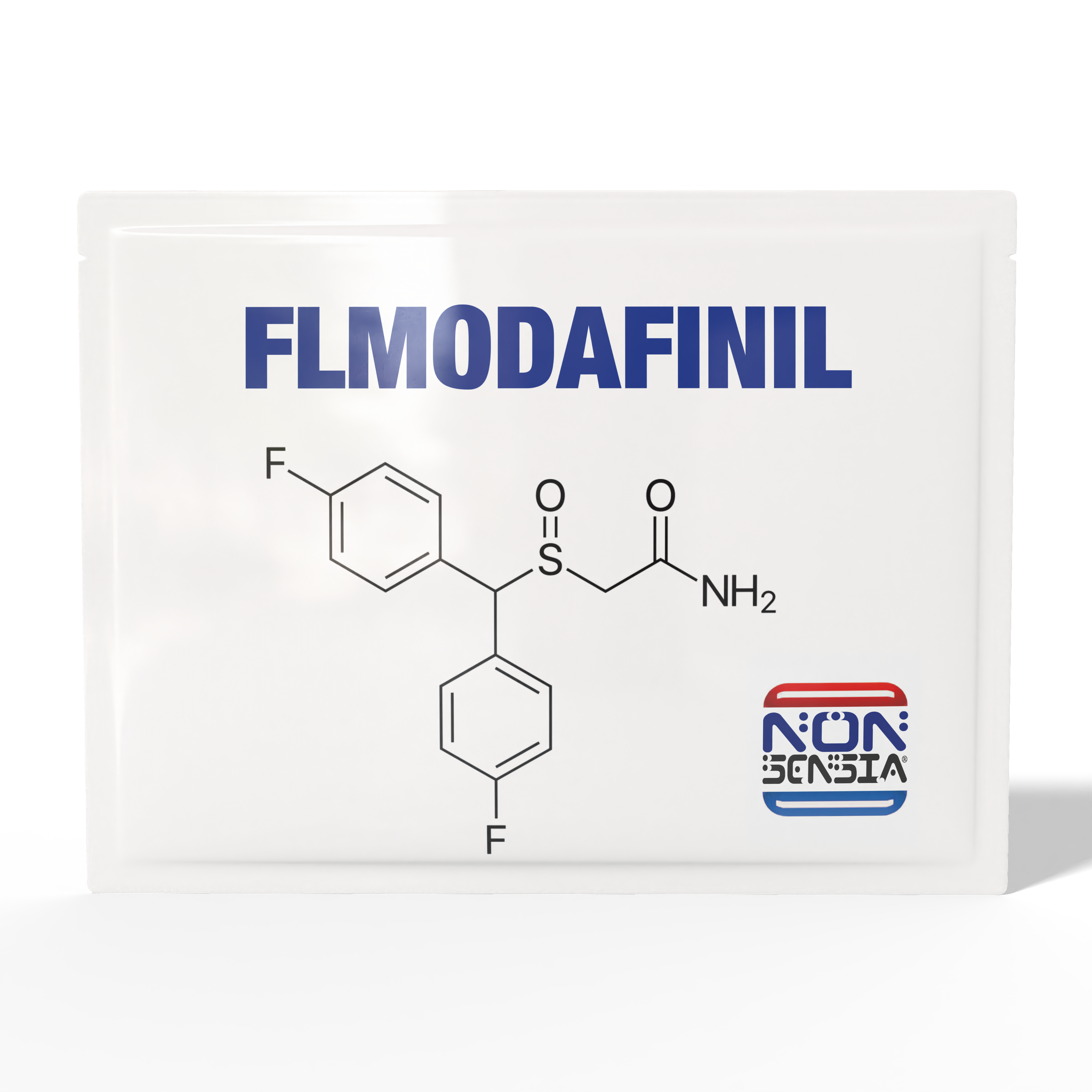
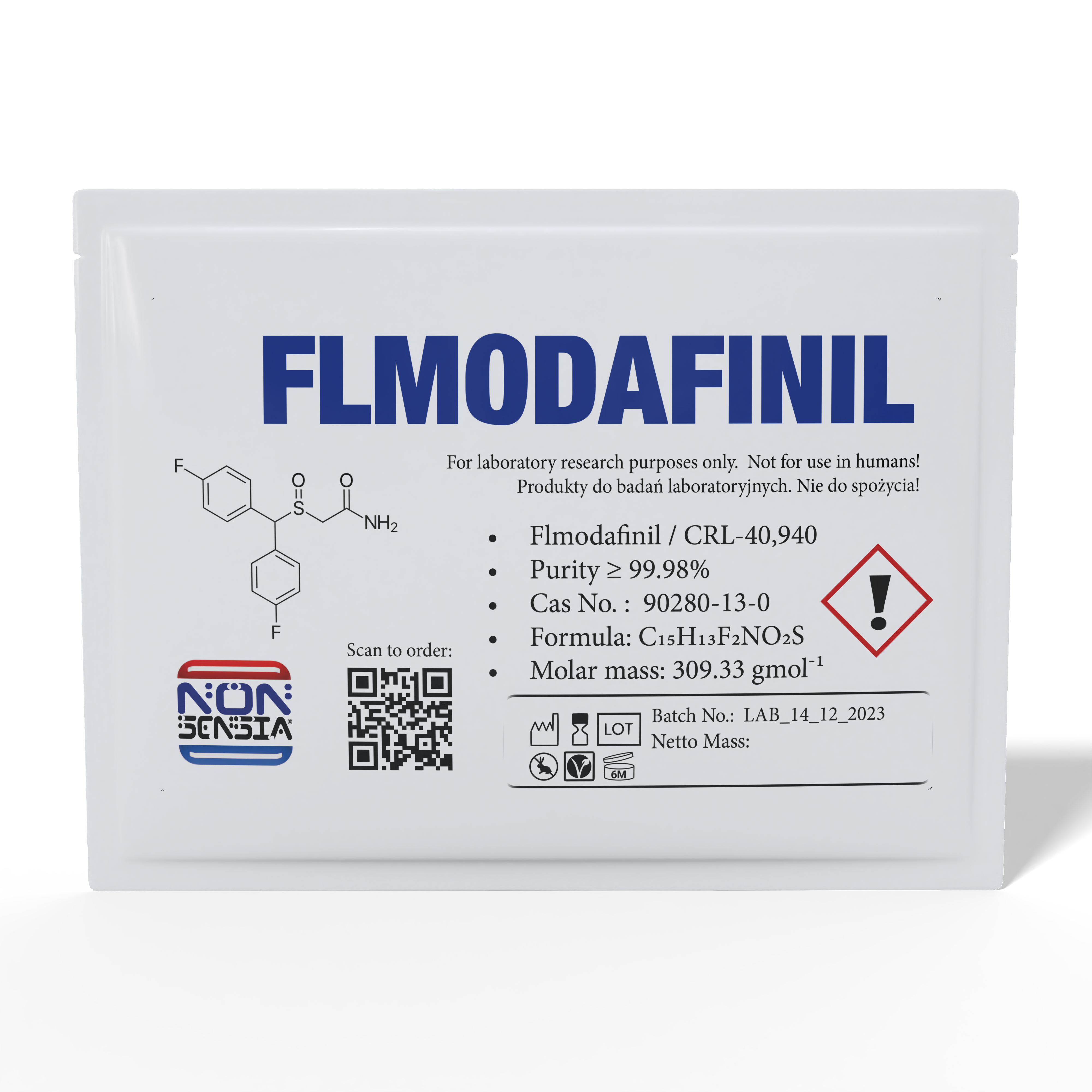
Product classification — read before ordering. This item is a chemical reagent and analytical reference material. It is not a medicinal product, dietary supplement, food, feed, novel food or cosmetic, and it is not intended for human or animal consumption or for any in-vivo administration whatsoever. It is supplied exclusively to laboratories, research institutions and professional users for in-vitro analytical, chromatographic and method-development work. Scientific findings summarised on this page describe substances investigated in published laboratory research; they are reported here as bibliographic facts about that literature and are not product claims, dosage guidance, or a recommendation of any use of this reagent.
Doping-control note. Flmodafinil is listed by name, together with its full IUPAC designation, in class S6.A, non-Specified Stimulants, of the WADA 2026 Prohibited List, prohibited in-competition [2]. Its N-hydroxy congener fladrafinil is listed alongside it. A newly listed substance is precisely the case in which an accredited laboratory has to build detection capability from scratch, and cannot do so without authenticated material. That is the principal reason this standard exists. It is not an invitation to use the material in any other way; see section 15.
Key facts
- Substance
- Flmodafinil, also bisfluoromodafinil and lauflumide — 2-[bis(4-fluorophenyl)methylsulfinyl]acetamide
- CAS
- 90280-13-0
- Development code
- CRL-40,940 (also written CRL-40940); NLS-4 in later work
- Formula / mass
- C15H13F2NO2S · 309.3 g·mol−1 · monoisotopic 309.06351 Da
- Grade
- Analytical reference standard, ≥99% by HPLC (area normalisation); batch value on Certificate of Analysis
- Quantity
- Eleven pack sizes from 1 g to 1000 g, crystalline powder
- Stereochemistry
- One stereocentre at the sulfinyl sulfur, undefined in the registry record — supplied as the racemate
- Diagnostic fragment
- m/z 203.067, the bis(4-fluorophenyl)methyl cation — 35.98 Da above modafinil's 167.086, which separates the two cleanly
- Critical analytical warning
- Degrades thermally in a hot GC injector [5]. Liquid chromatography, not GC, is the appropriate technique
- Hazard classification
- None published — no GHS classification and no ECHA notifications exist for this substance. See section 10
- Regulatory flag
- WADA 2026 Prohibited List, class S6.A, prohibited in-competition. Not an authorised medicine in any jurisdiction
- Intended use
- In-vitro analytical chemistry, LC-MS and HPLC identity and purity work, doping-control and supplement-screening reference material
- Excluded use
- Any human or animal administration; any consumable, medicinal or cosmetic product; any use in sport
- Substance identity and registry data
- Molecular structure
- Computed descriptors and what they predict
- Stereochemistry: is flmodafinil chiral?
- Solid-state behaviour and solution preparation
- Use as an analytical reference standard
- Reference spectral data
- Batch specification and Certificate of Analysis
- Handling, storage and stability
- Hazard classification — and its absence
- Discovery and development history
- Preclinical pharmacology
- Clinical research literature
- Regulatory status
- Permitted use and terms of supply
- Frequently asked questions
- How this page is sourced and verified
- References
1. Substance identity and registry data
Flmodafinil is 2-[bis(4-fluorophenyl)methylsulfinyl]acetamide: modafinil with a fluorine atom at the para position of each phenyl ring [1]. Everything else about the skeleton is unchanged — the same benzhydryl carbon, the same sulfinyl sulfur, the same primary acetamide arm. It is the only structural modification, and as section 6 shows, it is enough to change the analytical problem completely.
Every identifier below comes from a public authoritative registry [1][3], so a receiving laboratory can reconcile the material against its own inventory system without ambiguity.
Flmodafinil, bisfluoromodafinil, lauflumide, CRL-40,940 — what is the difference?
There is none at the level of the substance: all four name the same molecule, CAS 90280-13-0. Flmodafinil is the form used on the WADA Prohibited List, which spells out the IUPAC name alongside it [2]. Bisfluoromodafinil is descriptive. CRL-40,940 is the development code from the original Lafon series and the designation used in most of the analytical literature [5][7]. Lauflumide, and the code NLS-4, appear in later pharmacological work [11]. Searching on any one of them alone will miss part of the literature — a practical point for anyone doing their own review.
Do not confuse it with fladrafinil (CRL-40,941, CAS 90212-80-9), which is the N-hydroxy analogue: C15H13F2NO3S, 16 Da heavier [1]. The two are listed adjacently on the Prohibited List [2] and were characterised together for testing purposes [6].
| Common name | flmodafinil |
|---|---|
| IUPAC name | 2-[bis(4-fluorophenyl)methylsulfinyl]acetamide |
| CAS index name | Acetamide, 2-[[bis(4-fluorophenyl)methyl]sulfinyl]- |
| Synonyms | bisfluoromodafinil; lauflumide; CRL-40,940; CRL-40940; NLS-4; 2-[[bis(4-fluorophenyl)methyl]sulfinyl]acetamide |
| CAS Registry Number | 90280-13-0 |
| UNII (FDA GSRS) | 174R2IG4T0 |
| PubChem CID | 13271852 |
| ChEMBL ID | CHEMBL1672359 |
| DSSTox Substance ID | DTXSID00533646 |
| MDL Number | MFCD30475371 |
| Wikidata | Q21098952 |
| Molecular formula | C15H13F2NO2S |
| Average molecular mass | 309.3 g·mol−1 |
| Monoisotopic mass | 309.06351 Da |
| InChIKey | YEAQNUMCWMRYMU-UHFFFAOYSA-N |
| InChI | InChI=1S/C15H13F2NO2S/c16-12-5-1-10(2-6-12)15(21(20)9-14(18)19)11-3-7-13(17)8-4-11/h1-8,15H,9H2,(H2,18,19) |
| SMILES | C1=CC(=CC=C1C(C2=CC=C(C=C2)F)S(=O)CC(=O)N)F |
A correction worth stating explicitly. Commercial listings for this substance frequently circulate wrong chemistry: a molecular formula containing four fluorine atoms and three oxygens, and a molecular mass in the region of 359 g·mol−1, sometimes attached to a name describing a sulfonyl hydroxamic acid. None of that describes flmodafinil, and none of it describes fladrafinil either. The registry values are C15H13F2NO2S and 309.3 g·mol−1 [1]. If a supplier's datasheet disagrees with the registry, the registry is right and the datasheet has not been checked. This page previously carried the incorrect figures; they were replaced against PubChem on 22 August 2026.
2. Molecular structure
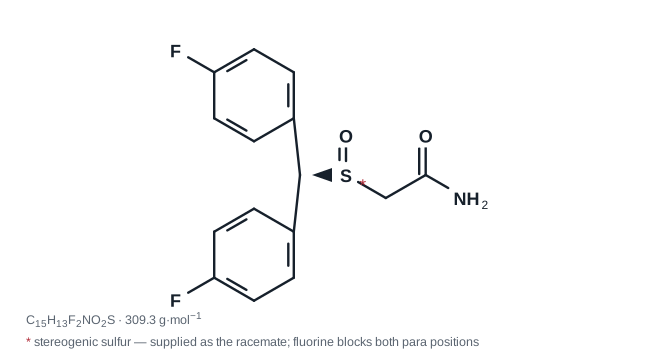
The two fluorine substituents do three things at once, and each shows up in a different measurement.
They shift the diagnostic mass fragment. The benzhydryl cation that dominates modafinil's product-ion spectrum becomes the bis(4-fluorophenyl)methyl cation, moving from m/z 167.086 to m/z 203.067 — a difference of 35.98 Da. Section 6.2 explains why that number is the most useful thing on this page.
They add hydrogen-bond acceptors without adding polarity where it counts. The computed acceptor count rises from three to five relative to modafinil, yet the topological polar surface area is unchanged at 79.4 Å2 [1]. Organic fluorine is a weak acceptor and the algorithms count it, but it contributes little to aqueous solvation. The practical reading is that retention behaviour is close to modafinil's, slightly more lipophilic, and not dramatically different.
They block the para positions. Any metabolic or synthetic chemistry that would hydroxylate the rings is closed off. This is the usual reason for para-fluorination in a medicinal-chemistry series, and it is relevant here because it shapes what metabolites a testing laboratory should look for [6].
Structural neighbours in this catalogue
Modafinil is the parent and the single most important comparator: identical skeleton, 35.98 Da lighter, chiral in the same way, and listed in the same S6.A class [2]. A method intended to cover the series must resolve and correctly assign both, and demonstrating that requires both materials in authenticated form.
Bromantane shares the regulatory class and nothing else; it is the achiral, halogen-tagged member of the same stimulant shelf, and the contrast with a chiral sulfoxide is instructive. The oxiracetam standard sits at the polar end of the same catalogue for gradient bracketing.
3. Computed descriptors and what they predict
Everything in this section is computed. There is no experimental physicochemistry for this substance. The registry record contains no measured melting point, boiling point, density, solubility or partition coefficient [1]. That is a real and unusual gap for a compound that has been in commerce for years, and this page prints no such value rather than importing one from a catalogue listing. Contrast this with the parent compound, for which a measured melting point of 164–166 °C and a measured logP are published: see the modafinil standard.
| Descriptor | Flmodafinil | Modafinil |
|---|---|---|
| Molecular formula | C15H13F2NO2S | C15H15NO2S |
| Monoisotopic mass | 309.06351 Da | 273.08235 Da |
| XLogP3-AA | 1.9 | 1.7 |
| Topological polar surface area | 79.4 Å2 | 79.4 Å2 |
| Hydrogen-bond donors | 1 | 1 |
| Hydrogen-bond acceptors | 5 | 3 |
| Rotatable bonds | 5 | 5 |
| Heavy atoms | 21 | 19 |
| Complexity | 356 | 302 |
| Formal charge | 0 | 0 |
| Defined / undefined stereocentres | 0 / 1 | 0 / 1 |
What these numbers predict in the laboratory
The descriptor set is almost superimposable on modafinil's, and that is the most useful thing about it: a method that works for modafinil is a rational starting point for this compound, needing adjustment rather than redesign. Expect comparable retention on C18 with a mid-range organic mobile phase, marginally later than the parent because of the slightly higher computed logP.
Neither the amide nor the sulfoxide ionises in a usable pH window, so mobile-phase pH is a weak lever on retention — convenient, because it removes a common source of inter-laboratory drift. Five rotatable bonds and no ionisable centre also mean peak shape is governed by the stationary phase rather than by buffer chemistry.
One caution follows from the identical polar surface area but higher acceptor count: selectivity against the parent on a plain C18 phase may be modest. Where the two must be separated with margin rather than merely resolved, a pentafluorophenyl or polar-embedded phase is the conventional next step, exploiting the aromatic fluorines directly.
4. Stereochemistry: is flmodafinil chiral?
Yes, and in exactly the same way as its parent. The registry record reports zero defined and one undefined atom stereocentre [1], and the standard InChIKey ends in UHFFFAOYSA — no stereochemical layer. The stereocentre is the sulfinyl sulfur, not a carbon: it carries the doubly bonded oxygen, a lone pair, the benzhydryl carbon and the methylene of the acetamide arm, and it does not invert at room temperature.
The material supplied is therefore the racemate. Two consequences matter in practice:
- An enantiomeric composition figure is meaningful for this substance, and a chiral method is a legitimate part of full characterisation — unlike the achiral standards in this catalogue, where no such method can be validated at all.
- No single-enantiomer product of flmodafinil is authorised anywhere, which is the opposite of the modafinil situation, where the (R)-enantiomer exists as the separately authorised armodafinil. Chiral analysis of flmodafinil is therefore a research and quality question, not a product-identity question.
Reviews of stereoisomer handling in doping control set out why enantioselective treatment matters for this class of analyte in general [8].
5. Solid-state behaviour and solution preparation
A second gap, stated rather than filled. No crystal form, polymorph screen, melting point or solubility figure is published for flmodafinil in the authoritative registries [1]. This is a sharper limitation than it first appears, because the parent compound is polymorphic and well studied in that respect. Whether flmodafinil shares that behaviour is, on the public record, simply unknown. This page does not assert a crystal form and prints no melting point. Where either matters to a procedure, determine it for the batch.
What can be said follows from structure. The compound is a neutral, moderately lipophilic crystalline solid with one hydrogen-bond donor; it is not expected to be appreciably hygroscopic, and there is no ionisable group to complicate handling. Methanol, acetonitrile and acetone are the appropriate solvents for chromatographic stock solutions, as they are for the parent. Water is not a usable solvent at practically relevant concentrations.
Because no certified solubility figure exists, determine the working concentration gravimetrically for the specific batch rather than inheriting one. Weigh, dissolve, confirm completeness of dissolution, verify against a UV or MS response, and record the result.
6. Use as an analytical reference standard
6.1 Why a newly listed substance needs a standard urgently
Flmodafinil appears by name in class S6.A of the WADA 2026 Prohibited List, with its full IUPAC designation printed beside it [2]. A laboratory cannot demonstrate that its initial testing procedure detects a substance at the required sensitivity, nor that its confirmation procedure identifies it unambiguously, against material it has never had in pure form. For a substance newly added to a list, that gap is not theoretical — it is the current state of most screening methods until authenticated material reaches the bench. Krug and colleagues characterised the metabolism and elimination of flmodafinil and fladrafinil specifically to close it [6].
6.2 The m/z 203.067 fragment, and what it solves
Under positive electrospray, protonated flmodafinil at m/z 310.071 fragments to the bis(4-fluorophenyl)methyl cation at m/z 203.067 — the fluorinated counterpart of the benzhydryl cation that dominates modafinil's spectrum at m/z 167.086. The two differ by 35.98 Da, the mass of two hydrogens exchanged for two fluorines.
That shift is worth more than it looks. Modafinil's base fragment is not specific: diphenhydramine, an extremely common antihistamine, produces the identical ion at the identical accurate mass, and cases positive for diphenhydramine have been misattributed to modafinil as a result [9]. Fluorination moves flmodafinil's fragment away from that interference entirely. The m/z 203.067 ion has no common over-the-counter competitor, which makes flmodafinil, paradoxically, the easier of the two to confirm once the transition is known.
The role of a reference standard is to establish that transition, its retention time and its qualifier ratios on the laboratory's own instrument. Without them the ion is just a number on this page.
6.3 The gas-chromatography trap — the warning that matters most
This is the finding that should govern method selection for this compound, and it is not obvious.
Dowling and colleagues investigated the behaviour of modafinil, modafinic acid, adrafinil, CRL-40,940 (flmodafinil) and CRL-40,941 (fladrafinil) in a heated gas-chromatography injection port, across a range of solvents. All of them degrade thermally in the injector. For the non-fluorinated members the degradation products include diphenylmethanol and 1,1,2,2-tetraphenylethane; for the fluorinated members, the corresponding tetrafluoro analogue [5].
The practical consequence is severe and easy to miss. A GC-MS run on this compound may report peaks that were created in the injector and were never in the sample. An analyst can therefore observe a chromatogram that is internally consistent, reproducible and entirely misleading — the degradation is systematic, so it repeats. Conclusions available from such a run include a false impurity profile, an understated assay, and an identification based on a species that does not exist in the vial.
Liquid chromatography is the appropriate technique for this compound class. Where GC-MS must be used — because a laboratory's screening platform is built on it — the injector behaviour has to be characterised deliberately, with an authentic standard, at the injector temperature actually in use. That characterisation is impossible without the standard, which is the strongest single argument for keeping one.
6.4 Reference material for supplement and product screening
Flmodafinil is one of the modafinil analogues that circulate in products sold as dietary supplements. Bakota and Nandrea developed and validated a liquid chromatography–high-resolution mass spectrometry method to identify and quantitate modafinil together with four unscheduled analogues — adrafinil, CRL-40,940, CRL-40,941 and N-methyl-4,4-difluoromodafinil — and applied it to products obtained by undercover purchase [7]. Their framing of the problem is the relevant one: the analogues are unapproved and, in the United States, unscheduled, and that combination is exactly what makes them attractive for inclusion in consumer products.
A laboratory doing this work needs authenticated material for each analogue it claims to detect. Broader surveys of stimulating agents in sport [10] and reviews of the non-medical cognitive-enhancement market [16][17] describe the same demand from a different direction. The parent modafinil standard and the bromantane standard cover the two other S6.A-listed substances in this catalogue, and a screen built for one of them should be qualified against all three.
6.5 Distinguishing flmodafinil from its analogues
| Property | Flmodafinil | Modafinil | Fladrafinil | Adrafinil |
|---|---|---|---|---|
| Code | CRL-40,940 | CRL-40476 | CRL-40,941 | CRL-40028 |
| Formula | C15H13F2NO2S | C15H15NO2S | C15H13F2NO3S | C15H15NO3S |
| Monoisotopic mass | 309.064 | 273.082 | 325.058 | 289.077 |
| Benzhydryl fragment | 203.067 | 167.086 | 203.067 | 167.086 |
| Terminal group | amide | amide | hydroxamic acid | hydroxamic acid |
| Degrades in GC injector | yes [5] | yes [5] | yes [5] | yes [5] |
| WADA 2026 | S6.A [2] | S6.A [2] | S6.A [2] | S6.A [2] |
| In this catalogue | this page | modafinil | — | — |
The row that matters is the fragment: flmodafinil and fladrafinil share m/z 203.067, and modafinil and adrafinil share 167.086. Within each fluorination class the fragment does not discriminate, and the precursor mass and retention time must do the work. A method that assigns on the product ion alone will confuse the amide with the hydroxamic acid — a 16 Da difference invisible after fragmentation.
7. Reference spectral data
The spectral record for this substance is nearly empty. A single Raman spectrum is deposited against the PubChem record, copyright John Wiley & Sons [1]. There is no deposited mass spectrum, no infrared spectrum, no 1H or 13C NMR and no 19F NMR — the last being a particularly conspicuous absence for a difluorinated compound, since 19F is a spin-½ nucleus at 100% natural abundance and gives a clean, essentially interference-free spectrum.
Stated plainly: a laboratory that needs a reference spectrum for this compound will have to acquire it. The batch material is suitable for exactly that, and 19F NMR is the technique that will give the most information for the least effort. The m/z 203.067 value quoted in section 6.2 is derived from the elemental composition of the fragment, not read from a deposited spectrum, and is labelled as such.
8. Batch specification and Certificate of Analysis
| Parameter | Method | Specification |
|---|---|---|
| Identity — chromatographic | HPLC or LC-MS, retention against reference | Conforms |
| Identity — spectroscopic | MS and/or NMR; 19F NMR recommended | Conforms |
| Assay | HPLC, area normalisation | ≥99% |
| Related substances | HPLC, area normalisation | Batch value reported |
| Residual solvents | GC headspace | Batch value reported |
| Water content | Karl Fischer titration | Batch value reported |
| Appearance | Visual | Crystalline powder |
| Enantiomeric composition | Chiral HPLC | Racemic — applicable to this substance (section 4) |
| Melting range | — | No registry value exists for comparison (section 5) |
The layout of the certificate and the method stated against each parameter can be reviewed on the specimen Certificate of Analysis.
Scope of the specification. This is an analytical reference standard with a batch Certificate of Analysis. It is not a certified reference material in the ISO 17034 sense — no metrologically traceable certified value with an assigned uncertainty budget, not produced by an accredited reference-material producer — and it is not a pharmacopoeial reference standard. Where either is required, this article does not meet the requirement.
9. Handling, storage and stability
- Storage. Sealed, cool, dry, protected from light.
- Thermal lability is the defining handling risk. The injector-port degradation documented by Dowling and colleagues [5] is a property of the molecule, not of the instrument. Avoid heating this compound. Do not oven-dry it, do not evaporate solutions to dryness at elevated temperature, and treat any procedure involving sustained heat as one that may alter the sample.
- Oxidation. A sulfoxide sits between a sulfide and a sulfone. Further oxidation to the corresponding sulfone is the chemically obvious degradation route; an unexpected later-eluting peak should be considered as a candidate sulfone before being called an unknown.
- Solution stability. Prepare stocks in methanol, acetonitrile or acetone, store refrigerated and protected from light, and re-verify rather than assume stability across long intervals. No published stability study for flmodafinil solutions was located.
- Personal protection. Gloves, eye protection, containment of dust, work under local exhaust. See section 10 — the reason for that recommendation is the absence of data, not its presence.
10. Hazard classification — and its absence
There is no hazard classification for this substance. None at all. The PubChem record contains no Safety and Hazards section, and no notifications to the ECHA Classification and Labelling Inventory exist for it [1]. That means no signal word, no hazard statements, no hazard classes and no precautionary statements have been assigned by anyone.
An absent classification is not a safety claim. It records that no notifier has classified the substance — which for a compound with essentially no commercial regulatory history is unsurprising and tells you nothing about its toxicity. It must not be read as evidence that the material is harmless, and it must not be used to justify lighter handling than for the parent compound.
In the absence of data the defensible working assumption is that flmodafinil should be handled at least as carefully as modafinil, whose aggregated classification is GHS Warning with H302 (harmful if swallowed), H332 (harmful if inhaled), H361d (suspected of damaging the unborn child) and H373, corresponding to classes Acute Tox. 4, Repr. 2 and STOT RE 2. The two molecules differ by two fluorine atoms on a shared skeleton, and there is no basis for assuming the fluorinated analogue is milder.
Practically: gloves, eye protection, dust containment under local exhaust, and a workplace risk assessment that treats the reproductive-toxicity concern raised for the parent as potentially applicable here until data say otherwise. Anyone who is or may become pregnant should review the Safety Data Sheet before handling. The Safety Data Sheet shipped with the batch is the controlling document.
11. Discovery and development history
Flmodafinil belongs to the CRL series developed at Laboratoire L. Lafon in France, the programme that produced adrafinil (CRL-40028) and then modafinil (CRL-40476). Within that series the fluorinated pair CRL-40,940 and CRL-40,941 were the analogues in which the para positions of both aromatic rings were blocked by fluorine [5]. The codes survive in the analytical literature and are still the most reliable search terms for the compound.
Unlike its parent, flmodafinil never became an authorised medicine. It re-entered the scientific record much later and from a different direction: as lauflumide, also designated NLS-4, in a 2018 study by Luca and colleagues that compared its wake-promoting properties with those of modafinil in mice [11]. That work is the principal primary pharmacological source for the compound and is described in section 12.
The wider context is the modafinil analogue programme in academic pharmacology, which has generated a substantial series of structurally related compounds studied as atypical dopamine transporter ligands [12][13][14]. Flmodafinil sits at the edge of that programme rather than within it: it is the analogue that reached the consumer market rather than the one that reached the clinic. Its appearance in products sold as supplements [7], and then on the Prohibited List for 2026 [2], follows from that.
12. Preclinical pharmacology
How to read this section. What follows summarises published laboratory research on the substance flmodafinil, reported as bibliographic fact and attributed to the experimental system that produced it. None of it describes, predicts or claims any effect of the reagent supplied on this page, which is not administered to anything. Nothing here is dosage guidance, a health claim, or a representation that the substance is safe or effective for any purpose.
The primary source is Luca and colleagues, who tested lauflumide (NLS-4) in C57BL/6J mice with continuous electroencephalographic and electromyographic recording over 24 hours following intraperitoneal injection at light onset. They reported that NLS-4 at 64 mg/kg induced a significantly longer duration of wakefulness than modafinil at 150 mg/kg; that neither treatment produced significant sleep rebound relative to its vehicle; and that spectral analysis of the subsequent non-REM electroencephalogram showed increased delta power and decreased theta power after NLS-4 [11].
What that study does and does not establish. It is a single rodent study, in one strain, by one route, at one dose of each comparator, measuring vigilance states rather than a molecular target. It does not identify a mechanism, it does not establish a dose–response relationship, and it has not to our knowledge been independently replicated. It is reported here because it is the best primary evidence that exists for this compound, not because it is strong evidence.
No target-level pharmacology specific to flmodafinil was located. What exists is class-level: modafinil and its structural analogues have been studied extensively as atypical dopamine uptake inhibitors — compounds that occupy the dopamine transporter while producing behavioural profiles unlike those of classical stimulants [12]. That programme has produced a series of purpose-built analogues examined for effort-related motivational function [13] and for the way stereochemistry tunes transporter selectivity [14], and comparative preclinical work has set wake-promoting agents of different mechanisms against one another [15]. Flmodafinil is a plausible member of that class by structure. It has not been characterised as one by measurement.
13. Clinical research literature
There is no clinical literature for flmodafinil. No controlled clinical trial of this substance was located, it holds no marketing authorisation in any jurisdiction, and no medicines regulator has assessed it for safety or efficacy. This section exists to state that plainly rather than to fill the space.
For context, the clinical evidence base that does exist covers the parent compound and other authorised wake-promoting agents — modafinil, solriamfetol, pitolisant — whose comparative efficacy in narcolepsy has been assessed by network meta-analysis [18]. For the authorised parent compound and its own clinical record see the modafinil standard. Flmodafinil does not appear in that literature. The reviews of non-medical cognitive-enhancement use that do mention analogues of this kind describe patterns of consumption and harm rather than efficacy [16][17].
Anyone encountering claims about clinical effects of flmodafinil should note that the evidence cited above is the entirety of the primary record: one mouse study [11].
14. Regulatory status
| Instrument / jurisdiction | Status |
|---|---|
| WADA Prohibited List 2026 | Listed. Entry "Flmodafinil (2-[Bis(4-fluorophenyl)methylsulfinyl]acetamide)" in class S6.A, Non-Specified Stimulants; prohibited in-competition. Fladrafinil is listed adjacently. Verified against the text of the 2026 International Standard, page 15 [2] |
| Poland — narcotics, psychotropics and new psychoactive substances | Not listed. Flmodafinil, fladrafinil, lauflumide and bisfluoromodafinil do not appear in Annexes 1, 2 or 3 of the consolidated regulation, Dz.U. 2024 poz. 1139 [4] |
| Poland — medicinal products | No marketing authorisation. Not a registered medicine |
| European Union | No marketing authorisation. Not an authorised medicinal product in any member state |
| EU — CLP classification | No harmonised classification under Annex VI and no self-classification notifications in the ECHA C&L Inventory (section 10) [1] |
| United States | Not an approved drug. Described in the analytical literature as unapproved and unscheduled [7]. The absence of scheduling is explicitly identified there as the reason analogues of this kind appear in consumer products |
| Other jurisdictions | Not assessed. Status must be verified locally before import, purchase or possession |
Is flmodafinil banned in sport?
Yes. It is a named entry in S6.A of the WADA 2026 Prohibited List and is prohibited in-competition [2]. Because it sits in S6.A rather than S6.B it is a non-Specified substance, which carries different consequences under the World Anti-Doping Code. This material is supplied so that laboratories can detect it; it must not be used by or supplied to athletes.
Is flmodafinil legal in Poland?
It is not a controlled substance under the Polish list of narcotic drugs, psychotropic substances and new psychoactive substances [4], and it is not an authorised medicine. It is supplied here strictly as an analytical reference material under the terms in section 15. Not being on a controlled-substances list is not the same as being approved for any human use, and nothing on this page offers it for one.
Limits of this section. The Polish entry is a verified negative: the consolidated regulation was retrieved and searched, and substances known to be listed were confirmed present in the same search before the absence of flmodafinil was recorded, so that a failed search could not be mistaken for a negative result. That check is valid for the document cited and the date stated. Jurisdictions marked "not assessed" are genuinely not assessed. Note also that this substance was newly named on the 2026 Prohibited List; regulatory attention to a compound tends to increase after such a listing, and the position stated here may change.
15. Permitted use and terms of supply
Research use only. Not for human or animal consumption.
- Supplied solely for in-vitro laboratory research, analytical chemistry, chromatographic and mass-spectrometric method development, and doping-control, forensic and supplement-screening reference applications.
- Not a medicinal product, investigational medicinal product, dietary supplement, food, feed, novel food or cosmetic. It holds no marketing authorisation anywhere and has never been assessed by a medicines regulator.
- Must not be ingested, inhaled, injected, applied to the body, or administered to any human or animal, under any circumstances and irrespective of quantity.
- Must not be used in the manufacture, compounding, formulation or repackaging of any product intended for human or animal consumption, and must not be presented or resold as a supplement, medicine or consumable product. The published analytical literature documents that analogues of this kind do appear in products sold as supplements [7]; supply for that purpose is expressly excluded from these terms.
- Must not be used by, supplied to, or administered to any athlete, or used in any manner connected with sporting competition. The substance is prohibited in-competition under the WADA Prohibited List [2].
- Because no hazard classification exists for this substance (section 10), handling must proceed on the precautionary basis described there rather than on the assumption that absent data means absent hazard.
- Intended for purchase and use exclusively by, or under the direct supervision of, persons professionally qualified to handle laboratory chemicals, at premises suitable for chemical storage.
- The purchaser is responsible for verifying the legal status of the substance in their own jurisdiction before ordering.
- No information on this page constitutes medical advice, dosage guidance, a health claim, or a representation that the substance is safe or effective for any purpose in humans.
By placing an order the purchaser confirms acceptance of these conditions and confirms the material will be used exclusively as described above.
16. Frequently asked questions
- What is flmodafinil used for in a laboratory?
- As an analytical reference standard: to establish retention time and product-ion transitions in a laboratory's own method, to characterise the compound's behaviour in the injector before a gas-chromatographic method is trusted, to spike blank matrix so that a real limit of detection can be measured, to prepare quality-control samples, and to demonstrate selectivity against modafinil, adrafinil and fladrafinil. Doping-control laboratories and laboratories screening consumer products for undeclared analogues are the main users.
- Is this product intended for human consumption?
- No. It is a chemical reagent and analytical reference material supplied for in-vitro laboratory use only. It is not a medicinal product, supplement or food, it holds no marketing authorisation anywhere, and it must not be ingested or administered to any human or animal.
- What is the correct molecular formula and molecular weight of flmodafinil?
- C15H13F2NO2S, with an average molecular mass of 309.3 grams per mole and a monoisotopic mass of 309.06351 daltons. Commercial listings frequently circulate a formula with four fluorine atoms and three oxygens and a mass near 359 grams per mole; that describes neither flmodafinil nor fladrafinil and should be treated as an error. The registry values are the ones above.
- Is flmodafinil the same thing as fladrafinil?
- No. Flmodafinil, CAS 90280-13-0, is the acetamide, C15H13F2NO2S, and its parent is the modafinil standard. Fladrafinil, CAS 90212-80-9, is the N-hydroxy analogue, C15H13F2NO3S, sixteen daltons heavier. They share the same benzhydryl fragment at mass-to-charge 203.067, so that ion does not distinguish them; the precursor mass and the retention time must do it. Both are named on the 2026 WADA Prohibited List.
- Is flmodafinil on the WADA Prohibited List?
- Yes. Flmodafinil appears by name, with its full IUPAC designation, in class S6.A, Non-Specified Stimulants, of the World Anti-Doping Agency 2026 Prohibited List, and is prohibited in-competition. Fladrafinil is listed alongside it, and modafinil and adrafinil are in the same class. This reference material is supplied for laboratories that need an authenticated standard to detect and confirm the substance, and must not be used by or supplied to athletes.
- Can flmodafinil be analysed by GC-MS?
- Only with great care, and preferably not. A published study of modafinil, modafinic acid, adrafinil, CRL-40,940 and CRL-40,941 found that all of them degrade thermally in a heated gas-chromatography injection port, producing 1,1,2,2-tetraphenylethane from the non-fluorinated compounds and its tetrafluoro analogue from the fluorinated ones. A gas-chromatographic run can therefore report peaks that were created in the injector and were never present in the sample, and because the degradation is systematic it repeats reproducibly. Liquid chromatography is the appropriate technique for this compound class.
- How is flmodafinil confirmed by mass spectrometry?
- Protonated flmodafinil appears at mass-to-charge 310.071 and fragments to the bis(4-fluorophenyl)methyl cation at 203.067. That fragment sits 35.98 daltons above modafinil's benzhydryl cation at 167.086, which separates the two compounds cleanly. It also avoids the interference that troubles modafinil, whose fragment is shared with the common antihistamine diphenhydramine. The role of a reference standard is to establish the transition, the retention time and the qualifier ratios on the laboratory's own instrument.
- Is the material chiral?
- Yes, at the sulfinyl sulfur, exactly as in modafinil. The registry record reports zero defined and one undefined atom stereocentre, so the substance is supplied as the racemate. An enantiomeric composition figure is meaningful for this compound and a chiral method is a legitimate part of full characterisation, but unlike modafinil there is no separately authorised single-enantiomer product to distinguish it from.
- What is the melting point of flmodafinil?
- No validated experimental value is published in the authoritative registries, and this page prints none. The same applies to boiling point, density, solubility and the experimental partition coefficient. That is an unusual gap for a compound in commerce and it is stated rather than filled from a catalogue listing. Use the values measured for the batch supplied.
- What are the hazards?
- No hazard classification exists. There is no GHS classification for flmodafinil and no notifications to the ECHA Classification and Labelling Inventory, which means no signal word, no hazard statements and no precautionary statements have been assigned by anyone. An absent classification is not a safety claim; it records that nobody has classified the substance. The defensible working assumption is to handle it at least as carefully as modafinil, whose classification includes harmful if swallowed, harmful if inhaled, suspected of damaging the unborn child, and possible organ damage on repeated exposure. Gloves, eye protection and dust containment are required, and the Safety Data Sheet shipped with the batch is the controlling document.
- How should the material be stored?
- Sealed, cool, dry and protected from light. The specific risk for this compound is heat: it degrades thermally, so it should not be oven-dried, evaporated to dryness at elevated temperature, or subjected to any sustained heating. Further oxidation of the sulfoxide to the corresponding sulfone is the chemically obvious degradation route, so an unexpected later-eluting peak should be considered as a candidate sulfone before being called an unknown.
- What does the published research actually say about flmodafinil?
- Very little, and the honest answer is that the primary record consists of one rodent study. Luca and colleagues reported in 2018 that the compound, under the name lauflumide or NLS-4, induced a longer duration of wakefulness in mice than modafinil did at a higher dose, with electroencephalographic spectral changes during subsequent non-REM sleep. That is a single study, in one mouse strain, by one route, measuring vigilance states rather than a molecular target, and it has not to our knowledge been independently replicated. No clinical trial of flmodafinil exists and no medicines regulator has assessed it.
- What pack sizes are available?
- Eleven: 1 g, 3 g, 5 g, 10 g, 20 g, 40 g, 80 g, 100 g, 250 g, 500 g and 1000 g, each supplied as crystalline powder with a batch Certificate of Analysis. Catalogue numbers follow the CAS-based scheme NSA-90280-13-0 with the pack size appended, for example NSA-90280-13-0-10G.
17. How this page is sourced and verified
| Document scope | Technical and regulatory description of flmodafinil supplied as an analytical reference material |
|---|---|
| Last reviewed | 22 August 2026 |
| Primary data sources | PubChem (NCBI) compound record CID 13271852; FDA GSRS (UNII); WADA International Standard — Prohibited List 2026; Polish Ministry of Health consolidated regulation Dz.U. 2024 poz. 1139 |
| Bibliographic verification | Every cited work was checked against PubMed and Crossref metadata. Each DOI was resolved and its registered title, journal, volume, issue and pagination confirmed against the citation printed here. Where a publisher landing page returned an access refusal to an automated request, the DOI was confirmed as registered in Crossref and retained. Where Crossref's registration year differs from the printed issue year because of online-first publication, the issue year is used |
| Regulatory verification | The WADA entry was confirmed by retrieving the text of the 2026 Prohibited List and reading the S6.A section directly, including the IUPAC name printed beside the entry. The absence from the Polish controlled-substances list was confirmed by retrieving the consolidated regulation and searching it, with substances known to be listed confirmed present in the same search first, so that a failed search could not be mistaken for a negative result |
| Rule on numerical values | No physical constant is printed unless it appears in a named authoritative registry or is measured for the delivered batch. Derived values — the m/z 203.067 fragment mass — are calculated from elemental composition and labelled as derived, not as measured |
| Rule on biological claims | Findings from the pharmacological literature are attributed to the experimental system that produced them. No finding is transferred to this reagent article, and no effect in humans is claimed for it |
| Corrections | Documented errors are corrected and the review date updated. The molecular formula and mass previously shown on this page were wrong and were replaced against the registry record on 22 August 2026 |
Limitations named directly
- The bibliography is short, and deliberately so. Eighteen sources are cited where other pages in this catalogue carry thirty or forty. That is not an editorial shortcut: the primary literature on flmodafinil consists of a handful of analytical papers and a single pharmacology study. Padding the list with tangential material would misrepresent the state of knowledge, which is the opposite of what a reference-standard page is for.
- There is no experimental physicochemistry. No melting point, boiling point, density, solubility or measured logP is published. Every number in section 3 is computed and labelled as such.
- There is no hazard classification at all. Section 10 explains what that does and does not mean, and why it is a reason for more caution rather than less.
- The spectral record is a single Raman spectrum. No mass spectrum, infrared spectrum or NMR of any nucleus is deposited. The fragment mass quoted in section 6.2 is derived arithmetically, not read from a spectrum.
- The pharmacology rests on one unreplicated rodent study. Section 12 says so in place, and the class-level literature cited alongside it describes related compounds, not this one.
Not yet on this page
This page does not currently carry a named author with stated professional qualifications, a named technical reviewer, or laboratory data generated in-house for a specific batch — no chromatogram, no spectrum, no measured retention data of our own. For a substance with this little public data those gaps matter more than usual, and they are named here because a page that sets out verification rules should apply them to itself first.
18. References
Citations follow the Chicago author–date convention. All external links carry rel="nofollow". Access to full texts is governed by the policies of the respective publishers.
Registry and regulatory sources
- National Center for Biotechnology Information. 2026. "PubChem Compound Summary for CID 13271852, Flmodafinil." PubChem. Accessed August 22, 2026. https://pubchem.ncbi.nlm.nih.gov/compound/13271852.
- World Anti-Doping Agency. 2025. World Anti-Doping Code International Standard: Prohibited List 2026. Effective 1 January 2026. Flmodafinil listed in class S6.A, Non-Specified Stimulants, page 15. https://www.wada-ama.org/en/prohibited-list.
- U.S. Food and Drug Administration. 2026. "Global Substance Registration System: UNII 174R2IG4T0, Flmodafinil." Accessed August 22, 2026. https://gsrs.ncats.nih.gov/ginas/app/beta/substances/174R2IG4T0.
- Minister Zdrowia. 2024. Obwieszczenie Ministra Zdrowia z dnia 17 czerwca 2024 r. w sprawie ogłoszenia jednolitego tekstu rozporządzenia Ministra Zdrowia w sprawie wykazu substancji psychotropowych, środków odurzających oraz nowych substancji psychoaktywnych. Dziennik Ustaw 2024, poz. 1139. https://eli.gov.pl/eli/DU/2024/1139.
Analytical methodology and detection
- Dowling, G., P. V. Kavanagh, B. Talbot, J. O'Brien, G. Hessman, G. McLaughlin, J. Twamley, and S. D. Brandt. 2017. "Outsmarted by Nootropics? An Investigation into the Thermal Degradation of Modafinil, Modafinic Acid, Adrafinil, CRL-40,940 and CRL-40,941 in the GC Injector: Formation of 1,1,2,2-Tetraphenylethane and Its Tetra Fluoro Analog." Drug Testing and Analysis 9 (3): 518–528. https://doi.org/10.1002/dta.2142.
- Krug, O., S. Guddat, C. Görgens, K. Walpurgis, F. Toma, A. Thomas, and M. Thevis. 2026. "Investigations into the Metabolism and Elimination of Flmodafinil and Fladrafinil for Sports Drug Testing Purposes." Drug Testing and Analysis 18 (8): 1076–1087. https://doi.org/10.1002/dta.70100.
- Bakota, E. L., and J. M. Nandrea. 2025. "Development and Validation of an Analytical Method to Identify and Quantitate Novel Modafinil Analogs in Products Marketed as Dietary Supplements." Journal of Dietary Supplements 22 (2): 329–344. https://doi.org/10.1080/19390211.2024.2417673.
- Thomas, A., and M. Thevis. 2022. "Stereoisomers in Sports Drug Testing: Analytical Strategies and Applications." Journal of Chromatography A 1674: 463154. https://doi.org/10.1016/j.chroma.2022.463154.
- Nowak, K., M. Zawadzki, and P. Szpot. 2025. "Beware of Misattributing 'Modafinil' in Diphenhydramine-Positive Cases." Forensic Toxicology 43 (2): 349–355. https://doi.org/10.1007/s11419-025-00716-5.
- Deventer, K., K. Roels, F. T. Delbeke, and P. Van Eenoo. 2011. "Prevalence of Legal and Illegal Stimulating Agents in Sports." Analytical and Bioanalytical Chemistry 401 (2): 421–432. https://doi.org/10.1007/s00216-011-4863-0.
Preclinical pharmacology
- Luca, G., M. Bandarabadi, E. Konofal, M. Lecendreux, L. Ferrié, B. Figadère, M. Tafti, and A. Vassalli. 2018. "Lauflumide (NLS-4) Is a New Potent Wake-Promoting Compound." Frontiers in Neuroscience 12: 519. https://doi.org/10.3389/fnins.2018.00519.
- Tanda, G., M. Hersey, B. Hempel, Z.-X. Xi, and A. H. Newman. 2021. "Modafinil and Its Structural Analogs as Atypical Dopamine Uptake Inhibitors and Potential Medications for Psychostimulant Use Disorder." Current Opinion in Pharmacology 56: 13–21. https://doi.org/10.1016/j.coph.2020.07.007.
- Ecevitoglu, A., N. Meka, R. A. Rotolo, G. A. Edelstein, S. Srinath, K. R. Beard, A. Original, and J. D. Salamone. 2024. "Potential Therapeutics for Effort-Related Motivational Dysfunction: Assessing Novel Atypical Dopamine Transport Inhibitors." Neuropsychopharmacology 49 (8): 1309–1317. https://doi.org/10.1038/s41386-024-01826-1.
- Kalaba, P., K. Pacher, P. J. Neill, V. Dragacevic, M. Zehl, J. Wackerlig, E. Kirchhofer, et al. 2023. "Chirality Matters: Fine-Tuning of Novel Monoamine Reuptake Inhibitors Selectivity through Manipulation of Stereochemistry." Biomolecules 13 (9): 1415. https://doi.org/10.3390/biom13091415.
- Krief, S., I. Berrebi-Bertrand, I. Nagmar, M. Giret, S. Belliard, D. Perrin, P. Uguen, et al. 2021. "Pitolisant, a Wake-Promoting Agent Devoid of Psychostimulant Properties: Preclinical Comparison with Amphetamine, Modafinil and Solriamfetol." Pharmacology Research & Perspectives 9 (5): e00855. https://doi.org/10.1002/prp2.855.
Context: non-medical use and comparative efficacy of authorised agents
- Schifano, F., V. Catalani, S. Sharif, F. Napoletano, J. M. Corkery, D. Arillotta, S. Fergus, A. Vento, and A. Guirguis. 2022. "Benefits and Harms of 'Smart Drugs' (Nootropics) in Healthy Individuals." Drugs 82 (6): 633–647. https://doi.org/10.1007/s40265-022-01701-7.
- Schifano, F., S. Bonaccorso, D. Arillotta, J. M. Corkery, G. Floresta, G. Papanti Pelletier, and A. Guirguis. 2025. "Focus on Cognitive Enhancement: A Narrative Overview of Nootropics and 'Smart Drug' Use and Misuse." Biology 14 (9): 1244. https://doi.org/10.3390/biology14091244.
- Yan, Z., J. Li, Y. Yu, S. Qiu, B. Wang, and J. Tang. 2025. "Comparative Efficacy of New Wake-Promoting Agents for Narcolepsy — a Network Meta-Analysis." BMC Neurology 25 (1): 466. https://doi.org/10.1186/s12883-025-04328-9.