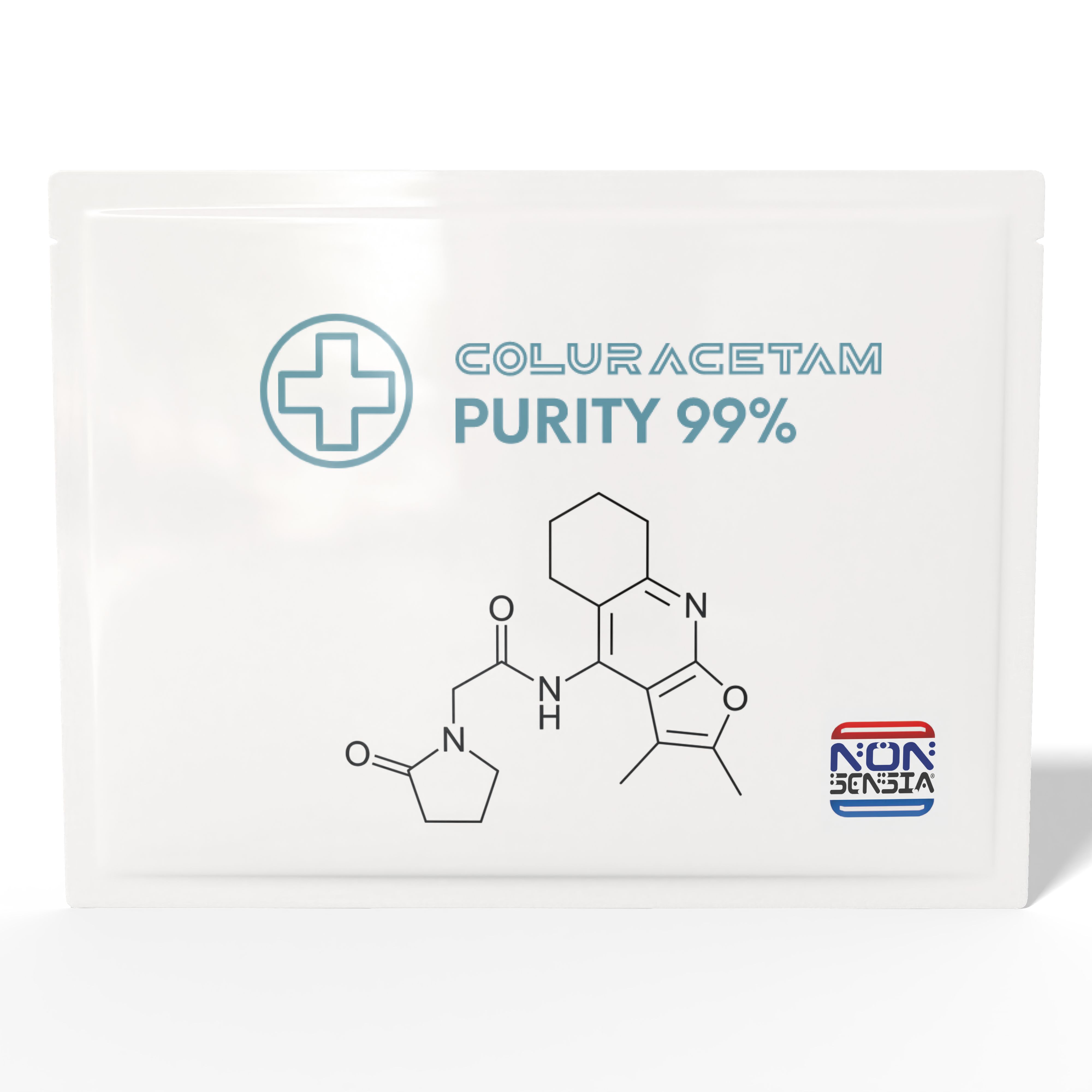
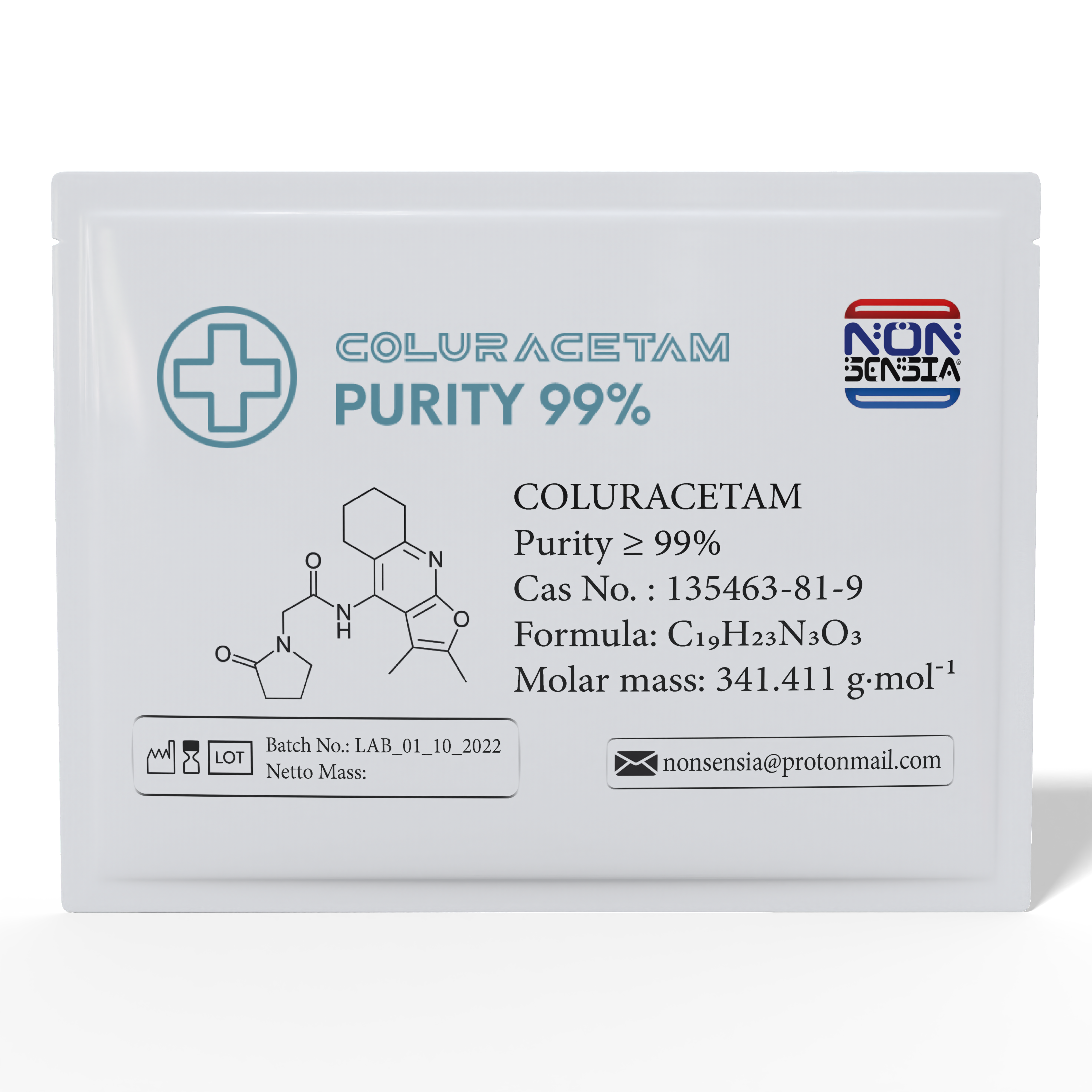
Product classification — read before ordering. This item is a chemical reagent and analytical reference material. It is not a medicinal product, dietary supplement, food, feed, novel food or cosmetic, and it is not intended for human or animal consumption or for any in-vivo administration whatsoever. It is supplied exclusively to laboratories, research institutions and professional users for in-vitro analytical, chromatographic and method-development work. Scientific findings summarised on this page describe substances investigated in published laboratory research; they are reported here as bibliographic facts about that literature and are not product claims, dosage guidance, or a recommendation of any use of this reagent.
Key facts
- Substance
- Coluracetam (INN), development code MKC-231 — N-(2,3-dimethyl-5,6,7,8-tetrahydrofuro[2,3-b]quinolin-4-yl)-2-(2-oxopyrrolidin-1-yl)acetamide
- CAS
- 135463-81-9
- Formula / mass
- C19H23N3O3 · 341.4 g·mol−1 · monoisotopic 341.17394 Da
- Grade
- Analytical reference standard, ≥99% by HPLC (area normalisation); batch value on Certificate of Analysis
- Quantity
- Three pack sizes: 1 g, 5 g and 10 g, crystalline powder
- Stereochemistry
- Achiral — zero stereocentres, defined or undefined. A single peak on any chiral column
- Pharmacological class
- High-affinity choline uptake (HACU) enhancer — a mechanism distinct from the rest of the racetam family [13]
- Hazard classification
- None published. No GHS classification, no EC number, no REACH dossier. See section 10
- Experimental physicochemistry
- None published. No measured melting point, density or solubility exists in the registries
- Regulatory
- Not on the WADA Prohibited List; not controlled in Poland; not an authorised medicine anywhere; not scheduled in the United States
- Intended use
- In-vitro analytical chemistry, LC-MS and HPLC method development, reference material for screening consumer products
- Excluded use
- Any human or animal administration; any consumable, medicinal or cosmetic product
- Substance identity and registry data
- Molecular structure
- Computed descriptors and what they predict
- Stereochemistry: coluracetam is achiral
- Solid-state behaviour and solution preparation
- Use as an analytical reference standard
- Reference spectral data
- Batch specification and Certificate of Analysis
- Handling, storage and stability
- Hazard classification — and its absence
- Discovery and development history
- Preclinical pharmacology: the HACU mechanism
- Clinical research literature
- Regulatory status
- Permitted use and terms of supply
- Frequently asked questions
- How this page is sourced and verified
- References
1. Substance identity and registry data
Coluracetam is the international nonproprietary name for N-(2,3-dimethyl-5,6,7,8-tetrahydrofuro[2,3-b]quinolin-4-yl)-2-(2-oxopyrrolidin-1-yl)acetamide [1]. The name places it in the racetam family, and the 2-oxopyrrolidin-1-yl-acetamide fragment on the right of the molecule is indeed the shared racetam motif. Everything to the left of it is not: a tricyclic furo[2,3-b]quinoline with a saturated carbocyclic ring, which no other member of the family carries. That asymmetry between the name and the structure is the single most useful thing to understand about this compound, and section 12 explains why.
Every identifier below comes from a public authoritative registry [1][2], so a receiving laboratory can reconcile the material against its own inventory system without ambiguity.
Coluracetam or MKC-231 — what is the difference?
None at the level of the substance. MKC-231 is the development code from the original Mitsubishi programme and is the designation used in essentially the whole primary pharmacological literature [6][7][8][9][10][11][12][13]. Coluracetam is the later INN. A literature search on the INN alone will miss almost everything published about the compound; searching on the code is what finds it. Note also that the code is written with a hyphen — searching MKC231 without one returns nothing in PubChem.
| INN | coluracetam |
|---|---|
| IUPAC name | N-(2,3-dimethyl-5,6,7,8-tetrahydrofuro[2,3-b]quinolin-4-yl)-2-(2-oxopyrrolidin-1-yl)acetamide |
| Development code | MKC-231 |
| CAS Registry Number | 135463-81-9 |
| UNII (FDA GSRS) | V6FL6O5GR7 |
| PubChem CID | 214346 |
| ChEMBL ID | CHEMBL37935 |
| DrugBank ID | DB21278 |
| DSSTox Substance ID | DTXSID60159386 |
| NCI Thesaurus code | C77391 |
| Nikkaji Number | J609.493G |
| MDL Number | MFCD00901416 |
| Wikidata | Q3683872 |
| Molecular formula | C19H23N3O3 |
| Average molecular mass | 341.4 g·mol−1 |
| Monoisotopic mass | 341.17394 Da |
| InChIKey | PSPGQHXMUKWNDI-UHFFFAOYSA-N |
| InChI | InChI=1S/C19H23N3O3/c1-11-12(2)25-19-17(11)18(13-6-3-4-7-14(13)20-19)21-15(23)10-22-9-5-8-16(22)24/h3-10H2,1-2H3,(H,20,21,23) |
| SMILES | CC1=C(OC2=NC3=C(CCCC3)C(=C12)NC(=O)CN4CCCC4=O)C |
Identifiers that do not exist for this substance, and what that tells you. Coluracetam has no EC number, no ChEBI entry, no KEGG identifier, no HMDB entry and no ATC code [1]. Those absences are not clerical. No EC number means the substance has never entered the European chemicals inventory, which in turn means there is no REACH dossier and no route by which a harmonised hazard classification could have been produced — see section 10. No ATC code means it has never been an authorised medicine anywhere. A laboratory reconciling this material against a corporate substance database should expect those fields to stay empty rather than treat them as missing data to be filled.
2. Molecular structure
![Structural formula of coluracetam (CAS 135463-81-9): a tricyclic furo[2,3-b]quinoline core bearing two methyl groups on the furan ring and a saturated carbocyclic ring, linked through an amide nitrogen to an acetamide arm ending in a 2-oxopyrrolidine ring](https://nonsensia.pl/wp-content/uploads/2026/08/coluracetam-structure-cas-135463-81-9.svg)
Three regions govern its behaviour in the laboratory.
The furo[2,3-b]quinoline core is a flat, fused, electron-rich heteroaromatic system carrying two methyl groups on the furan ring. It supplies almost all of the molecule's ultraviolet absorbance and almost all of its bulk: at complexity 540 it is by a wide margin the most structurally intricate compound in this catalogue [1]. It is also the reason coluracetam is retained far more strongly on reversed-phase columns than the small polar racetams it is nominally grouped with.
The saturated carbocyclic ring fused at positions 5 to 8 removes aromaticity from one third of the tricycle. That matters for photostability and for the fragmentation pattern, since a saturated ring fragments differently from an aromatic one.
The 2-oxopyrrolidin-1-yl acetamide arm is the racetam motif, and it is the only part of the molecule shared with piracetam, aniracetam or oxiracetam. It carries the single hydrogen-bond donor — the anilide NH — and two of the four acceptors.
Structural neighbours in this catalogue
The comparison that teaches the most is with oxiracetam, a small, strongly polar racetam of computed logP around −2.2 and molecular mass 158. Coluracetam shares its terminal fragment and almost nothing else: nearly 2.2 times the mass, and a computed logP more than four and a half log units higher. Any method built for one will fail on the other, which makes the pair a useful bracket when qualifying a gradient. Aniracetam and noopept sit between them.
3. Computed descriptors and what they predict
Everything in this section is computed. There is no experimental physicochemistry for this substance. The PubChem record for coluracetam contains no Experimental Properties section at all — no measured melting point, boiling point, density, refractive index, solubility or partition coefficient [1]. Figures for these constants circulate in commercial listings; they are not traceable to any named measurement and none is reproduced here.
| XLogP3-AA | 2.4 |
|---|---|
| Topological polar surface area | 75.4 Å2 |
| Hydrogen-bond donors | 1 |
| Hydrogen-bond acceptors | 4 |
| Rotatable bonds | 3 |
| Heavy atoms | 25 |
| Formal charge | 0 |
| Complexity (Cactvs) | 540 |
| Defined / undefined atom stereocentres | 0 / 0 |
| Defined / undefined bond stereocentres | 0 / 0 |
What these numbers predict in the laboratory
A computed logP of 2.4 with a polar surface area of 75.4 Å2 describes a moderately lipophilic, well-behaved reversed-phase analyte. Expect comfortable retention on C18 with a mid-range organic mobile phase — neither the excessive retention of a strongly lipophilic solid nor the void-volume elution of a polar racetam.
The extended heteroaromatic system is the practical gift. A fused, electron-rich tricycle absorbs strongly in the ultraviolet, so diode-array detection should give good sensitivity and a distinctive spectrum for library matching. For a compound with no deposited ultraviolet spectrum (section 7), acquiring one against an authentic standard is both easy and worth doing.
Only three rotatable bonds for twenty-five heavy atoms means an unusually rigid molecule. Rigid analytes give narrow, symmetrical peaks and reproducible retention, and are less prone to temperature-dependent peak distortion.
No ionisable centre of consequence. The quinoline nitrogen is part of a fused, electron-delocalised system and the anilide NH is not acidic in any usable range; mobile-phase pH is therefore a weak lever on retention. That removes a common source of inter-laboratory drift but also removes a tool for adjusting selectivity, so stationary-phase choice does the work.
4. Stereochemistry: coluracetam is achiral
Coluracetam has no stereocentre. The registry record reports zero defined and zero undefined atom stereocentres, and zero of each for bond stereocentres [1]; the standard InChIKey ends in UHFFFAOYSA, the marker for a structure carrying no stereochemical layer at all.
This section exists because the claim that this substance is a "dextrorotatory stereoisomer" circulates widely in commercial listings. It is not a matter of interpretation. A molecule with no stereogenic atom and no stereogenic bond has no enantiomers, cannot be dextrorotatory or laevorotatory, and cannot exist as a resolved isomer. Every carbon in the tricycle is either aromatic, or a methylene with two hydrogens, or a ring-fusion carbon whose substituents are fixed by the ring system.
What this means for the analyst. There is no enantiomeric impurity to specify, no chiral method to validate, and no enantiomeric ratio to report on the Certificate of Analysis. A single achiral HPLC or LC-MS method characterises this material completely, and a chiral column will give one peak. Conversely, this article cannot be used to qualify a chiral separation — for that a racemate with a genuine stereocentre is needed, such as the racemic modafinil standard, which is chiral at sulfur.
It also means that any supplier datasheet describing coluracetam as an isolated optical isomer has not been checked against the structure, and its other figures deserve the same scepticism.
5. Solid-state behaviour and solution preparation
No solid-state data are published for this substance. No crystal structure, no polymorph screen, no melting point, no density and no solubility figure appear in the authoritative registries [1]. This page asserts no crystal form and prints no melting point. Where either matters to a procedure, determine it for the batch — and note that doing so would generate data that does not currently exist in the public record for this compound.
What can be said follows from structure. Coluracetam is a neutral, rigid, moderately lipophilic crystalline solid with a single hydrogen-bond donor and a large flat aromatic surface. Flat fused aromatics of this kind tend to pack efficiently and are not usually hygroscopic; there is no ionisable group to complicate handling. Methanol, acetonitrile, acetone and dimethyl sulfoxide are the rational solvents for chromatographic stock solutions. Water is not usable at practically relevant concentrations.
Because no certified solubility figure exists, determine the working concentration gravimetrically for the specific batch rather than inheriting one: weigh, dissolve, confirm complete dissolution, verify against a ultraviolet or mass-spectrometric response, and record the result. For this compound that record has more value than usual, because there is nothing published to compare it with.
6. Use as an analytical reference standard
6.1 The gap this standard fills
Most reference standards exist because a well-studied substance needs routine confirmation. Coluracetam is the opposite case, and it is worth stating plainly because it is the whole argument for stocking it.
The substance is consumed, and it cannot be measured. On the demand side, coluracetam appears as a labelled ingredient in products sold as dietary supplements, and the United States Drug Enforcement Administration has recorded it in the National Forensic Laboratory Information System under the category New Drug since December 2023 [5] — an entry that exists only because forensic laboratories were submitting samples containing it. On the supply side, the published analytical literature for this compound is close to empty: no validated HPLC method, no LC-MS/MS assay, no impurity profile, no crystal structure and no published synthesis could be located for coluracetam specifically.
A measurement of that asymmetry. A bibliographic search of Crossref returns on the order of a single record for "coluracetam" against 863 for piracetam, 165 for aniracetam and 120 for nefiracetam — the same query run identically across the family. Coluracetam is the member of this class for which the analytical toolbox has essentially never been built. (The count for the development code MKC-231 is not usable as a comparison, because the hyphen tokenises and returns hundreds of thousands of unrelated records; it is quoted here only to explain why it is excluded.)
The practical consequence: a laboratory that needs to quantify coluracetam has nothing to start from except an authenticated standard and its own instrument. That is not a marketing claim, it is the state of the literature.
6.2 What has to be built from scratch, and what helps
Three properties make this compound easier to work with than its literature suggests:
- A strong, distinctive ultraviolet chromophore. The fused, electron-rich furoquinoline tricycle absorbs well, so diode-array detection gives both sensitivity and a spectrum worth putting in a library. No ultraviolet spectrum is deposited anywhere (section 7), so this is the cheapest useful measurement to make first.
- Rigidity. Three rotatable bonds across twenty-five heavy atoms means narrow, reproducible peaks.
- Achirality. No chiral method to develop, no enantiomeric purity to specify, no chiral column screen to fund (section 4).
What has to be established from the standard itself: retention time and relative retention on the laboratory's own column, the ultraviolet spectrum, the product-ion transitions and their ratios, the response factor, the limit of detection actually achieved in the relevant matrix, and the impurity profile of authentic material against which a sample can be judged.
6.3 Distinguishing coluracetam from the rest of the racetam family
The name is misleading and the structure is the reason. Coluracetam shares only the terminal 2-oxopyrrolidin-1-yl acetamide fragment with the classical racetams; the rest of the molecule has no counterpart in the family [14][15].
| Property | Coluracetam | Oxiracetam | Aniracetam | Piracetam |
|---|---|---|---|---|
| Molecular mass | 341.4 | 158.2 | 219.2 | 142.2 |
| Computed logP | 2.4 | −2.2 | 1.0 | −1.5 |
| Core beyond the racetam motif | furo[2,3-b]quinoline tricycle | none | anisoyl | none |
| Stereocentre | none | one (racemic) | none | none |
| Reported mechanism | HACU enhancer [13] | not established as a single target for the class [14][15] | ||
| Analytical literature | essentially none | substantial | substantial | very large |
| In this catalogue | this page | oxiracetam | aniracetam | — |
The row that matters operationally is logP. A gradient that elutes oxiracetam near the void will retain coluracetam strongly; a method built for coluracetam will not see oxiracetam at all. Grouping these substances under one catalogue heading does not make them one chromatographic problem, and a laboratory qualifying a multi-analyte racetam method needs both extremes present to prove it.
6.4 Screening consumer products
Because coluracetam is present in products on sale and absent from the analytical literature, the laboratories most likely to need this material are those screening consumer products for declared or undeclared ingredients. Identification in such work requires an authenticated standard for each substance claimed, and for this compound no pharmacopoeial or certified alternative exists.
7. Reference spectral data
Third-party spectra deposited against the compound record are listed below with attribution. They are the property of the depositors named and are cited so that a laboratory can locate an independent comparison. They are not the spectra of the batch supplied.
| Technique | Depositor and attribution | Notes |
|---|---|---|
| ATR-IR | Forensic Spectral Research; sample supplied by Cayman Chemical Company, catalogue number 26032, lot 0645363-2. Instrument Bio-Rad FTS. Copyright John Wiley & Sons, Inc. | The only deposited spectrum with provenance down to lot number |
| FT-Raman | Same sample and provenance. Copyright John Wiley & Sons, Inc. | Complementary vibrational technique |
| GC-MS | DigiLab GmbH; copyright DigiLab GmbH and Wiley-VCH GmbH | Electron-ionisation reference spectrum |
The absences are the point of this section. There is no deposited 1H NMR, no 13C NMR, no ultraviolet–visible spectrum and no LC-MS/MS spectrum for coluracetam [1]. For a compound whose dominant analytical need is a liquid-chromatographic method with mass-spectrometric or ultraviolet detection, the two spectra that would help most are precisely the two that do not exist. A laboratory building such a method has nothing to calibrate against except material it holds itself.
That gap is the strongest practical reason to keep an authenticated standard on the shelf for this substance rather than to rely on a library.
8. Batch specification and Certificate of Analysis
| Parameter | Method | Specification |
|---|---|---|
| Identity — chromatographic | HPLC, retention against reference | Conforms |
| Identity — spectroscopic | IR and/or MS against reference spectrum | Conforms |
| Assay | HPLC, area normalisation | ≥99% |
| Related substances | HPLC, area normalisation | Batch value reported |
| Residual solvents | GC headspace | Batch value reported |
| Water content | Karl Fischer titration | Batch value reported |
| Appearance | Visual | Crystalline powder |
| Enantiomeric purity | — | Not applicable — the substance is achiral (section 4) |
| Melting range | — | No registry value exists for comparison (section 5) |
The layout of the certificate and the method stated against each parameter can be reviewed on the specimen Certificate of Analysis.
Scope of the specification. This is an analytical reference standard; kilogram-scale orders come with a batch Certificate of Analysis. It is not a certified reference material in the ISO 17034 sense and not a pharmacopoeial reference standard. For coluracetam no certified or pharmacopoeial alternative is known to exist, so where a scheme requires one, that requirement cannot currently be met from any source.
9. Handling, storage and stability
- Storage. Sealed, cool, dry, protected from light. The extended heteroaromatic chromophore that makes ultraviolet detection easy also makes photodegradation a plausible route; amber glass costs nothing.
- Hydrolysis. The molecule contains two amide linkages, the anilide and the lactam. Amides are robust at neutral pH but both are potential sites under strongly acidic or basic conditions at elevated temperature. Avoid such conditions in sample preparation unless the effect has been characterised.
- Hygroscopicity. Not expected, on structural grounds — one donor, a large flat non-polar surface. No measured data exist either way.
- Solution stability. Prepare stocks in methanol, acetonitrile or dimethyl sulfoxide, store refrigerated and protected from light, and re-verify rather than assume stability. No published stability study for coluracetam solutions was located.
- Personal protection. Gloves, eye protection, dust containment under local exhaust. See section 10: this recommendation rests on the absence of data, not on its presence.
10. Hazard classification — and its absence
There is no hazard classification for coluracetam. The compound record contains no Safety and Hazards section and no notifications to the ECHA Classification and Labelling Inventory [1]. No signal word, no hazard statements, no hazard classes and no precautionary statements have been assigned by anyone, and this page therefore prints no pictogram and no H- or P-phrase. Doing so would mean inventing a regulatory determination that does not exist.
The absence has a traceable cause rather than being an oversight: coluracetam has no EC number (section 1), so it has never entered the European chemicals inventory, and without that entry there is no REACH registration and no mechanism by which a classification would have been generated.
An absent classification is not a safety claim. It records that nobody has classified the substance. It must not be read as evidence that the material is harmless, and it must not be used to justify lighter handling.
In the absence of any classification the defensible approach is to treat coluracetam as a biologically active organic solid of unknown hazard: gloves, eye protection, containment of dust under local exhaust, no eating or drinking in the handling area, and a workplace risk assessment that records the absence of data as a finding in its own right. The Safety Data Sheet shipped with the batch is the controlling document.
11. Discovery and development history
Coluracetam was developed in Japan under the code MKC-231 in a programme at Mitsubishi, and the whole of its primary pharmacological literature carries that designation. The compound was designed around a specific and unusual pharmacological hypothesis — enhancement of high-affinity choline uptake — rather than around structural analogy to piracetam, which is why its structure departs so far from the rest of the family it is named after.
The literature falls into three clear phases. The first, in the mid-1990s, established the behavioural effect: Murai and colleagues reported in 1994 that MKC-231 ameliorated working-memory deficits and decreased hippocampal acetylcholine in rats treated with the cholinergic neurotoxin AF64A [6], and Bessho and colleagues reported effects on water-maze learning deficits in 1996 [7].
The second, at the turn of the century, probed the boundaries: Akaike and colleagues examined a protective effect against glutamate cytotoxicity in cultured cortical neurons [8], and Uemura and colleagues reported central hyperglycaemic effects [9].
The third and most informative is a coordinated three-part series published together in the Journal of Neural Transmission in 2008, which set out to establish the mechanism directly [11][12][13]. Between the second and third phases, Shirayama and colleagues examined the compound against phencyclidine-induced behavioural deficits [10].
Development did not continue to an authorised medicine in any jurisdiction. What followed instead was appearance on the consumer market, and the regulatory footprint described in section 14 — a forensic reporting entry rather than an approval.
12. Preclinical pharmacology: the HACU mechanism
How to read this section. What follows summarises published laboratory research on the substance coluracetam (MKC-231), reported as bibliographic fact and attributed to the experimental system that produced it. None of it describes, predicts or claims any effect of the reagent supplied on this page, which is not administered to anything. Nothing here is dosage guidance, a health claim, or a representation that the substance is safe or effective for any purpose.
Coluracetam is one of the few compounds in this catalogue for which a specific proposed mechanism exists in the primary literature, and it is not the mechanism its family name suggests.
The proposal is enhancement of high-affinity choline uptake (HACU), the rate-limiting step in acetylcholine synthesis at cholinergic nerve terminals. The 2008 three-part series in the Journal of Neural Transmission examined it systematically in rats treated with AF64A, a neurotoxin that selectively damages cholinergic terminals. Part 1 reported long-lasting cognitive improvement after repeated administration [11]; part 2 examined effects on the synthesis and release of acetylcholine [12]; part 3 addressed the mode of action of the enhancement of high-affinity choline uptake itself [13].
That the third paper exists at all is what distinguishes this compound. Most of the substances catalogued as racetams have no established single target — a point made in the standard reviews of the class [14][15]. Coluracetam has a named, specific, mechanistically framed hypothesis with a dedicated study behind it.
What that literature does and does not establish. Four limitations apply. First, essentially all of it comes from one research group working within a single development programme, and the 2008 series shares authors with the 1996 work [7][11][12][13]. Second, the central model is AF64A-lesioned rats — a chemically induced cholinergic lesion, not a naturally occurring disease state. Third, no independent replication outside the originating programme was located. Fourth, the work is now between seventeen and thirty years old and has no modern follow-up.
The honest summary is that coluracetam has a well-specified mechanistic hypothesis with narrow supporting evidence, which is a different thing from an established mechanism.
13. Clinical research literature
No clinical literature for coluracetam was located. No published controlled clinical trial of this substance was found, it holds no marketing authorisation in any jurisdiction, and no medicines regulator has assessed it for safety or efficacy.
An unresolved discrepancy, reported rather than smoothed over. One aggregating database annotates coluracetam with a development-phase indicator suggesting a phase-2 clinical programme, while a direct query of the public clinical-trials registry returns no registered trials for the substance — a query that returns hundreds for modafinil when run identically, so the search itself is known to work. The two sources disagree and this page cannot resolve which is right from the public record. It therefore asserts neither that clinical trials were conducted nor that they were not. Anyone relying on this point should check the primary registry themselves.
What can be said without qualification is that the substance is not, and has never been, an authorised medicine, and that nothing on this page offers it as one.
14. Regulatory status
| Instrument / jurisdiction | Status |
|---|---|
| WADA Prohibited List 2026 | Not listed. Coluracetam does not appear on the 2026 Prohibited List. Of the racetam family, only fonturacetam (4-phenylpiracetam, carphedon) is named, in class S6.A; piracetam itself is not listed [3] |
| Poland — narcotics, psychotropics and new psychoactive substances | Not listed. Coluracetam does not appear in Annexes 1, 2 or 3 of the consolidated regulation, Dz.U. 2024 poz. 1139; no racetam appears there [4] |
| Poland — medicinal products | Not registered. A search of the national Register of Medicinal Products returns no coluracetam product |
| European Union | No marketing authorisation. No ATC code has ever been assigned [1] |
| EU — chemicals inventory | No EC number and no REACH registration, hence no classification of any kind (section 10) [1] |
| United States | Not a controlled substance. Recorded in the DEA National Forensic Laboratory Information System under category New Drug, added December 2023 [5]. See the note below on what that does and does not mean |
| Other jurisdictions | Not assessed. Status must be verified locally before import, purchase or possession |
What the NFLIS entry means, and what it does not. The National Forensic Laboratory Information System is a reporting programme that collects results from forensic laboratories analysing seized or submitted drug evidence. A category assignment records how such results are tabulated. It is not a scheduling action under the Controlled Substances Act and does not by itself make a substance controlled in the United States. It is reported here for two reasons: because it is a factual annotation in the registry record, and because the date it carries — December 2023 — is direct evidence that samples containing this substance were reaching forensic laboratories, which is part of the case for a reference standard made in section 6.1.
15. Permitted use and terms of supply
Research use only. Not for human or animal consumption.
- Supplied solely for in-vitro laboratory research, analytical chemistry, chromatographic and mass-spectrometric method development, and reference-standard applications including the screening of consumer products.
- Not a medicinal product, investigational medicinal product, dietary supplement, food, feed, novel food or cosmetic. It holds no marketing authorisation anywhere and has never been assessed by a medicines regulator.
- Must not be ingested, inhaled, injected, applied to the body, or administered to any human or animal, under any circumstances and irrespective of quantity.
- Must not be used in the manufacture, compounding, formulation or repackaging of any product intended for human or animal consumption, and must not be presented or resold as a supplement, medicine or consumable product.
- Because no hazard classification exists for this substance (section 10), handling must proceed on the precautionary basis described there rather than on the assumption that absent data means absent hazard.
- Intended for purchase and use exclusively by, or under the direct supervision of, persons professionally qualified to handle laboratory chemicals, at premises suitable for chemical storage.
- The purchaser is responsible for verifying the legal status of the substance in their own jurisdiction before ordering.
- No information on this page constitutes medical advice, dosage guidance, a health claim, or a representation that the substance is safe or effective for any purpose in humans.
By placing an order the purchaser confirms acceptance of these conditions and confirms the material will be used exclusively as described above.
16. Frequently asked questions
- What is coluracetam used for in a laboratory?
- As an analytical reference standard: to establish retention time and an ultraviolet spectrum in a laboratory's own method, to determine product-ion transitions for mass spectrometry, to measure a real limit of detection by spiking blank matrix, to prepare quality-control samples, and to identify the substance in consumer products that declare or contain it. Because no validated public method exists for this compound, almost every parameter has to be established from the standard itself.
- Is this product intended for human consumption?
- No. It is a chemical reagent and analytical reference material supplied for in-vitro laboratory use only. It is not a medicinal product, supplement or food, it holds no marketing authorisation anywhere, and it must not be ingested or administered to any human or animal.
- What is the molecular weight of coluracetam?
- 341.4 grams per mole, for the molecular formula C19H23N3O3, with a monoisotopic mass of 341.17394 daltons. Listings quoting a mass near 168 grams per mole are wrong by a factor of two and should be disregarded; the registry value is the one above.
- Is coluracetam chiral, or a dextrorotatory isomer?
- Neither. Coluracetam has no stereocentre at all: the registry record reports zero defined and zero undefined atom stereocentres and zero of each for bond stereocentres, and its standard InChIKey carries no stereochemical layer. A molecule with no stereogenic atom cannot be dextrorotatory or laevorotatory and has no enantiomers. Descriptions of this substance as an isolated optical isomer are structurally impossible and indicate a datasheet that has not been checked.
- Is coluracetam the same as MKC-231?
- Yes. MKC-231 is the development code from the original Japanese programme and coluracetam is the later international nonproprietary name. Almost the entire primary pharmacological literature uses the code rather than the name, so a search on the name alone will miss most of it. Note that the code must be searched with its hyphen; without it, database searches return nothing useful.
- What is the melting point of coluracetam?
- No validated experimental value is published, and this page prints none. The same applies to density, boiling point and solubility: the compound record contains no experimental properties section at all. Values circulating in commercial listings, including a density below that of water, are not traceable to any measurement. Use the values determined for the batch supplied.
- What chromatographic conditions suit this compound?
- Its computed logP of 2.4 and polar surface area of 75.4 square angstroms describe a moderately lipophilic, well-behaved reversed-phase analyte, comfortably retained on C18 with a mid-range organic mobile phase. The fused heteroaromatic core absorbs strongly in the ultraviolet, so diode-array detection is both sensitive and informative. There is no ionisable centre of consequence, so mobile-phase pH is a weak lever on retention and stationary-phase choice does the work of adjusting selectivity.
- How does coluracetam differ from other racetams?
- Far more than the shared name suggests. It shares only the terminal 2-oxopyrrolidinyl acetamide fragment; the rest of the molecule is a tricyclic furoquinoline that no other member of the family carries. In practical terms it is 2.2 times the mass of oxiracetam and more than four and a half log units more lipophilic, so a chromatographic method built for one will not work for the other. It is also the only member of the family with a specific named mechanistic hypothesis in the primary literature, namely enhancement of high-affinity choline uptake.
- What does the published research actually say about coluracetam?
- That it was studied as an enhancer of high-affinity choline uptake, the rate-limiting step in acetylcholine synthesis, mainly in rats with chemically induced cholinergic lesions. A coordinated three-part series published in 2008 addressed cognitive effects after repeated administration, effects on acetylcholine synthesis and release, and the mode of action of the uptake enhancement itself. The important qualification is that essentially all of this work comes from one research group within a single development programme, uses one lesion model, is between seventeen and thirty years old, and has no independent replication that could be located. It is a well-specified hypothesis with narrow supporting evidence, not an established mechanism.
- Is coluracetam banned in sport?
- It is not on the World Anti-Doping Agency 2026 Prohibited List. Of the racetam family only fonturacetam, also called 4-phenylpiracetam or carphedon, is named there, in class S6.A; piracetam itself is not listed. Absence from the list is a statement about that document on the date checked and nothing more, and athletes should verify the current list themselves rather than relying on this page.
- Is coluracetam legal in Poland or the United States?
- In Poland it does not appear in the consolidated list of narcotic drugs, psychotropic substances and new psychoactive substances, and it is not a registered medicine. In the United States it is not a controlled substance under the Controlled Substances Act; the only federal entry is a Drug Enforcement Administration forensic reporting category, added in December 2023, which records how laboratory results are tabulated rather than imposing any control. Not being scheduled is not the same as being approved for any human use, and nothing on this page offers it for one. Status differs between countries and must be verified locally.
- What are the hazards?
- No hazard classification exists. There is no GHS classification for coluracetam and no notifications to the ECHA Classification and Labelling Inventory, so no signal word, no hazard statements and no precautionary statements have been assigned by anyone, and this page prints no pictogram or H-phrase. The cause is traceable: the substance has no EC number, so it never entered the European chemicals inventory and no REACH dossier exists. An absent classification is not a safety claim. Handle the material as a biologically active organic solid of unknown hazard, with gloves, eye protection and dust containment, and treat the absence of data as a finding in the workplace risk assessment.
- What pack sizes are available?
- Three: 1 g, 5 g and 10 g, each supplied as crystalline powder; kilogram-scale orders come with a batch Certificate of Analysis. Catalogue numbers follow the CAS-based scheme NSA-135463-81-9 with the pack size appended, for example NSA-135463-81-9-5G.
17. How this page is sourced and verified
| Document scope | Technical and regulatory description of coluracetam supplied as an analytical reference material |
|---|---|
| Last reviewed | 22 August 2026 |
| Primary data sources | PubChem (NCBI) compound record CID 214346; FDA GSRS (UNII); WADA International Standard — Prohibited List 2026; Polish Ministry of Health consolidated regulation Dz.U. 2024 poz. 1139; DEA NFLIS annotation |
| Bibliographic verification | Every cited work was checked against PubMed and Crossref metadata. Each DOI was resolved and its registered title, journal, volume, issue and pagination confirmed against the citation printed here. One cited work has no DOI and is referenced by PubMed identifier instead. Where a Crossref record listed author given and family names in transposed order, the correct form was taken from the publication itself |
| Regulatory verification | Each negative regulatory finding was confirmed with a paired positive control: the WADA and Polish documents were retrieved and searched, and substances known to be listed in each were confirmed present in the same search before the absence of coluracetam was recorded, so that a failed search could not be mistaken for a negative result |
| Rule on numerical values | No physical constant is printed unless it appears in a named authoritative registry or is measured for the delivered batch. For this substance the registries contain no experimental constants at all, so none is printed |
| Rule on biological claims | Findings from the pharmacological literature are attributed to the experimental system that produced them. No finding is transferred to this reagent article, and no effect in humans is claimed for it |
| Corrections | The molecular mass, the claim of optical activity and the density figure previously shown on this page were wrong and were removed against the registry record on 22 August 2026. Documented errors are corrected and the review date updated |
Limitations named directly
- The bibliography is short because the literature is short. Sixteen sources are cited where other pages in this catalogue carry thirty or forty. The primary record for coluracetam is a handful of papers from one programme; padding the list would misrepresent the state of knowledge.
- There is no experimental physicochemistry and no analytical methodology specific to this compound. Every number in section 3 is computed. The one analytical reference cited [16] concerns piracetam, not coluracetam, and is included only to show what a developed method for a member of this family looks like — it is labelled as a different substance wherever it appears.
- There is no hazard classification at all, and no mechanism by which one could have been produced. Section 10 explains why that is a reason for more caution rather than less.
- The pharmacology comes from essentially one group, one lesion model and one era, with no independent replication located. Section 12 says so in place.
- One clinical-status question is unresolved between two public sources and is reported as unresolved in section 13 rather than decided.
Not yet on this page
This page does not currently carry a named author with stated professional qualifications, a named technical reviewer, or laboratory data generated in-house for a specific batch — no chromatogram, no spectrum, no measured retention or melting data of our own. For a substance with this little public data those gaps matter more than usual: in-house measurements here would be additions to the public record, not merely confirmations of it.
18. References
Citations follow the Chicago author–date convention. All external links carry rel="nofollow". Access to full texts is governed by the policies of the respective publishers.
Registry and regulatory sources
- National Center for Biotechnology Information. 2026. "PubChem Compound Summary for CID 214346, Coluracetam." PubChem. Accessed August 22, 2026. https://pubchem.ncbi.nlm.nih.gov/compound/214346.
- U.S. Food and Drug Administration. 2026. "Global Substance Registration System: UNII V6FL6O5GR7, Coluracetam." Accessed August 22, 2026. https://gsrs.ncats.nih.gov/ginas/app/beta/substances/V6FL6O5GR7.
- World Anti-Doping Agency. 2025. World Anti-Doping Code International Standard: Prohibited List 2026. Effective 1 January 2026. https://www.wada-ama.org/en/prohibited-list.
- Minister Zdrowia. 2024. Obwieszczenie Ministra Zdrowia z dnia 17 czerwca 2024 r. w sprawie ogłoszenia jednolitego tekstu rozporządzenia Ministra Zdrowia w sprawie wykazu substancji psychotropowych, środków odurzających oraz nowych substancji psychoaktywnych. Dziennik Ustaw 2024, poz. 1139. https://eli.gov.pl/eli/DU/2024/1139.
- U.S. Drug Enforcement Administration. 2023. "National Forensic Laboratory Information System: Coluracetam, drug category New Drug, added December 2023." Annotation reproduced in the PubChem record for CID 214346. https://www.nflis.deadiversion.usdoj.gov/.
Primary pharmacology of MKC-231
- Murai, S., H. Saito, E. Abe, Y. Masuda, J. Odashima, and T. Itoh. 1994. "MKC-231, a Choline Uptake Enhancer, Ameliorates Working Memory Deficits and Decreased Hippocampal Acetylcholine Induced by Ethylcholine Aziridinium Ion in Mice." Journal of Neural Transmission, General Section 98 (1): 1–13. https://doi.org/10.1007/BF01277590.
- Bessho, T., K. Takashina, R. Tabata, C. Ohshima, H. Chaki, H. Yamabe, M. Egawa, A. Tobe, and K. Saito. 1996. "Effect of the Novel High Affinity Choline Uptake Enhancer 2-(2-Oxopyrrolidin-1-yl)-N-(2,3-dimethyl-5,6,7,8-tetrahydrofuro[2,3-b]quinolin-4-yl)acetoamide on Deficits of Water Maze Learning in Rats." Arzneimittelforschung 46 (4): 369–373. https://pubmed.ncbi.nlm.nih.gov/8740080/.
- Akaike, A., T. Maeda, S. Kaneko, and Y. Tamura. 1998. "Protective Effect of MKC-231, a Novel High Affinity Choline Uptake Enhancer, on Glutamate Cytotoxicity in Cultured Cortical Neurons." Japanese Journal of Pharmacology 76 (2): 219–222. https://doi.org/10.1254/jjp.76.219.
- Uemura, K., S. Yoshioka, D. M. Surina-Baumgartner, T. Tamagawa, H. Miura, M. Ueda, N. Tamaya, A. Iguchi, and N. Hotta. 1999. "Central Nervous System-Mediated Hyperglycemic Effects of NIK-247, a Cholinesterase Inhibitor, and MKC-231, a Choline Uptake Enhancer, in Rats." Japanese Journal of Pharmacology 79 (1): 113–115. https://doi.org/10.1254/jjp.79.113.
- Shirayama, Y., A. Yamamoto, T. Nishimura, S. Katayama, and R. Kawahara. 2007. "Subsequent Exposure to the Choline Uptake Enhancer MKC-231 Antagonizes Phencyclidine-Induced Behavioral Deficits and Reduction in Septal Cholinergic Neurons in Rats." European Neuropsychopharmacology 17 (9): 616–626. https://doi.org/10.1016/j.euroneuro.2007.02.011.
- Bessho, T., K. Takashina, J. Eguchi, T. Komatsu, and K.-I. Saito. 2008. "MKC-231, a Choline-Uptake Enhancer: (1) Long-Lasting Cognitive Improvement after Repeated Administration in AF64A-Treated Rats." Journal of Neural Transmission 115 (7): 1019–1025. https://doi.org/10.1007/s00702-008-0053-4.
- Takashina, K., T. Bessho, R. Mori, J. Eguchi, and K.-I. Saito. 2008. "MKC-231, a Choline Uptake Enhancer: (2) Effect on Synthesis and Release of Acetylcholine in AF64A-Treated Rats." Journal of Neural Transmission 115 (7): 1027–1035. https://doi.org/10.1007/s00702-008-0048-1.
- Takashina, K., T. Bessho, R. Mori, K. Kawai, J. Eguchi, and K.-I. Saito. 2008. "MKC-231, a Choline Uptake Enhancer: (3) Mode of Action of MKC-231 in the Enhancement of High-Affinity Choline Uptake." Journal of Neural Transmission 115 (7): 1037–1046. https://doi.org/10.1007/s00702-008-0049-0.
The racetam class, and analytical methodology for a related compound
- Gouliaev, A. H., and A. Senning. 1994. "Piracetam and Other Structurally Related Nootropics." Brain Research Reviews 19 (2): 180–222. https://doi.org/10.1016/0165-0173(94)90011-6.
- Malykh, A. G., and M. R. Sadaie. 2010. "Piracetam and Piracetam-Like Drugs: From Basic Science to Novel Clinical Applications to CNS Disorders." Drugs 70 (3): 287–312. https://doi.org/10.2165/11319230-000000000-00000.
- Ovalles, J. F., J. N. A. Tettey, J. H. McB. Miller, and G. G. Skellern. 2000. "Determination of Piracetam and Its Impurities by TLC." Journal of Pharmaceutical and Biomedical Analysis 23 (4): 757–761. https://doi.org/10.1016/s0731-7085(00)00355-1. (Concerns piracetam, not coluracetam; cited as an example of a developed method for the family.)