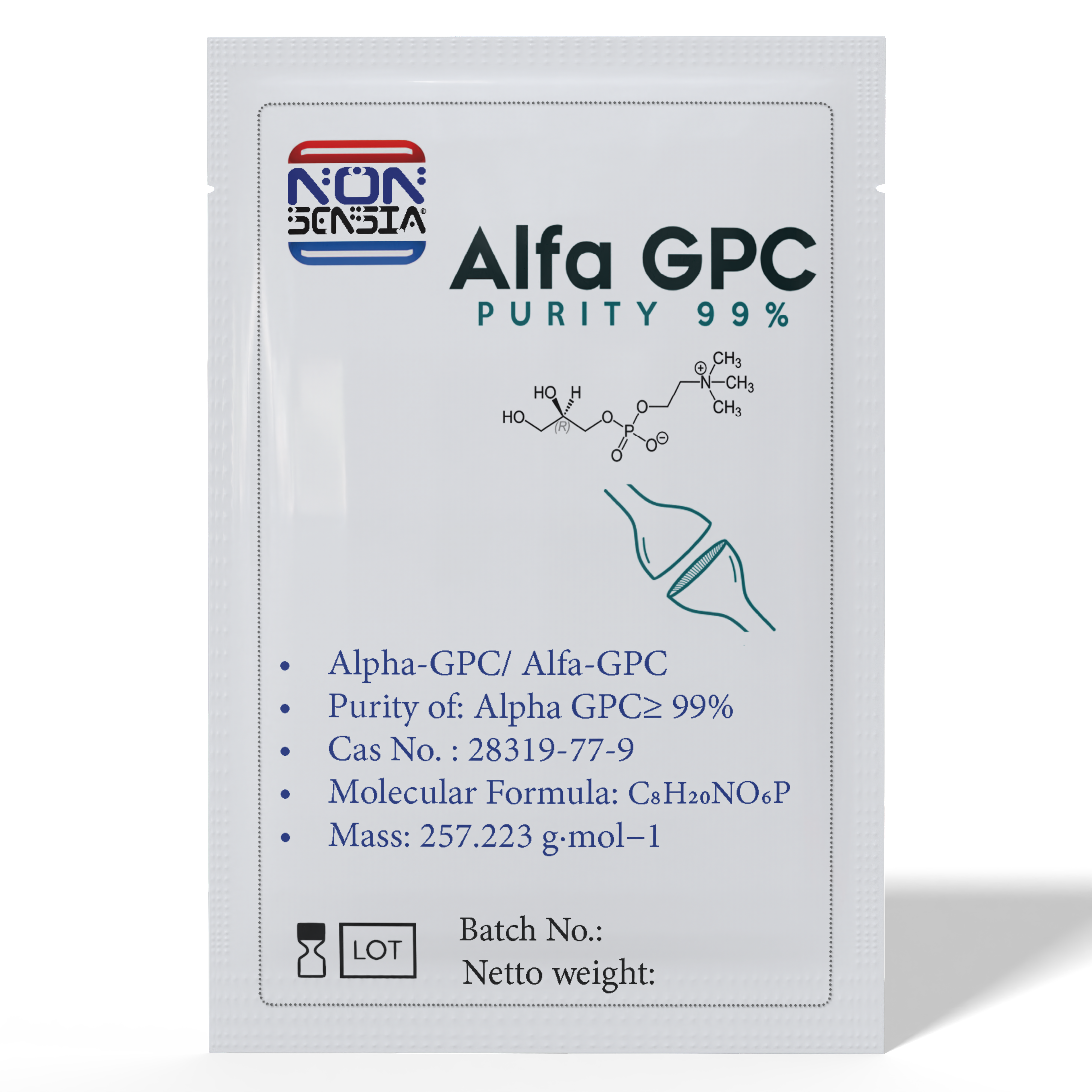
Product classification — read before ordering. This item is a chemical reagent and analytical reference material. It is not a medicinal product, dietary supplement, food, feed, novel food or cosmetic, and it is not intended for human or animal consumption or for any in-vivo administration whatsoever. It is supplied exclusively to laboratories, research institutions and professional users for in-vitro analytical, chromatographic and method-development work. Scientific findings summarised on this page describe substances investigated in published laboratory and clinical research; they are reported here as bibliographic facts about that literature and are not product claims, dosage guidance, or a recommendation of any use of this reagent.
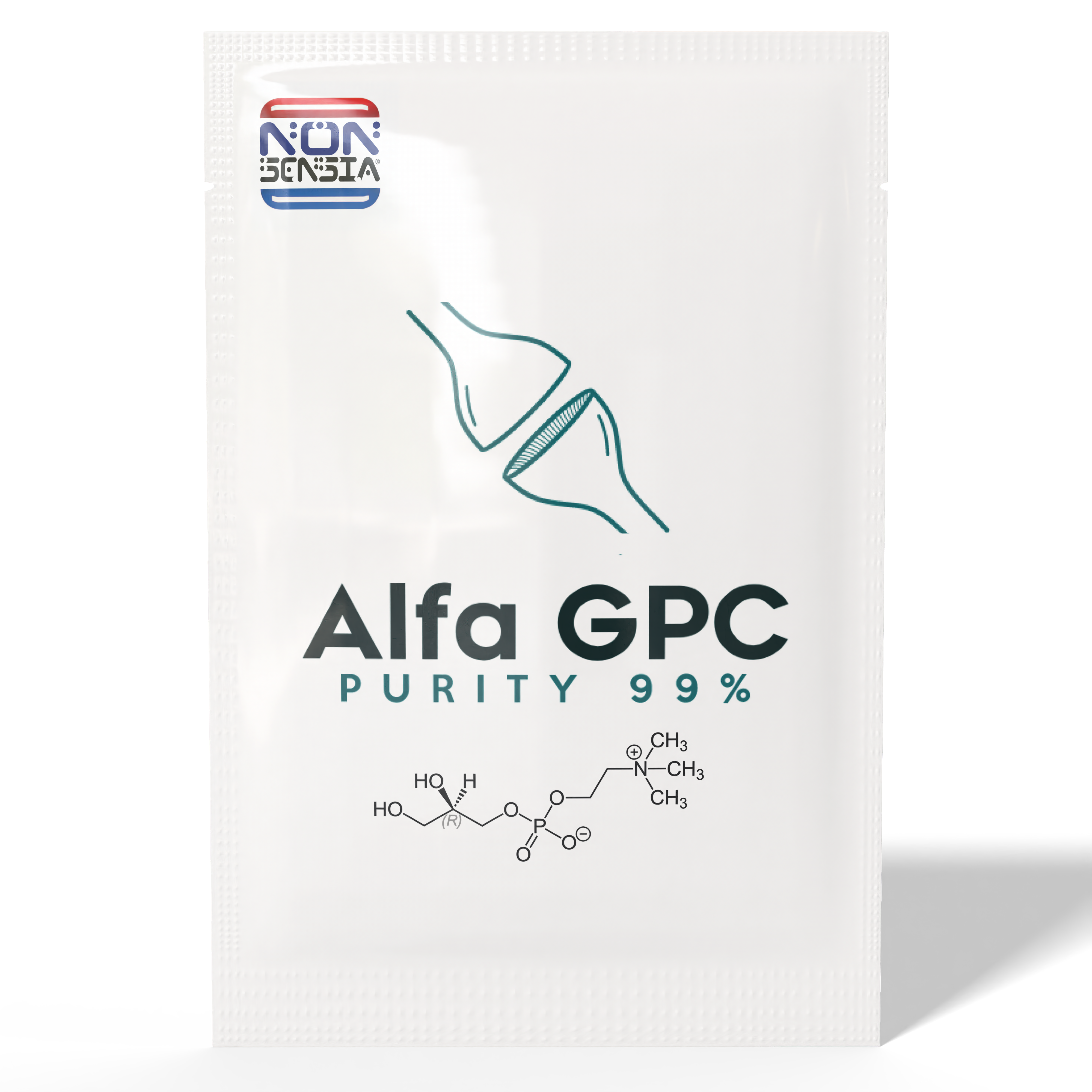
This substance occupies three regulatory worlds at once. Read section 14 before ordering. Choline alfoscerate is the active substance of authorised prescription medicines, including Gliatilin in Poland [5]. It also holds a GRAS notification in the United States as a food ingredient [6] and carries a United States Pharmacopeia monograph [7]. None of those statuses attaches to the material on this page, which is supplied as a laboratory reagent under the terms in section 15. The distinction is not cosmetic: an authorised medicine, a food ingredient and a laboratory reagent are three different legal articles even when the molecule is identical.
Key facts
- Substance
- Choline alfoscerate (INN), also L-α-glycerylphosphorylcholine, alpha-GPC, sn-glycero-3-phosphocholine
- CAS
- 28319-77-9 — see the warning below about two other CAS numbers on the same skeleton
- Formula / mass
- C8H20NO6P · 257.22 g·mol−1 · monoisotopic 257.10282 Da
- Grade
- Analytical reference standard, ≥99% by HPLC; see section 8 — "99%" alone is ambiguous for this substance
- Quantity
- Six pack sizes from 1 g to 80 g
- Stereochemistry
- Single enantiomer, one defined stereocentre, (2R) in CIP terms. InChIKey ends
-MRVPVSSYSA- - Molecular character
- Zwitterion — quaternary ammonium cation and phosphodiester anion, net charge zero
- Computed logP
- −2.3 — among the most polar substances in this catalogue
- Chromophore
- None. Ultraviolet detection is not available; this governs method choice (section 6.2)
- Key handling risk
- Hygroscopic. A weighing without a water determination is not a defensible mass (section 9)
- ATC code
- N07AX02
- Intended use
- In-vitro analytical chemistry, chromatographic and 31P NMR method development, positional-isomer and enantiomeric-purity work
- Excluded use
- Any human or animal administration; any consumable, medicinal or cosmetic product
- Substance identity and registry data
- Molecular structure
- Computed descriptors and what they predict
- Stereochemistry: which GPC is this?
- Solid-state behaviour, hygroscopicity and solubility
- Use as an analytical reference standard
- Reference spectral data
- Batch specification: what "99%" has to mean here
- Handling, storage and stability
- Hazard classification
- Origin and industrial context
- Preclinical pharmacology
- Clinical research literature
- Regulatory status
- Permitted use and terms of supply
- Frequently asked questions
- How this page is sourced and verified
- References
1. Substance identity and registry data
Choline alfoscerate is [(2R)-2,3-dihydroxypropyl] 2-(trimethylazaniumyl)ethyl phosphate [1] — the phosphodiester of glycerol and choline, and the deacylated backbone of phosphatidylcholine. Biochemically it is written sn-glycero-3-phosphocholine, and it occurs naturally in tissue and in fermented plant material [17].
Every identifier below comes from a public authoritative registry [1][2].
The most important thing on this page is which glycerophosphocholine you are buying. Three separate PubChem records carry the same fourteen-character InChIKey prefix SUHOQUVVVLNYQR, the same molecular formula and the same molecular mass — and three different CAS numbers. As verified on 22 August 2026:
- CID 657272, InChIKey
SUHOQUVVVLNYQR-MRVPVSSYSA-N, configuration (2R), CAS 28319-77-9. Synonyms include choline alfoscerate and sn-glycero-3-phosphocholine. This is the substance supplied here and the one that is a medicinal active substance. - CID 11234, InChIKey
SUHOQUVVVLNYQR-UHFFFAOYSA-N, no stereochemistry defined, CAS 563-24-6. Generic "glycerophosphocholine". - CID 71920, InChIKey
SUHOQUVVVLNYQR-QMMMGPOBSA-N, configuration (2S), CAS 4217-84-9 — and its first listed synonym is "L-alpha-Glycerylphosphorylcholine (GPC)", which is the common name of the (2R) compound above.
So the opposite enantiomer advertises itself under this substance's trade name. A purchase order, inventory record or literature search that matches on the name alpha-GPC, or on the InChIKey prefix, cannot distinguish the three. Only the full InChIKey and the CAS number do. Note also that the string "alpha-GPC" is not itself resolvable as a compound name in PubChem — searching it returns nothing.
| INN | choline alfoscerate |
|---|---|
| IUPAC name | [(2R)-2,3-dihydroxypropyl] 2-(trimethylazaniumyl)ethyl phosphate |
| Biochemical name | sn-glycero-3-phosphocholine |
| Common synonyms | alpha-GPC; L-α-glycerylphosphorylcholine; L-α-glycerophosphorylcholine; choline glycerophosphate |
| CAS Registry Number | 28319-77-9 |
| EC Number | 248-962-2 |
| UNII (FDA GSRS) | 60M22SGW66 |
| ATC code | N07AX02 |
| PubChem CID | 657272 |
| Deprecated CAS Numbers | 103709-68-8; 117829-79-5 — do not use on new records |
| ChEBI ID | CHEBI:16870 |
| ChEMBL ID | CHEMBL1567463 |
| DrugBank ID | DB04660 |
| KEGG ID | D07349 |
| HMDB ID | HMDB0000086 |
| DSSTox Substance ID | DTXSID70951010 |
| NCI Thesaurus code | C166883 |
| Nikkaji Number | J33.094I |
| Wikidata | Q28529699 |
| Molecular formula | C8H20NO6P |
| Average molecular mass | 257.22 g·mol−1 |
| Monoisotopic mass | 257.10282 Da |
| InChIKey | SUHOQUVVVLNYQR-MRVPVSSYSA-N |
| InChI | InChI=1S/C8H20NO6P/c1-9(2,3)4-5-14-16(12,13)15-7-8(11)6-10/h8,10-11H,4-7H2,1-3H3/t8-/m1/s1 |
| Isomeric SMILES | C[N+](C)(C)CCOP(=O)([O-])OC[C@@H](CO)O |
2. Molecular structure
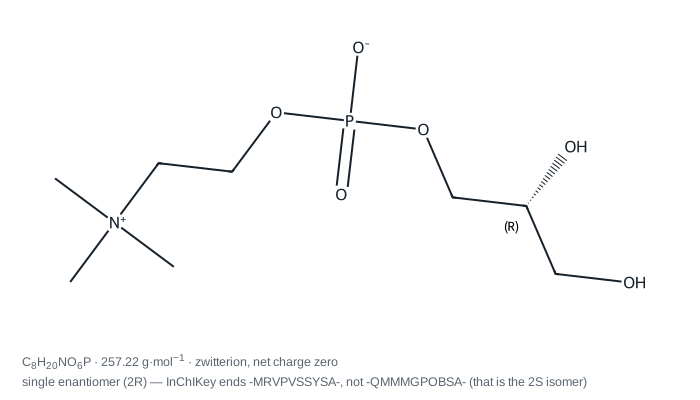
Three features define everything else about this compound in the laboratory.
It is a zwitterion. The quaternary ammonium of the choline head is permanently cationic at every pH, and the phosphodiester is anionic across the working range. The net formal charge is zero [1], which is why the molecule is not retained by simple ion exchange — but it is emphatically not a neutral molecule, and treating it as one is the usual source of method failure.
It carries two free hydroxyl groups on the glycerol, giving two hydrogen-bond donors and a strong affinity for water. That is the structural basis of the hygroscopicity discussed in section 5.
It has no chromophore whatsoever. There is no aromatic ring, no conjugation and no carbonyl beyond the phosphate. Ultraviolet detection is simply not available for this substance, which removes the default detector of pharmaceutical analysis and forces the method choices set out in section 6.2.
Structural neighbours in this catalogue
CDP-choline is the closest relative here: the same choline phosphate head extended by a cytidine diphosphate. Both are polar, both lack a usable chromophore in the ordinary sense, and a method built for one is a rational starting point for the other. The oxiracetam standard, often described as strongly polar, is in fact almost a log unit less polar than this compound. At the opposite extreme, the bromantane standard has a computed logP of +5 against this compound's −2.3 — more than seven log units apart, which makes the pair a useful bracket when qualifying the working range of a gradient system.
3. Computed descriptors and what they predict
| XLogP3-AA | −2.3 |
|---|---|
| Topological polar surface area | 99.1 Å2 |
| Hydrogen-bond donors | 2 |
| Hydrogen-bond acceptors | 6 |
| Rotatable bonds | 8 |
| Heavy atoms | 16 |
| Formal charge | 0 (zwitterionic) |
| Complexity (Cactvs) | 233 |
| Defined / undefined atom stereocentres | 1 / 0 |
| Defined / undefined bond stereocentres | 0 / 0 |
What these numbers predict in the laboratory
A computed logP of −2.3 with a polar surface area of 99.1 Å2 and two free hydroxyls describes a compound that will not be retained on C18. On a conventional reversed-phase column this substance elutes at or near the void volume, where it is unresolved from everything else polar in the sample. That is not a method to be optimised; it is a method that does not apply.
Combine that with the absence of any chromophore and the standard toolkit disappears entirely. Reversed-phase separation fails and ultraviolet detection fails, for two independent reasons. The published work on this compound reflects that: Zhao and colleagues developed and validated an intrinsic-stability HPLC method using a normal-phase separation with refractive-index detection [9], and Zhang and colleagues used column chromatography for preparative purification [11]. Neither reached for C18 and a diode array, because neither could.
A correction to a common assumption. Hydrophilic interaction chromatography is frequently proposed for polar analytes of this kind, and it is a reasonable idea. It is worth knowing that a literature search pairing this substance with HILIC returns essentially nothing — the published methods use normal phase with refractive index, evaporative light scattering, or nuclear magnetic resonance instead. The correct statement is "reversed phase with ultraviolet detection fails", which is well supported, rather than "use HILIC", which is an untested suggestion for this compound.
Eight rotatable bonds and no ring system make this a highly flexible molecule. It has no conformational rigidity to sharpen peaks, which is a further reason that separation quality depends heavily on the mode chosen.
4. Stereochemistry: which GPC is this?
Choline alfoscerate has one defined stereocentre and no undefined ones [1]. It sits at C-2 of the glycerol, and it is defined because the substance is a single enantiomer: the InChI carries the stereochemical layer /t8-/m1/s1 and the standard InChIKey ends in -MRVPVSSYSA-N, not the UHFFFAOYSA that marks an unspecified structure.
Two naming systems collide here, and that collision is the reason the mislabelling described in section 1 exists. Glycerol derivatives are conventionally named by the sn (stereospecific numbering) system used in lipid biochemistry, and separately by the older D/L convention, and separately again by CIP descriptors (R/S). The natural compound is sn-glycero-3-phosphocholine; it is called L-α-glycerylphosphorylcholine by tradition; and its CIP descriptor at C-2 is (R). A reader who assumes that "L" implies "(S)" will pick the wrong compound, and at least one public database record appears to have made exactly that error.
The safe practice is to specify the full InChIKey or the CAS number and to ignore the letter prefixes entirely.
Enantiomeric purity is therefore a real and meaningful specification for this material, and a published method exists to measure it: de Ferra and colleagues reported an effective determination of the enantiopurity of L-α-glycerophosphocholine using a chiral derivatising approach [10]. Section 8 explains why that number belongs on a certificate rather than being folded into a single purity figure.
5. Solid-state behaviour, hygroscopicity and solubility
The registry records a melting point of 142.5 °C and describes the substance as a solid [1]. That value is worth stating precisely because figures around 170 °C circulate widely; they are not registry values.
Hygroscopicity is the defining physical property
Two free hydroxyls, a phosphodiester and a quaternary ammonium make this compound strongly water-avid. In pharmaceutical practice that is not a footnote — it is the reason formulation of choline alfoscerate is difficult. Min and colleagues, developing a tablet to match an existing soft-gelatin capsule, had to address the substance's hygroscopicity directly through the choice of excipient and coating in order to obtain a workable solid dosage form [16].
What this means at the balance, and it is the single most useful sentence on this page. A hygroscopic substance takes up water from the air while you weigh it. A mass recorded without a concurrent water determination is not a defensible mass, and every downstream number that depends on it — assay, response factor, calibration concentration — inherits the error silently. For this compound, Karl Fischer titration is not an optional certificate line; it is the measurement that makes the weighing mean anything.
Practical consequences: keep the container closed, equilibrate a refrigerated container to room temperature before opening so that moisture does not condense onto cold solid, weigh quickly, and determine water content on the same material you weighed rather than relying on a figure from another batch.
Solubility — and a cautionary tale about published data
The compound is freely soluble in water, consistent with a computed logP of −2.3. Solubility in organic solvents is the practically interesting question, and here the literature offers something unusually instructive.
Zhou and colleagues published solubility determinations and a thermodynamic model analysis for L-α-glyceryl phosphorylcholine in organic solvent systems [13]. Chen, Chen and Acree subsequently published comments on that paper [14], and the original authors then published a corrigendum [15].
Why this page cites all three rather than just the first. A reader who finds the original paper and stops there gets numbers that were subsequently corrected. Citing the exchange in full is the only honest way to point at this dataset, and it is a concrete illustration of the rule stated in section 17: a value is only as good as the record it comes from, and record type matters as much as record content. Anyone using published solubility data for this substance should read the corrigendum before using the table.
6. Use as an analytical reference standard
6.1 Three different purities, one number
Most substances in this catalogue have one meaningful purity figure. Choline alfoscerate has three, and they are independent of one another:
- Chromatographic purity — freedom from unrelated impurities and degradation products.
- Enantiomeric purity — freedom from the (2S) enantiomer, measurable by the published chiral method [10].
- Positional-isomeric purity — freedom from β-GPC, the isomer in which the phosphocholine sits on the middle glycerol carbon instead of the terminal one.
The third is the one that surprises people, and it is the subject of section 6.3. A bare claim of "99%" does not say which of the three it refers to, and a material can be excellent on one axis and poor on another. Section 8 sets out how this is handled on the certificate.
6.2 No chromophore, no reversed phase — what actually works
As section 3 explains, the two default tools of pharmaceutical analysis both fail here for independent reasons: the compound is not retained on C18, and it does not absorb usefully in the ultraviolet.
The published methods reflect that. Zhao and colleagues built and validated an intrinsic-stability HPLC method for this substance using normal-phase separation with refractive-index detection [9]. Zhang and colleagues used preparative column chromatography for purification, reporting material of 99.8% purity and a specific rotation of −2.5° [11] — the latter being a reminder that optical rotation remains a usable, cheap check on a single-enantiomer substance.
What a reference standard is for here. Because there is no ultraviolet spectrum to match and no C18 retention time to inherit from the literature, essentially every parameter of a working method has to be established from authentic material: retention on whichever mode is chosen, the refractive-index or evaporative-light-scattering response factor, the mass-spectrometric transitions, and the specific rotation of known-good material. There is little here that can be looked up instead.
6.3 β-GPC: the impurity that shares everything except one bond
The positional isomer β-GPC has the same molecular formula, the same molecular mass and the same exact mass as the α form. It differs only in which glycerol carbon carries the phosphocholine group. No mass spectrometer separates them on mass, and chromatographic resolution of the pair is demanding.
The technique that does resolve them is phosphorus-31 NMR, because the phosphorus nucleus reports directly on its own chemical environment. Sun and colleagues published a validated quantitative 31P NMR method for determining the positional isomeric impurity in L-α-glycerylphosphorylcholine, reporting working determination in the range of roughly 0.03–0.25% w/w [8]. The approach rests on classical work establishing 31P NMR of phospholipids [12].
And here is the gap that makes an authenticated standard necessary rather than merely convenient. A validated 31P method exists in the literature — but no 31P NMR spectrum is deposited for this compound in the public compound record [1]. Verified on 22 August 2026: the record carries 1H NMR, two-dimensional 1H–13C HSQC and mass spectrometry, and no phosphorus spectrum of any kind. For the one nucleus that answers the one question this substance's quality turns on, there is a method and no reference data.
A laboratory setting up that determination therefore has to generate its own reference spectrum from material of known provenance. That is precisely what this article is supplied for.
6.4 Screening food, supplement and pharmaceutical material
Choline alfoscerate is simultaneously a pharmaceutical active substance [5], a notified food ingredient in the United States [6], a compendial article with a United States Pharmacopeia monograph [7], and a naturally occurring compound that can be produced by fermentation of plant material [17]. Laboratories may therefore encounter it in pharmaceutical, food and raw-material contexts, each with different specifications and different likely impurities. In every one of them, identity and isomeric purity are established against an authenticated reference — and, given the naming confusion documented in section 1, against one whose full InChIKey is stated and whose batch data appear on a Certificate of Analysis. The coluracetam standard covers a comparable screening need for a different compound in the same consumer category.
7. Reference spectral data
| Technique | Conditions | Note |
|---|---|---|
| 1H NMR | Varian, 500 MHz, water, pH 7.00 | Dominated by the choline trimethylammonium singlet near 3.20 ppm; the glycerol and choline methylene envelope falls between roughly 3.55 and 4.35 ppm |
| 2D 1H–13C HSQC | — | Useful for assigning the crowded methylene region above |
| Mass spectrometry | — | Collision cross sections are also reported: 155.5 and 157.17 Å2 for [M+H]+ and 161.8 Å2 for [M+Na]+, useful for ion-mobility work |
The absence that matters: there is no 31P NMR spectrum. For a molecule whose defining quality attribute is a phosphorus positional isomer, and for which a validated 31P method is published [8], the lack of deposited phosphorus reference data is the most consequential gap in the public record for this substance. There is also no deposited infrared or Raman spectrum.
The 1H data are genuinely useful and better than for most items in this catalogue — but note that the α and β positional isomers give closely similar proton spectra, so 1H NMR is a poor tool for the very question this compound raises.
8. Batch specification: what "99%" has to mean here
A single purity number is not sufficient for this substance, and this page will not pretend otherwise. Because chromatographic, enantiomeric and positional-isomeric purity are three independent quantities (section 6.1), a certificate that reports only one of them leaves two questions open. The specification below names all three explicitly, and states plainly which are reported as batch values.
| Parameter | Method | Specification |
|---|---|---|
| Identity — chromatographic | HPLC, retention against reference | Conforms |
| Identity — spectroscopic | 1H NMR against reference spectrum | Conforms |
| Assay (chromatographic purity) | HPLC, normal phase with RI or ELSD | ≥99% |
| Water content | Karl Fischer titration | Batch value reported — mandatory for this substance (section 5) |
| Positional isomer (β-GPC) | Quantitative 31P NMR [8] | Reported where determined — not detectable by mass |
| Enantiomeric purity | Chiral derivatisation [10]; or specific rotation as a screen [11] | Reported where determined |
| Residual solvents | GC headspace | Batch value reported |
| Melting range | Capillary | Batch value; registry value 142.5 °C |
The layout of the certificate and the method stated against each parameter can be reviewed on the specimen Certificate of Analysis.
Scope of the specification. This is an analytical reference standard with a batch Certificate of Analysis. It is not a certified reference material in the ISO 17034 sense and not a pharmacopoeial reference standard. A United States Pharmacopeia monograph exists for this substance [7]; compendial testing against it requires the corresponding USP reference standard, which must be obtained from the pharmacopoeia and not from this catalogue.
9. Handling, storage and stability
- Hygroscopicity is the primary handling issue. See section 5. Closed containers, room-temperature equilibration before opening, rapid weighing, and water determination on the weighed material.
- Base is the real chemical sensitivity. The molecule is a phosphodiester, and phosphodiesters are cleaved under alkaline conditions. Avoid basic buffers and alkaline sample preparation unless the effect has been characterised. Note that this is the opposite of the incompatibilities usually listed for this substance.
- Acid and oxidation are comparatively unremarkable for this structure. There is nothing readily oxidisable: no aromatic ring, no sulfide, no catechol.
- Solution stability. Aqueous solutions are practical, unlike for most standards in this catalogue, but should be prepared fresh, kept cold and kept at neutral pH.
- Storage. Sealed, cool, dry. Desiccated storage is appropriate.
- Personal protection. Gloves and eye protection as routine laboratory practice; see section 10.
10. Hazard classification
| Classification | Not Classified — reported as not meeting GHS hazard criteria by 6 of 6 reports |
|---|---|
| Hazard statements | None assigned. Zero of six reports supplied a hazard statement code |
| Basis | Six reports from companies, arising from one notification to the ECHA C&L Inventory |
| REACH | Registered substance, dossier status Active [1] |
How much weight this carries — and here the answer is different from most pages in this catalogue. "Not Classified" is still a self-classification rather than a harmonised classification under Annex VI of the CLP Regulation. But unlike substances with no ECHA presence at all, this one has an EC number and an active REACH registration, which means a dossier exists and the substance has been through a registration process. Six concordant reports on a registered substance is a materially stronger basis than a single notification on an unregistered one.
That said, an unclassified substance is not an unhandled one. Choline alfoscerate is an endogenous human metabolite and a renal osmolyte [1], which is reassuring context rather than a safety assessment of a purified reagent. Ordinary laboratory practice applies: gloves, eye protection, no eating or drinking in the handling area. The Safety Data Sheet shipped with the batch is the controlling document.
11. Origin and industrial context
Choline alfoscerate is not a designed molecule. It is a natural metabolite — the deacylated backbone of phosphatidylcholine, present in human tissue, in yeast, in bacteria and in plants, and functioning as one of the major osmolytes of the renal medulla [1]. Its identifiers reflect that biological status: it carries a ChEBI entry, a KEGG identifier, a Human Metabolome Database number and a MetaboLights accession, none of which the synthetic substances in this catalogue possess.
Industrially it is obtained by controlled deacylation of phosphatidylcholine from lecithin, and purified chromatographically [11]. It can also be produced by fermentation: Tse and colleagues reported production of α-glycerylphosphorylcholine in fermented roots, tubers and fruits [17], which is relevant to anyone analysing food matrices where the compound may be present without having been added.
Its regulatory trajectory is unusual and explains the three-worlds framing at the top of this page: it became an authorised medicinal active substance in several European systems, including Poland [5]; it received a GRAS notification as a food ingredient in the United States [6]; and it acquired a United States Pharmacopeia monograph [7]. The same molecule, three regimes.
12. Preclinical pharmacology
How to read this section. What follows summarises published research on the substance choline alfoscerate, reported as bibliographic fact. None of it describes, predicts or claims any effect of the reagent supplied on this page, which is not administered to anything. Nothing here is dosage guidance, a health claim, or a representation that the substance is safe or effective for any purpose.
The pharmacological rationale is straightforward and follows from the chemistry: choline alfoscerate is a choline-containing phospholipid precursor, as is the related CDP-choline standard, and the registry record classifies it as a parasympatholytic and neuroprotective agent as well as an endogenous metabolite [1].
This page does not attempt a survey of that preclinical literature. The reason is stated plainly: for a compound that is simultaneously an endogenous human metabolite, a food ingredient and an authorised medicine, the relevant evidence for a purchaser of an analytical reference material is the analytical and compendial literature covered in sections 5 to 8, not the pharmacology. The clinical position is summarised in section 13 because it determines the regulatory status in section 14, and for no other reason.
13. Clinical research literature
Medicinal product and laboratory reagent are different things. The studies below investigated authorised medicinal products containing choline alfoscerate, administered under medical supervision. They are reported as bibliographic facts about that literature and describe neither the article supplied on this page nor any use of it. This reagent is not a medicinal product and must not be administered to any human or animal.
Two recent items define the current state of that evidence. Sagaro, Traini and Amenta published a systematic review and meta-analysis of the activity of choline alphoscerate on adult-onset cognitive dysfunctions [18]. Jeon and colleagues subsequently reported a randomised, double-blind, placebo-controlled trial in amnestic mild cognitive impairment [19].
Formulation and bioequivalence work is also published: Min and colleagues compared a tablet formulation against a soft-gelatin capsule in healthy subjects [16], which is the study that documents the hygroscopicity problem discussed in section 5.
What this page does not do. It does not weigh, summarise or characterise the strength of that clinical evidence, and it draws no conclusion about efficacy. Those questions belong to the medicinal products and to the regulators that authorised them, not to a supplier of a laboratory reagent. The references are given so that a reader can go to the primary sources.
14. Regulatory status
| Instrument / jurisdiction | Status |
|---|---|
| Poland — medicinal products | Authorised medicine. Gliatilin 400 mg capsules and Gliatilin 1000 250 mg/ml solution for injection, active substance choline alfoscerate, ATC N07AX02, marketing authorisation holder Italfarmaco S.p.A. Verified against the national Register of Medicinal Products [5] |
| Poland — narcotics, psychotropics and new psychoactive substances | Not listed in Annexes 1, 2 or 3 of the consolidated regulation, Dz.U. 2024 poz. 1139 [4] |
| WADA Prohibited List 2026 | Not listed [3] |
| United States — food | GRAS notification GRN 419, submitted 2012, with the agency raising no questions; use as a food ingredient at the levels notified [6] |
| United States — compendial | United States Pharmacopeia monograph exists for this substance [7] |
| European Union — chemicals | EC number 248-962-2; REACH registered, dossier status Active [1] |
| European Union — food | Not determined for this revision. The Novel Food status of this substance in the EU could not be established from a machine-readable primary source and is not asserted here in either direction |
| United States — DEA | Not scheduled; no forensic reporting-category entry located |
Why the three-regime position matters to a purchaser. That a molecule is an authorised medicine in Poland, a notified food ingredient in the United States and a registered industrial chemical in the EU does not mean the material on this page inherits any of those statuses. This article is supplied as a laboratory reagent under the terms in section 15. It is not a medicine, it is not food-grade, and it is not the pharmacopoeial reference standard. Anyone requiring any of those must obtain the corresponding article through the corresponding channel.
Limits of this section. The Polish entries were verified from the national register and the consolidated controlled-substances regulation, in each case with a paired positive control confirming the search worked before an absence was recorded. The EU Novel Food position is genuinely unresolved: the relevant catalogue is served as a client-side application whose data endpoints do not return machine-readable results, and this page does not guess at what it could not read. Jurisdictions not listed were not assessed.
15. Permitted use and terms of supply
Research use only. Not for human or animal consumption.
- Supplied solely for in-vitro laboratory research, analytical chemistry, chromatographic, NMR and mass-spectrometric method development, isomeric- and enantiomeric-purity work, and reference-standard applications.
- Not a medicinal product, investigational medicinal product, dietary supplement, food, food ingredient, feed, novel food or cosmetic. The existence of an authorised medicine and of a food-ingredient notification containing this substance elsewhere does not extend to this article, which is neither.
- Must not be ingested, inhaled, injected, applied to the body, or administered to any human or animal, under any circumstances and irrespective of quantity.
- Must not be used in the manufacture, compounding, formulation or repackaging of any product intended for human or animal consumption, and must not be presented or resold as a supplement, food ingredient or medicine.
- Must not be used for compendial testing against the pharmacopoeial monograph; that requires the pharmacopoeial reference standard (section 8).
- Intended for purchase and use exclusively by, or under the direct supervision of, persons professionally qualified to handle laboratory chemicals, at premises suitable for chemical storage.
- The purchaser is responsible for verifying the legal status of the substance in their own jurisdiction before ordering.
- No information on this page constitutes medical advice, dosage guidance, a health claim, or a representation that the substance is safe or effective for any purpose in humans.
By placing an order the purchaser confirms acceptance of these conditions and confirms the material will be used exclusively as described above.
16. Frequently asked questions
- What is alpha-GPC used for in a laboratory?
- As an analytical reference standard, supplied with a batch Certificate of Analysis: to establish retention and detector response on a method that cannot use C18 or ultraviolet detection, to generate a phosphorus-31 NMR reference spectrum for positional-isomer work, to establish enantiomeric purity, and to identify and quantify the substance in pharmaceutical, food and raw-material samples.
- Is this product intended for human consumption?
- No. It is a chemical reagent and analytical reference material supplied for in-vitro laboratory use only. That choline alfoscerate is an authorised medicine in Poland and a notified food ingredient in the United States does not extend to this article, which is neither a medicine nor food-grade material and must not be ingested or administered to any human or animal.
- Which glycerophosphocholine am I buying, and why does it matter?
- The (2R) enantiomer, CAS 28319-77-9, InChIKey SUHOQUVVVLNYQR-MRVPVSSYSA-N, also called choline alfoscerate or sn-glycero-3-phosphocholine. It matters because three separate PubChem records share the same InChIKey prefix, the same formula and the same mass, with three different CAS numbers: the (2R) compound, one with no stereochemistry defined, and the (2S) enantiomer. Verified on 22 August 2026, the (2S) record carries as its first listed synonym the name "L-alpha-Glycerylphosphorylcholine (GPC)", which is the common name of the (2R) compound. Matching on the name alpha-GPC, or on the InChIKey prefix, cannot distinguish them. Only the full InChIKey and the CAS number can.
- Why does "L-alpha" not mean the S isomer?
- Because three naming systems overlap on glycerol derivatives. The natural compound is sn-glycero-3-phosphocholine in stereospecific numbering, is traditionally called L-alpha-glycerylphosphorylcholine, and has the CIP descriptor R at the glycerol C2. A reader who assumes that the letter L implies the descriptor S will select the wrong compound, and at least one public database record appears to have made that error. The safe practice is to specify the full InChIKey or the CAS number and ignore the letter prefixes.
- Why can I not analyse this compound on C18 with UV detection?
- For two independent reasons. Its computed logP is minus 2.3 and its polar surface area is 99.1 square angstroms, so it is not retained on a C18 column and elutes at or near the void volume. Separately, the molecule contains no chromophore at all, so there is nothing for an ultraviolet detector to see. Published methods use normal-phase separation with refractive-index detection, or nuclear magnetic resonance. Note that although hydrophilic interaction chromatography is often suggested for polar analytes, essentially no published work pairs it with this compound, so it should be treated as an untested suggestion rather than an established method.
- What is beta-GPC and why is it hard to detect?
- Beta-GPC is the positional isomer in which the phosphocholine group sits on the middle carbon of the glycerol rather than a terminal one. It has the same molecular formula, the same molecular mass and the same exact mass as the alpha form, so no mass spectrometer separates them on mass, and their proton NMR spectra are closely similar. Phosphorus-31 NMR does resolve them, because the phosphorus nucleus reports on its own environment directly, and a validated quantitative phosphorus-31 method has been published for exactly this determination. The complication is that no phosphorus-31 spectrum is deposited for this compound in the public record, so the reference data must be generated in-house.
- What does "99% purity" mean for this substance?
- On its own, not enough. Choline alfoscerate has three independent purity questions: chromatographic purity, enantiomeric purity against the S isomer, and positional-isomeric purity against beta-GPC. A material can be excellent on one and poor on another, and a single unqualified number does not say which was measured. The specification on this page names all three separately, and the batch Certificate of Analysis states which were determined.
- How does alpha-GPC compare with CDP-choline?
- Both are polar choline-containing phosphate esters and both defeat conventional reversed-phase separation with ultraviolet detection, so a method developed for one is a rational starting point for the other. They are not interchangeable: CDP-choline is a nucleotide, substantially larger, and carries a cytosine ring that does absorb in the ultraviolet, which alpha-GPC entirely lacks. The CDP-choline standard is listed separately in this catalogue.
- Is alpha-GPC hygroscopic, and what should I do about it?
- Yes, strongly. It has two free hydroxyl groups, a phosphodiester and a quaternary ammonium, and formulation work on the pharmaceutical product had to address the property directly through excipient and coating choice. The practical consequence is that a mass recorded without a concurrent water determination is not a defensible mass, and every number derived from it inherits the error. Keep containers closed, bring refrigerated material to room temperature before opening so moisture does not condense onto cold solid, weigh quickly, and run Karl Fischer titration on the same material you weighed.
- What is the melting point of alpha-GPC?
- The registry records 142.5 degrees Celsius. Figures around 170 to 172 degrees circulate in commercial listings; they are not registry values and should be disregarded. Densities near 1.93 grams per cubic centimetre also circulate and appear in no registry.
- What degrades alpha-GPC?
- Base. The molecule is a phosphodiester, and phosphodiesters are cleaved under alkaline conditions, so basic buffers and alkaline sample preparation should be avoided unless the effect has been characterised. Acid and oxidation are comparatively unremarkable for this structure, since there is nothing readily oxidisable in it: no aromatic ring, no sulfide, no catechol. Moisture uptake is a separate and more immediate practical problem.
- Is alpha-GPC a controlled substance or banned in sport?
- It does not appear on the World Anti-Doping Agency 2026 Prohibited List, and it does not appear in the Polish list of narcotic drugs, psychotropic substances or new psychoactive substances. It is, however, the active substance of authorised prescription medicines in Poland, so the medicines legislation applies to those products independently of any controlled-substances list. Nothing on this page provides access to a medicine.
- What pack sizes are available?
- Six: 1 g, 5 g, 10 g, 20 g, 40 g and 80 g, each supplied as crystalline solid with a batch Certificate of Analysis. Catalogue numbers follow the CAS-based scheme NSA-28319-77-9 with the pack size appended, for example NSA-28319-77-9-10G.
17. How this page is sourced and verified
| Document scope | Technical and regulatory description of choline alfoscerate supplied as an analytical reference material |
|---|---|
| Last reviewed | 22 August 2026 |
| Primary data sources | PubChem (NCBI) compound record CID 657272; FDA GSRS (UNII); Polish Register of Medicinal Products; Polish Ministry of Health consolidated regulation Dz.U. 2024 poz. 1139; WADA Prohibited List 2026; FDA GRAS notification inventory; United States Pharmacopeia–National Formulary |
| Bibliographic verification | Every cited work was checked against Crossref metadata; each DOI was resolved and its registered title, journal, volume and pagination confirmed. Record type and record history were checked as well as content: where a cited dataset was subsequently commented on and corrected, the comment and the corrigendum are cited alongside the original rather than the original alone |
| Database claims | Statements about the contents of chemical databases (sections 1 and 6.3) are stated with the date on which they were read, because such records are edited. They are reproducible by anyone with the identifiers given |
| Regulatory verification | Each negative finding was confirmed with a paired positive control — substances known to be listed were confirmed present in the same search before an absence was recorded |
| Corrections | The melting point, density, solubility statements, solvent classification and stability warnings previously shown on this page were wrong and were replaced on 22 August 2026 |
Limitations named directly
- The EU Novel Food position is unresolved and is asserted in neither direction. Section 14 explains why.
- No 31P NMR reference spectrum exists in the public compound record, for the nucleus that answers this substance's central quality question. Section 6.3 sets out the consequence.
- Published solubility data for this compound required a corrigendum. Section 5 cites the original, the comment and the correction together; a reader using the original alone would use superseded numbers.
- This page deliberately does not survey the pharmacology. Section 12 explains why: for a purchaser of an analytical reference material, the analytical and compendial literature is the relevant evidence, and a survey of clinical efficacy would be padding on a page that must not make health claims.
- The bibliography is nineteen sources. That is fewer than for the best-studied substances in this catalogue and reflects a deliberate focus on analytical, compendial and regulatory material over pharmacology.
Not yet on this page
This page does not carry a named author with stated professional qualifications, a named technical reviewer, or laboratory data generated in-house — no chromatogram, no 31P spectrum, no measured water content or specific rotation of our own. For this substance the phosphorus spectrum is the most conspicuous of those gaps, because it is the measurement the public record lacks entirely.
18. References
Citations follow the Chicago author–date convention. All external links carry rel="nofollow". Access to full texts is governed by the policies of the respective publishers.
Registry, regulatory and compendial sources
- National Center for Biotechnology Information. 2026. "PubChem Compound Summary for CID 657272, Choline Alfoscerate." PubChem. Accessed August 22, 2026. https://pubchem.ncbi.nlm.nih.gov/compound/657272.
- U.S. Food and Drug Administration. 2026. "Global Substance Registration System: UNII 60M22SGW66, Choline Alfoscerate." Accessed August 22, 2026. https://gsrs.ncats.nih.gov/ginas/app/beta/substances/60M22SGW66.
- World Anti-Doping Agency. 2025. World Anti-Doping Code International Standard: Prohibited List 2026. Effective 1 January 2026. https://www.wada-ama.org/en/prohibited-list.
- Minister Zdrowia. 2024. Obwieszczenie Ministra Zdrowia z dnia 17 czerwca 2024 r. w sprawie ogłoszenia jednolitego tekstu rozporządzenia Ministra Zdrowia w sprawie wykazu substancji psychotropowych, środków odurzających oraz nowych substancji psychoaktywnych. Dziennik Ustaw 2024, poz. 1139. https://eli.gov.pl/eli/DU/2024/1139.
- Urząd Rejestracji Produktów Leczniczych, Wyrobów Medycznych i Produktów Biobójczych. 2026. "Rejestr Produktów Leczniczych: Gliatilin (choline alfoscerate), ATC N07AX02; podmiot odpowiedzialny Italfarmaco S.p.A." Accessed August 22, 2026. https://rejestry.ezdrowie.gov.pl/rpl/search/public.
- U.S. Food and Drug Administration. 2012. "GRAS Notice Inventory: GRN No. 419, L-alpha-glycerylphosphorylcholine." Accessed August 22, 2026. https://www.fda.gov/food/generally-recognized-safe-gras/gras-notice-inventory.
- United States Pharmacopeial Convention. USP–NF monograph for choline alfoscerate. https://doi.org/10.31003/uspnf_m10375_04_01.
Analytical methodology, purity and solid-state behaviour
- Sun, L., Y. Fan, Q. Wang, L. Xiang, H. Han, and D. Chen. 2022. "Validated Quantitative 31P NMR Spectroscopy for Positional Isomeric Impurity Determination in L-α-Glycerylphosphorylcholine." Journal of Pharmaceutical and Biomedical Analysis 221: 115067. https://doi.org/10.1016/j.jpba.2022.115067.
- Zhao, H., L. Sun, H. Chen, L. Xiang, and D. Chen. 2020. "Intrinsic Stability Study of L-α-Glycerylphosphorylcholine with HPLC Method Development and Validation." Journal of Pharmaceutical and Biomedical Analysis 188: 113468. https://doi.org/10.1016/j.jpba.2020.113468.
- de Ferra, L., A. Massa, A. Di Mola, and B. Diehl. 2020. "An Effective Method for the Determination of the Enantio-purity of L-α-Glycerophosphocholine (L-α-GPC)." Journal of Pharmaceutical and Biomedical Analysis 183: 113152. https://doi.org/10.1016/j.jpba.2020.113152.
- Zhang, K., X. Wang, J. Huang, and Y. Liu. 2012. "Purification of L-alpha Glycerylphosphorylcholine by Column Chromatography." Journal of Chromatography A 1220: 108–114. https://doi.org/10.1016/j.chroma.2011.12.003.
- Henderson, T. O., T. Glonek, and T. C. Myers. 1974. "Phosphorus-31 Nuclear Magnetic Resonance Spectroscopy of Phospholipids." Biochemistry 13: 623–628. https://doi.org/10.1021/bi00700a034.
- Zhou, C., H. Yan, W. Yang, and Y. Hu. 2024. "Solubility Determination and Thermodynamic Model Analysis of L-α-Glyceryl Phosphorylcholine in Different Organic Solvents." Journal of Pharmaceutical and Biomedical Analysis 241: 115998. https://doi.org/10.1016/j.jpba.2024.115998. See also the comment [14] and the corrigendum [15].
- Chen, A., J. Chen, and W. E. Acree. 2024. "Comments Regarding 'Solubility Determination and Thermodynamic Model Analysis of L-α-Glyceryl Phosphorylcholine in Different Organic Solvents'." Journal of Pharmaceutical and Biomedical Analysis 247: 116217. https://doi.org/10.1016/j.jpba.2024.116217.
- Zhou, C., H. Yan, W. Yang, and Y. Hu. 2024. "Corrigendum to 'Solubility Determination and Thermodynamic Model Analysis of L-α-Glyceryl Phosphorylcholine in Different Organic Solvents'." Journal of Pharmaceutical and Biomedical Analysis 248: 116269. https://doi.org/10.1016/j.jpba.2024.116269.
Formulation, natural occurrence and clinical context
- Min, M.-H., J.-H. Park, J.-H. Hur, H.-C. Shin, Y.-J. Cho, and D.-D. Kim. 2019. "Formulation and Bioequivalence Studies of Choline Alfoscerate Tablet Comparing with Soft Gelatin Capsule in Healthy Volunteers." Drug Design, Development and Therapy 13: 1049–1058. https://doi.org/10.2147/DDDT.S193424.
- Tse, T. J., F. Chicilo, D. J. Wiens, J. Shen, J. Anleu Alegria, Y. J. Kim, J. Y. Hong, J. K. Kim, E.-C. Shin, and M. Reaney. 2024. "Production of α-Glycerylphosphorylcholine in Fermented Roots, Tubers, and Fruits." Foods 13: 3085. https://doi.org/10.3390/foods13193085.
- Sagaro, G. G., E. Traini, and F. Amenta. 2023. "Activity of Choline Alphoscerate on Adult-Onset Cognitive Dysfunctions: A Systematic Review and Meta-Analysis." Journal of Alzheimer's Disease 92: 59–70. https://doi.org/10.3233/JAD-221189.
- Jeon, J., S. Y. Lee, S. Lee, C. Han, G. D. Park, S.-J. Kim, J. G. Chang, and W. J. Kim. 2024. "Efficacy and Safety of Choline Alphoscerate for Amnestic Mild Cognitive Impairment: A Randomized Double-Blind Placebo-Controlled Trial." BMC Geriatrics 24. https://doi.org/10.1186/s12877-024-05366-7.