Forskolin ≥99% – Analytical Reference Standard, 1000 mg | CAS 66575-29-9
- Home
- Forskolin ≥99% – Analytical Reference Standard, 1000 mg | CAS 66575-29-9
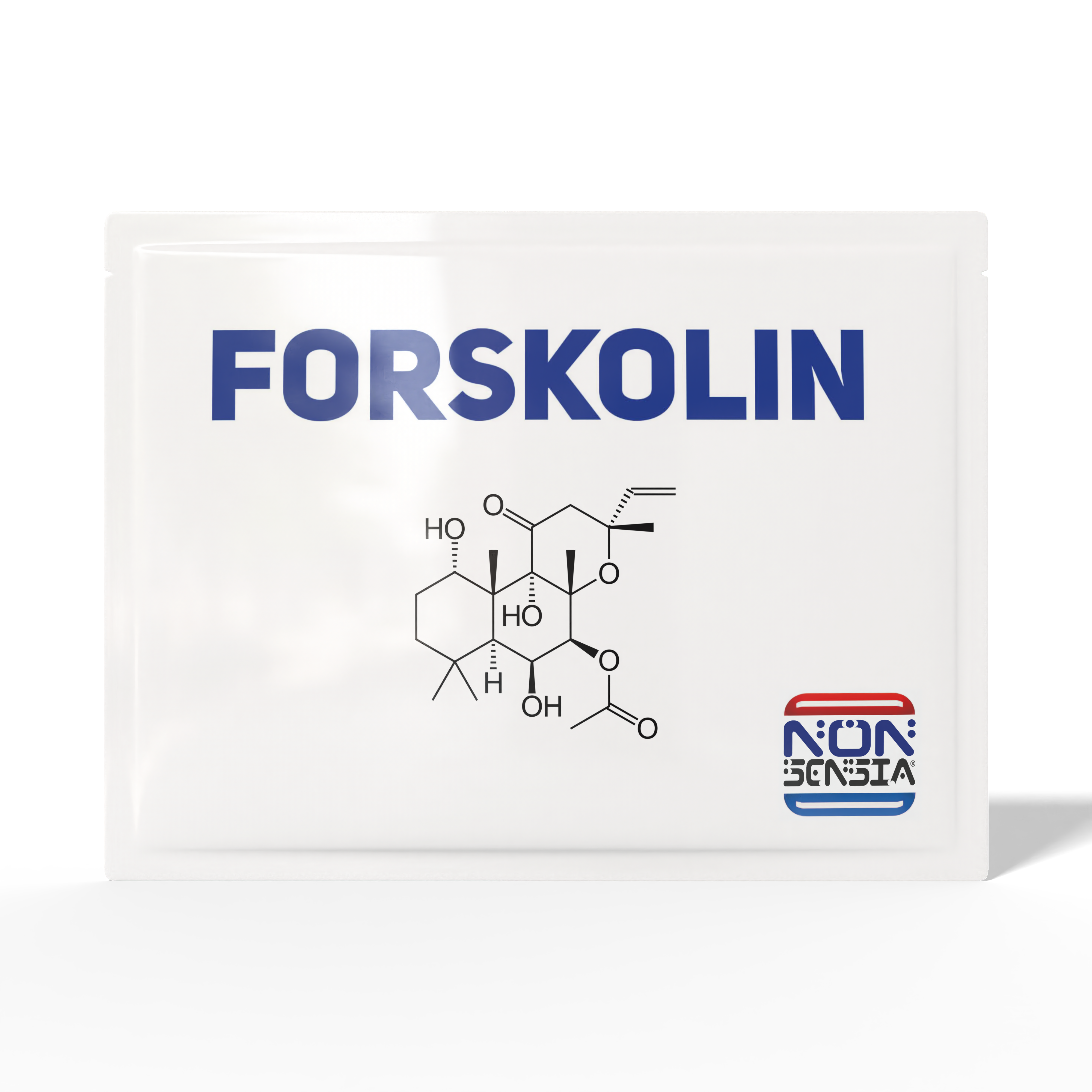
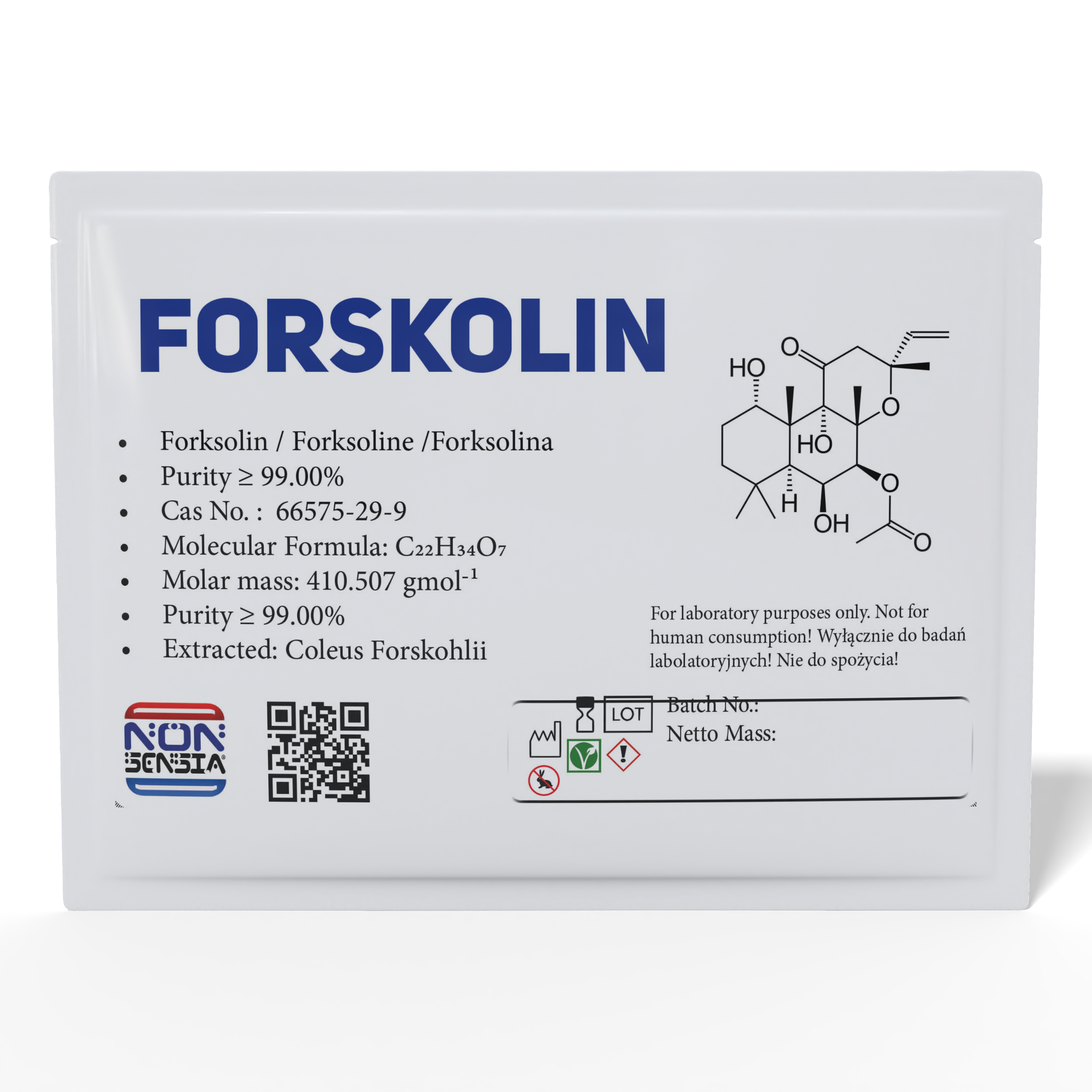
Forskolin ≥99% – Analytical Reference Standard, 1000 mg | CAS 66575-29-9
30,85 zł
Forskolin Reference Standard — CAS 66575-29-9, (3R,4aR,5S,6S,6aS,10S,10aR,10bS), 1000 mg
A single, fully specified labdane diterpene — free molecule, no salt and no hydrate — supplied for chromatographic identity work, retention-time anchoring and method development. Laboratory reagent and analytical reference material only — not for human or animal consumption, not a medicinal product, and not the botanical extract that shares its name.
- Net quantity: 1000 mg of a single chemical substance, not a standardised plant preparation — the difference is set out in full below
- CAS / EC / UNII / ATC: 66575-29-9 · 266-410-9 (check digit validated offline) · 1F7A44V6OU · no ATC code exists
- Formula / mass: C22H34O7 · 410.5 g·mol−1. Neutral free molecule — formal charge 0, one covalently bonded unit — so not a hydrochloride, and not the 546.1 g·mol−1 prodrug salt whose name sits among this compound’s registry synonyms
- Stereochemistry: eight defined centres, zero undefined, absolute configuration on file; InChIKey
OHCQJHSOBUTRHG-KGGHGJDLSA-N. Eight centres permit 256 stereoisomers - The core problem, first direction: fifty registry records share the InChIKey skeleton
OHCQJHSOBUTRHG, and forty-five of them carry the monoisotopic mass 410.23045342 Da — identical to eight decimal places. Twenty-four are complete, distinct stereoisomers - The core problem, second direction: isoforskolin has a different skeleton block and an identical stereo block,
KGGHGJDLSA, plus the same formula and the same exact mass. Comparing half an InChIKey fails whichever half you pick - Why fragmentation does not rescue it: at every collision energy from 15 to 75 the base peak is m/z 59.0138, the acetate anion — at the top of that range some sixty times larger than anything else in the spectrum. Isoforskolin sheds the same acetate and gives the same ion
- Library matching is unavailable: the public spectral library holds sixteen records for forskolin and zero for isoforskolin (control on the same interface: sixty-eight for curcumin). There is nothing on the other side to match against
- Data gaps, measured with controls: the registry holds one experimental-property subsection — collision cross section. No melting point, no solubility, no pKa and no specific rotation; no 1H NMR, no 2D NMR, no UV-Vis, no Raman, no GC-MS
- Hazards: Warning, H312 at 97% of notifiers — aggregated from just 99 reports and 4 notifications, one of which records no hazard at all
- WADA 2026 and Polish schedules: not listed in either, each zero verified against positive controls that fired on the same document
Every unit ships with batch documentation. Full registry data with three independent naming systems, the identity problem in both of its directions, the deposited fragmentation behaviour peak by peak, the methods that do discriminate, the difference between a pure substance and a standardised botanical preparation, spectral and physicochemical coverage measured against positive controls, regulatory position in four jurisdictions, and 48 cited sources are set out below.
Out of stock
Quick Payment
100% New
Fast Delivery
- Additional Information
Product classification — read before ordering. This item is a chemical reagent and analytical reference material. It is not a medicinal product, dietary preparation, food, feed, novel food or cosmetic, and it is not intended for human or animal consumption or for any in-vivo administration whatsoever. It is supplied exclusively to laboratories, research institutions and professional users for in-vitro analytical, chromatographic and method-development work. Scientific findings summarised on this page describe substances investigated in published laboratory research; they are reported here as bibliographic facts about that literature and are not product claims, dosage guidance, or a recommendation of any use of this reagent.
This is the most stereochemically complex molecule in this catalogue, and its identity problem runs in two opposite directions at once. Read sections 4 and 5 before ordering. Forskolin carries eight defined stereocentres and zero undefined ones [1]. Eight centres permit 28 = 256 stereoisomers, and a search of the public registry for records sharing this molecule’s atom connectivity returns fifty separate records — forty-five of which carry the monoisotopic mass 410.23045342 Da, identical to the eighth decimal place, and twenty-four of which are fully specified stereoisomers holding their own entries [1]. That is the first direction: anything keyed on the InChIKey skeleton merges all fifty. The second direction is less expected and worse. Isoforskolin is a different molecule with a different skeleton block — and an identical stereochemistry block, KGGHGJDLSA, because it carries the same eight descriptors [1][2]. It also carries the same molecular formula and the same monoisotopic mass. Section 6 shows why the dominant ion in forskolin’s mass spectrum is precisely the fragment that cannot tell the two apart.
Key facts
- Substance
- Forskolin; INN and USAN colforsin; also indexed as coleonol. A labdane-type diterpene of plant origin
- CAS
- 66575-29-9. A second number, 66428-89-5, is carried in the same record; 72569-68-7 and 64657-11-0 are marked deprecated [1]
- EC / ECHA
- 266-410-9 · registry entry 100.060.354, filed by the agency under the name Colforsin [10]
- PubChem CID
- 47936 [1]
- UNII
- 1F7A44V6OU, registered as COLFORSIN [12]
- ATC code
- None — measured, not assumed; see section 12 [11]
- Formula
- C22H34O7
- Molecular mass
- 410.5 g·mol−1 as filed [1]; authorities differ in the second and third decimal — see section 9
- Monoisotopic mass
- 410.23045342 Da — equal to the exact mass; isotope atom count 0 [1]
- InChIKey
OHCQJHSOBUTRHG-KGGHGJDLSA-N- Stereocentres
- 8 defined, 0 undefined; 0 defined bond stereocentres, 0 undefined bond stereocentres. Configuration (3R,4aR,5S,6S,6aS,10S,10aR,10bS) [1]
- Salt or hydrate
- Neither. Formal charge 0, one covalently bonded unit — a neutral free molecule [1]
- Computed descriptors
- XLogP3-AA 1; TPSA 113 Å2; 3 donors / 7 acceptors; 3 rotatable bonds; 29 heavy atoms; complexity 747 [1]
- Experimental properties
- One subsection only in the public record: collision cross section. No melting point, no solubility, no pKa, no specific rotation [1]
- Deposited spectra
- 13C NMR, ATR-IR and mass spectrometry. No 1H NMR, no 2D NMR, no UV-Vis, no Raman, no GC-MS [1]
- GHS
- Warning — H312 at 97% of notifiers; aggregated from 99 reports and 4 notifications, one of which reports no hazard at all [1]
- WADA 2026
- Not prohibited — verified against the list with four positive controls [19]
- Pack
- 1000 mg
On this page
- What this material is
- Identity and registry codes
- Structure and stereochemistry
- Fifty records, one skeleton, one mass
- The mirror trap: isoforskolin
- Why fragmentation makes it worse
- Methods that do discriminate
- Extract and reference standard are different articles
- Physicochemical data: an almost empty shelf
- Spectra: what exists, what does not
- Hazard classification
- Regulatory status
- Handling, storage and documentation
- What we certify and what we do not
- Terms of supply
- Questions and answers
1. What this material is
This page describes forskolin supplied as an analytical reference material: a weighed quantity of a single identified chemical substance, intended to serve as the point of comparison against which another sample is measured. A reference material has one narrow job. When a laboratory reports that a plant material contains a stated percentage of forskolin, or that a chromatographic peak at a given retention time is forskolin and not something else, that report is only as good as the material the instrument was calibrated against. Everything downstream inherits the identity of one vial.
Forskolin is a labdane-type diterpene isolated from the roots of a plant in the mint family, and it is one of the most heavily used reagents in cell biology, because it activates adenylyl cyclase directly and therefore raises cyclic AMP in almost any cell type without going through a receptor. That is why the literature count is enormous and simultaneously unhelpful: the registry links 6,052 indexed publications to this substance [1], and the overwhelming majority of them use forskolin as a tool rather than studying it as an object. A paper that adds forskolin to a dish in order to raise cyclic AMP tells you nothing whatsoever about how to confirm that the powder in your own vial is forskolin.
The papers that do address that question are far fewer, and they converge on one uncomfortable finding, which is the subject of this page. Forskolin is exceptionally difficult to identify by the techniques most laboratories actually own. Not because it is obscure — it is not — but because of an unusual coincidence of three properties: eight stereocentres, a close regioisomer of identical exact mass, and a fragmentation pathway whose dominant product ion is common to both. Sections 3 to 7 set that out in detail, with the measurement behind each claim.
A fourth problem sits alongside the analytical one and is commercial rather than chemical. The word forskolin is used in the marketplace for two entirely different articles: a single pure compound with a CAS number, and a botanical extract of variable composition in which that compound is one component among several. Section 8 sets out why those are not interchangeable and why the difference is measurable rather than semantic.
For the general terms on which this shop supplies reference materials, the surrounding reference standards category collects the rest of the catalogue on the same basis.
2. Identity and registry codes
Every identifier below is quoted from a public registry, with the registry named. Where two registries disagree, or use different conventions for the same structure, both are given rather than a choice being made silently.
| Registry title | Forskolin [1] |
|---|---|
| INN / USAN | Colforsin (colforsina, colforsine, colforsinum) [1][11][12] |
| CAS Registry Number | 66575-29-9 [1][11] |
| Second CAS in the same record | 66428-89-5, filed against a naphthopyran-style name [1] |
| Deprecated CAS numbers | 72569-68-7, 64657-11-0 [1] |
| EC number | 266-410-9 [10] |
| ECHA registry entry | 100.060.354, filed under the name Colforsin [10] |
| PubChem CID | 47936 [1] |
| UNII (FDA) | 1F7A44V6OU [12] |
| ChEBI | CHEBI:42471 [1] |
| ChEMBL | CHEMBL52606; highest development phase recorded: phase 2 [13] |
| DrugBank | DB02587 [1] |
| KEGG | C09076 (compound) and D03584 (drug) [11] |
| DSSTox | DTXSID8040484 [1] |
| NCI Thesaurus | C166496 [1] |
| LIPID MAPS | LMPR0104030004 [1] |
| Protein Data Bank | ligand code FOK; bound structure 1CJT [1] |
| Nikkaji / MDL / Wikidata | J22.273I · MFCD00082317 · Q412747 [1] |
| MeSH | Colforsin, M0358301 [1] |
| HMDB | No identifier — a search of the full record returns zero matches for the HMDB pattern, while the same search of the same record returns four matches for the ChEBI pattern, eight for the DSSTox pattern and five for the LIPID MAPS pattern [1] |
| ATC code | None. The drug record carries no ATC line and no ATC branch in its classification tree [11] |
| Development codes | HL 362, L-751362B, NSC-357088, NSC-375489 [1] |
Three systematic names, and none of them is wrong
Automated name generation, the European agency’s own filing and the natural-product literature disagree about which framework this molecule should be named on. All three names describe the same structure and all three are encountered in supplier documentation:
| Benzo[f]chromene nomenclature (computer-generated) | [(3R,4aR,5S,6S,6aS,10S,10aR,10bS)-3-ethenyl-6,10,10b-trihydroxy-3,4a,7,7,10a-pentamethyl-1-oxo-5,6,6a,8,9,10-hexahydro-2H-benzo[f]chromen-5-yl] acetate [1] |
|---|---|
| Naphtho[2,1-b]pyran nomenclature (European registry filing) | (3R,4aR,5S,6S,6aS,10S,10aR,10bS)-3-ethenyl-6,10,10b-trihydroxy-3,4a,7,7,10a-pentamethyl-1-oxo-dodecahydro-1H-naphtho[2,1-b]pyran-5-yl acetate [10] |
| Labdane (natural-product) nomenclature | 7β-acetoxy-8,13-epoxy-1α,6β,9α-trihydroxylabd-14-en-11-one |
Three naming systems, three sets of locants, one molecule. This matters more than usual here, because the position of the acetate group is the single feature separating forskolin from the compound in section 5 — and that position is called C-5 in the first two systems and C-7 in the third. A certificate stating acetate at C-7 and a database record stating chromen-5-yl acetate describe the same substance, and an analyst comparing them without noticing the change of numbering will conclude that they do not.
Machine-readable descriptors
| Connectivity SMILES (no stereochemistry) | CC(=O)OC1C(C2C(CCC(C2(C3(C1(OC(CC3=O)(C)C=C)C)O)C)O)(C)C)O |
|---|---|
| Isomeric SMILES | CC(=O)O[C@H]1[C@H]([C@@H]2[C@]([C@H](CCC2(C)C)O)([C@@]3([C@@]1(O[C@@](CC3=O)(C)C=C)C)O)C)O |
| InChI | InChI=1S/C22H34O7/c1-8-19(5)11-14(25)22(27)20(6)13(24)9-10-18(3,4)16(20)15(26)17(28-12(2)23)21(22,7)29-19/h8,13,15-17,24,26-27H,1,9-11H2,2-7H3/t13-,15-,16-,17-,19-,20-,21+,22-/m0/s1 |
| InChIKey | OHCQJHSOBUTRHG-KGGHGJDLSA-N |
| Stereochemical layer | /t13-,15-,16-,17-,19-,20-,21+,22-/m0/s1 — eight signed positions, one per centre |
Note the two SMILES strings. The first carries no stereochemical information at all; the second encodes all eight centres. If a supplier record, a database import or a laboratory information system stores the first, the entire stereochemistry is gone and nothing downstream will flag its absence. This is not hypothetical: a stereochemistry-free record for exactly this connectivity exists in the registry in its own right, as CID 3413, carrying the same formula and the same monoisotopic mass with zero defined and eight undefined stereocentres [3]. Any process that rounds a structure to its connectivity lands on it.
Identity trap one: the only synonym containing a salt is not this substance
The registry record for forskolin carries 159 depositor-supplied synonyms, and exactly one of them contains the string HCl: a long naphthopyran name ending …N,N-dimethyl-β-alanine ester HCl [1]. That name does not belong to forskolin. It belongs to colforsin daropate hydrochloride, a water-soluble prodrug developed in a separate synthetic programme [36] and filed as its own record: C27H44ClNO8, molecular mass 546.1 g·mol−1, with two covalently bonded units because of the chloride counter-ion [6]. Its free base is a third record again, C27H43NO8, 509.6 g·mol−1, monoisotopic 509.29886733 Da [5]. A catalogue entry that copies synonyms mechanically from the registry therefore attaches, to a page about a 410.5 g·mol−1 neutral molecule, the name of a salt 135.6 g·mol−1 heavier. Any gravimetric calculation carried out on that basis is wrong by a third.
Forskolin itself is unambiguously a free, neutral molecule: formal charge 0, one covalently bonded unit, isotope atom count 0 [1]. It is neither a salt nor a hydrate, and the mass of 410.5 g·mol−1 applies to the substance as supplied, without any counter-ion or water-of-crystallisation correction. Compare procaine hydrochloride, where the salt is the article and the free-base mass would be the error, or CDP-choline, where sodium-salt and free-acid forms circulate side by side under one common name. Getting the direction of that correction backwards is a routine and expensive mistake, and here the correction is simply not to be applied at all.
Identity trap two: a registry record wearing this substance’s own names
Among the fifty records sharing this connectivity (section 4) there is one titled, literally, Coleonol;Colforsin — two of forskolin’s own common names concatenated into a single title string. That record, CID 73759682, carries four defined and four undefined stereocentres [4]. It is half-specified: the connectivity is right, the formula is right, the mass is right, and half the stereochemistry is simply missing. A database lookup by the name colforsin that returns this record instead of CID 47936 returns something that is not a defined chemical individual at all, and nothing in the title warns of it.
The name space around this molecule is a minefield in both directions. Each of the resolutions below was measured by direct name lookup rather than assumed:
| Name queried | Record returned | Is that forskolin? |
|---|---|---|
forskolin | CID 47936 | Yes |
colforsin | CID 47936 | Yes — the international name |
coleonol | CID 47936 | Yes |
coleonol B | CID 9549169 | No — this is isoforskolin |
isoforskolin | CID 9549169 | No — a different compound entirely |
coleonol C | no record found | — |
One letter separates coleonol from coleonol B, and the two names resolve to different substances of identical mass. Section 5 is about what follows from that.
Identity trap three: the botanical name is not the chemical identity
The source plant is filed in the taxonomy database under identifier 41228, whose scientific name is Plectranthus barbatus, carrying Coleus barbatus and Coleus forskohlii as synonyms — all three names resolve to that same single record [14]. Its lineage is Lamiales → Lamiaceae → Nepetoideae → Ocimeae → Plectranthinae → Plectranthus: it is a member of the mint family [14].
Why the common name Indian nettle should never appear on a document about this plant. Nettles are Urticaceae. This plant is Lamiaceae. The two families are not close, and the confusion is not a translation nicety: Acalypha indica, the species most often meant by Indian nettle in horticultural writing, sits in Malpighiales → Euphorbiaceae, a third family again [14]. Three different families, one loosely applied common name. Plant names of this kind circulate freely in commercial listings for this substance; they are not registry values. A certificate of analysis that identifies its botanical source by a common name rather than by a binomial with an authority has not identified it at all, which is why both a binomial and a taxonomy identifier appear above.
3. Structure and stereochemistry
Forskolin is a labdane diterpene: a bicyclic decalin core with an oxygen-bridged pyran ring fused across it, bearing three hydroxyl groups, one ketone, one acetate ester and a terminal vinyl group. The framework is dense — twenty-nine heavy atoms, only three rotatable bonds, and a computed complexity score of 747 [1]. Nearly every ring-fusion carbon and nearly every carbon bearing an oxygen is a stereocentre.
The registry states the stereochemistry without ambiguity. The four stereodescriptor counters are quoted here verbatim, because for this molecule they are the whole specification:
| Defined atom stereocentre count | 8 |
|---|---|
| Undefined atom stereocentre count | 0 |
| Defined bond stereocentre count | 0 |
| Undefined bond stereocentre count | 0 |
| InChI stereo layer | /t13-,15-,16-,17-,19-,20-,21+,22-/m0/s1 |
| Isotope atom count | 0 |
| Formal charge | 0 |
| Covalently bonded units | 1 — free molecule, no counter-ion |
Eight defined, none undefined. The substance is a single, fully specified stereoisomer, configuration (3R,4aR,5S,6S,6aS,10S,10aR,10bS). The stereo layer of the InChI can be counted directly as an independent cross-check: 13-, 15-, 16-, 17-, 19-, 20-, 21+, 22- is eight signed positions, matching the counter exactly, followed by the parity flag /m0 and the absolute-stereo flag /s1. The /s1 flag is what makes this an absolute rather than a relative assignment: the record is not saying these centres are arranged thus with respect to one another, it is saying this is one specific enantiomer, and it is this one.
Eight centres permit 28 = 256 stereoisomers. That number is arithmetic, not rhetoric. It is also, on its own, misleading in the reassuring direction: most of those 256 are not accessible from the plant and most have never been made. What matters is not how many could exist but how many the public record already treats as distinct entities, and how many of those an ordinary instrument would confuse with the product. Section 4 answers both questions with measurements rather than estimates, and both answers are larger than intuition suggests.
Where forskolin sits among the chiral reference materials in this catalogue
Comparison across a catalogue is the fastest way to see that this molecule differs in kind rather than in degree. Bromantane is achiral: it has no stereocentres at all, and a registry search for records sharing its connectivity returns two, one of which is itself. Apigenin is a flat aromatic flavone with nothing to confuse. Aniracetam and oxiracetam sit near the same end of the scale. Modafinil carries a single stereocentre, at sulfur, and is supplied as the racemate. Tadalafil, documented in this catalogue as a hard stereochemical case in its own right, has two centres and four stereoisomers.
Forskolin has eight. The step from two centres to eight is not a doubling of difficulty; it is a change from a problem that can be enumerated on a page to one that cannot. Four stereoisomers can be listed in a table and each given a retention time. Two hundred and fifty-six cannot, and no laboratory holds standards for them. That is exactly why the practical question for this molecule is never which of the 256 is it but is it the one from the plant, or is it something else of the same mass — and the sections that follow are about how much harder that narrower question turns out to be.
Where the absolute configuration actually comes from
Every one of the eight descriptors above traces back to a small and old body of work, and it is worth naming precisely, because its age is itself a fact about the compound. The molecular and crystal structure of forskolin was solved by single-crystal X-ray diffraction and published in 1980 [22]. Absolute configuration — the distinction between the molecule and its mirror image, which ordinary diffraction on a light-atom structure cannot make — was established through a companion study on a brominated derivative, 1-benzyl-7-desacetyl-7-bromoisobutyryl-forskolin, published in the same journal in the same year [23]. The bromine atom is there for one reason: a heavy atom produces measurable anomalous dispersion, and anomalous dispersion is what fixes the handedness.
That is a clean, classical and entirely convincing experiment. It is also the load-bearing one. When a certificate of analysis for this substance states a configuration, the chain of evidence behind that statement runs back through the registry to two crystallographic papers from 1980, one of them on a derivative synthesised specifically so that the question could be answered at all. Nothing is wrong with that chain. It is simply much shorter, and much older, than the confident tone of most product documentation implies, and a buyer is entitled to know how short it is.
4. Fifty records, one skeleton, one mass
This is the central analytical fact about forskolin as a reference material, and it is best stated as a measurement rather than as a caution.
The registry offers a search that returns every record sharing a given molecule’s atom connectivity — that is, every record whose atoms are joined in the same order, regardless of how the stereochemistry is drawn or whether it is drawn at all. Run on forskolin, that search returns fifty records [1]. Their properties were then fetched in a single batch and counted:
| Class of record | Count | What it means |
|---|---|---|
| Total records with this connectivity | 50 | All share the InChIKey skeleton block OHCQJHSOBUTRHG |
| Carrying monoisotopic mass exactly 410.23045342 Da | 45 | Identical to the eighth decimal place; no mass measurement separates them |
| — of those, fully specified (8 defined, 0 undefined) | 24 | Genuine, complete stereoisomers each holding its own record |
| — of those, partially specified (4 to 7 defined) | 20 | Ill-defined entities: 8 records at 7 centres, 2 at 6, 5 at 5, 5 at 4 |
| — of those, fully unspecified (0 defined, 8 undefined) | 1 | CID 3413 — the flat record [3] |
| Isotope-labelled (mass shifted deliberately) | 5 | The only members of the family a mass spectrometer can separate |
Forty-five registry records carry the monoisotopic mass 410.23045342 Da — identical to the final decimal place — and all fifty share the first fourteen characters of their InChIKey, OHCQJHSOBUTRHG. Among them are twenty-four fully specified stereoisomers, twenty half-specified entities, and one record carrying no stereochemistry at all. No mass measurement, at any resolution, separates them. An instrument capable of resolving 410.23045342 from 410.23045343 would still report all forty-five as the same number, because it is the same number.
The measurement is not an artefact of the search
A count of fifty means nothing unless the same instrument returns different counts for different molecules; a search that always returns fifty would be a broken search. The identical query was therefore run on three control substances, chosen to span the range:
| Substance | Stereocentres | Records sharing its connectivity |
|---|---|---|
| Bromantane | 0 — achiral | 2 |
| Curcumin (a plant diterpenoid-adjacent reference standard) | 0 | 29 |
| Forskolin | 8 | 50 |
| Tadalafil | 2 | 279 |
The instrument fires, and it fires with different values. Two for an achiral cage compound, fifty for forskolin, two hundred and seventy-nine for a molecule that is the target of an enormous falsification literature and therefore attracts a swarm of deposited analogues. The number is a real property of each record, not a fixed reply. It is also worth reading the tadalafil row correctly: a larger count there reflects the sheer volume of deposited material rather than a harder stereochemical problem. What makes forskolin harder is not the size of the set but its composition — twenty-four of its fifty are complete, distinct stereoisomers, which is a fundamentally different situation from a long tail of duplicate deposits.
Two of the fifty deserve to be named individually
Most of the fifty are anonymous systematic names differing in one or two descriptors. Two are not, and both are instructive about how registry noise behaves in practice.
CID 73759682 is titled Coleonol;Colforsin and carries four defined and four undefined stereocentres [4]. It bears two of the product’s own names while specifying only half its stereochemistry. A name-based lookup can land on it, and a certificate archive keyed on names rather than on identifiers can file against it.
CID 139024465 has forskolin’s connectivity, forskolin’s formula and forskolin’s monoisotopic mass, with seven defined and one undefined stereocentre. Its deposited title is the systematic name of a morphinan opioid antagonist — a compound with a completely different formula, a nitrogen atom and no relationship to this one whatsoever [1]. The structure in the record is a forskolin stereoisomer; the title is somebody else’s drug. We report this as measured rather than explained: we do not know how the mismatch arose, and it does not matter for the practical point, which is that titles in a public registry are depositor-supplied text and are not part of the structural record. A workflow that trusts the title of a record it found by structure has trusted the least reliable field in it.
A concrete failure mode. It is standard practice to index or deduplicate chemical inventories on the InChIKey skeleton, precisely because the skeleton is robust to tautomers, salt forms and drawing conventions. Applied to this molecule, that practice merges twenty-four complete stereoisomers, twenty half-specified entities, one stereochemistry-free record and five isotope-labelled analogues into a single entity. If your inventory system, your certificate archive or your spectral library keys on the skeleton, it has already discarded the only distinction that matters here. For apigenin or bromantane, skeleton-level indexing loses nothing at all. For forskolin it loses everything.
The five records that break the pattern, and why
Five of the fifty do not carry the mass 410.23045342 Da, and the exception explains the rule. All five are isotope-labelled. The clearest is Forskolin-13C2-D3, whose monoisotopic mass is 415.25599333 Da and whose isotope atom count is five rather than zero [9]. Four further records carry one or two labels each, with monoisotopic masses of 409.24188600, 411.23380825, 411.23673017 and 412.23716309 Da.
That offset is not incidental to those compounds; it is the entire reason they exist. A labelled analogue is synthesised to serve as an internal standard: it co-elutes with the analyte, ionises and fragments in the same way, suffers the same matrix suppression, and is nonetheless separately countable because the mass spectrometer can see the gap. The only members of this fifty-record family that mass spectrometry can reliably distinguish are the ones deliberately built to be distinguishable — and they were built that way by moving mass, not by moving stereochemistry, because moving stereochemistry would not have worked.
Practical note on internal standards. A labelled internal standard controls for recovery, injection volume and ion suppression. It does not control for stereochemical or regiochemical identity, because it shares the analyte’s blindness on both counts: a labelled (3R,4aR,5S,6S,6aS,10S,10aR,10bS) standard quantifies the wrong isomer exactly as faithfully as the right one. Quantitative rigour and identity rigour are separate problems requiring separate controls.
5. The mirror trap: isoforskolin
Section 4 described a collision on the first block of the InChIKey — the connectivity skeleton. This section describes the opposite collision, on the second block, and it is the more dangerous of the two because the standard defence against the first one walks straight into it.
The InChIKey has two blocks. The first, fourteen characters, encodes connectivity. The second, ten characters, encodes everything else: stereochemistry, isotopic composition, protonation. Analysts who know about skeleton collisions routinely defend against them by comparing the second block, on the reasoning that stereochemistry lives there and stereochemistry is what the skeleton discards. For this molecule that defence fails, and it fails silently.
| Property | Forskolin | Isoforskolin | Same? |
|---|---|---|---|
| PubChem CID | 47936 | 9549169 | no |
| Molecular formula | C22H34O7 | C22H34O7 | identical |
| Molecular mass | 410.5 | 410.5 | identical |
| Monoisotopic mass | 410.23045342 Da | 410.23045342 Da | identical to 8 decimals |
| Defined atom stereocentres | 8 | 8 | identical |
| Stereodescriptor set | 3R,4aR,5S,6S,6aS,10S,10aR,10bS | 3R,4aR,5S,6S,6aS,10S,10aR,10bS | identical |
| InChIKey skeleton block | OHCQJHSOBUTRHG | CLOQVZCSBYBUPB | different |
| InChIKey second block | KGGHGJDLSA | KGGHGJDLSA | identical |
| Acetate group | at C-5 | at C-6 | the only difference |
| Free hydroxyl | at C-6 | at C-5 | swapped |
The two compounds differ by the migration of a single acetyl group between two adjacent hydroxyl positions. Everything else — formula, mass, exact mass, count of stereocentres, the eight descriptors themselves — is the same. They are regioisomers, not stereoisomers, which is why their skeleton blocks differ; and because their stereochemistry is genuinely identical, their second blocks do not.
Read the two InChIKeys together. Forskolin: OHCQJHSOBUTRHG-KGGHGJDLSA-N. Isoforskolin: CLOQVZCSBYBUPB-KGGHGJDLSA-N. A verifier that compares the skeleton merges forskolin with forty-nine other records but does at least reject isoforskolin. A verifier that compares the stereo block rejects most of those forty-nine but accepts isoforskolin as forskolin. Neither half of the key answers the question on its own, and the two halves fail on opposite populations. The only correct comparison is the complete key, character for character — a discipline that sounds trivial and that shortcut code violates constantly.
Isoforskolin is a real, separately studied compound
This is not a database curiosity generated by an enumeration algorithm. Isoforskolin has its own pharmacokinetic literature, including a dedicated liquid chromatography–tandem mass spectrometry method developed specifically for it [29], and it has been compared with forskolin side by side as a distinct chemical entity in inflammation research [35]. A published method exists for isoforskolin because a laboratory needed to measure isoforskolin and could not do so with a forskolin method. That is the clearest possible statement that the two are not interchangeable.
Acetyl migration between neighbouring hydroxyls in this framework is a documented phenomenon in its own right: 1-acetyl-7-deacetylforskolin, in which the acetate has moved to a third position again, has been isolated and characterised as a separate compound [34]. The acetate group on this skeleton is mobile, and its position is the identity.
The trap closes: no reference spectrum of the interferent exists
If two compounds share a mass, the usual answer is to distinguish them by spectral library matching. That answer is unavailable here, and the absence was measured with a positive control rather than assumed:
| Compound searched | Records returned | Reading |
|---|---|---|
| Forskolin | 16, of which 13 are forskolin itself | The search matches names as substrings, so three records of 1,9-dideoxyforskolin are returned as well; the thirteen genuine records span several instruments and energies |
| Isoforskolin | 0 | No deposited spectrum of any kind |
| Curcumin (control on the same library, same day) | 68 (36 named exactly curcumin) | The search works and returns large numbers when they exist — and inflates them the same way for the control as for the target |
The registry record for isoforskolin tells the same story from the other side. An enumeration of its sections returns no Spectral Information heading at all and no experimental properties — the record contains a structure, identifiers, a hazard classification and literature links, and nothing that could be compared against an instrument reading [2].
What that combination means in practice. The one compound that shares forskolin’s exact mass to eight decimal places, its molecular formula and all eight of its stereodescriptors has no deposited spectrum anywhere in the public record. A laboratory cannot library-match its way out of the ambiguity, because there is nothing on the other side to match against. It can only establish, by chromatography against an authentic standard, that its peak sits where forskolin’s peak sits — which is exactly what a reference material is for, and exactly why the retention-time claim on a certificate is the load-bearing one for this substance rather than the mass claim.
6. Why fragmentation makes it worse
When exact mass fails, the standard next step is tandem mass spectrometry: fragment the molecule and identify it from the pattern of the pieces. For most compounds that recovers the situation, because fragmentation is sensitive to where groups sit and not merely to how many atoms are present. For forskolin it does the opposite, and the reason can be read directly off the deposited spectra.
Six high-resolution product-ion spectra of forskolin are deposited from a single well-documented acquisition: negative-mode electrospray on an Orbitrap analyser, collision energies from 15 to 90, resolution 17,500, on a C18 column with a formic-acid and methanol gradient, retention time 17.494 minutes [15]. The peak lists were fetched and sorted by relative intensity:
| Collision energy | Base peak | Next four ions, with relative intensity out of 999 |
|---|---|---|
| 15 | m/z 59.0138 | 409.2234 (265) · 367.2126 (106) · 349.2021 (104) · 331.1916 (67) |
| 30 | m/z 59.0138 | 367.2124 (71) · 123.0451 (19) · 313.1810 (19) · 331.1913 (15) |
| 45 | m/z 59.0138 | 97.0659 (23) · 57.0346 (15) · 123.0452 (14) · 95.0502 (13) |
| 75 | m/z 59.0138 | 57.0346 (11) · 97.0659 (10) · 95.0503 (9) · 73.0295 (5) |
At every collision energy from 15 to 75, the base peak is m/z 59.0138 — the acetate anion, CH3COO−. At the lowest energy in the set it is already nearly four times more intense than the surviving precursor ion at m/z 409.2234. At the highest, the second-largest peak in the entire spectrum stands at eleven parts in nine hundred and ninety-nine — the base peak is some ninety times larger than anything else present (999 ÷ 11). Isoforskolin carries the same acetate group on the adjacent carbon and loses it to give the same ion at the same mass. The strongest signal in forskolin’s mass spectrum is therefore precisely the signal that carries no positional information at all.
This is worth sitting with, because it inverts the usual intuition about tandem mass spectrometry. Normally a dominant fragment is a gift: it is reproducible, it survives matrix effects, and it makes a sensitive transition for quantitation. Here the dominant fragment is a liability for identification precisely because it dominates. A transition of 409.2 → 59.0 is an excellent quantitative transition and a worthless confirmatory one. It says this molecule contained an acetate ester, which is true of forskolin, of isoforskolin, of 1-acetyl-7-deacetylforskolin [34], and of a large fraction of the plant metabolome besides.
The informative ions are the weak ones
The ions that could in principle carry positional information are the ones near the top of the mass range, and they are exactly the ones that vanish first. At collision energy 15 the series 409.2234 → 367.2126 → 349.2021 → 331.1916 is visible: a loss of 42 (ketene, from the acetate), a loss of 60 (acetic acid), then a further loss of 18 (water). By collision energy 45 the largest of these stands at eleven parts in nine hundred and ninety-nine and the spectrum is dominated by small hydrocarbon fragments at m/z 97.0659, 95.0502 and 57.0346, which say nothing about the parent at all.
The practical consequence is a narrow and awkward operating window. The energy at which the diagnostic ions are strong enough to see is the energy at which the spectrum is least sensitive, and the energy that gives good sensitivity gives a spectrum that is almost entirely acetate. Method development for this compound is a compromise between those two, and the compromise has to be documented rather than inherited.
Each deposited spectrum carries a hashed spectral identifier, which allows an exact machine comparison rather than a visual one. The four quoted above are splash10-0a4i-9002200000-a8ce9cf7f6bcbdb5fae3 at energy 15, splash10-0a4i-9001000000-34d19485cad4b7ba6830 at 30, splash10-0a4i-9100000000-5f44a02bf36538780000 at 45 and splash10-0a4i-9000000000-54997a37086923147f8a at 75 [15]. Note that all four share the same first two blocks, splash10-0a4i: the hash prefix encodes the dominant peaks, and the dominant peak does not change across a five-fold change in collision energy. Matching any of these hashes confirms that a sample fragments like forskolin. As sections 4 and 5 established, that confirms neither configuration nor the position of the acetate.
Positive-mode spectra do not rescue it
Positive-mode spectra are also deposited, from a different instrument and a different laboratory: the protonated molecule at m/z 411.2377 gives a base peak at m/z 259.1690 at intermediate collision energy, with further ions at 201.1273, 113.0599, 95.0495 and 67.0549 [16]. Adducts with ammonium at 428.2643 and sodium at 433.2197 are recorded in the same set. This is a more informative series than the negative-mode one, since it retains more of the ring system. It is also a series generated by the fused framework, which forskolin and isoforskolin share atom for atom.
Collision cross section: a fourth dimension that is nearly flat
Ion-mobility spectrometry adds a shape measurement to a mass measurement and can in principle separate isomers that mass alone cannot. The deposited collision cross sections for forskolin are the only experimental physical data in the entire record (section 9), and they are worth reading for what they promise and what they do not:
| Ion | Value (Å2) | Method and provenance |
|---|---|---|
| [M+Na]+ | 194.3 | Drift tube, nitrogen buffer gas, positive electrospray; toxicological screening dataset |
| [M+Na]+ | 191.9 | Travelling wave, calibrated with polyalanine and drug standards |
| [M+Na]+ | 190.46 | Travelling wave, same calibration |
| [M+K]+ | 193.09 | Travelling wave |
| [M+H]+ | 187.23 | Travelling wave |
| [M+H−H2O]+ | 184.53 | Travelling wave |
Three values are deposited for the sodium adduct of a single compound: 190.46, 191.9 and 194.3 Å2, a spread of roughly two per cent between the extremes. That spread is between laboratories and calibration approaches for the same ion of the same substance. Any isomer separation by ion mobility would have to resolve a difference smaller than the disagreement already visible within the record for one compound — and there is no deposited cross section for isoforskolin to compare against in any case [2]. We report the technique as documented, and the comparison as unavailable.
7. Methods that do discriminate
Three families of technique are documented as capable of separating forskolin from the compounds that share its mass. Each carries the same prerequisite, and it is the reason this page exists: a reference material of confirmed identity. None of them is self-calibrating.
Chromatography, and the retention axis
Because the ambiguity is regiochemical rather than merely stereochemical, forskolin and isoforskolin are separable on ordinary achiral reversed-phase columns — they are different compounds with different polarity and different hydrogen-bonding geometry, not mirror images. This is the good news, and it is the basis of essentially all practical work on the compound.
A reversed-phase liquid chromatographic method for quantifying forskolin in the plant material was published in an official-methods journal and remains the reference point for that determination [25]. Broader quality-control approaches to the raw material have been set out as a case study on this species specifically [30]. The complete isolation, purification and characterisation of forskolin taken from products already on the market has been reported in detail [28] — the closest published analogue to what a buyer of a reference standard is actually doing.
Retention time is only a measurement if the axis is anchored. A retention time is not a property of a compound; it is a property of a compound on a stated column, with a stated gradient, at a stated temperature and flow. The deposited value of 17.494 minutes quoted in section 6 is meaningful only alongside its conditions: a 1.7 µm C18 column of 2.1 × 150 mm, mobile phases of 0.1% formic acid and methanol, gradient from 90:10 to 0:100 between two and fifteen minutes, 0.20 mL min−1 [15]. Transferred to any other system, that number is worthless and a standard injected on your own system is the only thing that replaces it. This is the single most important operational sentence on this page.
Nuclear magnetic resonance
Proton NMR resolves the question directly and unambiguously. The carbon bearing the acetate ester is strongly deshielded relative to the carbon bearing a free hydroxyl, so the proton attached to it appears well downfield of its neighbour. In forskolin that downfield proton sits on C-5; in isoforskolin it sits on C-6, on the other side of the same bond. Two-dimensional correlation experiments settle it beyond argument by connecting the ester carbonyl to one specific proton.
This is the definitive answer, and it comes with an awkward footnote that section 10 develops: the public record contains no proton spectrum of forskolin at all, and none of isoforskolin either [1][2]. The technique that answers the question best is the technique for which no reference data has been deposited, so a laboratory using it must generate its own reference spectrum — from an authentic standard.
Chiroptical measurement
Optical rotation and circular dichroism respond to absolute configuration directly rather than inferring it from retention behaviour, and for a molecule with eight centres they are the natural check on whether a material is the natural enantiomer at all. The registry carries the synonym (−)-forskolin, asserting that the natural compound is laevorotatory [1].
Section 9 records what it does not carry: a numerical value for that rotation. The record states the sign and omits the magnitude, which for a chiroptical check is the difference between a usable reference and a direction of travel. A laboratory measuring a rotation on this material therefore obtains a number with nothing in the public record to compare it against, unless it holds a standard of confirmed configuration.
What all three have in common
Chromatography needs a standard to establish which peak is which on your column. Proton NMR needs a standard because no reference spectrum is deposited. Polarimetry needs a standard because no reference value is deposited. Not one of these techniques tells you what you are holding without something of known identity to compare against. That is what an analytical reference standard is for, and it is why the identity statement on a certificate is not a decorative detail but the entire product.
8. Extract and reference standard are different articles
Everything above concerns a single pure compound. In the marketplace the word forskolin is also, and more often, applied to a botanical extract in which that compound is one component of a mixture, usually accompanied by a percentage figure. The two articles are not the same thing, and the difference is measurable rather than rhetorical.
| Forskolin as a reference standard | An extract standardised to a stated percentage | |
|---|---|---|
| What it is | One chemical substance, CAS 66575-29-9 | A mixture of plant constituents, of which one is that substance |
| Identity established by | Structure, mass, retention time, spectra | Botanical source plus an assay figure for one component |
| Composition | Fixed by definition | Varies with harvest, plant part and processing |
| What the number means | Assay of the substance in the vial | Content of one component; the remainder is unspecified |
| Can calibrate an instrument? | Yes, that is its purpose | No — you cannot calibrate against a mixture of unknown composition |
Three findings from the published literature make the difference concrete rather than definitional.
First, the composition of the plant changes with the season. A study tracking four labdane-type diterpenoids in this species across the year found their proportions shifting with harvest time [31]. A declaration that a material contains a stated percentage of forskolin is therefore a statement about one component of a mixture whose other components move with the calendar. The declared number can be perfectly accurate and the material still differ substantially between lots.
Second, the compound is made in one specific tissue. Manoyl oxide, the biosynthetic precursor of forskolin, is synthesised in specialised root cork cells, and the pathway has been mapped from that precursor through to the finished molecule [38][37]. A root preparation and a leaf preparation of the same plant are not the same raw material, and no amount of processing makes them equivalent. A source description that names the species but not the plant part has not described the source.
Third, the market for these preparations has a documented authenticity problem. A multi-analytical strategy for detecting adulteration in commercial preparations of this plant was developed and published [26], then extended into a rapid flow-injection screening method for the same purpose [27]. Work of that kind is not undertaken speculatively; it is undertaken because the problem was found. Separately, forskolin has been isolated from products already on the market and fully characterised, which is the direct experimental route to establishing what such products actually contain [28].
What the percentage on an extract label is and is not. It is an assay result for one named component, obtained by a chromatographic method that itself required a reference standard to produce. It is not a statement about the other constituents, about the plant part used, about the harvest date, or about which of the labdane diterpenoids in the mixture the peak actually was. The literature above shows that each of those four unknowns has been documented to vary. This page describes the other article: a single substance supplied so that questions of that kind can be answered rather than assumed.
The related compounds you are actually separating from
The plant does not make forskolin alone, and the accompanying compounds are not inert traces. Two are well characterised and both are separable by mass — which, given sections 4 to 6, is a warning rather than a reassurance:
| Compound | Record | Formula | Monoisotopic mass (Da) | Difference from forskolin |
|---|---|---|---|---|
| Forskolin | CID 47936 | C22H34O7 | 410.23045342 | — |
| Isoforskolin | CID 9549169 | C22H34O7 | 410.23045342 | none — invisible to mass |
| 9-Deoxyforskolin | CID 13471717 | C22H34O6 | 394.23553880 | −16 Da — resolvable |
| (−)-1,9-Dideoxyforskolin | CID 107948 | C22H34O5 | 378.24062418 | −32 Da — resolvable |
Read that table in the order the instrument sees it. A laboratory screening by exact mass will cleanly detect and reject the two deoxy compounds, sixteen and thirty-two daltons away, and will feel that its method is working. It will pass isoforskolin through untouched, because there is nothing there to detect. A method whose visible successes are the easy cases and whose silent failure is the hard one is worse than no method, because it produces confidence.
The deoxy compounds are also not analytically uninteresting in their own right. 1,9-Dideoxyforskolin is inactive at adenylyl cyclase, which is why it is a standard negative control in that field — and it nonetheless has documented pharmacological activity of its own, both as a modulator in resistant tumour cells [32] and as an agent with calcium-channel-blocker-like behaviour in cerebellar granule cells [33]. A trace impurity with independent activity is not a rounding error in a preparation, and its presence is a property of a lot, not of the substance.
Why the exact isomer matters, structurally rather than rhetorically
It would be reasonable to ask whether all of this stereochemical precision is over-engineering — whether, in practice, close analogues behave closely enough that the distinction is academic. The structural literature answers that directly, and the answer is no.
Forskolin’s binding site on adenylyl cyclase has been resolved crystallographically: the enzyme’s catalytic domains were solved in complex with a stimulatory G-protein subunit, with forskolin occupying a pocket at the interface between the two catalytic halves [43]. That is the origin of the ligand code and bound structure quoted in section 2. The binding site has since been reviewed in detail alongside the inhibitor literature [44], resolved again by cryo-electron microscopy for a specific enzyme isoform [45], and mapped residue by residue for another isoform to identify the exact contacts the molecule makes [46].
The relevant point for a reference material is not pharmacological but geometric. A pocket that contacts a ligand at named individual residues is a pocket that responds to where the substituents sit. That is why 1,9-dideoxyforskolin, differing by two hydroxyls, is inactive at this target while remaining active elsewhere [32][33] — and it is the structural reason a laboratory studying this system with the wrong isomer does not get a slightly wrong answer but an unrelated one. Molecules of this shape are read by their surfaces, and eight stereocentres plus a mobile acetate is a great deal of surface to get wrong.
Where the material comes from, and why four different answers exist
Forskolin is obtained from plant material because obtaining it any other way is difficult, and the scale of that difficulty is itself a fact about the molecule. Total chemical synthesis has been pursued for decades; a representative contribution constructs a key intermediate through a sequence of consecutive rearrangements, and the length of such routes is the direct arithmetic consequence of installing eight stereocentres with control [39]. Nobody supplies this compound by total synthesis at reference-material scale.
The alternatives are all biological, and each exists to work around a limitation of the one before it. The complete biosynthetic pathway from the diterpene precursor to forskolin was elucidated and reconstituted, which made heterologous production conceivable [37]; a review of that work traces the field’s development [49]. Production in engineered yeast has since been constructed and optimised [40], offering a route independent of harvest and season. Plant-tissue culture was investigated much earlier as an alternative to field cultivation [41], and modern agronomic work has examined aeroponic cultivation to raise yield from the plant itself [42]. A book-length treatment of the compound and its source plant collects the pharmacological and production literature in one place [48].
The practical consequence for a buyer is that material reaching the market may have come from field-grown roots, from tissue culture, from an aeroponic system or from a fermenter, and those routes carry different impurity profiles: a plant route brings the co-occurring labdanes of the table above, while a fermentation route brings pathway intermediates instead. Neither profile is visible in a molecular formula, a mass, or an InChIKey. It is visible in a chromatogram, which is one more reason the retention axis has to be anchored to something known.
9. Physicochemical data: an almost empty shelf
For most substances in this catalogue, this section reproduces a populated table of measured properties with its attributions. For forskolin it cannot, and the shape of that absence was measured rather than inferred.
The registry record organises measured data under a heading called Experimental Properties, subdivided by property. An enumeration of every section path in the complete record for forskolin returns exactly one such subsection: collision cross section [1]. There is no melting point, no boiling point, no solubility, no experimental partition coefficient, no dissociation constant, no density, no refractive index, no physical description, no colour or form, and no specific rotation.
The control that makes that zero a finding
A search returning nothing looks identical to a search that was never really run. The same enumeration, by the same method, on the same day, was therefore run against two control substances chosen because their records are certainly populated:
| Subsection | Forskolin | Curcumin (control) | Tadalafil (control) |
|---|---|---|---|
| Physical description | absent | present | present |
| Colour / form | absent | present | — |
| Melting point | absent | present | present |
| Solubility | absent | present | present |
| Density | absent | present | — |
| Refractive index | absent | present | — |
| Stability / shelf life | absent | present | — |
| Decomposition | absent | present | — |
| Experimental logP | absent | — | present |
| Dissociation constants | absent | — | present |
| Vapour pressure | absent | — | present |
| Collision cross section | present | present | present |
Curcumin is the more informative of the two controls, because it is the closest available comparator: another plant-derived compound of similar molecular weight, supplied by the same kind of vendor into the same kind of laboratory, whose record carries melting point, colour, solubility, density, refractive index, stability and decomposition data. The instrument that finds nine populated subsections for curcumin finds one for forskolin. The emptiness is a property of the record, not of the search.
What follows operationally. A laboratory cannot verify a forskolin reference standard by melting point, because there is no reference melting point in the public record to verify it against. It cannot check solubility against a published figure, because there is none. It cannot check optical rotation against a published value, because there is none. For this substance the physical-constant route to identity confirmation is closed, and that is not a failure of diligence by any particular buyer — it is the state of the public record. What remains is chromatography and spectroscopy against an authentic standard, which returns to sections 6 and 7.
The missing rotation is in a different category from the rest
Of all the gaps above, one deserves separate treatment. Optical rotation is the oldest, cheapest and most widely available chiroptical measurement in existence; a polarimeter is standard equipment in laboratories where the instruments of section 7 are not. For a molecule whose entire identity problem is stereochemical, it is the one measurement a routine laboratory could actually make.
The registry asserts the sign: it carries (−)-forskolin among the synonyms, so the natural compound is laevorotatory [1]. It does not carry the magnitude. Independent corroboration comes from the federal substance register, which files this substance with stereochemistry ABSOLUTE and eight defined stereocentres out of eight — and with the field for optical activity set to UNSPECIFIED [12]. Two registries, filed by different bodies for different purposes, agree that the configuration is fully known and that the rotation is not recorded.
A laboratory measuring a rotation on this material therefore obtains a number with nothing in the public record to compare it against. That number is still worth measuring — it is a lot-to-lot consistency check of real value — but it cannot serve as an identity test until the laboratory has established its own reference value on material of confirmed identity.
The molecular mass depends on which table of atomic weights you use
Even the molecular mass, the most boring number on any certificate, is not agreed to three decimal places. Five sources were queried directly and two arithmetic values computed:
| Value (g·mol−1) | Source |
|---|---|
| 410.5 | PubChem compound record [1] |
| 410.50 | KEGG, both the compound record C09076 and the drug record D03584 [11] |
| 410.502 | Federal substance register, UNII 1F7A44V6OU [12] |
| 410.51 | ChEMBL, CHEMBL52606 [13] |
| 410.5012 | Computed from conventional atomic weights (C 12.0107, H 1.00794, O 15.9994) |
| 410.507 | Computed from the abridged standard atomic weights (C 12.011, H 1.008, O 15.999) |
The spread runs from 410.50 to 410.51 — about twenty-five parts per million, which matters to nobody weighing out milligrams and matters a great deal to anyone reconciling two certificates that disagree. The third decimal place of this number is a property of the atomic-weight table used, not of the substance. A document quoting 410.507 and a document quoting 410.502 are not in conflict; they used different tables. The figure to argue about, if any figure is worth arguing about, is the monoisotopic mass — 410.23045342 Da — which is defined by isotope masses rather than by terrestrial abundance averages, and on which every source consulted agrees exactly.
10. Spectra: what exists, what does not
Deposited spectroscopic data is the second place where the public record for this compound is thin, and here too the pattern of the gaps is not random. The section headings present in the record were enumerated rather than skimmed:
| Technique | Present | Provenance |
|---|---|---|
| 13C NMR | Yes | Deposited spectral collection; recorded at the Institute of Organic Chemistry, University of Vienna [17] |
| 1H NMR | No | — |
| 2D NMR (COSY, HSQC, HMBC, NOESY) | No | — |
| UV-Vis | No | — |
| Raman | No | — |
| Transmission IR (KBr, nujol) | No | — |
| ATR-IR | Yes | Bio-Rad FTS, ATR-neat; single sample from one vendor, catalogue 344275, lot 986024 [18] |
| GC-MS / EI-MS | No | — |
| LC-MS/MS, negative mode | Yes, six spectra | Orbitrap, collision energies 15 to 90 [15] |
| LC-MS/MS, further negative-mode set | Yes | Quadrupole time-of-flight, an independent depositing laboratory [15] |
| LC-MS, positive and negative survey scans | Yes | Quadrupole time-of-flight, a third depositing laboratory [15] |
| MS2, positive mode | Yes | Q Exactive, collision energies 35 to 65 [16] |
Three observations follow, and each is uncomfortable in a different way.
First, there is no proton spectrum. Only carbon. As section 7 set out, proton NMR is the technique that answers this molecule’s central question — where the acetate sits — most directly and most cheaply. The public record contains a carbon spectrum, which is genuinely useful for confirming the carbon skeleton and the presence of the ester carbonyl, and omits the one experiment that would settle the regiochemistry in a single acquisition. A laboratory that wants that answer must produce its own reference spectrum, which requires material of known identity.
Second, there is no ultraviolet spectrum, while a substantial fraction of published quantitative work on this compound uses liquid chromatography with ultraviolet or diode-array detection [25][30]. Forskolin has only a weak chromophore — an isolated ketone and a terminal alkene, with no extended conjugation — so ultraviolet detection here operates at short wavelength where selectivity is poor and everything else in a plant extract absorbs too. That combination, weak chromophore plus no deposited reference spectrum, means the wavelength and absorptivity underlying any calibration have to come from the method paper rather than from a reference record. It is also part of the reason so much of the modern literature on this compound moved to mass spectrometry, which sections 4 to 6 have already shown to be blind in the direction that matters.
Third, and least obvious: the infrared spectrum comes from a single lot. The deposited ATR-IR spectrum was recorded on one sample, from one vendor, from one catalogue number and one lot [18]. One technique applied to one material tells you about that material. It does not tell you that a second lot, recrystallised differently, would look the same. Vibrational spectroscopy is the family most sensitive to solid form, and the solid-state literature on this compound is thin enough that nobody can say how many forms exist: the only solid-form study located is a single paper on electrospray-prepared cocrystals [24], and a search for polymorphism work on forskolin returned nothing specific to this substance. We report that as an open question rather than as an absence of polymorphism, because a search that finds nothing is not the same as a phenomenon that does not occur, and no positive control was available to distinguish the two.
What the deposited spectra are good for, stated plainly. The carbon spectrum confirms the carbon framework. The infrared spectrum confirms the functional groups: hydroxyl, ketone, ester. The mass spectra confirm the elemental composition and the presence of an acetate ester. Together they establish, to a high standard, that a sample belongs to this compound class. None of them establishes which member of the class it is, and for this molecule that is the whole question. The gap is not a criticism of the depositors, who deposited what they measured; it is a fact about what a buyer can and cannot check.
11. Hazard classification
The registry carries an aggregated hazard classification for forskolin, and it is important to read what that aggregation is before relying on it.
| Signal word | Warning |
|---|---|
| Hazard statement | H312 — Harmful in contact with skin, at 97% of notifiers |
| Hazard class | Acute Tox. 4, dermal, at 97% |
| Precautionary statements | P280, P302+P352, P317, P321, P362+P364, P501 |
| Pictogram | Field present in the record, value empty |
| Carcinogenicity | “No indication of carcinogenicity to humans (not listed by IARC).” |
How thin the basis is, quoted word for word. The record states that this aggregation is “provided per 99 reports by companies from 4 notifications”, that the substance is “reported as not meeting GHS hazard criteria per 1 of 99 reports by companies”, and that “there are 3 notifications provided by 98 of 99 reports with hazard statement code(s)” [1]. Four notifications is an extremely narrow foundation, and one of the four says the substance does not meet the criteria at all. The 97% figure is therefore not a measure of how harmful this substance is — it is a count of how many of a very small number of notifying companies agreed with one another. Percentages of this kind are tallies of opinions, not confidence intervals on a toxicological finding.
What we did not measure, and why we say so
Whether a legally binding harmonised classification exists for this substance in the European Union is a separate question from the aggregation above, and it was measured. The substance record served by the agency’s public interface carries a field listing regulatory-process participation and a field for the harmonised-classification index number. For this substance the process field returns EC_INVENTORY, ECHA_CHEMOINFORMATICS, CNL_NOTIFIED and REG_PRE_REGISTERED_2008, and the index-number field is empty [10]. The marker for a harmonised entry, CNL_HARMONISED, is absent; the marker for a company notification, CNL_NOTIFIED, is present. Three positive controls on the same field fired: benzene, formaldehyde and phenol each return CNL_HARMONISED alongside a populated Annex VI index number (601-020-00-8, 605-001-00-5 and 604-001-00-2 respectively) [10]. The detector therefore distinguishes the two states, and the reading for this substance is that the classification above is self-classification by notifying companies and not a harmonised classification.
This distinction is not pedantry. Self-classification and harmonised classification differ in legal force: a different supplier may lawfully classify the same substance differently under the first, and may not under the second. A safety data sheet that presents an aggregate of notifications as though it were harmonised has overstated its own authority.
12. Regulatory status
Each statement in this section is a measurement against a named document, and every negative statement was made with a positive control on the same document, so that a zero can be distinguished from a broken search.
Anti-doping
Forskolin is not prohibited under the World Anti-Doping Code Prohibited List for 2026 [19]. Searching the list returns zero occurrences for forskolin, zero for colforsin, zero for coleus and zero for plectranthus. Those zeros are meaningful because the same search of the same document returns bromantan twice, modafinil four times, meldonium twice and clenbuterol twice. Four positive controls, four hits: the instrument fires when it should.
Controlled substances in Poland
Forskolin does not appear in the Polish schedules of narcotic drugs, psychotropic substances or new psychoactive substances. The document is named, and it is the version in force: the Minister of Health regulation on the schedules, consolidated text Dz.U. 2024 poz. 1139, as amended by Dz.U. 2025 poz. 598 and Dz.U. 2026 poz. 934, the latter in force since 28 July 2026 [21]. All three texts were searched together, because a consolidated text alone is out of date the moment an amending regulation is published. Across the three, occurrences of forskolin, colforsin, coleus and plectranthus total zero, against positive controls in the same corpus returning 28 occurrences of the amphetamine stem, 62 of the morphine stem and 2 of the cocaine stem. The substance also carries no United States controlled-substance schedule in its registry record [1].
Medicinal product status in Poland
No medicinal product containing forskolin or colforsin is entered in the Polish Register of Medicinal Products [20]. The claim is about composition, so the field queried is the register’s active-substance field, not its product-name field: a product-name search answers only whether a product is called something. Queried on the active-substance field, forskolin, colforsin and coleus each return zero records, against positive controls on the same field returning 292 records for paracetamolum, 225 for ibuprofenum and 22 for the morphine stem [20]. The product-name field, queried separately, returns zero for the same three terms and forty-three for paracetamol and forty-eight for ibuprofen — consistent, but not evidence about composition, which is why the active-substance field is the one reported here.
European chemicals inventory
Forskolin is present in the European inventory, under the name Colforsin, EC number 266-410-9, registry entry 100.060.354 [10]. That number was independently validated offline against the inventory’s own check-digit algorithm: weighting the digits 2, 6, 6, 4, 1, 0 by one through six gives 2 + 12 + 18 + 16 + 5 + 0 = 53, and 53 modulo 11 = 9, which is the declared check digit. The number is internally consistent, which is a cheap test worth running on any EC number that appears on a document.
Two further fields in that record were read, with controls:
| Substance | Tonnage band | Annex VI index no. | Regulatory processes recorded |
|---|---|---|---|
| Formaldehyde (control) | 1,000,000–10,000,000 tonnes | 605-001-00-5 | includes REG_REGISTERED and CNL_HARMONISED |
| Phenol (control) | 1,000,000–10,000,000 tonnes | 604-001-00-2 | includes REG_REGISTERED and CNL_HARMONISED |
| Benzene (control) | 100,000–1,000,000 tonnes | 601-020-00-8 | includes REG_REGISTERED and CNL_HARMONISED |
| Colforsin / forskolin | none recorded | none — field empty | EC_INVENTORY, ECHA_CHEMOINFORMATICS, CNL_NOTIFIED, REG_PRE_REGISTERED_2008 — no REG_REGISTERED, no CNL_HARMONISED |
The tonnage and Annex VI fields populate for the three controls and are empty for this one, while the process field is populated for all four and differs in content. Read plainly: forskolin is in the inventory as a known substance and was pre-registered in 2008, and there is no completed registration dossier, no tonnage band and no harmonised classification recorded against it. That is the ordinary position for a substance handled in gram quantities as a laboratory reagent rather than manufactured industrially, and it is stated here because a buyer comparing supplier documents is entitled to know that the absence is expected rather than suspicious.
Medicine status
Forskolin has an international non-proprietary name, colforsin, and a substance registration with the United States authority [12], and it reached phase 2 of clinical development as its highest recorded phase [13]. It has no ATC code: the drug record carries no ATC line and no ATC branch in its classification hierarchy, a search of the complete record returning zero occurrences of the term [11]. An ATC code is assigned to substances used as medicines; its absence, together with the phase-2 ceiling and the empty medicinal register above, is consistent with a compound that was developed and not authorised.
The same drug record does carry two entries worth quoting because they inform section 13: an efficacy annotation reading Antiglaucoma, and a metabolism annotation naming CYP3A as the enzyme family involved [11]. The second is corroborated by a published study of this plant and its major constituents on cytochrome P450 induction [47]. That is a bibliographic fact about the substance’s metabolic handling in published research; it is recorded here because interaction potential is a genuine property of a chemical and not because it says anything about this reagent’s use.
A separate article that shares the family name
Colforsin daropate and its hydrochloride are different substances from forskolin, with different formulae, different masses and their own registry records [5][6]. They arose from a synthetic programme aimed at producing water-soluble derivatives of forskolin [36]. Any regulatory statement about colforsin daropate is a statement about colforsin daropate. We have not verified the registration status of that compound in any jurisdiction and make no claim about it.
Gaps we are not filling
Two regulatory questions were not measured and are reported as open rather than guessed. First, novel-food status in the European Union for this substance or for preparations of the source plant: the relevant catalogue was queried and returned its application shell rather than data, so we obtained no result — not a negative result, no result. Second, the status of colforsin daropate in Japan, where that separate compound was developed. Both are answerable; neither was answered here, and a page that quietly omitted them would be implying a completeness it does not have.
13. Handling, storage and documentation
The guidance below follows from the classification in section 11 and from the structure in section 3. It concerns handling of a laboratory reagent by trained personnel and nothing else.
| Personal protection | Nitrile gloves, safety glasses, laboratory coat. The aggregated classification is dermal (H312, section 11), so glove discipline is the specific control rather than a generic one. Weigh under local exhaust: this is a fine solid that becomes airborne readily. |
|---|---|
| Light | Store protected from light as a matter of ordinary practice for a polyfunctional natural product. We make no specific photostability claim: no photodegradation study for this compound was located, and no stability or decomposition data appears in the registry record (section 9). Absence of a study is not evidence of stability. |
| Moisture | Store dry, in a closed container. The molecule carries three hydroxyls and an acetate ester; esters on polyhydroxylated frameworks are the structural motif most prone to transesterification and migration, and acetyl migration on this exact skeleton is documented as producing separate, isolable compounds [34]. That is a structural argument for dry storage, not a measured shelf-life. |
| Temperature | Ambient in a closed container is adequate for a dry crystalline solid. We make no case for refrigeration and no case against it: no melting point, no decomposition temperature and no stability data exist in the public record (section 9), so any specific temperature recommendation would be invented. Cold storage of a container subsequently opened in a warm room invites condensation, which given the row above is an active disadvantage. |
| Solution preparation | No measured aqueous solubility exists for this substance in the public record. The computed partition coefficient is low (XLogP3-AA 1) and the polar surface area high (113 Å2) for a diterpene, so it is more polar than the class average — but a computed descriptor is not a solubility measurement and must not be quoted as one. Determine solubility empirically in your own solvent system and record what you find. |
| Chromatography | Record the column, gradient, temperature and flow alongside every retention time. For this compound the retention time is the identity evidence (section 7), and a retention time without its conditions is not a measurement. |
| Waste | Halogen-free organic chemical waste, in accordance with local regulations. Do not release to drains. |
| Records | Record lot number, date received and date opened. Given the acetyl-migration chemistry above and the complete absence of published stability data, the date of opening is more informative for this substance than for most. |
14. What we certify and what we do not
This section exists because the difference between a supplier’s statement and a certified value is the difference a reference material is bought for. We would rather state the boundary plainly than let a page imply more than it can support.
| Claim | Status |
|---|---|
| Chemical identity: CAS, EC, UNII, formula, masses, InChI, InChIKey, the four stereodescriptor counters | Quoted from named public registries [1][10][11][12][13][14], each identifier traceable to its source and several cross-checked against a second registry |
| The count of fifty connectivity-sharing records, and its breakdown | Measured directly, with three positive controls reported alongside it (section 4) |
| Regulatory statements in section 12 | Measured against named documents [19][20][21][10][11], each negative accompanied by a positive control that fired on the same document or the same field |
| Literature summarised in sections 5 to 8 | Every claim carries a citation with a resolvable identifier; every reference was checked to resolve, and none of the twenty-six with a DOI carries a retraction notice — a check whose positive control is a knowingly retracted paper, which the same query does flag |
| Assay for the specific lot supplied | Not certified on this page. Any purity statement applies to the lot it was measured on and belongs on lot documentation, not in catalogue copy |
| Regiochemical purity — freedom from isoforskolin | Not certified. Establishing it requires chromatography or proton NMR against a standard, and no reference spectrum of the interferent exists anywhere in the public record (section 5). We do not report a figure we have not measured; sections 4 to 6 exist so that a buyer knows to ask for one |
| Stereochemical purity, enantiomeric or diastereomeric excess | Not certified. With eight centres and twenty-four fully specified stereoisomers on record, this is a real omission rather than a formality |
| Specific rotation | Not certified, and no public reference value exists to certify against (section 9) |
| Solid form: polymorph, habit, solvate or amorphous state | Not certified. The published solid-state literature on this compound amounts to a single cocrystal study [24]; we could locate no polymorphism work at all and report that as an open question, not as an absence of polymorphs |
| Water content | Not certified. |
| Botanical origin, plant part and harvest date | Not certified on this page. Given the seasonal variation documented for this species [31] and the root-specific biosynthesis [38], these are meaningful variables and belong on lot documentation if they are stated at all |
| Pharmacopoeial status | This material is not supplied as a pharmacopoeial reference standard, and we are not aware of a compendial monograph for it. It is a laboratory reference material, and it is not interchangeable with a compendial article for compendial testing |
15. Terms of supply
This material is supplied as a laboratory reagent and analytical reference material, for in-vitro laboratory use by qualified personnel in an appropriately equipped facility. It is not a medicinal product, not a food, feed, novel food or cosmetic ingredient, and it is not supplied for administration to humans or animals in any form or by any route.
By ordering, the purchaser confirms that they are a professional user acquiring the material for laboratory purposes; that they will handle it in accordance with section 13 and their own institutional risk assessment; that they will not administer it to humans or animals, nor supply it to any person who intends to; and that they are responsible for compliance with all laws applicable at the destination.
Nothing on this page is medical advice, nor an offer of a medicinal product, nor guidance on the use of any medicine. Statements about published research in sections 5 to 8 and 12 describe that research; they describe neither this article nor any use of it. Figures for the forskolin content of botanical preparations circulate widely in commercial listings; they are assay results for other articles, not registry values, and they are not properties of the substance described here.
16. Questions and answers
- Why does this page spend so long on stereochemistry?
- Because forskolin has more stereocentres than anything else in this catalogue, and because the usual identity tests cannot see them. The record states eight defined atom stereocentres and zero undefined ones, which permits 256 stereoisomers in principle. A registry search for records sharing this molecule’s atom connectivity returns fifty, of which forty-five carry the monoisotopic mass 410.23045342 Da — identical to the eighth decimal place — and twenty-four are fully specified stereoisomers with their own entries. Mass spectrometry, which is what most laboratories reach for, returns the same answer for all forty-five.
- What exactly is the isoforskolin problem?
- Isoforskolin is not a stereoisomer of forskolin. It is a regioisomer: the acetate group sits on the neighbouring carbon, and the free hydroxyl and the acetate have swapped places. Everything else is identical — the molecular formula, the molecular mass, the monoisotopic mass to eight decimal places, the count of stereocentres, and all eight stereodescriptors. Because the stereochemistry really is identical, the two compounds share the second block of their InChIKey exactly:
KGGHGJDLSA. Only the first block differs. - So can I just compare InChIKeys?
- Only if you compare the whole key, character for character. The two halves fail on opposite populations, which is what makes this molecule unusual. Comparing the skeleton block alone merges forskolin with forty-nine other records but does reject isoforskolin. Comparing the stereo block alone rejects most of those forty-nine but accepts isoforskolin as forskolin. Shortcuts that compare one block are common in database and inventory code, and for this substance either shortcut is wrong.
- Can I confirm identity by LC-MS/MS?
- You can confirm the elemental composition and the presence of an acetate ester, which is a real and useful result. You cannot confirm which isomer you hold. Worse, the dominant product ion works against you: at every collision energy from 15 to 75 in the deposited negative-mode spectra, the base peak is m/z 59.0138 — the acetate anion. At the highest energy it is roughly ninety times more intense than anything else in the spectrum. Isoforskolin loses the same acetate from the adjacent carbon and gives the same ion at the same mass. The strongest signal is the one that carries no positional information.
- Then how is it done properly?
- Chromatographic retention against an authentic standard, on your own column and your own gradient, with proton or two-dimensional NMR as the definitive check where the question is critical. Both approaches require material of known identity, because the public record supplies neither a proton spectrum of forskolin nor any spectrum at all of isoforskolin. That is the practical reason a reference standard exists for this compound: not to confirm the mass, which any spectrometer confirms, but to fix the retention axis against which a 410.2305 peak either is or is not forskolin.
- Is there really no deposited spectrum of isoforskolin?
- None that we could find, and the search was run with a control so that the zero can be trusted. The public spectral library returns sixteen records for forskolin — thirteen of them forskolin itself, the other three 1,9-dideoxyforskolin caught by substring name matching — zero for isoforskolin, and sixty-eight for curcumin queried on the same interface on the same day. The registry record for isoforskolin has no spectral-information section at all and no experimental properties. So the one compound that shares forskolin’s exact mass to eight decimals cannot be library-matched, because there is nothing on the other side to match against.
- Is forskolin supplied as a salt or a hydrate?
- Neither. The record shows a formal charge of zero and one covalently bonded unit, meaning no counter-ion, and an isotope atom count of zero. It is a free, neutral molecule and the mass of 410.5 g·mol−1 applies as supplied. Be careful with synonyms copied from the registry: of 159 depositor-supplied names on the forskolin record, exactly one contains the string HCl, and that name belongs to colforsin daropate hydrochloride — a different substance, a prodrug, and 135.6 g·mol−1 heavier.
- Why do different documents give slightly different molecular masses?
- Because the third decimal place depends on which table of atomic weights was used, not on the substance. Queried directly, one registry gives 410.5, another 410.50, the federal substance register 410.502 and a fourth database 410.51; computed from abridged standard atomic weights the value is 410.507, and from conventional ones 410.5012. Documents quoting 410.502 and 410.507 are not in conflict. The number that is not table-dependent, and on which every source agrees exactly, is the monoisotopic mass: 410.23045342 Da.
- What is the melting point?
- We do not publish one, because the public record does not contain one and we have not measured it. This is not evasion: an enumeration of every experimental-property subsection in the registry record returns exactly one, collision cross section. There is no melting point, no boiling point, no solubility, no dissociation constant, no density and no refractive index. The same enumeration run on curcumin — another plant-derived compound of comparable molecular weight — returns nine populated subsections, so the instrument works and the emptiness is real.
- What is the specific rotation?
- There is no published value in the public record, and this gap is the most frustrating of them all. The registry carries the synonym (−)-forskolin, so the sign is on file; the magnitude is not. The federal substance register corroborates from a second direction, filing the stereochemistry as absolute with eight of eight centres defined while leaving the optical-activity field unspecified. For a molecule whose whole identity problem is stereochemical, the one measurement a routine laboratory could make has no reference value deposited against it.
- How does this compare with an extract standardised to a stated percentage?
- They are different articles. This page describes a single chemical substance with a CAS number. An extract is a mixture in which that substance is one component, and the stated percentage is an assay result for that component only — produced, incidentally, by a chromatographic method that itself needed a reference standard. Published work on this species documents four labdane diterpenoids whose proportions shift with harvest season, and the compound is biosynthesised specifically in root cork cells, so plant part and harvest date are real variables. You cannot calibrate an instrument against a mixture of unknown composition.
- What impurities should I expect, and can I detect them?
- Two co-occurring relatives are easy: 9-deoxyforskolin at 394.2355 Da and 1,9-dideoxyforskolin at 378.2406 Da, sixteen and thirty-two daltons lighter, both cleanly resolvable by exact mass. Isoforskolin is not, at any resolution. That asymmetry is the trap: a mass-based screen will visibly catch the two easy cases and silently pass the hard one, which produces confidence rather than detection. The deoxy compounds are also not inert — 1,9-dideoxyforskolin has documented activity of its own in published work, so its presence in a lot is a real variable rather than a rounding error.
- Does it need refrigeration?
- We make no case either way, and we would rather say that than invent a temperature. There is no melting point, no decomposition temperature and no stability data in the public record, so any specific recommendation would have no basis. Ambient storage in a closed, dry container is adequate for a dry crystalline solid, and refrigerating a container that is subsequently opened in a warm room invites condensation, which works against the requirement that structural reasoning does support — dryness, because acetate esters on polyhydroxylated frameworks migrate, and migration on this exact skeleton is documented as producing separate isolable compounds.
- Is forskolin prohibited in sport, or a controlled substance?
- Not under the 2026 Prohibited List, and not in the Polish schedules. Searching the anti-doping list returns zero occurrences for forskolin, colforsin, coleus and plectranthus, while the same search of the same document returns hits for bromantan, modafinil, meldonium and clenbuterol — four positive controls, four hits. The Polish schedules — consolidated text Dz.U. 2024 poz. 1139 together with its amendments Dz.U. 2025 poz. 598 and Dz.U. 2026 poz. 934, the last in force since 28 July 2026 — return zero for the same terms against controls returning 28 for the amphetamine stem, 62 for morphine and 2 for cocaine. The zeros reflect the documents rather than a failed search. None of this changes the status of the material on this page, which is a reagent.
- Is it a medicine anywhere?
- It has an international non-proprietary name, colforsin, and a substance registration with the United States authority, and it reached phase 2 as its highest recorded development phase. It has no ATC code: the drug record carries no ATC line and no ATC branch in its classification tree. No medicinal product containing it is entered in the Polish register: the register’s active-substance field returns zero for forskolin, colforsin and coleus, against controls on that same field returning 292 records for paracetamolum, 225 for ibuprofenum and 22 for the morphine stem. A product-name search would answer a different question — what a product is called, not what is in it. A separate substance, colforsin daropate, was developed as a water-soluble derivative and has its own registry records; we make no claim about its status in any jurisdiction.
- What is the hazard classification based on?
- On very little, and the record says so in its own words. The aggregation is provided per 99 reports by companies from 4 notifications; one of those 99 reports states that the substance does not meet the hazard criteria at all. Four notifications is a narrow foundation, and the 97% figure attached to H312 counts how many of a small number of notifying companies agreed with one another, not how harmful the substance is. Whether a legally binding harmonised classification exists is a separate question, which we report as unmeasured because the detector available to us does not fire even on a known positive control.
- Do you supply a certificate of analysis?
- Lot documentation accompanies the material. What that documentation does and does not cover is set out in section 14, including the items we do not certify: regiochemical purity against isoforskolin, stereochemical purity, specific rotation, solid form, water content, and botanical origin with plant part and harvest date. We would rather name those gaps than let a certificate imply a coverage it does not have.
References
Chemical registries and structural records
- National Center for Biotechnology Information. 2026. “PubChem Compound Summary for CID 47936, Forskolin.” PubChem. https://pubchem.ncbi.nlm.nih.gov/compound/47936.
- National Center for Biotechnology Information. 2026. “PubChem Compound Summary for CID 9549169, Isoforskolin.” PubChem. https://pubchem.ncbi.nlm.nih.gov/compound/9549169.
- National Center for Biotechnology Information. 2026. “PubChem Compound Summary for CID 3413 — the stereochemistry-free record for the forskolin connectivity.” PubChem. https://pubchem.ncbi.nlm.nih.gov/compound/3413.
- National Center for Biotechnology Information. 2026. “PubChem Compound Summary for CID 73759682, titled Coleonol;Colforsin.” PubChem. https://pubchem.ncbi.nlm.nih.gov/compound/73759682.
- National Center for Biotechnology Information. 2026. “PubChem Compound Summary for CID 444029, Colforsin daropate.” PubChem. https://pubchem.ncbi.nlm.nih.gov/compound/444029.
- National Center for Biotechnology Information. 2026. “PubChem Compound Summary for CID 444028, Colforsin daropate hydrochloride.” PubChem. https://pubchem.ncbi.nlm.nih.gov/compound/444028.
- National Center for Biotechnology Information. 2026. “PubChem Compound Summary for CID 107948, (−)-1,9-Dideoxyforskolin.” PubChem. https://pubchem.ncbi.nlm.nih.gov/compound/107948.
- National Center for Biotechnology Information. 2026. “PubChem Compound Summary for CID 13471717, 9-Deoxyforskolin.” PubChem. https://pubchem.ncbi.nlm.nih.gov/compound/13471717.
- National Center for Biotechnology Information. 2026. “PubChem Compound Summary for CID 171394663, Forskolin-13C2-D3.” PubChem. https://pubchem.ncbi.nlm.nih.gov/compound/171394663.
- European Chemicals Agency. 2026. “Colforsin — substance information, EC 266-410-9, registry entry 100.060.354.” ECHA. https://chem.echa.europa.eu/100.060.354.
- Kanehisa Laboratories. 2026. “KEGG DRUG D03584 (Colforsin) and KEGG COMPOUND C09076.” Kyoto Encyclopedia of Genes and Genomes. https://www.kegg.jp/entry/D03584.
- United States Food and Drug Administration. 2026. “Global Substance Registration System record for COLFORSIN, UNII 1F7A44V6OU.” FDA GSRS. https://gsrs.ncats.nih.gov/ginas/app/beta/substances/1F7A44V6OU.
- European Molecular Biology Laboratory – European Bioinformatics Institute. 2026. “ChEMBL compound record CHEMBL52606, COLFORSIN.” ChEMBL. https://www.ebi.ac.uk/chembl/compound_report_card/CHEMBL52606/.
- National Center for Biotechnology Information. 2026. “NCBI Taxonomy record 41228, Plectranthus barbatus (synonyms Coleus barbatus, Coleus forskohlii); and record 478095, Acalypha indica.” NCBI Taxonomy. https://www.ncbi.nlm.nih.gov/Taxonomy/Browser/wwwtax.cgi?id=41228.
Deposited spectra
- MassBank Consortium. 2026. “Forskolin — mass spectral records, including MSBNK-LCSB-LU040851 to LU040856 (Orbitrap, negative mode, collision energies 15–90), MSBNK-Fiocruz-FIO00540 to FIO00543 and the Washington State University BML series.” MassBank Europe. https://massbank.eu/MassBank/Result?compound=forskolin.
- MassBank of North America. 2026. “Forskolin — positive-mode MS/MS records VF-NPL-QEHF011719, 011720 and 011721.” MoNA. https://mona.fiehnlab.ucdavis.edu/spectra/search?query=forskolin.
- Robien, W. 2026. “13C NMR spectrum of forskolin, spectrum identifier 48QXZenrIoV.” Deposited by NMRShiftDB / SpectraBase from the Institute of Organic Chemistry, University of Vienna; indexed in the PubChem spectral section for CID 47936. https://pubchem.ncbi.nlm.nih.gov/compound/47936#section=Spectral-Information. (The SpectraBase host itself returned HTTP 403 to every request from our vantage point, including with a browser user agent; the deposit is cited through the indexing record that does resolve.)
- Forensic Spectral Research. 2026. “ATR-IR spectrum of forskolin, spectrum identifier Bh3zFrITxCK; Bio-Rad FTS, ATR-neat; sample catalogue 344275, lot 986024.” Deposited via SpectraBase; indexed in the PubChem spectral section for CID 47936. https://pubchem.ncbi.nlm.nih.gov/compound/47936#section=Spectral-Information.
Regulatory documents
- World Anti-Doping Agency. 2026. “World Anti-Doping Code International Standard: Prohibited List 2026.” WADA. https://www.wada-ama.org/en/prohibited-list.
- Urząd Rejestracji Produktów Leczniczych, Wyrobów Medycznych i Produktów Biobójczych. 2026. “Rejestr Produktów Leczniczych — public search interface.” https://rejestry.ezdrowie.gov.pl/rpl/search/public.
- Minister Zdrowia. 2024–2026. “Rozporządzenie w sprawie wykazu substancji psychotropowych, środków odurzających oraz nowych substancji psychoaktywnych — consolidated text Dz.U. 2024 poz. 1139, as amended by Dz.U. 2025 poz. 598 and Dz.U. 2026 poz. 934 (in force from 28 July 2026).” Dziennik Ustaw. https://api.sejm.gov.pl/eli/acts/DU/2026/934/text.pdf.
Crystal structure, absolute configuration and solid state
- Paulus, E. F. 1980. “Molecular and Crystal Structure of Forskolin.” Zeitschrift für Kristallographie 152 (3–4): 239–245. https://doi.org/10.1524/zkri.1980.152.3-4.239.
- Paulus, E. F. 1980. “Molecular and Crystal Structure of 1-Benzyl-7-desacetyl-7-bromoisobutyryl-forskolin.” Zeitschrift für Kristallographie 153 (1–4): 43–72. https://doi.org/10.1524/zkri.1980.153.14.43.
- Patil, S., P. Agarwal, S. Rojatkar, and K. Mahadik. 2018. “Electrosprayed Forskolin Cocrystals with Enhanced Aqueous Solubility.” Analytical Chemistry Letters 8 (3): 321–330. https://doi.org/10.1080/22297928.2018.1467277.
Analytical methods, authenticity and quality control
- Schaneberg, B. T., and I. A. Khan. 2003. “Quantitative Analysis of Forskolin in Coleus forskohlii (Lamiaceae) by Reversed-Phase Liquid Chromatography.” Journal of AOAC International 86 (3): 467–470. https://pubmed.ncbi.nlm.nih.gov/12852560/.
- Jiménez-Amezcua, I., S. Rivas-Blas, M. Diez-Municio, A. C. Soria, A. I. Ruiz-Matute, and M. L. Sanz. 2022. “Development of a Multianalytical Strategy for Detection of Frauds in Coleus forskohlii Supplements.” Journal of Chromatography A 1676: 463198. https://doi.org/10.1016/j.chroma.2022.463198.
- Jiménez-Amezcua, I., M. Diez-Municio, A. C. Soria, A. I. Ruiz-Matute, and M. L. Sanz. 2025. “Flow Injection Analysis–Mass Spectrometry for the Fast Detection of Frauds in Coleus forskohlii Food Supplements.” Journal of Chromatography A 1740: 465547. https://doi.org/10.1016/j.chroma.2024.465547.
- Pritchard, A. O., D. B. Nemez, D. E. Herbert, S. Dakshinamurti, and J. L. Sorensen. 2021. “The Isolation, Purification and Complete Characterization of the Diterpene Forskolin from Nutritional Supplements.” Bioorganic & Medicinal Chemistry Letters 44: 128119. https://doi.org/10.1016/j.bmcl.2021.128119.
- Tian, L., Y. Wang, Y. Ling, J. Yin, J. Chen, and J. Huang. 2011. “A Sensitive and Specific HPLC-MS/MS Analysis and Preliminary Pharmacokinetic Characterization of Isoforskolin in Beagle Dogs.” Journal of Chromatography B 879 (31): 3688–3693. https://doi.org/10.1016/j.jchromb.2011.10.007.
- Ahmad, S., E. T. Tamboli, K. Chester, S. H. Ansari, M. Sharma, and R. Parveen. 2015. “Quality Control Aspects of Herbs and Botanicals in Developing Countries: Coleus forskohlii Briq. a Case Study.” Journal of Pharmacy and Bioallied Sciences 7 (4): 254–259. https://doi.org/10.4103/0975-7406.168020.
Related compounds, acetyl migration and analogue activity
- Chaudhary, M. K., A. Misra, D. Tripathi, P. Srivastava, and S. Srivastava. 2024. “Impact of Seasonal Variation on Four Labdane-Type Diterpenoids in Coleus forskholii Briq.” Natural Product Research 38 (13): 2342–2347. https://doi.org/10.1080/14786419.2023.2171413.
- Shalinsky, D. R., D. D. Heath, A. P. Jekunen, J. E. Alcaraz, and S. B. Howell. 1993. “Selective Modulation of Vinblastine Sensitivity by 1,9-Dideoxyforskolin and Related Diterpenes in Multidrug Resistant Tumour Cells.” British Journal of Cancer 67 (3): 471–479. https://doi.org/10.1038/bjc.1993.89.
- Zerr, P., U. Becherer, J. L. Rodeau, and A. Feltz. 1996. “Forskolin’s Structural Analogue 1,9-Dideoxyforskolin Has Ca2+ Channel Blocker-Like Action in Rat Cerebellar Granule Cells.” European Journal of Pharmacology 303 (1–2): 101–108. https://doi.org/10.1016/0014-2999(96)00048-9.
- Sasaki, T., K. Furukata, T. Iimori, S. Ikegami, S. Ide, T. Hosokami, and M. Senda. 1995. “1-Acetyl-7-deacetylforskolin: A Potential Non-Specific Inactive Analog of Forskolin for Estimation of Its Specific High-Affinity Binding and Adenylyl Cyclase Stimulation in Vitro.” Life Sciences 57 (14): 1367–1373. https://doi.org/10.1016/0024-3205(95)02094-Y.
- Du, X., R. Shi, Y. Wang, W. Wu, S. Sun, Z. Dai, et al. 2019. “Isoforskolin and Forskolin Attenuate Lipopolysaccharide-Induced Inflammation through TLR4/MyD88/NF-κB Cascades in Human Mononuclear Leukocytes.” Phytotherapy Research 33 (3): 602–609. https://doi.org/10.1002/ptr.6248.
- Tatee, T., A. Narita, K. Narita, G. Izumi, T. Takahira, M. Sakurai, et al. 1996. “Forskolin Derivatives. I. Synthesis, and Cardiovascular and Adenylate Cyclase-Stimulating Activities of Water-Soluble Forskolins.” Chemical and Pharmaceutical Bulletin 44 (12): 2274–2279. https://doi.org/10.1248/cpb.44.2274.
Biosynthesis, synthesis and production routes
- Pateraki, I., J. Andersen-Ranberg, N. B. Jensen, S. G. Wubshet, A. M. Heskes, V. Forman, B. Hallström, et al. 2017. “Total Biosynthesis of the Cyclic AMP Booster Forskolin from Coleus forskohlii.” eLife 6: e23001. https://doi.org/10.7554/eLife.23001.
- Pateraki, I., J. Andersen-Ranberg, B. Hamberger, A. M. Heskes, H. J. Martens, P. Zerbe, S. S. Bach, et al. 2014. “Manoyl Oxide (13R), the Biosynthetic Precursor of Forskolin, Is Synthesized in Specialized Root Cork Cells in Coleus forskohlii.” Plant Physiology 164 (3): 1222–1236. https://doi.org/10.1104/pp.113.228429.
- Ye, H., G. Deng, J. Liu, and F. G. Qiu. 2009. “Expedient Construction of the Ziegler Intermediate Useful for the Synthesis of Forskolin via Consecutive Rearrangements.” Organic Letters 11 (23): 5442–5444. https://doi.org/10.1021/ol902133q.
- Ju, H., C. Zhang, S. He, W. Nan, and W. Lu. 2022. “Construction and Optimization of Saccharomyces cerevisiae for Synthesizing Forskolin.” Applied Microbiology and Biotechnology 106 (5–6): 1933–1944. https://doi.org/10.1007/s00253-022-11819-z.
- Sen, J., A. K. Sharma, N. P. Sahu, and S. B. Mahato. 1992. “Production of Forskolin in In Vitro Cultures of Coleus forskohlii.” Planta Medica 58 (4): 324–327. https://doi.org/10.1055/s-2006-961477.
- Le Cabec, A., P. E. Campos, O. Yzebe, R. Pele, C. Colas, and E. Destandau. 2024. “Enhancement of Forskolin Production Using Aeroponic Cultivation of Coleus forskohlii and the Impact on the Plant Phytochemistry.” Molecules 29 (17): 4215. https://doi.org/10.3390/molecules29174215.
Molecular target and structural context
- Tesmer, J. J. G., R. K. Sunahara, A. G. Gilman, and S. R. Sprang. 1997. “Crystal Structure of the Catalytic Domains of Adenylyl Cyclase in a Complex with Gsα·GTPγS.” Science 278 (5345): 1907–1916. https://doi.org/10.1126/science.278.5345.1907.
- Seifert, R., G. H. Lushington, T.-C. Mou, A. Gille, and S. R. Sprang. 2012. “Inhibitors of Membranous Adenylyl Cyclases.” Trends in Pharmacological Sciences 33 (2): 64–78. https://doi.org/10.1016/j.tips.2011.10.006.
- Qi, C., P. Lavriha, V. Mehta, B. Khanppnavar, I. Mohammed, Y. Li, M. Lazaratos, et al. 2022. “Structural Basis of Adenylyl Cyclase 9 Activation.” Nature Communications 13: 1045. https://doi.org/10.1038/s41467-022-28685-y.
- Bhatia, V., S. Maghsoudi, M. Hinton, A. Y. Bhagirath, N. Singh, A. Jaggupilli, P. Chelikani, and S. Dakshinamurti. 2023. “Characterization of Adenylyl Cyclase Isoform 6 Residues Interacting with Forskolin.” Biology 12 (4): 572. https://doi.org/10.3390/biology12040572.
- Hebbani Nagarajappa, S., S. Pandit, M. Divanji, B. Mariyanna, P. Kumar, and A. Godavarthi. 2016. “Effect of Coleus forskohlii and Its Major Constituents on Cytochrome P450 Induction.” Journal of Traditional and Complementary Medicine 6 (1): 130–133. https://doi.org/10.1016/j.jtcme.2014.11.027.
- Pullaiah, T. 2022. “Pharmacology of Coleus forskohlii and Forskolin.” In Forskolin, 65–106. Singapore: Springer Nature. https://doi.org/10.1007/978-981-19-6521-0_5.
- Yuan, H. R., M. G. Li, J. Y. Zhao, M. L. Wen, and X. L. Han. 2020. “Recent Advances in Biosynthesis of Forskolin” [in Chinese]. Zhongguo Zhong Yao Za Zhi 45 (16): 3790–3796. https://pubmed.ncbi.nlm.nih.gov/32893572/.