


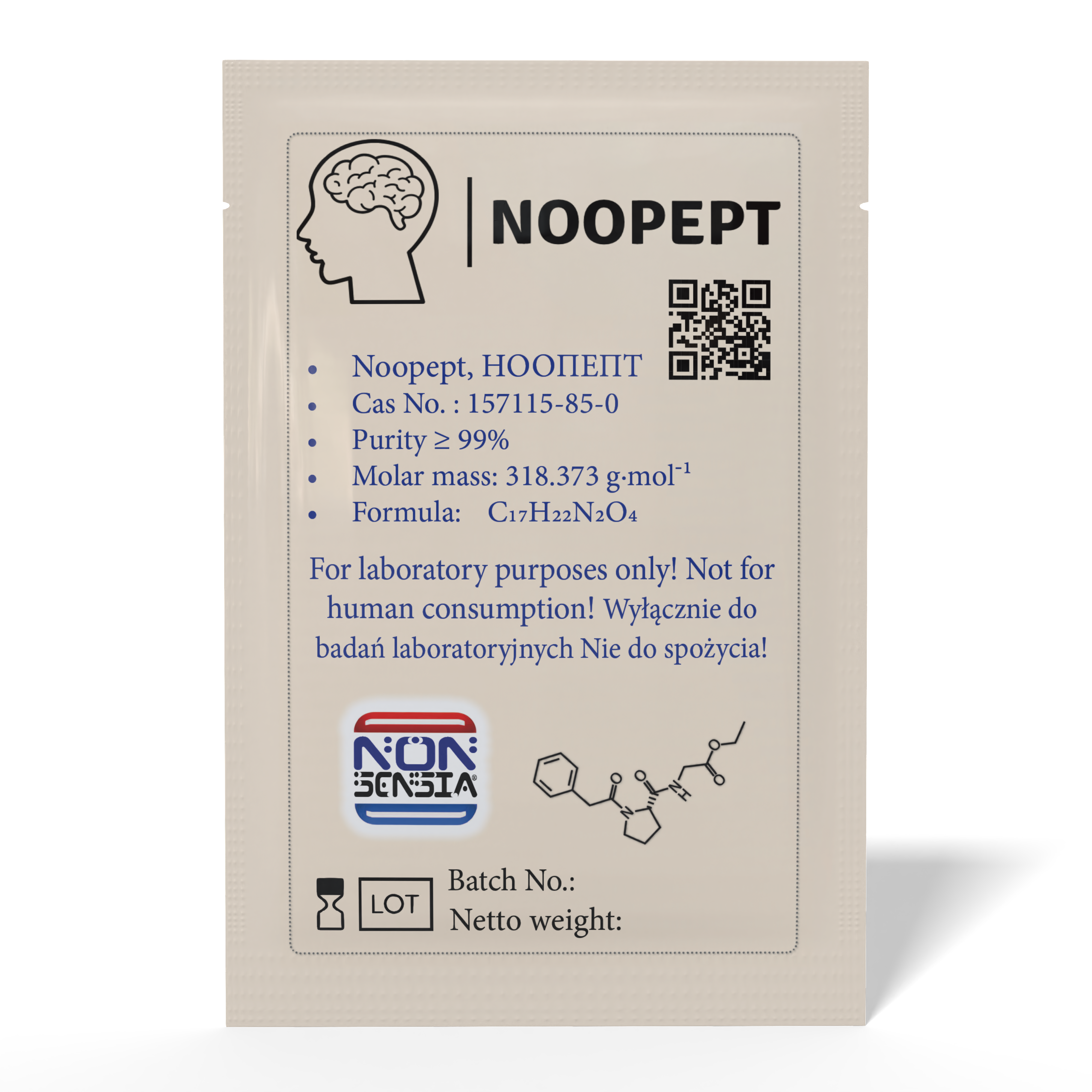
Product classification — read before ordering. This item is a chemical reagent and analytical reference material. It is not a medicinal product, dietary supplement, food, feed, novel food or cosmetic, and it is not intended for human or animal consumption or for any in-vivo administration whatsoever. It is supplied exclusively to laboratories, research institutions and professional users for in-vitro analytical, chromatographic and method-development work. Scientific findings summarised on this page describe substances investigated in published laboratory research; they are reported here as bibliographic facts about that literature and are not product claims, dosage guidance, or a recommendation of any use of this reagent.
Key facts
- Substance
- Noopept — INN omberacetam, development code GVS-111. Ethyl 2-[[(2S)-1-(2-phenylacetyl)pyrrolidine-2-carbonyl]amino]acetate
- CAS
- 157115-85-0
- Formula / mass
- C17H22N2O4 · 318.4 g·mol−1 · monoisotopic 318.15796 Da
- Grade
- Analytical reference standard, ≥99% by HPLC (area normalisation); batch value on Certificate of Analysis
- Quantity
- Seven pack sizes from 1 g to 100 g, crystalline powder
- Chemical class
- Dipeptide ethyl ester — N-phenylacetyl-L-prolylglycine ethyl ester. Not a classical racetam
- Stereochemistry
- One defined stereocentre from the L-proline residue. InChIKey carries a stereochemical layer (
-AWEZNQCLSA-), unlike the achiral standards in this catalogue - Identity warning
- Three PubChem records share this InChIKey prefix and two of them are mislabelled. Identity resolves only on the full InChIKey — see section 6.2
- Stability note
- Cyclises to cyclo-L-prolylglycine, which is also its principal metabolite — degradant and metabolite are the same molecule
- Hazard classification
- Effectively none: a single ECHA notification states the substance does not meet GHS criteria. See section 10
- Experimental physicochemistry
- None in the compound registry — but a 2025 solid-state study fills part of the gap [7]
- Regulatory
- Not on the WADA Prohibited List, not controlled in Poland, not an authorised medicine in Poland or the EU
- Intended use
- In-vitro analytical chemistry, HPLC and LC-MS method development, enantiomeric-purity work, reference material for screening consumer products
- Excluded use
- Any human or animal administration; any consumable, medicinal or cosmetic product
- Substance identity and registry data
- Molecular structure
- Computed descriptors and what they predict
- Stereochemistry: the L-proline centre
- Solid-state behaviour and solution preparation
- Use as an analytical reference standard
- Reference spectral data
- Batch specification and Certificate of Analysis
- Handling, storage and stability
- Hazard classification
- Discovery and development history
- Preclinical pharmacology and metabolism
- Clinical research literature
- Regulatory status
- Permitted use and terms of supply
- Frequently asked questions
- How this page is sourced and verified
- References
1. Substance identity and registry data
Noopept is the common name for ethyl 2-[[(2S)-1-(2-phenylacetyl)pyrrolidine-2-carbonyl]amino]acetate, better described in peptide terms as N-phenylacetyl-L-prolylglycine ethyl ester [1]. Its international nonproprietary name is omberacetam.
That name is misleading in the same way the whole racetam label is misleading here. Noopept is not a 2-oxopyrrolidine acetamide; it is a dipeptide ethyl ester built from proline and glycine with a phenylacetyl cap. It shares no functional group arrangement with piracetam. What it shares is a design intent: it was conceived as a peptide mimic of the piracetam pharmacophore, which is a different claim entirely and is discussed in section 11.
Every identifier below comes from a public authoritative registry [1][2].
Noopept, omberacetam or GVS-111 — what is the difference?
None at the level of the substance: all three name CAS 157115-85-0. GVS-111 is the development code used throughout the primary Russian literature [12][13][14][16]; searching on it finds work that the other two names miss. Omberacetam is the INN. Noopept is the name under which the substance reached the consumer market and the one most likely to appear on a sample submitted for analysis.
Two naming traps documented on this page's own predecessor. First, "Nootropyl" is not a synonym for noopept — it is a trade name of piracetam, CAS 7491-74-9, C6H10N2O2, molecular mass 142.16, a completely different molecule. Second, the CAS number 304663-22-7 circulates as a supposed deprecated registry number for noopept. It is not: it resolves to a different PubChem record with the formula C16H17NO2. Noopept has no deprecated CAS number.
| INN | omberacetam |
|---|---|
| Common name | noopept |
| Development code | GVS-111 |
| IUPAC name | ethyl 2-[[(2S)-1-(2-phenylacetyl)pyrrolidine-2-carbonyl]amino]acetate |
| Peptide name | N-phenylacetyl-L-prolylglycine ethyl ester |
| CAS Registry Number | 157115-85-0 |
| Deprecated CAS | none — see the warning above |
| EC Number | 839-170-3 |
| UNII (FDA GSRS) | 4QBJ98683M |
| PubChem CID | 180496 |
| ChEMBL ID | CHEMBL4303687 |
| DrugBank ID | DB19956 |
| DSSTox Substance ID | DTXSID80166214 |
| NCI Thesaurus code | C166777 |
| Nikkaji Number | J759.455K |
| MDL Number | MFCD00941121 |
| Wikidata | Q7049784 |
| Molecular formula | C17H22N2O4 |
| Average molecular mass | 318.4 g·mol−1 |
| Monoisotopic mass | 318.15796 Da |
| InChIKey | PJNSMUBMSNAEEN-AWEZNQCLSA-N |
| InChI | InChI=1S/C17H22N2O4/c1-2-23-16(21)12-18-17(22)14-9-6-10-19(14)15(20)11-13-7-4-3-5-8-13/h3-5,7-8,14H,2,6,9-12H2,1H3,(H,18,22)/t14-/m0/s1 |
| Isomeric SMILES | CCOC(=O)CNC(=O)[C@@H]1CCCN1C(=O)CC2=CC=CC=C2 |
Three identifiers that do not exist for this substance are worth naming: there is no ChEBI entry, no KEGG identifier and no ATC code [1]. The absent ATC code is the meaningful one — it confirms that omberacetam has never been an authorised medicine in any system that assigns them.
2. Molecular structure
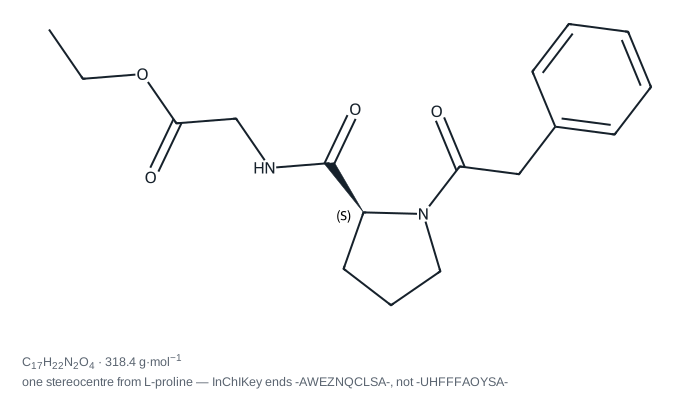
The molecule has three regions, and unusually for this catalogue each one is a potential point of chemical change rather than merely a property.
The phenylacetyl cap supplies the only ultraviolet chromophore — a plain monosubstituted benzene ring. It absorbs weakly and without structure, which is why ultraviolet detection for this compound is workable but unimpressive, and why mass spectrometry earns its place.
The L-proline ring carries the single stereocentre and, more importantly, the secondary amide nitrogen that makes the proline–glycine bond geometrically special. Proline amides are the classic site of cis/trans isomerism in peptides and the classic site of intramolecular cyclisation. Section 9 explains why that matters for storage.
The glycine ethyl ester is the terminus and the most labile part of the molecule: an ester on a small peptide, hydrolysable in principle and cyclisable in practice.
Structural neighbours in this catalogue
The instructive comparison is with the compounds noopept is shelved beside rather than with anything it resembles. Oxiracetam and aniracetam are genuine 2-oxopyrrolidine acetamides; coluracetam carries that motif on a large heteroaromatic core. Noopept carries none of it. Grouping the four under one catalogue heading is a convention of the consumer market, not a statement of chemistry, and a chromatographic method built for one of them will not transfer to noopept.
3. Computed descriptors and what they predict
The compound registry contains no experimental properties section for noopept — no melting point, boiling point, density, solubility, measured logP, pKa or specific rotation [1]. Every value in Table 2 is computed. There is, however, one important exception to that emptiness: a 2025 solid-state study supplies real measured structural data, and it is described in section 5 [7].
| XLogP3-AA | 1.5 |
|---|---|
| Topological polar surface area | 75.7 Å2 |
| Hydrogen-bond donors | 1 |
| Hydrogen-bond acceptors | 4 |
| Rotatable bonds | 7 |
| Heavy atoms | 23 |
| Formal charge | 0 |
| Complexity (Cactvs) | 432 |
| Defined / undefined atom stereocentres | 1 / 0 |
| Defined / undefined bond stereocentres | 0 / 0 |
What these numbers predict in the laboratory
A computed logP of 1.5 with a polar surface area of 75.7 Å2 describes a moderately polar, well-behaved reversed-phase analyte. Expect useful retention on C18 with a mid-range organic mobile phase — comfortably between the strongly retained bromantane standard and the barely retained polar racetams.
Seven rotatable bonds is the number to notice, and it is high. Compare 2 for bromantane and 3 for coluracetam. A flexible molecule can give broader peaks, more temperature-dependent retention and, in the case of a proline amide specifically, the possibility of cis/trans rotamers interconverting on the chromatographic timescale. If a peak for this compound looks broader or more shouldered than expected, rotameric exchange is a candidate explanation before column degradation is assumed — and raising the column temperature is the diagnostic experiment, since it speeds the exchange and sharpens the peak.
One donor and four acceptors, no ionisable centre of consequence. Neither amide is acidic in a usable range and the ester is neutral, so mobile-phase pH is a weak lever on retention. Stationary-phase chemistry does the work of adjusting selectivity.
A weak chromophore. The single unconjugated phenyl ring absorbs around 254 nm without a distinctive maximum. Ultraviolet detection works for assay at reasonable concentrations but is poor for identity confirmation; mass spectrometry is the appropriate technique where identity is in question.
4. Stereochemistry: the L-proline centre
Noopept has one defined stereocentre and no undefined ones [1]. It sits at the α-carbon of the proline residue and it is defined because the molecule is built from L-proline, a chiral pool starting material.
The registry record marks this explicitly. The InChI carries the stereochemical layer /t14-/m0/s1, and the standard InChIKey ends in -AWEZNQCLSA-N. That second block is the one to read: it is not UHFFFAOYSA, the marker for a structure with no stereochemical information. For this substance the difference between those two strings is the difference between a defined single enantiomer and an unspecified one.
Why this matters more here than on most pages in this catalogue. A single-enantiomer substance made from a chiral pool amino acid has a specific quality question attached to it: has the stereocentre survived? Peptide couplings can epimerise the α-carbon, and the D-proline diastereomer is a real, nameable, potential impurity rather than a hypothetical one. An enantiomeric or diastereomeric purity figure is therefore meaningful for this material, and a chiral or diastereoselective method is a legitimate part of full characterisation — unlike the achiral standards in this catalogue, such as the bromantane standard, where no such method can be validated at all.
5. Solid-state behaviour and solution preparation
Unlike most substances in this catalogue, noopept has real, recent, measured solid-state data — and it comes from a Polish group. Araj, Szeleszczuk and colleagues at the Medical University of Warsaw, working with collaborators in Athens and Łódź, published a physicochemical and structural analysis of the compound in the Journal of Pharmaceutical and Biomedical Analysis in 2025 [7]. The study combined single-crystal X-ray diffraction, powder X-ray diffraction, thermogravimetric analysis and differential scanning calorimetry, solid-state 13C cross-polarisation magic-angle-spinning NMR, and periodic density-functional calculations, and it included a polymorph screen.
What that means practically. For this compound a laboratory can compare a batch against a published crystal structure and a published solid-state NMR spectrum rather than against nothing. That is a stronger position than for most items in this catalogue, and it makes powder X-ray diffraction a genuinely useful identity and form check here. The paper is the first place to look before designing any solid-state work on noopept.
What remains absent is the ordinary catalogue physics: the compound registry still lists no melting point, no solubility and no measured partition coefficient [1]. This page prints none of them.
Preparing stock solutions
The computed polarity places noopept comfortably in methanol, acetonitrile, ethanol and dimethyl sulfoxide. Aqueous working dilutions are feasible at analytical concentrations, which is not true of the lipophilic standards in this catalogue.
The caution specific to this molecule concerns aqueous and basic conditions. It is an ester on a dipeptide; both hydrolysis and intramolecular cyclisation are chemically available routes, and section 9 sets out why the second matters more than the first. Prepare aqueous dilutions fresh, keep them cold, avoid basic buffers for storage, and do not assume that a stock solution left overnight contains what it contained when it was made.
6. Use as an analytical reference standard
6.1 Why this substance needs one
Noopept is widely present in products sold as dietary supplements. The United States National Institutes of Health dietary supplement label database records dozens of labelled products containing it [6], and the Drug Enforcement Administration has carried it in the National Forensic Laboratory Information System reporting category since 2014 [5]. Cohen and colleagues, analysing cognitive-enhancement supplements sold in the United States, found unapproved drugs including omberacetam present in products and frequently at doses that did not match the label [10].
Laboratories screening such products need authenticated material for every substance they claim to identify. The coluracetam standard covers the same problem for a different compound in the same consumer category. For noopept the need is sharpened by the identity problem described next, which has no equivalent among the other standards in this catalogue.
6.2 The identity trap: the InChIKey prefix is not the substance
This is the strongest single technical reason to hold a characterised noopept standard, and it is a problem in the reference data itself rather than in any laboratory's method.
An InChIKey has two blocks. The first, fourteen characters, encodes the skeleton and connectivity. The second encodes stereochemistry, isotopes and protonation. Software and spreadsheets routinely match on the first block alone, because it is the part that looks like a fingerprint.
For noopept that shortcut fails. As recorded on 22 August 2026, three separate PubChem compound records share the prefix PJNSMUBMSNAEEN, and only one of them is this substance:
| Record | Full InChIKey | Defined stereocentres | What the record's own title says |
|---|---|---|---|
| CID 180496 — this substance | PJNSMUBMSNAEEN-AWEZNQCLSA-N | 1, configuration (2S) | consistent with the structure |
| CID 45926902 | PJNSMUBMSNAEEN-UHFFFAOYSA-… | 0 — no stereochemistry defined | describes the compound as "(2S)", which the record itself does not encode |
| CID 36688216 | PJNSMUBMSNAEEN-CQSZACIVSA-… | 1, configuration (2R) — D-proline | describes the residue as "L-prolyl", which is the opposite configuration |
Read the consequences carefully, because they are not abstract. A laboratory matching on the first InChIKey block alone will treat all three as the same substance. Two of the three carry titles that contradict their own encoded stereochemistry, so reading the title instead of the key does not rescue the match either. The stereochemically undefined record is the one that carries supplier catalogue numbers, which is precisely the record a purchasing or inventory system is most likely to have inherited.
Two further facts close the gap. The ChEMBL entry for this compound records its chirality flag as undefined. And no circular dichroism or optical rotatory dispersion spectrum is deposited for noopept in the compound record [1] — so none of the deposited spectral data distinguishes the enantiomers either.
Identity for this substance resolves on the full InChIKey and on a measurement, not on a name, not on a prefix, and not on a catalogue number. Establishing that measurement is what a reference standard is for.
The gap is also visible in the literature: a PubMed search for work on the enantiomeric purity of noopept returns nothing, on an instrument that returned results for every other query in the same session. No published method distinguishes the L- and D-proline diastereomers of this compound.
6.3 The degradation trap: the degradant is the metabolite
The second distinctive property of this molecule is that its expected chemical breakdown product and its principal biological metabolite are the same compound.
Gudasheva and colleagues showed that the phenylacetyl-prolylglycine ethyl ester skeleton converts into cyclo-L-prolylglycine, the diketopiperazine formed by intramolecular cyclisation [11]. Independently, the same group had identified cyclo-L-prolylglycine as the major metabolite of GVS-111 in rat brain [12], having first characterised that cyclic dipeptide as an endogenous compound in its own right [13].
Why an analyst should care. When a peak for cyclo-L-prolylglycine appears in a chromatogram, its presence alone does not tell you whether the sample was degraded or metabolised — or whether the diketopiperazine was there from the start, since it is also endogenous. Distinguishing those cases requires the parent standard, a stability protocol and a matrix blank; it cannot be resolved from the chromatogram of an unknown.
It also means that stability-indicating method development for noopept has an unusually well-defined target: the analyst knows in advance which degradant to look for and can obtain or generate it deliberately.
An absence worth naming. No forced-degradation study following the ICH Q1A framework was located for noopept. The cyclisation route is documented chemically and metabolically, but the systematic acid, base, oxidative, thermal and photolytic stress study that a stability-indicating method normally rests on does not appear to exist in the public literature. A laboratory doing that work would be generating data that is not currently available anywhere.
6.4 What Russian pharmaceutical analysis already established
Two papers deserve particular attention because they are the closest thing to an official analytical foundation for this substance. Gusev and colleagues published the development of analytical methods for the creation of a state reference sample of noopept [8], and Grushevskaya and colleagues published the pharmaceutical analysis and standardisation of noopept tablets [9]. Both appeared in Pharmaceutical Chemistry Journal.
These matter for two reasons. First, they are the only published work on this compound written from the perspective of a reference-standard producer rather than a pharmacologist. Second, their existence establishes that a formal reference sample of noopept was created within one regulatory system — which is a useful precedent, and also a reminder that the material supplied here is not that reference sample and does not carry its status (section 8).
7. Reference spectral data
| Technique | Depositor and attribution |
|---|---|
| 13C NMR | Deposited by W. Robien, University of Vienna |
| GC-MS | DigiLab GmbH; copyright DigiLab GmbH and Wiley-VCH GmbH |
| FTIR (KBr) | Sample provided by LiftMode, lot NPT-20141216 |
| ATR-IR and Raman | Composynth, catalogue number NOO0063 |
What is missing, and why each absence matters here. There is no 1H NMR and no two-dimensional NMR, so the deposited data cannot confirm the proline–glycine connectivity directly. There is no LC-MS/MS spectrum, which is the technique most laboratories would actually use for this analyte. There is no ultraviolet spectrum. There is no powder X-ray diffractogram in the compound record — though the 2025 solid-state paper supplies one [7]. And, as section 6.2 sets out, there is no circular dichroism or optical rotatory dispersion spectrum, so nothing in the deposited set addresses the stereochemical question that is this compound's central identity risk.
A laboratory that needs any of these must acquire them, and the batch material is suitable for exactly that.
8. Batch specification and Certificate of Analysis
| Parameter | Method | Specification |
|---|---|---|
| Identity — chromatographic | HPLC or LC-MS, retention against reference | Conforms |
| Identity — spectroscopic | IR and/or MS against reference spectrum | Conforms |
| Assay | HPLC, area normalisation | ≥99% |
| Related substances | HPLC, area normalisation | Batch value reported |
| Cyclo-L-prolylglycine | HPLC | Reported where determined — the expected degradant (section 6.3) |
| Residual solvents | GC headspace | Batch value reported |
| Water content | Karl Fischer titration | Batch value reported |
| Stereochemical purity | Chiral or diastereoselective HPLC | Applicable to this substance (section 4); reported where determined |
The layout of the certificate and the method stated against each parameter can be reviewed on the specimen Certificate of Analysis.
Scope of the specification. This is an analytical reference standard; kilogram-scale orders come with a batch Certificate of Analysis. It is not a certified reference material in the ISO 17034 sense, not a pharmacopoeial reference standard, and not the Russian state reference sample described in the literature [8]. Where a scheme requires any of those, this article does not meet the requirement.
9. Handling, storage and stability
- Storage. Sealed, cool, dry, protected from light.
- Cyclisation is the defining stability risk. The glycine ethyl ester and the proline amide are positioned for intramolecular attack, and the product is cyclo-L-prolylglycine [11][12]. Warmth, moisture and basic conditions all favour it. Do not store solutions at room temperature, do not use basic buffers for storage, and treat any new later- or earlier-eluting peak as a candidate diketopiperazine before calling it an unknown.
- Ester hydrolysis is the second available route and gives the corresponding free acid. It is favoured by the same conditions.
- Solid-state form. A published crystal structure and polymorph screen exist [7]. If solid-state form matters to the intended use, compare the batch against that work rather than assuming, and avoid recrystallising or drying by an undocumented route.
- Weighing. The compound registry gives no hygroscopicity data. Determine water content for the batch rather than assuming it is dry.
- Personal protection. Gloves, eye protection, containment of dust. See section 10 — the reason is the thinness of the classification, not its content.
10. Hazard classification
There is effectively no hazard classification for noopept, and the reason is unusual enough to state precisely. The ECHA Classification and Labelling Inventory carries one notification for this substance, and that notification states that it does not meet the GHS hazard criteria [1][3]. There is therefore no signal word, no hazard statement and no precautionary statement, and this page prints no pictogram and no H- or P-phrase.
"One company says it is not hazardous" is not the same as "it is not hazardous". A single self-classification, unreviewed and unharmonised, is the thinnest possible evidential basis. It must not be read as a safety assessment, and it must not be used to justify lighter handling than for any other biologically active organic solid of unknown toxicity.
In practice: gloves, eye protection, containment of dust under local exhaust, no eating or drinking in the handling area, and a workplace risk assessment that records the thinness of the available data as a finding in its own right. The Safety Data Sheet shipped with the batch is the controlling document.
11. Discovery and development history
Noopept came out of the V. V. Zakusov Institute of Pharmacology in Moscow, from a research programme with an explicit design hypothesis: that the pharmacological activity of piracetam could be reproduced by a dipeptide that mimicked its presumed active conformation. The compound was developed under the code GVS-111 and first reported internationally in 1994 [16].
That design origin explains the structural mismatch discussed in section 1. Noopept was never intended to be a racetam by structure; it was intended to be a peptide that behaved like one. Whether the hypothesis was correct is a separate question, and the literature does not settle it.
The programme produced an unusually coherent body of work from one group. The endogenous cyclic dipeptide cyclo-prolylglycine was identified in rat brain in 1996 [13]; it was shown to be the principal brain metabolite of GVS-111 in 1997 [12]; the pharmacokinetics of the parent and its metabolites in rat brain were reported in 2001 [14]; a molecular mechanism was proposed in 2016 [15]; and in 2017 the same group reported that the parent converts into cyclo-L-prolylglycine and that the cyclic dipeptide shows a similar activity spectrum [11]. Read in order, those papers describe a compound whose active species may be its own metabolite.
In parallel, Russian pharmaceutical chemistry produced the analytical and standardisation work described in section 6.4 [8][9]. The substance reached the consumer market internationally under the name noopept, which is how it now arrives in analytical laboratories [6][10].
12. Preclinical pharmacology and metabolism
How to read this section. What follows summarises published laboratory research on the substance noopept (GVS-111), reported as bibliographic fact and attributed to the experimental system that produced it. None of it describes, predicts or claims any effect of the reagent supplied on this page, which is not administered to anything. Nothing here is dosage guidance, a health claim, or a representation that the substance is safe or effective for any purpose.
The mechanistic thread that matters analytically is metabolic rather than receptor-level. Boiko and colleagues reported the pharmacokinetics of GVS-111 and related metabolites in rat brain [14], and the identification of cyclo-L-prolylglycine as the major brain metabolite came from the same institute [12]. Vakhitova and colleagues later proposed a molecular mechanism for the substituted Pro-Gly dipeptide in Acta Naturae [15].
The 2017 finding that the parent ester converts into cyclo-L-prolylglycine, and that the cyclic dipeptide shows a comparable activity spectrum [11], is the pivot of the whole story: it raises the possibility that the administered compound functions largely as a precursor. For an analytical laboratory the reading is simpler and more useful — any method for this substance must be able to see both species and tell them apart.
What this literature does and does not establish. Essentially all of the primary pharmacology comes from one institute, and the authorship overlaps heavily across three decades: Gudasheva, Ostrovskaya, Voronina and Seredenin appear across the 1994, 1996, 1997, 2001, 2016 and 2017 papers. The models are rodent. Independent replication outside the originating programme is scarce. The metabolite identification and the cyclisation chemistry are well supported and internally consistent; the broader pharmacological claims rest on a narrow base.
One further point of sourcing discipline: at least one paper on noopept published in an international journal was subsequently retracted. It is not cited on this page. Anyone conducting their own literature search on this compound should check retraction status before relying on a result.
13. Clinical research literature
Medicinal product and laboratory reagent are different things. Clinical work on this substance was conducted within the Russian regulatory system on a product authorised there. It is reported here as bibliographic fact and describes neither the article supplied on this page nor any use of it. This reagent is not a medicinal product, holds no marketing authorisation in Poland or the European Union, has not been assessed by any medicines regulator in those jurisdictions, and must not be administered to any human or animal.
The published analytical and standardisation work on noopept tablets [9] establishes that a tablet product existed and was subject to pharmaceutical standardisation within that system. This page does not assert anything about the current authorisation status of any such product, because that was not verified from a primary regulatory source for this revision.
What can be stated without qualification: omberacetam has no ATC code, no marketing authorisation in Poland or the European Union, and no entry in the Polish Register of Medicinal Products [1][4]. Section 14 gives the checks behind that.
14. Regulatory status
| Instrument / jurisdiction | Status |
|---|---|
| WADA Prohibited List 2026 | Not listed by name. Neither noopept nor omberacetam appears on the 2026 Prohibited List [3]. See the important caveat below |
| Poland — narcotics, psychotropics and new psychoactive substances | Not listed. Does not appear in Annexes 1, 2 or 3 of the consolidated regulation, Dz.U. 2024 poz. 1139 [4] |
| Poland — medicinal products | Not registered. A search of the national Register of Medicinal Products returns no noopept or omberacetam product |
| European Union | No marketing authorisation. No ATC code has ever been assigned [1] |
| United States | Not a controlled substance. Recorded in the DEA National Forensic Laboratory Information System under category Other Substances since May 2014 [5] — a reporting category, not a scheduling action. Present as a labelled ingredient in dietary supplement products [6][10] |
| EU — CLP classification | No harmonised classification. One self-classification notification, stating that the substance does not meet GHS criteria (section 10) [3] |
| Other jurisdictions | Not assessed. Status must be verified locally before import, purchase or possession |
A caveat on the anti-doping position that athletes in particular should read. Absence of a substance's name from the Prohibited List does not by itself make it permitted. The List includes class S0, Non-Approved Substances, which covers pharmacological substances not currently approved for human therapeutic use by any governmental regulatory health authority. A substance with no marketing authorisation anywhere in the European Union may fall within that class regardless of whether it is named. This page states what the document says; it does not give anti-doping advice, and anyone competing under the World Anti-Doping Code should seek a determination from their own anti-doping organisation rather than rely on a supplier's page.
Limits of this section. Each negative finding above was confirmed with a paired positive control: substances known to be on the WADA List and on the Polish controlled-substances list were confirmed present in the same searches before the absence of noopept was recorded, so a failed search could not be mistaken for a negative result. Those checks are valid for the documents cited and the date stated. The current Russian regulatory position was not verified from a primary source for this revision and is therefore not asserted anywhere on this page.
15. Permitted use and terms of supply
Research use only. Not for human or animal consumption.
- Supplied solely for in-vitro laboratory research, analytical chemistry, chromatographic and mass-spectrometric method development, stability and stereochemical-purity work, and reference-standard applications including the screening of consumer products.
- Not a medicinal product, investigational medicinal product, dietary supplement, food, feed, novel food or cosmetic. It holds no marketing authorisation in Poland or the European Union and has not been assessed by a medicines regulator in either.
- Must not be ingested, inhaled, injected, applied to the body, or administered to any human or animal, under any circumstances and irrespective of quantity.
- Must not be used in the manufacture, compounding, formulation or repackaging of any product intended for human or animal consumption, and must not be presented or resold as a supplement or medicine. The published literature documents that this substance does appear in products sold as supplements [6][10]; supply for that purpose is expressly excluded from these terms.
- Must not be used by, supplied to, or administered to any athlete, or used in any manner connected with sporting competition. See the S0 caveat in section 14.
- Because the hazard classification rests on a single notification (section 10), handling must proceed on the precautionary basis described there.
- Intended for purchase and use exclusively by, or under the direct supervision of, persons professionally qualified to handle laboratory chemicals, at premises suitable for chemical storage.
- The purchaser is responsible for verifying the legal status of the substance in their own jurisdiction before ordering.
- No information on this page constitutes medical advice, dosage guidance, a health claim, or a representation that the substance is safe or effective for any purpose in humans.
By placing an order the purchaser confirms acceptance of these conditions and confirms the material will be used exclusively as described above.
16. Frequently asked questions
- What is noopept used for in a laboratory?
- As an analytical reference standard, supplied with a batch Certificate of Analysis: to establish retention time and product-ion transitions in a laboratory's own method, to develop a stability-indicating method that separates the parent from its cyclisation product, to establish stereochemical purity, to spike blank matrix so that a real limit of detection can be measured, and to identify the substance in consumer products that declare or contain it. Because no published method distinguishes its stereoisomers, a laboratory doing that work is generating data that does not currently exist.
- Is this product intended for human consumption?
- No. It is a chemical reagent and analytical reference material supplied for in-vitro laboratory use only. It is not a medicinal product, supplement or food, it holds no marketing authorisation in Poland or the European Union, and it must not be ingested or administered to any human or animal.
- What is the correct molecular formula and mass of noopept?
- C17H22N2O4, average molecular mass 318.4 grams per mole, monoisotopic mass 318.15796 daltons. Listings quoting a formula containing sulfur, or a mass near 369, are wrong: this molecule contains no sulfur at all. The registry values are the ones above.
- Is noopept the same thing as omberacetam or GVS-111?
- Yes, all three name CAS 157115-85-0. Omberacetam is the international nonproprietary name, GVS-111 is the development code used throughout the primary Russian literature, and noopept is the name under which the substance reached the consumer market. Searching only on the marketing name will miss most of the scientific literature.
- Is Nootropyl a synonym for noopept?
- No, and the confusion is worth correcting explicitly. Nootropyl is a trade name of piracetam, CAS 7491-74-9, formula C6H10N2O2, molecular mass 142.16 grams per mole. It is a different molecule of less than half the mass. Similarly, the CAS number 304663-22-7 sometimes presented as a deprecated registry number for noopept belongs to a different compound; noopept has no deprecated CAS number.
- Why can the InChIKey be misleading for this substance?
- Because three separate PubChem records share its fourteen-character InChIKey prefix, and only one of them is noopept. One of the other two has no stereochemistry defined at all yet describes itself in its title as the S-isomer, and the third encodes the opposite configuration, built from D-proline, while describing itself as L-prolyl. Software that matches on the prefix alone will treat all three as identical, and reading the record titles instead does not help, because two of them contradict their own encoded structures. Identity for this compound resolves only on the full InChIKey, which for noopept is PJNSMUBMSNAEEN-AWEZNQCLSA-N.
- Is noopept chiral?
- Yes. It has one defined stereocentre, at the alpha carbon of the proline residue, because it is built from L-proline. The InChI carries a stereochemical layer and the InChIKey ends in AWEZNQCLSA rather than UHFFFAOYSA. This matters more than usual here: peptide chemistry can epimerise that centre, so the D-proline diastereomer is a real potential impurity and a stereochemical purity figure is meaningful for this material.
- What degrades noopept, and how would I see it?
- Intramolecular cyclisation to cyclo-L-prolylglycine, the diketopiperazine, is the chemically expected route, favoured by warmth, moisture and basic conditions. Ester hydrolysis to the free acid is the second route. The complication specific to this compound is that cyclo-L-prolylglycine is also its principal biological metabolite and is additionally an endogenous compound in its own right, so its presence in a chromatogram does not by itself distinguish degradation from metabolism or from natural occurrence. Resolving that requires the parent standard, a stability protocol and a matrix blank.
- What is the melting point of noopept?
- No melting point is published in the compound registry, and this page prints none. The same applies to solubility, density and measured partition coefficient. There is, however, a 2025 study reporting single-crystal and powder X-ray diffraction, thermal analysis and solid-state carbon-13 NMR for this compound, together with a polymorph screen, and that paper is the right starting point for any solid-state work.
- What chromatographic conditions suit this compound?
- Its computed logP of 1.5 and polar surface area of 75.7 square angstroms describe a moderately polar analyte that is comfortably retained on C18 with a mid-range organic mobile phase. There is no ionisable centre of consequence, so mobile-phase pH is a weak lever on retention. Note that the molecule has seven rotatable bonds and contains a proline amide, so if peaks appear broader or shouldered, rotameric exchange is a candidate explanation and raising the column temperature is the diagnostic experiment. The ultraviolet chromophore is a single unconjugated phenyl ring, so ultraviolet detection is adequate for assay but weak for identity; mass spectrometry is the better choice where identity is in question.
- Is noopept banned in sport?
- It is not listed by name on the World Anti-Doping Agency 2026 Prohibited List. That is not the same as being permitted. The List includes class S0, Non-Approved Substances, covering pharmacological substances not approved for human therapeutic use by any governmental regulatory health authority, and a substance with no marketing authorisation may fall within it regardless of whether it is named. Anyone competing under the World Anti-Doping Code should obtain a determination from their own anti-doping organisation rather than rely on a supplier page.
- Is noopept legal in Poland?
- It is not a controlled substance under the Polish list of narcotic drugs, psychotropic substances and new psychoactive substances, and it is not a registered medicine in Poland or the European Union. It is supplied here strictly as an analytical reference material under the terms in section 15. Not being on a controlled-substances list is not the same as being approved for any human use, and nothing on this page offers it for one.
- What pack sizes are available?
- Seven: 1 g, 5 g, 10 g, 20 g, 40 g, 80 g and 100 g, each supplied as crystalline powder with a batch Certificate of Analysis. Catalogue numbers follow the CAS-based scheme NSA-157115-85-0 with the pack size appended, for example NSA-157115-85-0-10G. For reference-standard work the 1 g and 5 g sizes are the usual choice; the larger sizes exist for laboratories running extended method-development or stability programmes.
- What are the hazards?
- There is effectively no classification. The ECHA inventory carries a single notification for this substance, and that notification states that it does not meet GHS hazard criteria, so no signal word, hazard statement or precautionary statement has been assigned and this page prints no pictogram. One company saying a substance is not hazardous is the thinnest possible evidential basis and is not a safety assessment. Handle the material as a biologically active organic solid of unknown toxicity, with gloves, eye protection and dust containment, and record the thinness of the data in the workplace risk assessment. The Safety Data Sheet shipped with the batch is the controlling document.
17. How this page is sourced and verified
| Document scope | Technical and regulatory description of noopept (omberacetam) supplied as an analytical reference material |
|---|---|
| Last reviewed | 22 August 2026 |
| Primary data sources | PubChem (NCBI) compound record CID 180496; FDA GSRS (UNII); WADA International Standard — Prohibited List 2026; Polish Ministry of Health consolidated regulation Dz.U. 2024 poz. 1139; Polish Register of Medicinal Products; DEA NFLIS annotation; NIH Dietary Supplement Label Database |
| Bibliographic verification | Every cited work was checked against PubMed and Crossref metadata. Each DOI was resolved and its registered title, journal, volume, issue and pagination confirmed against the citation printed here. Record type was checked as well as metadata: at least one paper on this compound is a retracted article, and it is not cited |
| Regulatory verification | Each negative finding was confirmed with a paired positive control — substances known to be listed were confirmed present in the same search before an absence was recorded, so a failed search could not be mistaken for a negative result |
| Rule on database records | Claims about the contents of chemical databases (section 6.2) are stated with the date on which they were read, because such records are edited. They are reproducible by anyone with the identifiers given |
| Rule on numerical values | No physical constant is printed unless it appears in a named authoritative registry, in a cited primary study, or is measured for the delivered batch |
| Rule on biological claims | Findings are attributed to the experimental system that produced them. No finding is transferred to this reagent article, and no effect in humans is claimed for it |
| Corrections | The molecular formula, molecular mass, systematic name and one product tag previously shown on this page were wrong and were replaced against the registry record on 22 August 2026 |
Limitations named directly
- The compound registry contains no experimental physicochemistry. Every value in section 3 is computed. The measured solid-state data in section 5 come from a single cited study, not from the registry.
- The hazard classification rests on one notification, and that notification asserts the absence of hazard. Section 10 explains why that is the weakest possible basis rather than a reassurance.
- The primary pharmacology comes from essentially one institute, with overlapping authorship across three decades and little independent replication. Section 12 says so in place.
- No published method distinguishes the stereoisomers of this compound, and no circular dichroism or optical rotatory dispersion data are deposited. The identity risk described in section 6.2 therefore currently has no published analytical solution.
- The current Russian regulatory position was not verified from a primary source and is not asserted anywhere on this page.
- The bibliography is short — sixteen sources — because the primary literature on this compound is concentrated and finite. Padding it would misrepresent the state of knowledge.
Not yet on this page
This page does not carry a named author with stated professional qualifications, a named technical reviewer, or laboratory data generated in-house for a specific batch — no chromatogram, no spectrum, no measured retention or stereochemical purity of our own. For this substance the last of those is the most conspicuous: the identity problem set out in section 6.2 is precisely the kind that in-house measurement would close.
18. References
Citations follow the Chicago author–date convention. All external links carry rel="nofollow". Access to full texts is governed by the policies of the respective publishers.
Registry and regulatory sources
- National Center for Biotechnology Information. 2026. "PubChem Compound Summary for CID 180496, Omberacetam." PubChem. Accessed August 22, 2026. https://pubchem.ncbi.nlm.nih.gov/compound/180496.
- U.S. Food and Drug Administration. 2026. "Global Substance Registration System: UNII 4QBJ98683M, Omberacetam." Accessed August 22, 2026. https://gsrs.ncats.nih.gov/ginas/app/beta/substances/4QBJ98683M.
- World Anti-Doping Agency. 2025. World Anti-Doping Code International Standard: Prohibited List 2026. Effective 1 January 2026. https://www.wada-ama.org/en/prohibited-list.
- Minister Zdrowia. 2024. Obwieszczenie Ministra Zdrowia z dnia 17 czerwca 2024 r. w sprawie ogłoszenia jednolitego tekstu rozporządzenia Ministra Zdrowia w sprawie wykazu substancji psychotropowych, środków odurzających oraz nowych substancji psychoaktywnych. Dziennik Ustaw 2024, poz. 1139. https://eli.gov.pl/eli/DU/2024/1139.
- U.S. Drug Enforcement Administration. 2014. "National Forensic Laboratory Information System: Omberacetam, drug category Other Substances, added May 2014." Annotation reproduced in the PubChem record for CID 180496. https://www.nflis.deadiversion.usdoj.gov/.
- National Institutes of Health, Office of Dietary Supplements. 2026. "Dietary Supplement Label Database: products labelled as containing noopept / omberacetam." Accessed August 22, 2026. https://dsld.od.nih.gov/.
Solid-state chemistry, pharmaceutical analysis and standardisation
- Araj, S. K., Ł. Szeleszczuk, T. Gubica, M. Zielińska-Pisklak, K. Bethanis, E. Christoforides, M. K. Dudek, and D. M. Pisklak. 2025. "Physicochemical and Structural Analysis of N-Phenylacetyl-L-prolylglycine Ethyl Ester (Noopept) — An Active Pharmaceutical Ingredient." Journal of Pharmaceutical and Biomedical Analysis 252: 116474. https://doi.org/10.1016/j.jpba.2024.116474.
- Gusev, A. V., L. N. Grushevskaya, O. B. Stepanenko, N. I. Avdyunina, B. M. Pyatin, V. P. Lezina, and O. S. Anisimova. 2007. "Developing Analytical Methods for the Creation of the State Reference Sample of Noopept." Pharmaceutical Chemistry Journal 41 (12): 666–669. https://doi.org/10.1007/s11094-008-0037-6.
- Grushevskaya, L. N., N. I. Avdyunina, B. M. Pyatin, K. V. Alekseev, L. M. Gaevaya, M. S. Sergeeva, M. E. Dudenkova, V. S. Klumova, and N. V. Tikhonova. 2011. "Pharmaceutical Analysis and Standardization of Noopept Tablets." Pharmaceutical Chemistry Journal 45 (6): 377–380. https://doi.org/10.1007/s11094-011-0638-3.
- Cohen, P. A., B. Avula, Y.-H. Wang, I. Zakharevich, and I. Khan. 2021. "Five Unapproved Drugs Found in Cognitive Enhancement Supplements." Neurology: Clinical Practice 11 (3). https://doi.org/10.1212/CPJ.0000000000000960.
Chemistry, metabolism and pharmacology
- Gudasheva, T. A., K. N. Kolyasnikova, E. A. Kuznetsova, S. A. Litvinova, N. N. Zolotov, T. A. Voronina, R. U. Ostrovskaya, and S. B. Seredenin. 2017. "N-Phenylacetylglycyl-L-Proline Ethyl Ester Converts into Cyclo-L-Prolylglycine Showing a Similar Spectrum of Neuropsychotropic Activity." Pharmaceutical Chemistry Journal 50 (11): 705–710. https://doi.org/10.1007/s11094-017-1516-4.
- Gudasheva, T. A., S. S. Boyko, R. U. Ostrovskaya, T. A. Voronina, V. K. Akparov, S. S. Trofimov, G. G. Rozantsev, A. P. Skoldinov, V. P. Zherdev, and S. B. Seredenin. 1997. "The Major Metabolite of Dipeptide Piracetam Analogue GVS-111 in Rat Brain and Its Similarity to Endogenous Neuropeptide Cyclo-L-Prolylglycine." European Journal of Drug Metabolism and Pharmacokinetics 22 (3): 245–252. https://doi.org/10.1007/bf03189814.
- Gudasheva, T. A., S. S. Boyko, V. Kh. Akparov, R. U. Ostrovskaya, S. P. Skoldinov, G. G. Rozantsev, T. A. Voronina, V. P. Zherdev, and S. B. Seredenin. 1996. "Identification of a Novel Endogenous Memory Facilitating Cyclic Dipeptide Cyclo-Prolylglycine in Rat Brain." FEBS Letters 391 (1–2): 149–152. https://doi.org/10.1016/0014-5793(96)00722-3.
- Boiko, S. S., V. P. Zherdev, T. A. Gudasheva, S. A. Korotkov, and R. U. Ostrovskaya. 2001. "Pharmacokinetics of the New Potential Dipeptide Nootrope GVS-111 and Related Metabolites in Rat Brain." Pharmaceutical Chemistry Journal 35 (9): 474–476. https://doi.org/10.1023/a:1014082406443.
- Vakhitova, Yu. V., S. V. Sadovnikov, S. S. Borisevich, R. U. Ostrovskaya, T. A. Gudasheva, and S. B. Seredenin. 2016. "Molecular Mechanism Underlying the Action of Substituted Pro-Gly Dipeptide Noopept." Acta Naturae 8 (1): 82–89. https://doi.org/10.32607/20758251-2016-8-1-82-89.
- Seredenin, S., R. Ostrovskaya, T. Gudasheva, J. Halikas, T. Voronina, S. Trofimov, T. Garibova, H. Valdman, H. Kravchenko, and D. Overstreet. 1994. "A Novel Cognitive Enhancing Substance GVS-111." Neuropsychopharmacology 11 (4): 283. https://doi.org/10.1038/sj.npp.1380206. (Single-page item; treated as a conference communication rather than a full report.)